Lepidophloios
Lepidophloios laricinus
Image: Image sourced via web search (Fair use / Educational)
About Lepidophloios
Lepidophloios laricinus was a massive, tree-like lycopsid that dominated the vast, swampy forests of the Carboniferous period, approximately 320 to 300 million years ago. Belonging to the extinct order Lepidodendrales, commonly known as scale trees, this remarkable organism was not a true tree in the modern botanical sense, but rather a gigantic relative of today's diminutive clubmosses. Flourishing across the equatorial regions of the supercontinent Pangaea, particularly in what is now Europe and North America, Lepidophloios played a foundational role in the Earth's biosphere. Its towering presence and prolific growth contributed significantly to the immense peat deposits that would eventually compress into the world's primary coal reserves. In the realm of paleontology, Lepidophloios is of paramount significance, offering profound insights into early vascular plant evolution, the dynamics of Paleozoic terrestrial ecosystems, and the dramatic climatic shifts that characterized the late Carboniferous world. The study of this organism has fundamentally shaped our understanding of how ancient forests functioned and how they permanently altered the atmospheric composition of our planet.
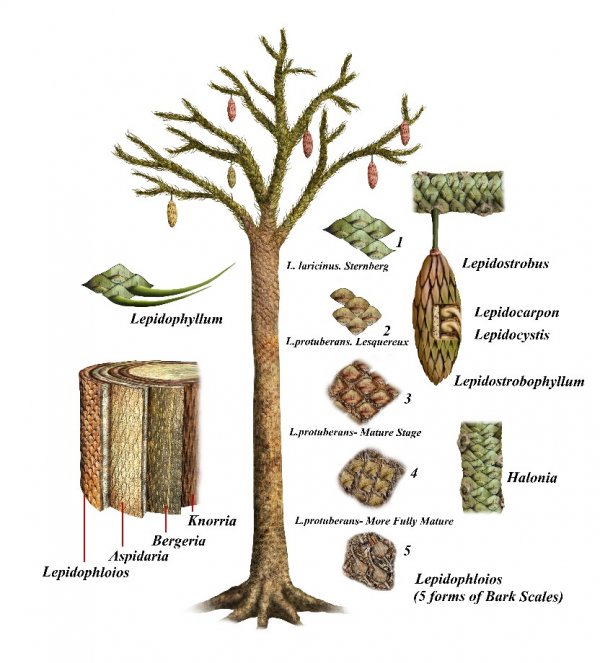
In terms of physical description, Lepidophloios laricinus was an awe-inspiring sight, reaching staggering heights of up to 30 to 40 meters (approximately 3000 to 4000 centimeters), with a trunk diameter that could exceed one meter at its base. Unlike modern hardwood trees, which rely on a thick cylinder of dense secondary wood for structural support, Lepidophloios was constructed quite differently. Its trunk consisted of a relatively small central core of vascular tissue surrounded by a massive, thick layer of spongy cortex or bark. This thick bark provided the primary structural integrity for the towering plant. The most distinctive feature of Lepidophloios, and the source of its classification as a 'scale tree,' was the striking pattern of leaf cushions that covered its trunk and branches. As the plant grew, it shed its grass-like leaves, leaving behind diamond-shaped or rhomboidal scars. In Lepidophloios, these leaf cushions were wider than they were tall and overlapped in a downward direction, resembling the scales of a giant reptile or the overlapping shingles on a roof. This downward-directed overlapping is a key diagnostic feature that distinguishes the genus Lepidophloios from its close relative Lepidodendron, whose leaf cushions were typically taller than they were wide. The root system, known by the form genus Stigmaria, consisted of four massive, bifurcating axes that spread horizontally through the muddy swamp substrate, anchoring the colossal plant in the waterlogged soil. At the apex of the plant, a dichotomously branching crown bore long, linear leaves and massive reproductive cones, creating a canopy that shaded the swamp floor below.
As a photosynthetic organism, the paleobiology of Lepidophloios was intricately tied to the unique environmental conditions of the Carboniferous swamps. It utilized sunlight, water, and carbon dioxide to produce energy, but its growth patterns and life cycle were markedly different from modern trees. Paleobotanists believe that Lepidophloios exhibited a determinate growth strategy. This means the plant likely grew as an unbranched pole for the majority of its life, rapidly ascending toward the canopy to secure sunlight in the dense, competitive forest environment. Only upon reaching maturity did it undergo a sudden, rapid phase of dichotomous branching at its apex, producing a crown of foliage and reproductive organs. This rapid vertical growth was facilitated by its relatively cheap construction—producing spongy cortical tissue requires far less energy and resources than producing dense lignin-rich wood. Reproduction was achieved not through seeds, but via massive, spore-bearing cones known as Lepidostrobus or Flemingites. These cones produced two distinct types of spores (heterospory): large megaspores that would develop into female gametophytes, and tiny microspores that would yield male gametophytes. The sheer volume of spores produced by a single Lepidophloios tree was astronomical, ensuring that at least a few would find the precise, water-rich conditions necessary for fertilization and the establishment of a new generation in the shifting, dynamic environment of the coal swamps.
The ecological context of Lepidophloios laricinus was the quintessential Carboniferous coal swamp—a vast, tropical, waterlogged environment that stretched across the equatorial regions of Euramerica. The climate was hot, humid, and remarkably stable, with little seasonal variation. These swamps were characterized by slow-moving or stagnant water, highly acidic and anoxic (oxygen-poor) soils, and an incredibly dense accumulation of plant debris. Lepidophloios stood as a canopy emergent, sharing the skyline with other giant lycopsids like Lepidodendron and Sigillaria, as well as towering horsetails (Calamites) and massive tree ferns. The atmospheric conditions of this era were extraordinary; oxygen levels are estimated to have peaked at around 30 to 35 percent, significantly higher than today's 21 percent. This hyper-oxygenated atmosphere, largely a byproduct of the massive photosynthetic output of plants like Lepidophloios and the delayed decomposition of their remains in the anoxic swamp waters, supported a unique fauna. Giant arthropods roamed the forest floor and understory, including the massive millipede-like Arthropleura, which could reach lengths of over two meters, and the colossal griffinfly Meganeura, boasting a wingspan of nearly 75 centimeters. Early tetrapods, including diverse amphibians and the very first reptiles, navigated the complex, root-choked waterways. Lepidophloios was a foundational species in this ecosystem; its massive, falling trunks provided structural habitat, while its shed leaves, bark, and spores formed the base of a detritus-driven food web that supported countless invertebrates and, ultimately, the vertebrate predators of the swamp.
The discovery history of Lepidophloios is deeply intertwined with the Industrial Revolution and the birth of modern paleobotany. As coal mining operations expanded rapidly across Europe and North America in the 18th and 19th centuries, miners frequently uncovered spectacular, large-scale impressions of ancient plant life in the shale and sandstone layers immediately above and below the coal seams. The genus Lepidophloios was formally established in the mid-19th century by pioneering paleobotanists who recognized that its distinctive, downward-overlapping leaf cushions represented a unique biological entity distinct from Lepidodendron. Kaspar Maria von Sternberg and Adolphe Brongniart, often considered the fathers of paleobotany, were instrumental in the early classification of these Carboniferous flora. One of the greatest challenges in the discovery and naming of Lepidophloios—and indeed all fossil plants—is the phenomenon of form taxa. Because a massive tree rarely fossilizes intact, its various parts (roots, bark, leaves, cones, and spores) are typically found isolated from one another. Consequently, 19th-century scientists assigned different generic names to different plant parts. The roots were called Stigmaria, the leaves Lepidophyllum, the cones Lepidostrobus, and the bark impressions Lepidophloios. It took decades of painstaking work, often relying on rare, exceptionally preserved specimens where these parts were found physically attached, to reconstruct the whole plant. The specific epithet 'laricinus' refers to the larch-like appearance of certain foliage associated with these plants, highlighting the early attempts to draw morphological parallels between these bizarre ancient organisms and familiar modern flora.
The evolutionary significance of Lepidophloios cannot be overstated, as it represents a spectacular, albeit ultimately doomed, evolutionary experiment in arborescence (tree-like growth). Lepidophloios belongs to the Lycopodiopsida, an ancient lineage of vascular plants that diverged from the ancestors of ferns and seed plants over 400 million years ago. While modern lycopsids (clubmosses, spike mosses, and quillworts) are small, herbaceous plants rarely exceeding a few tens of centimeters in height, Lepidophloios demonstrates that this lineage was capable of producing some of the largest and most dominant forest trees in Earth's history. The evolution of the arborescent habit in Lepidophloios was achieved through a unique anatomical pathway—relying on a massive cortex rather than secondary xylem (wood) for support. Furthermore, the heterosporous reproductive strategy of Lepidophloios—producing distinct male and female spores—is viewed by evolutionary biologists as a crucial transitional step toward the evolution of the true seed. By retaining the megaspore within the cone for a longer period, these plants were edging closer to the seed habit that would eventually allow later plant lineages to conquer dry land. However, the highly specialized nature of Lepidophloios, heavily reliant on the specific, waterlogged conditions of the Carboniferous swamps for both structural support and reproduction, proved to be its evolutionary Achilles' heel. When the climate shifted, the lineage could not adapt, leaving only their diminutive, herbaceous cousins to carry the lycopsid legacy into the modern era.
Scientific debates surrounding Lepidophloios have historically centered on its growth habits, its precise taxonomic relationships, and the mechanics of its eventual extinction. For many years, paleobotanists debated whether these giant lycopsids grew slowly over centuries, like modern hardwood trees, or if they experienced rapid, weed-like growth. Modern consensus, supported by anatomical studies of the spongy cortex and the lack of prominent growth rings, strongly favors the rapid-growth hypothesis, suggesting a life cycle that may have been completed in just a few decades. Another ongoing area of refinement is the complex taxonomy of form genera. As new, exceptionally preserved fossils—particularly those found in coal balls (permineralized peat)—are discovered, researchers continuously revise which specific cones, leaves, and roots belong to the biological entity of Lepidophloios laricinus versus other closely related species. Furthermore, the exact causes of the Carboniferous Rainforest Collapse, the event that drove Lepidophloios to extinction, remain a subject of intense study. While general climate drying and cooling due to glaciation in the southern hemisphere (Gondwana) are widely accepted as the primary drivers, the specific localized impacts, the speed of the collapse, and the exact sequence of ecological unraveling continue to generate vigorous debate and ongoing field research.
The fossil record of Lepidophloios is remarkably rich and geographically extensive, reflecting its former dominance across the equatorial regions of Pangaea. Fossils are predominantly found in the Carboniferous Coal Measures of Europe (including the UK, Germany, and France) and the Pennsylvanian subperiod deposits of North America (particularly in the Appalachian and Illinois basins). The preservation quality ranges from fair to exceptional, depending on the mode of fossilization. The most visually striking fossils are large-scale impressions and casts of the trunk, which beautifully preserve the intricate, overlapping diamond patterns of the leaf cushions. These are often found in the shales forming the 'roof' of coal seams. However, the most scientifically valuable fossils are found within coal balls—nodules of peat that were permineralized by calcium carbonate or silica before they could be compressed into coal. These coal balls preserve the cellular anatomy of Lepidophloios in exquisite, three-dimensional detail, allowing paleobotanists to study the microscopic structure of its vascular tissue, cortex, and reproductive organs. Tens of thousands of specimens have been collected over the past two centuries, making Lepidophloios one of the best-understood extinct plants in the fossil record, with famous sites like the Joggins Fossil Cliffs in Nova Scotia providing unparalleled glimpses into its ancient environment.
The cultural impact of Lepidophloios, while perhaps less direct than that of charismatic dinosaurs, is deeply embedded in our modern industrial society. The very coal that fueled the Industrial Revolution, powered steam engines, and generated electricity for over a century is composed largely of the compressed, carbonized remains of Lepidophloios and its lycopsid relatives. In museums worldwide, such as the Field Museum in Chicago or the Natural History Museum in London, Lepidophloios is a staple of Carboniferous forest dioramas, captivating the public with its alien, scaly bark and towering height. These reconstructions serve a vital educational purpose, illustrating the vastness of geologic time, the dramatic changes our planet's climate has undergone, and the bizarre, magnificent forms that life has taken throughout Earth's history.
Classification
Time Period
Discovery
Location
Europe and North America
Formation
Coal Measures
Frequently Asked Questions
What is Lepidophloios?
Lepidophloios laricinus was a massive, tree-like lycopsid that dominated the vast, swampy forests of the Carboniferous period, approximately 320 to 300 million years ago. Belonging to the extinct order Lepidodendrales, commonly known as scale trees, this remarkable organism was not a true tree in th...
When did Lepidophloios live?
Lepidophloios lived during the carboniferous period of the paleozoic era approximately 320-300 million years ago.
Where was Lepidophloios discovered?
Fossils of Lepidophloios were discovered in Europe and North America in the Coal Measures.
What did Lepidophloios eat?
Lepidophloios was a photosynthetic. It lived in terrestrial habitats.
What type of fossil is Lepidophloios?
Lepidophloios is preserved as a impression fossil. The preservation quality is good.
Related Specimens
From the paleozoic era · impression fossils