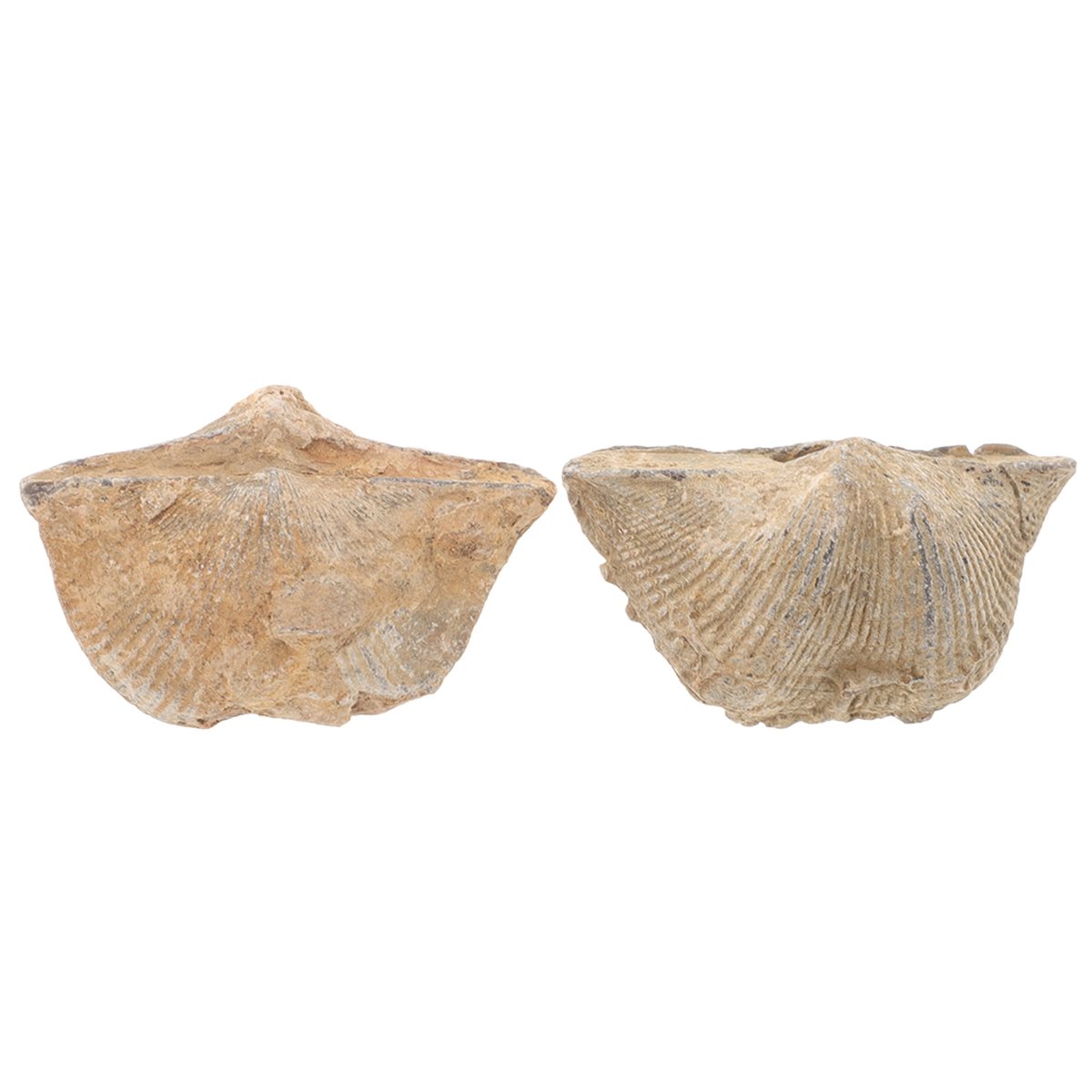
Lunulicardium
Lunulicardium fragile
Image: Image sourced via web search (Fair use / Educational)
About Lunulicardium
Lunulicardium fragile is an extinct species of bivalve mollusc that inhabited the marine ecosystems of the Devonian Period, approximately 390 to 370 million years ago. As a member of the class Bivalvia, it is a distant relative of modern clams, oysters, and scallops, offering a crucial window into the early evolution and diversification of this highly successful group of invertebrates. Fossils of Lunulicardium are particularly significant due to their frequent occurrence in lagerstätten—sites of exceptional fossil preservation—which have revealed not only their hard shells but also rare soft-tissue anatomy, providing invaluable data for paleontological research.
Lunulicardium fragile was a relatively small bivalve, with its shell typically measuring between 2 and 5 centimeters in length. The shell, or carapace, was composed of two symmetrical valves hinged at the dorsal margin. Its most distinguishing feature, from which it derives its name, is its prominent crescent-shaped or moon-like (lunate) outline, particularly evident along the anterior margin. The shell itself was thin and delicate, as suggested by the species name 'fragile'. The exterior surface was adorned with fine, concentric growth lines, which mark successive stages of the animal's development. Some specimens also exhibit faint radial ribs, although these are less pronounced than the concentric ornamentation. The hinge structure, or dentition, was relatively simple, characteristic of early bivalves in the order Cyrtodontida. Exceptionally preserved fossils from the Hunsrück Slate in Germany have revealed pyritized remains of soft tissues, including the outline of the mantle, the muscular foot, and even delicate gill structures. These features are almost never preserved in the fossil record, making Lunulicardium a key taxon for understanding the internal anatomy of Paleozoic molluscs. Compared to a modern cherrystone clam, Lunulicardium was of a similar size but possessed a more flattened and distinctly crescent-shaped shell.
The paleobiology of Lunulicardium is inferred from its morphology and the geological context of its fossils. Its well-developed gill structures, revealed in pyritized fossils, strongly suggest it was a filter-feeder, a common feeding strategy among bivalves. It would have used these gills to strain plankton, algae, and organic detritus from the water column. Unlike many modern clams that are benthic (bottom-dwelling) and often burrow into sediment, Lunulicardium is widely interpreted as having been a pelagic or nektonic organism, meaning it lived freely within the water column rather than on the seafloor. This hypothesis is supported by its thin, lightweight shell, which would have reduced the energy needed to stay afloat, and its frequent association in fossil assemblages with other free-swimming organisms like cephalopods and early fish. It likely achieved locomotion through rhythmic clapping of its valves, similar to modern scallops, propelling itself through the water with jets of expelled water. There is no direct evidence of social behavior, but it is often found in dense fossil assemblages, suggesting it may have lived in large, free-floating shoals, a strategy that could have offered protection from predators. Its growth lines indicate a pattern of incremental growth, likely influenced by seasonal variations in food availability and water temperature.
During the Devonian Period, often called the 'Age of Fishes', the world's oceans teemed with life. Lunulicardium lived in epicontinental seas that covered large parts of the supercontinent Euramerica. The climate was generally warm and stable. These marine ecosystems were complex and highly structured, featuring the first extensive coral and stromatoporoid reefs. Lunulicardium occupied a niche in the pelagic zone, floating or swimming above the seafloor. It shared this environment with a diverse array of organisms. Its primary food source would have been the abundant phytoplankton and zooplankton that formed the base of the marine food web. In turn, Lunulicardium would have been a food source for numerous predators. The Devonian seas were home to formidable hunters, including the heavily armored placoderm fish like Dunkleosteus, early sharks such as Cladoselache, and large, predatory nautiloids. As a small, shelled mollusc, Lunulicardium's main defense was likely its mobility and the protection afforded by its thin shell. Its position in the food web was that of a primary consumer, transferring energy from plankton to higher trophic levels, making it an important link in the Devonian marine ecosystem. Its co-occurrence with pelagic trilobites and cephalopods helps paleontologists reconstruct the structure of these ancient open-water communities.
The discovery and study of Lunulicardium are intrinsically linked to the famous Hunsrück Slate (Hunsrückschiefer) lagerstätte of the Rhineland, Germany. These slate deposits, quarried for roofing tiles since Roman times, began yielding exceptionally preserved fossils in the 19th century. The German paleontologist Ferdinand von Roemer is credited with some of the earliest scientific descriptions of fauna from this region, though the genus Lunulicardium itself was formally established by Guido von Münster in 1840. The specific epithet 'fragile' was assigned by the Bohemian paleontologist Joachim Barrande. The most significant discoveries, however, were made possible by the advent of X-ray radiography in the 20th century. Wilhelm Stürmer, a German radiologist and amateur paleontologist, pioneered the use of X-rays in the 1960s and 1970s to peer inside the slate slabs. This non-destructive technique revealed the delicate, pyritized soft tissues of Lunulicardium and other Hunsrück fauna, which were invisible on the surface. These X-ray images provided unprecedented insights into the anatomy of these ancient creatures and revolutionized the study of the site. There are no individually nicknamed specimens of Lunulicardium akin to 'Sue' the T. rex, but the collections of Stürmer, now housed in institutions like the Senckenberg Research Institute, represent a priceless repository of paleontological data on this genus.
Lunulicardium holds a significant place in the evolutionary history of the Bivalvia. As an early member of the class, it provides critical evidence for the initial diversification of bivalves during the Paleozoic Era. Its existence in the Devonian demonstrates that by this time, bivalves had already evolved a range of life modes, including the specialized pelagic lifestyle, moving beyond the ancestral burrowing habits of their earliest relatives. The preservation of its soft tissues confirms that the fundamental body plan of bivalves—including the mantle, gills, and foot—was well-established by the mid-Paleozoic. Taxonomically, Lunulicardium is placed within the order Cyrtodontida, an extinct group considered to be ancestral or closely related to the Pteriomorphia, a major modern subclass that includes oysters, scallops, and mussels. The simple hinge structure and overall shell morphology of Lunulicardium exhibit features that are transitional between more primitive, ancestral bivalves and the more derived pteriomorphs. Its specialized pelagic adaptation is also an example of convergent evolution, as other bivalve lineages, such as some modern scallops and file clams, independently evolved a similar free-swimming lifestyle much later in geologic history. Thus, Lunulicardium is not just a curiosity but a key piece of the puzzle in understanding the macroevolutionary trends within one of the most successful phyla on Earth.
The primary scientific debate surrounding Lunulicardium has centered on its precise mode of life. While the consensus view supports a pelagic, free-swimming existence, some researchers have proposed alternative interpretations. One hypothesis suggested it might have been pseudoplanktonic, attaching itself to floating objects like seaweed or logs via a byssus (a bundle of proteinaceous threads). The presence of a byssal notch in some related bivalves lends some credence to this idea, although direct evidence of a byssus in Lunulicardium is lacking. Another interpretation is that it was epibenthic, living on the surface of the seafloor rather than actively swimming. However, the thinness of its shell and its frequent preservation in deep-water, low-oxygen shale deposits—environments less suitable for typical benthic life—make a pelagic lifestyle the most widely accepted hypothesis. Ongoing research using advanced imaging techniques on Hunsrück specimens continues to refine our understanding of its functional morphology, potentially settling these long-standing debates about its paleoecology and behavior.
The fossil record of Lunulicardium is geographically widespread, with specimens found in Devonian marine strata in Europe (particularly Germany, the Czech Republic, and Poland) and North America. However, it is most famous and abundant in the Hunsrück Slate of Germany. This Emsian-age formation is a Konservat-Lagerstätte, renowned for its 'Hunsrück-type' preservation, where soft tissues and delicate structures are replaced by the mineral pyrite. This pyritization, combined with burial in an anoxic deep-water environment, prevented decay and scavenging, leading to the preservation of stunningly complete fossils. Tens of thousands of invertebrate fossils have been recovered from these slate quarries over the centuries. While not rare within this specific formation, exceptionally preserved specimens showing soft parts remain scientifically precious. Typically, only the flattened shell is preserved, but the unique conditions of the Hunsrück Slate mean that Lunulicardium is one of the best-understood Paleozoic bivalves in terms of its complete anatomy.
While Lunulicardium fragile is not a household name like Tyrannosaurus or Triceratops, it holds a place of honor in paleontological circles and museum collections specializing in invertebrate evolution. Major natural history museums, such as the Senckenberg Museum in Frankfurt, Germany, and the Museum für Naturkunde in Berlin, feature prominent displays of fossils from the Hunsrück Slate, with Lunulicardium often used as a prime example of exceptional pyritized preservation. Its educational importance lies in its ability to demonstrate that fossils are not just bones or shells, but can sometimes preserve the entire biology of an ancient organism. The striking X-ray images of its soft tissues are frequently reproduced in textbooks and scientific publications, captivating students and researchers alike with a ghostly glimpse into the soft anatomy of a creature that lived nearly 400 million years ago.
Classification
Time Period
Discovery
Location
Germany (Rhineland)
Formation
Hunsrück Slate (Hunsrückschiefer)
Frequently Asked Questions
What is Lunulicardium?
Lunulicardium fragile is an extinct species of bivalve mollusc that inhabited the marine ecosystems of the Devonian Period, approximately 390 to 370 million years ago. As a member of the class Bivalvia, it is a distant relative of modern clams, oysters, and scallops, offering a crucial window into t...
When did Lunulicardium live?
Lunulicardium lived during the devonian period of the paleozoic era approximately 390-370 million years ago.
Where was Lunulicardium discovered?
Fossils of Lunulicardium were discovered in Germany (Rhineland) in the Hunsrück Slate (Hunsrückschiefer).
What did Lunulicardium eat?
Lunulicardium was a filter-feeder. It lived in marine, pelagic habitats.
What type of fossil is Lunulicardium?
Lunulicardium is preserved as a body fossil. The preservation quality is exceptional.
Related Specimens
From the paleozoic era · body fossils