Nimravus
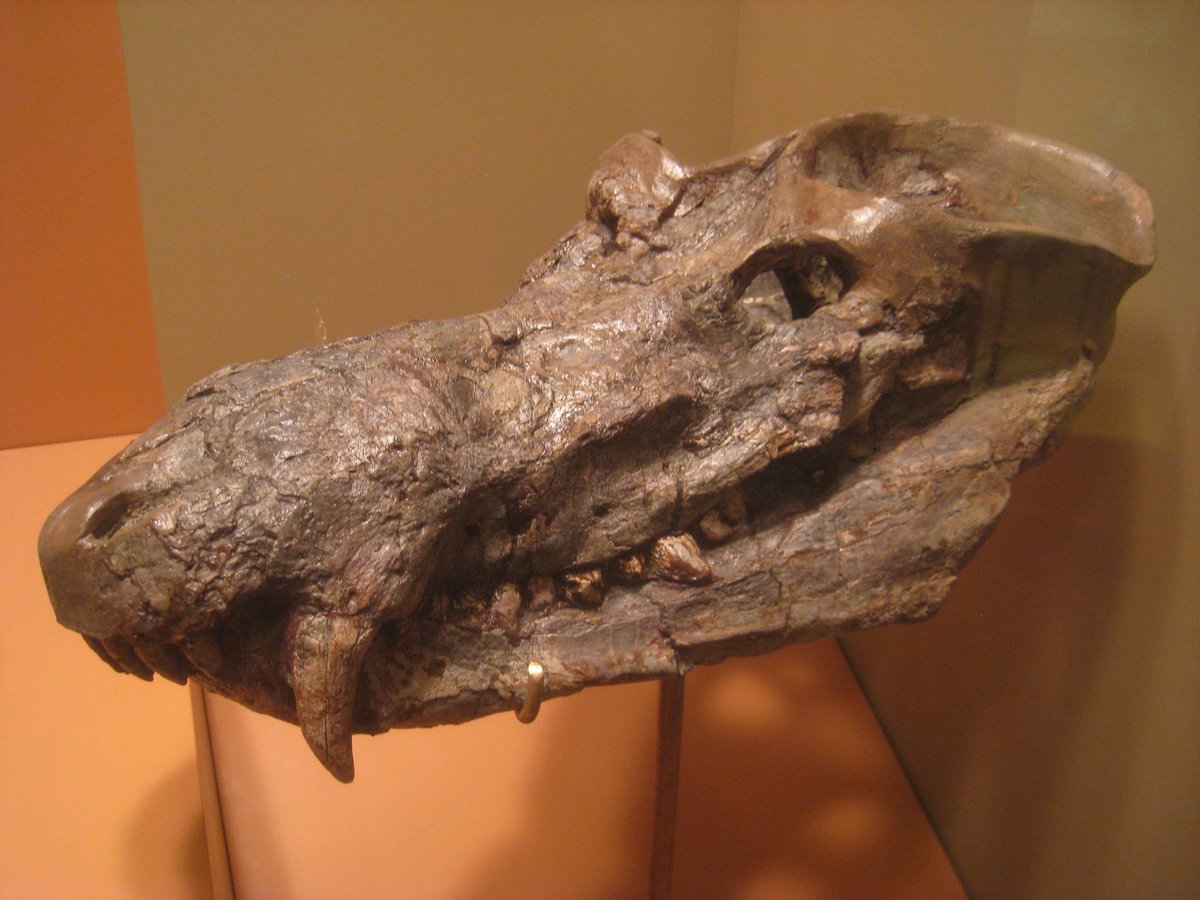
Nimravus brachyops
Image: Image sourced via web search (Fair use / Educational)
About Nimravus
Nimravus brachyops was a formidable cat-like predator that roamed North America during the Oligocene epoch, approximately 33 to 23 million years ago. As a member of the extinct family Nimravidae, often called 'false saber-toothed cats,' it represents a striking example of convergent evolution with true cats (family Felidae), possessing a similar body plan and predatory adaptations. Its fossils provide crucial insights into the diversification of carnivorans following the Eocene-Oligocene extinction event and the complex ecological dynamics of ancient North American ecosystems.
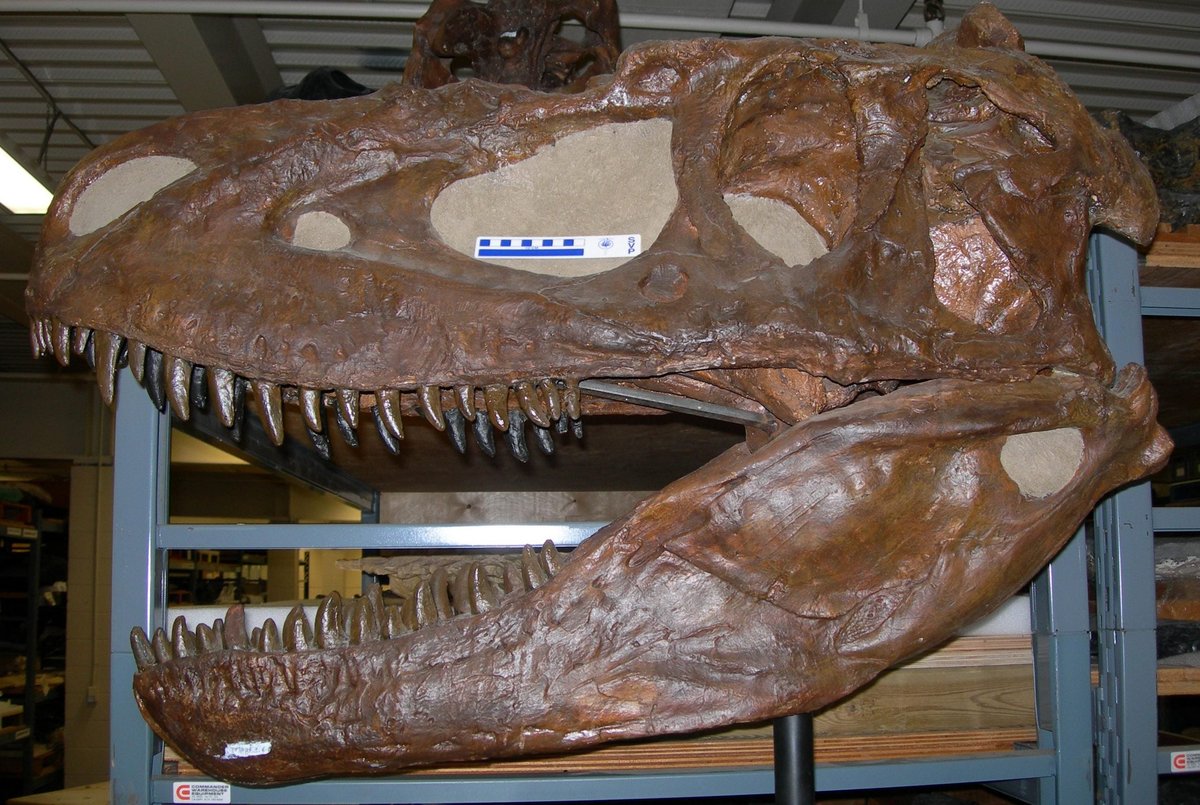
Nimravus was a medium-sized predator, comparable in size to a modern leopard or a large bobcat. It had a body length of approximately 120 centimeters (about 4 feet) and an estimated body mass ranging from 40 to 60 kilograms (88 to 132 pounds). Its physique was sleek and muscular, characterized by a long, low-slung body and relatively short, powerful legs, suggesting a combination of stealth and ambush hunting rather than long-distance pursuit. The skull is one of its most distinctive features, bearing a superficial resemblance to that of a felid but with key anatomical differences. The most prominent of these are the saber-like upper canines, which were long, slender, and slightly curved, though not as exaggerated as those of later, more famous saber-toothed cats like Smilodon. A bony flange on the lower jaw, the mandibular flange, served to protect these delicate canines when the mouth was closed. The skull was relatively short and broad (the species name 'brachyops' means 'short-faced'), and it possessed a smaller braincase compared to modern felids of similar size. Its skeleton was robust, with strong forelimbs equipped with partially retractable claws, indicating an ability to grapple with and subdue struggling prey. The tail was moderately long, likely aiding in balance during agile movements through its woodland and savanna-like habitats.
As an apex carnivore, the paleobiology of Nimravus was centered around predation. Its dental morphology, particularly the shearing carnassial teeth (the fourth upper premolar and first lower molar) and the piercing saber-canines, confirms a hypercarnivorous diet consisting exclusively of meat. The structure of its canines suggests a specific killing method, likely a deep, precise stabbing bite to the throat or neck of its prey to sever major blood vessels, a technique inferred for many saber-toothed predators. This contrasts with the strangulation bite used by most modern big cats. Its robust forelimbs and semi-retractable claws would have been essential for seizing and immobilizing prey before delivering the fatal bite. Locomotion in Nimravus was likely plantigrade or semi-plantigrade, meaning it walked on the soles of its feet, similar to bears, rather than on its toes like modern cats (digitigrade). This posture, combined with its powerful musculature, suggests it was an ambush predator, using cover to stalk close to its victims before launching a short, explosive attack. Fossil evidence, including specimens with healed injuries, indicates a life of frequent, violent conflict. There is little direct evidence for social behavior, but like many modern solitary predators, it may have exhibited territoriality and complex interactions during mating or raising young. Its growth patterns and metabolism were likely similar to those of modern mid-sized mammalian carnivores, requiring a consistent intake of large prey to sustain its energy needs.
The world of Nimravus during the Oligocene was a landscape in transition. Following the cooler, drier conditions that began with the Eocene-Oligocene transition, vast forests began to give way to more open woodlands and grasslands. This environmental shift spurred the evolution of new types of herbivores, which in turn provided a diverse prey base for predators like Nimravus. It shared its habitat with a rich fauna, including early horses like Miohippus, small camels such as Poebrotherium, rhinos like Subhyracodon, and the large, pig-like entelodonts ('terminator pigs') such as Archaeotherium. Nimravus occupied a high trophic level, preying on these medium-sized herbivores. However, it was not without competition or danger. It coexisted with other large predators, including the creodont Hyaenodon and other nimravids like Hoplophoneus. The predator-prey dynamics were complex; while Nimravus hunted herbivores, it may have been preyed upon as a juvenile or competed fiercely for carcasses with larger carnivores like the entelodonts. A famous fossil from the John Day Formation shows a Nimravus skull with puncture wounds that perfectly match the teeth of Eusmilus, another nimravid, providing direct evidence of interspecific combat among these ancient predators. This fossil highlights the intense competition that characterized the Oligocene carnivore guild.
The discovery and study of Nimravus are closely tied to the prolific fossil beds of the American West. The genus was first described by the renowned American paleontologist Edward Drinker Cope in 1879. The type species, Nimravus brachyops, was named based on a partial skull found in the John Day Formation of Oregon, a region that has since yielded numerous high-quality specimens. Cope was a central figure in the 'Bone Wars,' a period of intense and competitive fossil hunting in the late 19th century, and his work on Nimravus was part of a broader effort to catalogue the strange and wonderful fauna of North America's past. One of the most remarkable fossils ever found is a block from the John Day Formation preserving two individuals, a Nimravus and a small herbivore, locked in a predator-prey struggle, though this specific association has been debated. Another significant specimen, housed at the University of Oregon Museum of Natural and Cultural History, shows a Nimravus skull pierced by the canines of another nimravid, offering a rare snapshot of ancient behavior. These and other well-preserved skeletons have allowed paleontologists to reconstruct its anatomy and lifestyle with a high degree of confidence, making Nimravus one of the best-understood nimravids.
Nimravus holds a crucial position in the evolutionary history of carnivorans. It belongs to the family Nimravidae, a group that is entirely extinct and represents a separate, parallel evolutionary lineage to the true cats of the family Felidae. This makes Nimravus a textbook example of convergent evolution, where two unrelated groups independently evolve similar body forms and adaptations to fill a similar ecological niche—in this case, that of a saber-toothed predator. For many years, nimravids were considered the direct ancestors of cats, but detailed anatomical studies of the ear region (specifically the auditory bulla) and other skull features have firmly established them as a distinct family within the suborder Feliformia. They are more basal ('primitive') than felids, splitting off from the main cat lineage early in carnivoran evolution. Nimravus and its relatives, therefore, demonstrate that the saber-toothed morphology was a highly successful predatory adaptation that evolved multiple times in different mammalian lineages, including nimravids, felids (like Smilodon), and even extinct marsupials (like Thylacosmilus). Studying Nimravus helps scientists understand the evolutionary pathways and constraints that shape the development of hypercarnivorous mammals.
Despite being well-studied, Nimravus is not without scientific debates. The primary area of ongoing discussion revolves around the precise classification and interrelationships within the Nimravidae family. The exact placement of Nimravidae within the broader Carnivora order has been revised over the years, though a consensus now places them as basal feliforms. The number of valid Nimravus species is also a subject of research, with some named species potentially representing variations within a single, more variable species like N. brachyops. Furthermore, interpretations of its behavior, particularly its hunting technique, are based on inference from skeletal morphology. While the throat-biting hypothesis is widely accepted, the exact mechanics and the range of prey it could tackle remain topics of biomechanical modeling and analysis. New fossil discoveries continually refine our understanding, occasionally challenging long-held assumptions about its locomotion or social structure. For instance, the degree to which it was plantigrade versus digitigrade continues to be analyzed, impacting interpretations of its agility and hunting style.
The fossil record of Nimravus is robust, primarily concentrated in North America. The most significant and well-preserved specimens have been unearthed from the White River Formation of South Dakota, Nebraska, and Wyoming, as well as the John Day Formation of Oregon. These sites, dating to the Oligocene, have yielded numerous complete and partial skeletons, skulls, and isolated bones. The quality of preservation is often good to excellent, allowing for detailed anatomical study. The abundance of fossils has made Nimravus a key index fossil for the Oligocene epoch in North America. While less common than some of its contemporaries like the oreodonts, dozens of individuals are known, providing a solid sample size for studying individual variation, pathology, and growth. Famous fossil sites like Agate Fossil Beds National Monument in Nebraska and the fossil beds of the John Day Basin are critical localities for understanding Nimravus and its ecosystem. Its remains provide a clear window into the fauna that dominated the continent millions of years before the arrival of the more famous Pleistocene megafauna.
In popular culture, Nimravus is often overshadowed by its larger and more famous saber-toothed counterparts like Smilodon. However, it holds a significant place in paleontological outreach and museum exhibits. As a 'false' saber-toothed cat, it serves an important educational role in explaining the concept of convergent evolution to the public. Skeletons and life-sized reconstructions of Nimravus are featured in major natural history museums, including the American Museum of Natural History and the Field Museum. It has appeared in various documentaries and books about prehistoric life, often used to illustrate the unique fauna of the Oligocene. While not a household name, its sleek, leopard-like build and saber teeth make it a compelling subject that captures the public's fascination with the predators of Earth's ancient past.
Classification
Time Period
Discovery
Location
North America (specifically Oregon, USA)
Formation
John Day Formation
Frequently Asked Questions
What is Nimravus?
Nimravus brachyops was a formidable cat-like predator that roamed North America during the Oligocene epoch, approximately 33 to 23 million years ago. As a member of the extinct family Nimravidae, often called 'false saber-toothed cats,' it represents a striking example of convergent evolution with t...
When did Nimravus live?
Nimravus lived during the paleogene period of the cenozoic era approximately 33-23 million years ago.
Where was Nimravus discovered?
Fossils of Nimravus were discovered in North America (specifically Oregon, USA) in the John Day Formation.
What did Nimravus eat?
Nimravus was a carnivore. It lived in terrestrial (woodlands and open plains) habitats.
What type of fossil is Nimravus?
Nimravus is preserved as a body fossil. The preservation quality is good.
Related Specimens
From the cenozoic era · body fossils