Mapusaurus
Mapusaurus roseae
Image: Image sourced via web search (Fair use / Educational)
About Mapusaurus
Mapusaurus roseae was a colossal carnivorous dinosaur that roamed the floodplains of what is now South America during the Late Cretaceous period, approximately 97 to 93 million years ago. As one of the largest theropods ever discovered, its fossils provide critical insights into the ecology of giant predators and have fueled scientific debate about social behavior in dinosaurs. Its discovery in a bonebed containing multiple individuals has made it a cornerstone for understanding the paleobiology of the Carcharodontosauridae, a family of enormous predatory dinosaurs that rivaled the famous tyrannosaurs in size and ferocity.
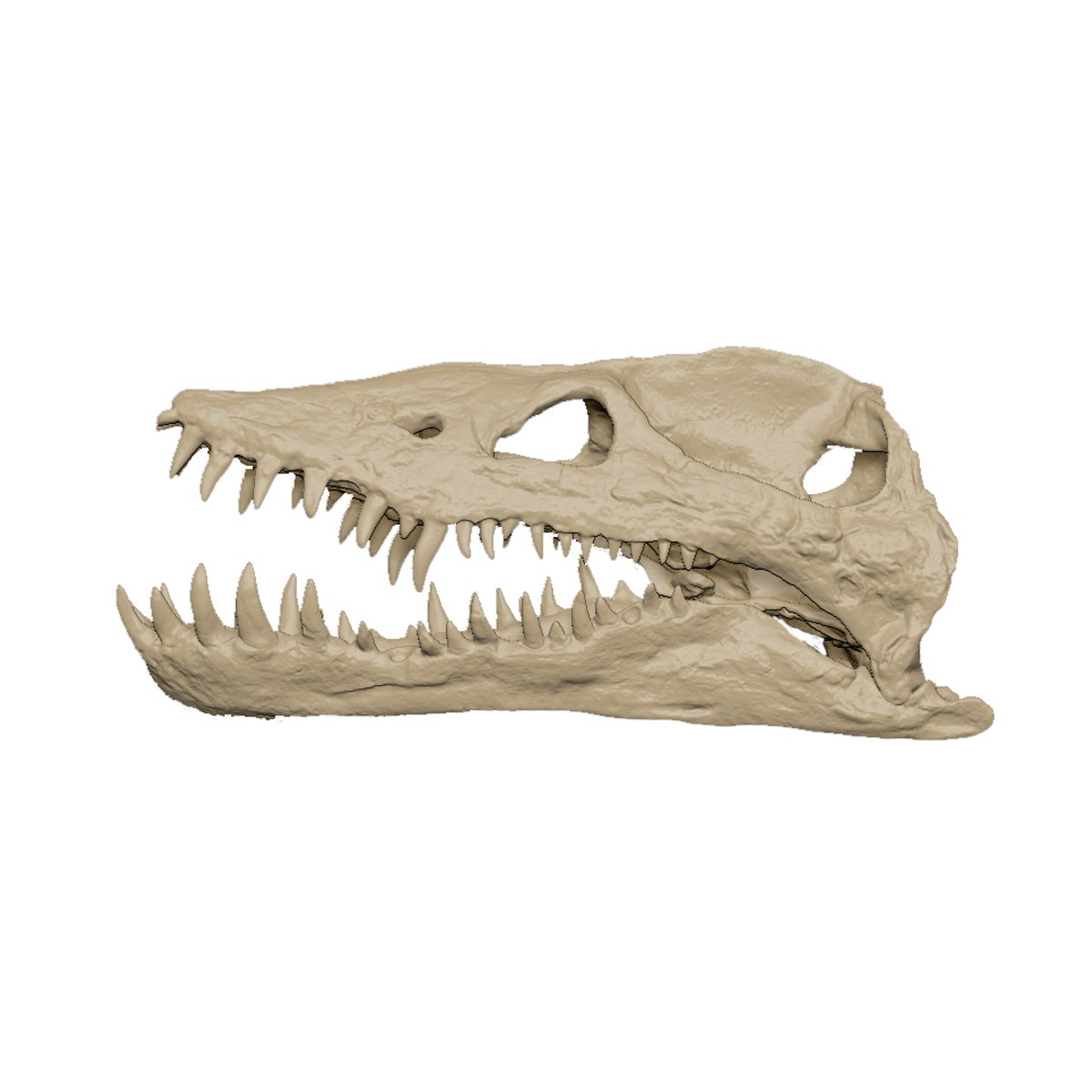
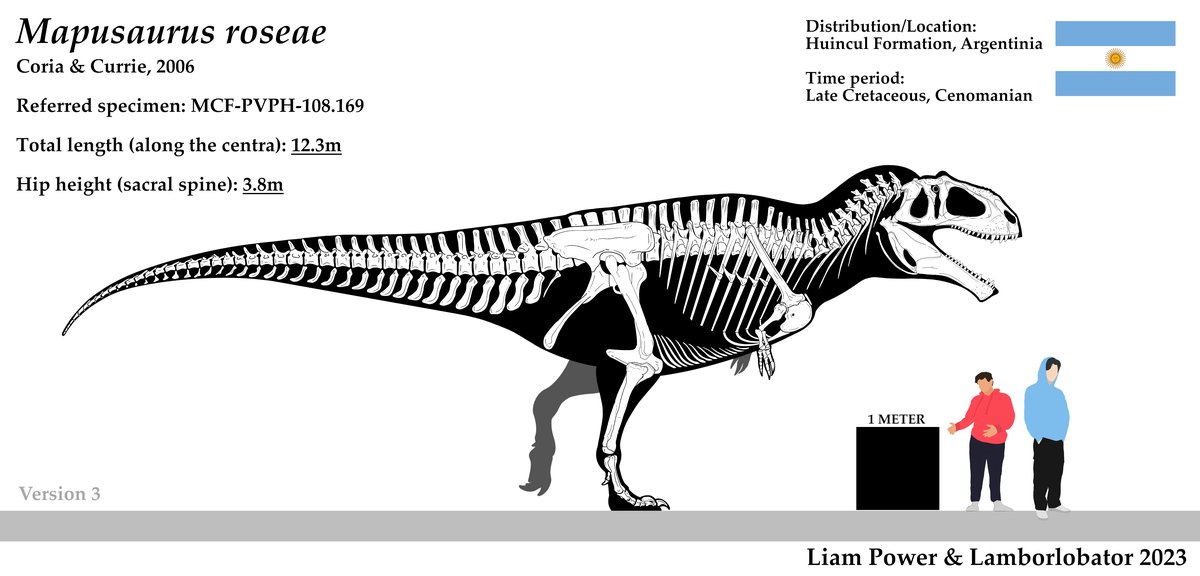
Mapusaurus was an animal of immense proportions, a true giant among terrestrial predators. Conservative estimates place its body length between 10 to 12.6 meters (approximately 33 to 41 feet), with some paleontologists suggesting maximum lengths approaching those of its larger relative, Giganotosaurus. Its weight is estimated to have been between 3 and 5 metric tons (6,600 to 11,000 pounds), comparable to a large bull African elephant. The skull of Mapusaurus was long, deep, and narrow, characterized by extensive fenestration (openings) that reduced its weight without compromising structural integrity. Its jaws were filled with long, blade-like, serrated teeth, perfectly adapted for slicing through flesh. Unlike the robust, bone-crushing teeth of Tyrannosaurus rex, the teeth of Mapusaurus were designed for creating deep, bleeding wounds. The skeleton was robust, with powerful hind limbs supporting its massive body, while its forelimbs were relatively small, likely possessing three clawed digits. Its long, muscular tail would have acted as a crucial counterbalance, providing stability during rapid movements and turns. The overall build was more gracile than that of Tyrannosaurus, suggesting a creature built for sustained pursuit of large prey over open terrain.
The paleobiology of Mapusaurus is a subject of intense scientific interest, primarily due to the unique circumstances of its discovery. The concentration of multiple individuals of different ages in a single location strongly suggests some form of group behavior. This has led to the compelling hypothesis that Mapusaurus may have hunted cooperatively. Such a strategy would have enabled them to tackle the largest herbivores of their ecosystem, such as the colossal sauropod Argentinosaurus, an animal that a lone Mapusaurus would have struggled to bring down. The proposed hunting method likely involved coordinated attacks, with pack members using their slicing teeth to inflict massive blood loss, eventually weakening and overwhelming their prey. This contrasts with the solitary ambush predation often inferred for other large theropods. Locomotion was bipedal, and while not a sprinter on the level of smaller theropods, it was likely capable of impressive bursts of speed. Growth studies based on the bonebed individuals indicate a relatively rapid growth rate during its juvenile and subadult stages, reaching near-maximum size in a pattern similar to other large dinosaurs. Its metabolism was likely mesothermic, possessing an elevated metabolic rate higher than modern reptiles but lower than that of birds or mammals, allowing it to sustain an active, predatory lifestyle.
Mapusaurus lived in a warm, semi-arid environment characterized by extensive floodplains, braided river systems, and seasonal rainfall. This ecosystem, preserved in the rocks of the Huincul Formation in Patagonia, Argentina, was home to some of the largest land animals of all time, creating a true 'land of giants.' The dominant herbivore, and the likely primary prey for Mapusaurus, was the titanosaurian sauropod Argentinosaurus huinculensis, which could reach lengths of over 30 meters and weigh upwards of 70 metric tons. Other herbivores in this environment included the rebbachisaurid sauropod Cathartesaura and iguanodontian dinosaurs. Mapusaurus occupied the apex predator niche, competing with other large carnivores such as the abelisaurid Skorpiovenator. The presence of such enormous prey likely drove the evolution of immense body size and potential pack-hunting behavior in Mapusaurus, as it was one of the few predators capable of threatening a healthy adult Argentinosaurus. The food web was complex, with smaller carnivores and scavengers likely feeding on the kills of these giant predators, and a diverse flora of conifers, ferns, and cycads supporting the base of the ecosystem.
The discovery of Mapusaurus is a story of international collaboration and persistent fieldwork. The fossils were unearthed between 1997 and 2001 by the Argentinian-Canadian Dinosaur Project from a single bonebed at a site known as Cañadón del Gato. The project was led by renowned paleontologists Rodolfo Coria of Argentina and Philip J. Currie of Canada. The sheer concentration of bones, representing at least seven and possibly as many as nine individuals of varying ages, was a remarkable find. This mass accumulation of skeletons provided an unprecedented opportunity to study population structure and variation within a single species of giant theropod. The formal description and naming of the dinosaur occurred in 2006. The genus name, Mapusaurus, is derived from the Mapuche word 'Mapu,' meaning 'of the Earth,' and the Greek 'saurus,' meaning 'lizard.' The species name, 'roseae,' is a tribute to both Rose Letwin, who sponsored the expeditions, and the rose-colored rocks in which the fossils were found. The holotype specimen, MCF-PVPH-108.1, consists of a right nasal bone, but the wealth of associated material from the bonebed forms the basis of our understanding of the animal's anatomy.
Mapusaurus holds a crucial position in the evolutionary history of theropod dinosaurs. It belongs to the family Carcharodontosauridae and the subfamily Giganotosaurini, a clade of giant carnivores that dominated the southern continents during the mid-Cretaceous. Its closest relatives include Giganotosaurus and Tyrannotitan, both also from South America. The discovery of Mapusaurus helped solidify the understanding that carcharodontosaurids, not tyrannosaurids, were the dominant apex predators in Gondwana during this period. These dinosaurs represent a separate and parallel evolutionary path to gigantism compared to the tyrannosaurs of Laurasia (the northern continents). Carcharodontosaurids are characterized by their shark-like teeth and distinctive skull features. Mapusaurus provides a vital data point for understanding the anatomy, diversity, and paleobiology of this group, particularly highlighting the potential for complex social structures, which had previously been more strongly associated with smaller dromaeosaurs or tyrannosaurids. The evolutionary success of the carcharodontosaurids demonstrates how different lineages of theropods adapted to fill the apex predator role in geographically isolated ecosystems during the Cretaceous.
The primary scientific debate surrounding Mapusaurus centers on the interpretation of the bonebed. While the hypothesis of cooperative pack hunting is popular and compelling, it is not universally accepted. Some researchers argue that the bonebed could represent a 'predator trap,' where individual animals were mired in mud over a period of time while attempting to scavenge a carcass. Others suggest the accumulation could be the result of a catastrophic event, such as a flood or drought, that killed a group of animals that were living in proximity but not necessarily hunting as a coordinated unit. Differentiating between a social group and a simple aggregation is challenging based solely on fossil evidence. The debate highlights the difficulty of inferring complex behaviors from the geological record. Further taphonomic analysis of the site and the discovery of similar bonebeds in the future will be necessary to resolve this fascinating question about the social lives of these giant carnivores. There are no major taxonomic disputes, as its placement within Carcharodontosauridae is well-supported by numerous skeletal characteristics shared with Giganotosaurus.
The fossil record of Mapusaurus is geographically restricted to the Huincul Formation in the Neuquén Province of Argentina. To date, all known material comes from the single, highly productive bonebed at the Cañadón del Gato locality. This site has yielded hundreds of disarticulated but well-preserved bones from a minimum of seven individuals, ranging from juveniles to large adults. The preservation quality is generally good, allowing for detailed anatomical study. The recovered elements represent most of the skeleton, including parts of the skull, vertebrae, ribs, limb bones, and pelvic girdle. The disarticulated nature of the bones, however, means that a complete, articulated skeleton of a single individual has not been found. This makes reconstructing a definitive composite skeleton challenging, requiring scaling and combining elements from different individuals. Nonetheless, the sheer volume of material from this one site makes Mapusaurus one of the best-represented giant theropods, offering invaluable data on individual variation and growth stages within a population.
Since its description in 2006, Mapusaurus has captured the public imagination as a southern counterpart to Tyrannosaurus rex. Its immense size and the tantalizing possibility of pack-hunting behavior have made it a popular subject in dinosaur documentaries, including the BBC's 'Planet Dinosaur,' where it was depicted hunting Argentinosaurus in a coordinated group. It has also been featured in books, video games, and museum exhibits. Casts and reconstructions of Mapusaurus skeletons are displayed in several museums, notably the Museo Carmen Funes in Plaza Huincul, Argentina, near where it was discovered. Its story serves as a powerful educational tool, illustrating the incredible diversity of dinosaur life, the process of scientific discovery, and the dynamic, ever-changing nature of prehistoric ecosystems.
Classification
Time Period
Discovery
Location
Neuquén Province, Argentina
Formation
Huincul Formation
Frequently Asked Questions
What is Mapusaurus?
Mapusaurus roseae was a colossal carnivorous dinosaur that roamed the floodplains of what is now South America during the Late Cretaceous period, approximately 97 to 93 million years ago. As one of the largest theropods ever discovered, its fossils provide critical insights into the ecology of giant...
When did Mapusaurus live?
Mapusaurus lived during the cretaceous period of the mesozoic era approximately 97-93 million years ago.
Where was Mapusaurus discovered?
Fossils of Mapusaurus were discovered in Neuquén Province, Argentina in the Huincul Formation.
What did Mapusaurus eat?
Mapusaurus was a carnivore. It lived in terrestrial habitats.
What type of fossil is Mapusaurus?
Mapusaurus is preserved as a body fossil. The preservation quality is good.
Related Specimens
From the mesozoic era · body fossils