Deinotherium
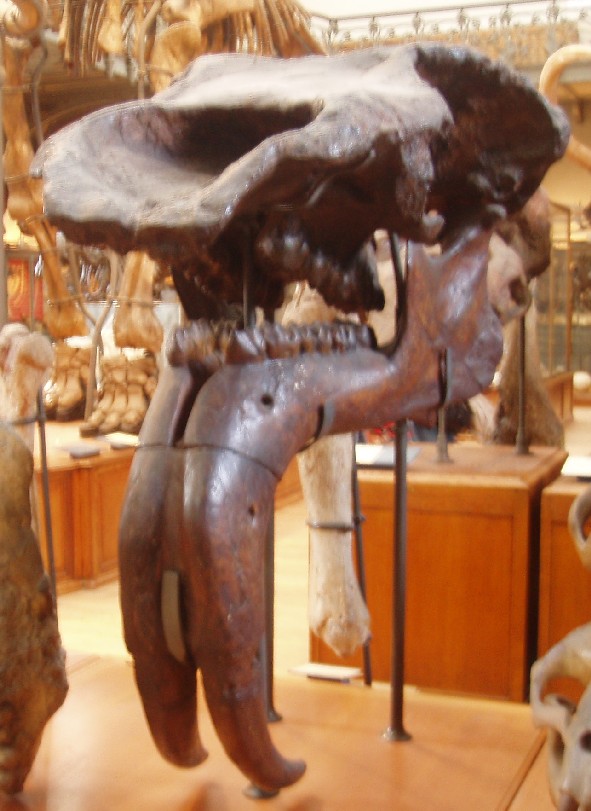
Deinotherium giganteum
Image: File:Deinotherium giganteum.JPG - Wikimedia Commons (CC BY-SA)
About Deinotherium
Deinotherium, a name that translates from Greek as "terrible beast," was a truly colossal prehistoric relative of modern elephants that inhabited vast swathes of Africa, Asia, and Europe. This mega-herbivore was a prominent member of the terrestrial fauna throughout the Miocene and Pliocene epochs, from approximately 20 million to 2 million years ago, representing a highly successful and distinct lineage within the order Proboscidea. Its immense size and bizarre, downward-curving mandibular tusks make it one of the most recognizable and intriguing of all extinct mammals, offering a unique window into the diverse evolutionary pathways explored by elephant-like creatures during the Cenozoic Era.
The physical appearance of Deinotherium was both familiar and strikingly alien when compared to its modern relatives. It was one of the largest terrestrial mammals of its time, with the largest species, *Deinotherium giganteum*, standing between 3.5 and 4 meters (11.5 to 13 feet) at the shoulder, and some exceptionally large males possibly reaching even greater heights. Its body mass is estimated to have been immense, typically ranging from 10 to 12 metric tons (22,000 to 26,500 pounds), making it comparable in weight to the largest known mammoths and significantly heavier than most modern African elephants. Its overall body plan was elephant-like, with a massive, barrel-shaped torso supported by thick, pillar-like legs designed to bear its tremendous weight. The skull was relatively long, low, and flattened on top compared to that of modern elephants, which have high, domed skulls to anchor powerful neck muscles. While it undoubtedly possessed a flexible, muscular trunk, the structure of its nasal opening suggests the trunk may have been shorter and more robust than that of living elephants. The most defining and peculiar feature, however, was its dentition. Deinotherium completely lacked upper incisors or tusks, but instead sported a pair of large, formidable tusks that emerged from the tip of its lower jaw, or mandible. These tusks curved distinctly downwards and slightly backwards, resembling a gigantic, two-pronged hoe, a feature unique among all known proboscideans.
The paleobiology of Deinotherium was dictated by its massive size and unique anatomical adaptations. As a dedicated herbivore, its diet consisted entirely of plant matter, and its dental and cranial morphology point towards a specialized feeding strategy known as browsing. The molar teeth were not the complex, ridged grinding plates of modern elephants but were more primitive, with transverse crests known as lophs, similar to those of tapirs. This type of dentition, termed lophodont, is highly effective for shearing and crushing tough, fibrous vegetation such as leaves, twigs, and bark, rather than grinding abrasive grasses. The function of its bizarre mandibular tusks has been a subject of extensive scientific debate. The prevailing hypothesis, supported by wear patterns on fossil tusks, suggests they were used to strip bark from trees, a behavior known as decortication. Alternatively, they may have been employed to hook and pull down high branches, bringing foliage within reach of its trunk and mouth. Other proposed functions include digging for roots and tubers or excavating for water in dry riverbeds. Locomotion was graviportal, meaning its limbs were adapted for supporting great weight, resulting in a slow, deliberate walk. Inferred social behavior, based on modern elephant analogues, suggests they may have lived in matriarchal herds, with males becoming more solitary as they reached maturity.
Deinotherium thrived within the dynamic ecosystems of the Neogene period, a time of significant global climate change and shifting landscapes. During the Miocene, its primary habitat consisted of extensive woodlands, gallery forests along rivers, and subtropical savannas that were expanding across Africa, Europe, and Asia. The climate was generally warmer and wetter than today, supporting lush vegetation that provided ample food for such a large browser. It shared these environments with a diverse array of other large mammals. In Europe, its contemporaries included early horses like *Hipparion*, rhinos such as *Aceratherium*, the peculiar tusked artiodactyl *Chalicotherium*, and various saber-toothed cats like *Machairodus* that would have been among the few predators capable of threatening a young or infirm Deinotherium. In the food web, Deinotherium was a primary consumer of immense ecological importance. As a mega-browser, it acted as a major ecosystem engineer, shaping the structure of forests and woodlands by clearing vegetation, creating pathways for smaller animals, and dispersing seeds. Its feeding habits would have maintained open spaces within forested areas, influencing the distribution of plant species and the habitats available to other fauna. The eventual cooling and drying trend of the late Pliocene, which led to the expansion of open grasslands at the expense of woodlands, is considered a primary factor in its decline and eventual extinction.
The discovery and scientific recognition of Deinotherium date back to the early days of paleontology in the 19th century. The first scientifically described fossils were large molar teeth found in the Dinotheriensande (Deinotherium Sands) of Eppelsheim, Germany. In 1829, the German naturalist Johann Jakob Kaup studied these teeth and, recognizing their distinctness from mastodons, erected the genus *Deinotherium*, combining the Greek words "deinos" (terrible) and "therion" (beast). Initially, with only teeth to study, the animal's full appearance remained a mystery. The true breakthrough came in 1836 with the discovery of a nearly complete skull and the characteristic mandible with its downward-curving tusks, also in Eppelsheim. This remarkable specimen revealed the animal's unique anatomy and shocked the scientific community. Kaup initially, and incorrectly, reconstructed the creature as a semi-aquatic, tapir-like animal that used its tusks to anchor itself to riverbanks. This interpretation was later corrected as more complete postcranial remains were found, confirming its terrestrial, elephant-like build. One of the most significant specimens is the complete skull and jaw from Eppelsheim, which remains a cornerstone of the genus's study and is housed at the Natural History Museum of Darmstadt. Subsequent discoveries across Europe, Asia, and particularly Africa have since provided a much fuller picture of its anatomy, diversity, and geographic range.
From an evolutionary perspective, Deinotherium represents a major, early, and ultimately extinct side-branch of the proboscidean family tree. It belongs to the family Deinotheriidae, which diverged from the lineage leading to modern elephants very early in proboscidean history, likely during the Oligocene epoch. This ancient divergence explains its many primitive features, such as its simple, lophodont molars, which contrast sharply with the complex, high-crowned, and multi-ridged molars of mammoths and modern elephants that evolved for grinding abrasive grasses. Deinotherium is not a direct ancestor of modern elephants but rather a distant cousin that followed a completely different evolutionary trajectory. Its most significant evolutionary experiment was the development of mandibular tusks derived from the lower incisors, while simultaneously losing the upper incisors entirely. This is the reverse of the condition seen in all other advanced proboscideans (the Elephantiformes), where tusks develop from the upper incisors and the lower ones are lost. This makes Deinotherium a fascinating case of evolutionary convergence in developing large tusks for foraging, but through a completely different anatomical route. The success of this lineage, which persisted for nearly 20 million years, demonstrates that this alternative body plan was highly effective for its time and ecological niche.
Despite being recognized for nearly two centuries, Deinotherium continues to be the subject of scientific debate, primarily concerning its taxonomy and behavior. The exact number of valid species within the genus *Deinotherium* is contested. While *D. giganteum* from Europe, *D. proavum*, *D. indicum* from Asia, and *D. bozasi* from Africa are commonly cited, some researchers argue that the differences between them represent regional or temporal variations within a single, widespread species, a concept known as a chronospecies. The precise function of its unique tusks also remains a topic of discussion. While the bark-stripping and branch-pulling hypotheses are the most widely accepted, the possibility of their use in digging or even for intraspecific display and combat cannot be entirely ruled out. Furthermore, recent biomechanical studies have attempted to model the range of motion of its head and neck to better constrain the possible uses of its tusks, providing new evidence to refine older theories. The nature of its trunk—whether it was long and slender like an Asian elephant's or shorter and more muscular—is also inferred rather than known directly, as soft tissues do not fossilize, leaving room for ongoing interpretation based on cranial anatomy.
The fossil record of Deinotherium is extensive, attesting to its widespread success and long duration as a genus. Fossils have been unearthed across three continents, with significant finds in countries such as Germany, France, Greece, Kenya, Tanzania, India, and Pakistan. The quality of preservation varies widely, from isolated teeth, which are the most common finds, to partial and occasionally complete skeletons. Famous fossil sites that have yielded important Deinotherium remains include Eppelsheim in Germany, the Siwalik Hills in India and Pakistan, and numerous localities within the East African Rift Valley, such as Olduvai Gorge. The African species, *Deinotherium bozasi*, is particularly well-documented from Plio-Pleistocene sites and is known to have co-existed with early hominins like *Australopithecus* and *Homo habilis*. The sheer number of specimens collected over the past two centuries has allowed paleontologists to study its growth patterns (ontogeny), geographic variation, and evolutionary history in considerable detail, making it one of the best-understood extinct proboscideans outside of the main elephantid line.
Although extinct for two million years, Deinotherium has left a lasting mark on human culture and the scientific imagination. Its imposing skeleton and bizarre skull are centerpiece exhibits in many of the world's major natural history museums, including those in Paris, London, and Frankfurt, where they captivate the public with their sheer scale and strange beauty. It frequently appears in popular science books, documentaries, and even video games about prehistoric life, often highlighted as a prime example of the strange and wonderful forms that evolution can produce. For students of paleontology, Deinotherium serves as a crucial case study in evolutionary divergence, demonstrating that the familiar elephant body plan is just one of many successful models explored by the order Proboscidea over its long and complex history.
Classification
Time Period
Discovery
Location
Eppelsheim, Germany
Frequently Asked Questions
What is Deinotherium?
Deinotherium, a name that translates from Greek as "terrible beast," was a truly colossal prehistoric relative of modern elephants that inhabited vast swathes of Africa, Asia, and Europe. This mega-herbivore was a prominent member of the terrestrial fauna throughout the Miocene and Pliocene epochs, ...
When did Deinotherium live?
Deinotherium lived during the neogene period of the cenozoic era approximately 20-2 million years ago.
Where was Deinotherium discovered?
Fossils of Deinotherium were discovered in Eppelsheim, Germany.
What did Deinotherium eat?
Deinotherium was a herbivore. It lived in terrestrial habitats.
What type of fossil is Deinotherium?
Deinotherium is preserved as a body fossil. The preservation quality is good.
Related Specimens
From the cenozoic era · body fossils