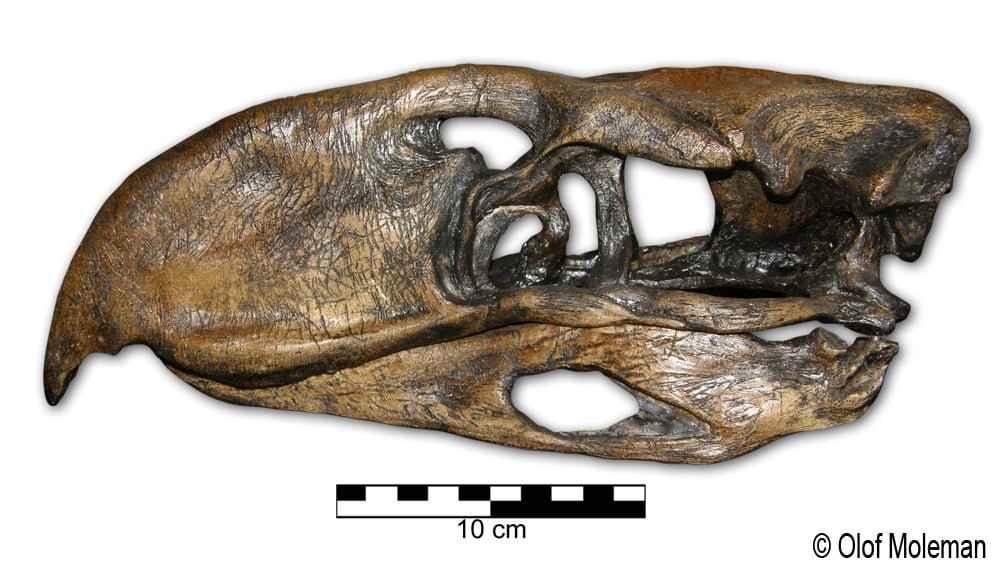
Phorusrhacos
Phorusrhacos longissimus
Image: Image sourced via web search (Fair use / Educational)
About Phorusrhacos
Phorusrhacos longissimus was a colossal, flightless predatory bird that roamed the plains of Miocene South America, representing one of the continent's apex predators long before the arrival of large placental carnivores. As a prominent member of the extinct family Phorusrhacidae, colloquially known as "terror birds," this formidable creature played a crucial role in its ecosystem, offering paleontologists a stunning example of avian adaptation to a top predatory niche. Flourishing between approximately 20 and 13 million years ago, its fossils provide invaluable insights into the unique evolutionary pathways that unfolded on the isolated island continent of South America during the Cenozoic Era.
Phorusrhacos was a truly imposing animal, standing as one of the largest members of its family. It reached an estimated height of around 2.5 meters (8.2 feet) and likely weighed between 130 to 150 kilograms (287 to 330 pounds), comparable in mass to a large ostrich or a small moa, but with a far more robust and predatory build. Its most defining feature was its massive skull, which could measure up to 65 centimeters (26 inches) in length. This skull was not merely large; it was a highly specialized killing tool, deep and narrow with a powerfully hooked beak, reminiscent of a modern eagle's but scaled up to terrifying proportions. The beak's sharp, decurved tip was ideal for piercing flesh, crushing bone, and dismembering prey. Its skeleton was a paradox of avian grace and brute force. While its neck vertebrae were strong and flexible, allowing for powerful, rapid strikes, its body was stocky and powerful. The wings were vestigial, reduced to small, stubby appendages that would have been useless for flight, possibly used for balance or display. In stark contrast, its legs were long, muscular, and built for speed, ending in three forward-facing toes armed with formidable, non-retractile talons. These legs were not just for locomotion; they were weapons capable of delivering powerful kicks to subdue struggling prey.
The paleobiology of Phorusrhacos paints a picture of a highly effective and terrifying predator. Its diet was strictly carnivorous, and its anatomy suggests a versatile hunting strategy. Biomechanical studies of its skull, conducted by researchers like Federico Degrange, indicate that while the skull was incredibly strong vertically for downward strikes, it was relatively weak against side-to-side forces. This suggests a hunting method involving a rapid, hatchet-like downward blow with its massive beak to stun or kill prey, followed by tearing and dismembering. It was likely an ambush predator, using its speed not for long-distance pursuit but for explosive bursts to close the distance on unsuspecting victims. Its prey would have included a variety of medium-sized native South American mammals, such as the sheep-like astrapotheres, litopterns, and large rodents. Some paleontologists propose it may have also been a kleptoparasite, using its intimidating size to steal kills from other predators like the saber-toothed marsupial Thylacosmilus. Its powerful legs, capable of propelling it at estimated speeds of up to 50 kilometers per hour (31 mph), made it one of the fastest terrestrial animals in its environment. There is little direct evidence for social behavior, but like many large predators, it may have been a solitary hunter, defending a large territory.
Phorusrhacos lived during the Miocene Epoch, a time when South America was an isolated island continent, fostering a unique and endemic fauna. The climate of Patagonia, where its fossils are found, was warmer and more humid than today, supporting vast grasslands, savannas, and open woodlands. This environment was populated by a diverse array of strange mammals that had evolved in isolation for millions of years. Phorusrhacos shared its habitat with creatures like the rhino-like Toxodon, the camel-like Macrauchenia, and giant ground sloths such as Megatherium's smaller ancestors. As an apex predator, Phorusrhacos sat at the top of the food web. Its primary competitors were other large carnivores, most notably the borhyaenids (marsupial-like predators) and the sebecid crocodylomorphs that stalked the waterways. The predator-prey dynamics were shaped by this unique assemblage of animals, with Phorusrhacos likely preying on the young or infirm individuals of larger herbivores and actively hunting the diverse mid-sized mammals that populated the plains. Its extinction, along with most other phorusrhacids, is thought to be linked to the climatic changes of the later Neogene and the eventual formation of the Isthmus of Panama, which allowed more advanced placental predators from North America to invade the continent during the Great American Biotic Interchange.
The discovery history of Phorusrhacos is intertwined with the early days of paleontology in Argentina. The genus was first described in 1887 by the pioneering Argentine paleontologist Florentino Ameghino. The initial discovery, made by his brother Carlos Ameghino in the Santa Cruz Formation of Patagonia, consisted of a fragment of a lower jaw. Mistaking its immense size and bird-like yet reptilian features, Florentino Ameghino initially identified it as the mandible of a giant, toothless edentate mammal. He named it Phorusrhacos longissimus, with the genus name's meaning being a subject of debate, possibly derived from Greek words meaning "rag-bearer" in reference to the wrinkled texture of the jawbone. It wasn't until 1891, after the discovery of more complete skeletal material, including skulls and leg bones, that its true identity as a gigantic predatory bird was recognized. This re-evaluation, championed by Ameghino himself as well as other paleontologists like Charles Depéret and Richard Lydekker, cemented the concept of the "terror birds" in the scientific consciousness. The holotype specimen, MACN-A 52-18, remains a cornerstone of phorusrhacid research, and subsequent finds throughout the 20th century have provided a much clearer picture of this remarkable animal's anatomy and lifestyle.
Phorusrhacos holds immense evolutionary significance as a prime example of convergent evolution and adaptive radiation. It belongs to the order Cariamae, whose only living relatives are the two species of seriemas found in South America today. These modern birds are much smaller, long-legged terrestrial predators, and they provide a living model for understanding the basic body plan and behaviors from which the giant terror birds evolved. The rise of the phorusrhacids demonstrates how, in the absence of large placental carnivores, an avian lineage can radiate to fill the niche of apex predator. They evolved features analogous to those of theropod dinosaurs, like Tyrannosaurus rex, with a massive head, reduced forelimbs, and powerful hindlimbs, showcasing how similar ecological pressures can lead to similar body forms in distantly related groups. The evolutionary history of Phorusrhacos and its kin is a testament to the ecological dominance birds could achieve on an isolated continent, representing a distinct and highly successful evolutionary experiment that lasted for nearly 60 million years before being ultimately outcompeted by the influx of North American predators.
Despite its iconic status, Phorusrhacos has been at the center of several scientific debates. For decades, the exact number of valid terror bird genera and species was a matter of intense taxonomic confusion, with many names being assigned to fragmentary remains. A major revision by paleontologist Herculano Alvarenga and his colleagues in the early 21st century helped to streamline the Phorusrhacidae family, clarifying the relationships between genera like Phorusrhacos, Kelenken, and Devincenzia. Another significant debate revolves around their hunting capabilities. While the "hatchet-strike" model is widely accepted, some researchers have argued for a more varied feeding strategy, including the possibility that the beak was used to pick up and violently shake smaller prey to death, similar to how modern seriemas dispatch lizards and snakes. The exact running speed and agility of these birds are also debated, with different biomechanical models producing varying estimates. Recent discoveries continue to refine our understanding; for instance, the well-preserved skull of a related genus, Kelenken, confirmed that these birds possessed some of the largest heads relative to body size of any known bird, reinforcing their status as hypercarnivores.
The fossil record of Phorusrhacos is primarily concentrated in the rich Miocene deposits of the Santa Cruz Formation in Patagonia, Argentina. This geological unit is famous for its exceptional preservation of a diverse terrestrial fauna from the period. While a complete, articulated skeleton of Phorusrhacos has yet to be found, numerous partial skeletons and isolated bones have been recovered, making it one of the better-known terror birds. The known material includes several skulls, mandibles, vertebrae, and numerous limb bones, which together provide a comprehensive view of its skeletal anatomy. The preservation quality is generally good, with bones often showing fine surface detail, which has been crucial for biomechanical and anatomical studies. Other phorusrhacid fossils have been found across South America, from Brazil to Uruguay, and even a single genus, Titanis, made it to North America, but the Santa Cruz Formation remains the key locality for understanding Phorusrhacos itself. The abundance of fossils from this region has allowed paleontologists to reconstruct not just the animal, but the entire ecosystem in which it thrived.
Phorusrhacos, and terror birds in general, have captured the public imagination and carved a significant niche in popular culture. Their intimidating appearance and role as top predators have made them popular subjects in television documentaries, including "Walking with Beasts" and "Prehistoric Predators," where they are often depicted as swift and brutal hunters. They have also appeared in video games and movies, frequently portrayed as formidable adversaries. Major natural history museums, such as the American Museum of Natural History in New York and the Field Museum in Chicago, often feature impressive skeletal mounts or life-sized reconstructions of Phorusrhacos or its relatives, showcasing the sheer scale and ferocity of these magnificent prehistoric birds. This cultural presence serves an important educational role, introducing the public to the fascinating and unique evolutionary history of South America's isolated past and highlighting the incredible diversity of life that has existed on Earth.
Classification
Time Period
Discovery
Location
Santa Cruz Province, Argentina
Formation
Santa Cruz Formation
Frequently Asked Questions
What is Phorusrhacos?
Phorusrhacos longissimus was a colossal, flightless predatory bird that roamed the plains of Miocene South America, representing one of the continent's apex predators long before the arrival of large placental carnivores. As a prominent member of the extinct family Phorusrhacidae, colloquially known...
When did Phorusrhacos live?
Phorusrhacos lived during the neogene period of the cenozoic era approximately 20-13 million years ago.
Where was Phorusrhacos discovered?
Fossils of Phorusrhacos were discovered in Santa Cruz Province, Argentina in the Santa Cruz Formation.
What did Phorusrhacos eat?
Phorusrhacos was a carnivore. It lived in terrestrial habitats.
What type of fossil is Phorusrhacos?
Phorusrhacos is preserved as a body fossil. The preservation quality is good.
Related Specimens
From the cenozoic era · body fossils