Olenoides
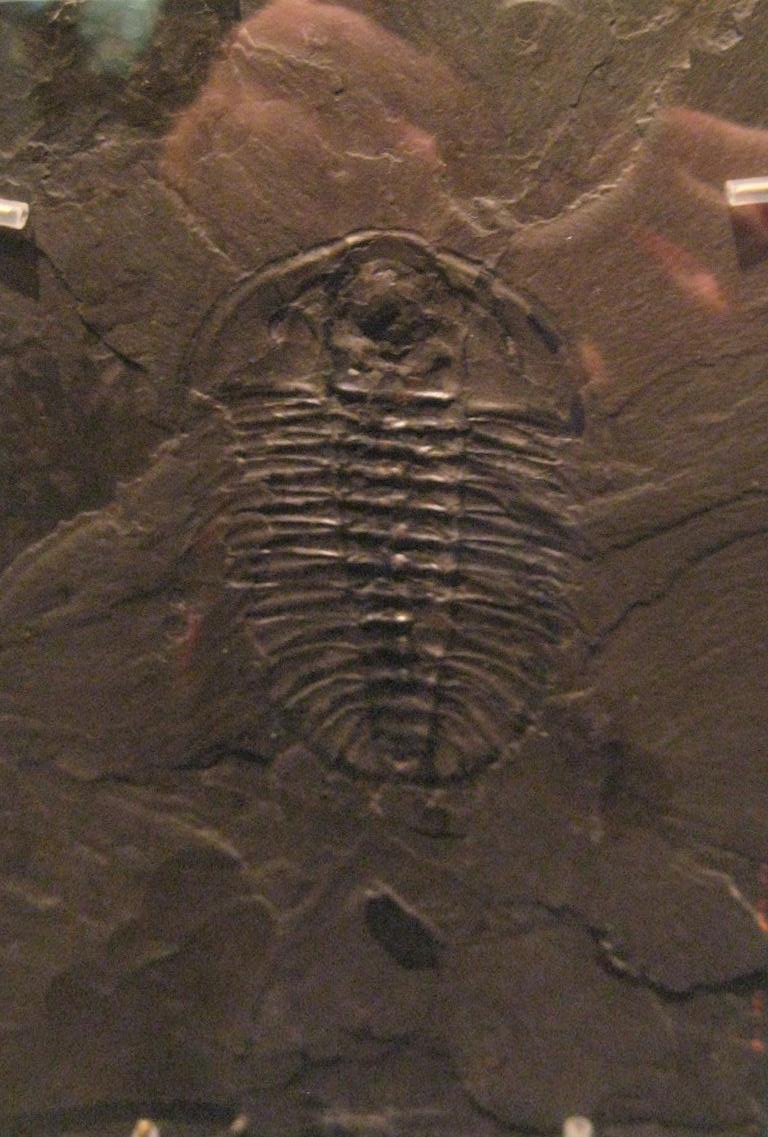
Olenoides serratus
Image: File:Olenoides serratus.jpg - Wikimedia Commons (CC BY-SA)
About Olenoides
Olenoides is a genus of extinct marine arthropod known as a trilobite, which flourished during the middle of the Cambrian Period, approximately 508 to 497 million years ago. Its fossils, particularly those of the species *Olenoides serratus*, are among the most iconic and scientifically invaluable specimens recovered from the Burgess Shale Lagerstätte in British Columbia, Canada. The exceptional preservation of its soft tissues, including limbs, gills, and antennae, has provided paleontologists with an unparalleled view into the anatomy and lifestyle of one of the Paleozoic Era's most successful animal groups, cementing its status as a key organism for understanding the Cambrian Explosion.
The physical anatomy of *Olenoides serratus* epitomizes the classic trilobite body plan, yet with distinctive and robust features. Adults typically reached lengths of 5 to 10 centimeters, making them a medium-sized inhabitant of the Cambrian seafloor. Their body was dorsoventrally flattened and divided longitudinally into three lobes: a prominent central axial lobe and two flanking pleural lobes, from which the name "trilobite" is derived. Transversely, the body consisted of a semicircular cephalon (head), a segmented thorax, and a fused tail shield known as the pygidium. The cephalon bore a pair of large, crescent-shaped compound eyes, providing a wide field of vision, and a single pair of long, flexible, multi-jointed antennae that projected forward, serving as primary sensory organs for touch and chemical detection. The thorax was composed of seven articulating segments, each equipped with a pair of formidable, backward-curving pleural spines. These sharp spines, along with the tough, mineralized calcite exoskeleton, likely functioned as a formidable defense against the apex predators of its time, such as the large arthropod *Anomalocaris*. The pygidium was relatively small and rounded, also fringed with spines, completing its well-armored dorsal profile.
The true marvel of *Olenoides* lies in its exceptionally preserved soft anatomy, which reveals the complex machinery hidden beneath its dorsal shield. Unlike the vast majority of trilobite fossils, which are mere mineralized carapaces, Burgess Shale specimens preserve the delicate, unmineralized appendages in stunning detail as carbon films. These fossils confirm that trilobites possessed biramous, or two-branched, limbs. Each thoracic segment, as well as the segments under the cephalon and pygidium, bore a pair of these limbs. The lower branch, the telopodite, was a sturdy, jointed walking leg used for locomotion across the muddy substrate. The inner base of each walking leg, known as a gnathobase, was lined with sharp, interlocking spines. When the legs moved in a coordinated, wave-like motion, these gnathobases would have formed a "food-processing" channel along the midline of the body, shredding and passing prey items forward towards the mouth, which was located on the underside of the cephalon. The upper branch of the limb, the exopodite, consisted of a shaft bearing a delicate fringe of fine filaments, forming a feathery gill. These gills were the primary respiratory structures, facilitating gas exchange with the surrounding seawater as the animal walked or swam. This intricate combination of walking legs, food-grinding gnathobases, and respiratory gills on a single limb structure showcases a remarkable example of multifunctional appendage evolution in early arthropods.
Paleobiological analysis, heavily informed by its preserved appendages, paints a clear picture of *Olenoides* as an active and predatory benthic organism. Its robust walking legs were well-suited for traversing the soft, silty seafloor of its deep-water marine habitat. The powerful, spiny gnathobases are direct evidence of a carnivorous or durophagous (shell-crushing) diet. It likely preyed upon smaller, soft-bodied or lightly shelled organisms such as worms, brachiopods, and other small arthropods that it encountered on or within the sediment. It would have used its long antennae to probe the environment, locating prey before grasping and shredding it with its leg spines. As an arthropod, *Olenoides* would have grown through a process of ecdysis, or molting, periodically shedding its exoskeleton to increase in size. Disarticulated fossil remains found in the Burgess Shale are often interpreted as discarded molts rather than carcasses, providing evidence of this fundamental aspect of its life cycle. The presence of numerous trace fossils, such as the trackways named *Cruziana* and resting burrows called *Rusophycus*, are widely attributed to trilobites like *Olenoides*, further confirming their mobile, bottom-dwelling lifestyle.
*Olenoides* lived in a unique ecological setting during the middle Cambrian, a time of rapid evolutionary innovation. The Burgess Shale fauna inhabited a deep-water marine environment on a continental slope adjacent to a massive submarine cliff, known as the Cathedral Escarpment. The seafloor was composed of fine mud and silt, and the community was periodically buried by submarine mudflows, which led to the exceptional preservation of its inhabitants. This ecosystem was remarkably diverse, and *Olenoides* was a key mid-level predator within its complex food web. It shared its habitat with a bizarre menagerie of animals, including the enigmatic *Hallucigenia*, the five-eyed *Opabinia*, and the formidable apex predator *Anomalocaris*, which likely preyed upon *Olenoides* despite its defensive spines. Other co-existing trilobites included *Elrathia* and *Ptychagnostus*. *Olenoides* would have competed for resources with other benthic predators and scavengers while hunting smaller invertebrates like the priapulid worm *Ottoia* and the brachiopod *Micromitra*. Its position in the food web highlights the establishment of complex predator-prey dynamics and ecological tiering shortly after the main burst of the Cambrian Explosion.
The discovery and study of *Olenoides* are inextricably linked to the work of American paleontologist Charles Doolittle Walcott. In 1909, while surveying the geology of the Canadian Rockies, Walcott discovered the Burgess Shale fossil bed on what is now known as Fossil Ridge. Among the thousands of fossils he excavated and shipped back to the Smithsonian Institution between 1910 and 1924, the specimens of *Olenoides serratus* were particularly spectacular. While the species had been scientifically described earlier in 1877 by Fielding Bradford Meek from more fragmentary remains found in Nevada, Walcott's specimens were revolutionary. For the first time, he could see the delicate antennae, legs, and gills that had been hypothesized but never before observed. Walcott meticulously prepared and studied these fossils, publishing a landmark monograph in 1918 that provided the first detailed illustrations and descriptions of trilobite soft-part anatomy. His work on *Olenoides* was a monumental contribution, confirming that trilobites were not simple, primitive creatures but highly complex arthropods, and his original specimens remain cornerstones of the paleontological collection at the National Museum of Natural History in Washington, D.C.
The evolutionary significance of *Olenoides* cannot be overstated. As a member of the Order Corynexochida, it represents a relatively early branch within the trilobite evolutionary tree. More importantly, its exquisitely preserved soft tissues provide a crucial "Rosetta Stone" for interpreting the biology of all other trilobites where only the dorsal exoskeleton is preserved. The confirmation of biramous limbs with gill-bearing exopodites in *Olenoides* provided a foundational model for trilobite physiology and locomotion that has been applied across the entire class. This anatomical blueprint firmly places trilobites within the phylum Arthropoda, showcasing key arthropod characteristics like a segmented body, jointed appendages, and a chitinous exoskeleton. It also provides a vital data point for understanding the ancestral condition of arthropod limbs. The biramous limb of *Olenoides* is considered a primitive state from which the more specialized uniramous (single-branched) limbs of insects and myriapods and the modified limbs of chelicerates later evolved. Thus, *Olenoides* serves as a key fossil taxon for calibrating molecular clocks and reconstructing the evolutionary relationships among the major arthropod subphyla, offering a tangible link to the deep ancestral nodes of this incredibly diverse and successful animal group.
Despite its status as a well-understood fossil, *Olenoides* has not been entirely free from scientific debate, primarily centered on the precise function of its appendages and its exact placement within trilobite phylogeny. Early interpretations by Walcott were later refined by the comprehensive re-examination of the Burgess Shale fauna beginning in the 1970s by paleontologists Harry Whittington, Derek Briggs, and Simon Conway Morris. Whittington's meticulous work, involving dissecting specimens and creating detailed models, confirmed the biramous limb structure and elucidated the coordinated leg movements required for both walking and feeding. Some debate continues regarding the flexibility and exact motion of the gill branches and the efficiency of the gnathobasic feeding system. Furthermore, the higher-level classification of trilobites is a field of ongoing research, and the precise relationship of the Order Corynexochida to other major trilobite orders is periodically revised as new fossil discoveries and cladistic analyses emerge. However, the fundamental anatomical interpretation of *Olenoides* itself has remained remarkably stable, a testament to the quality of the fossil evidence.
The fossil record of *Olenoides* is notable for its quality rather than its quantity or broad geographic distribution. The genus is primarily known from middle Cambrian deposits in North America, a region that constituted the paleocontinent of Laurentia. The most famous and scientifically important locality is the Burgess Shale in Yoho National Park, Canada, where hundreds of specimens of *Olenoides serratus*, many with soft-part preservation, have been collected. Other species of *Olenoides* and related genera have been found in Cambrian formations across the western United States, particularly in Utah and Nevada, such as the Wheeler Shale and Marjum Formation. However, it is the Burgess Shale specimens that are globally renowned for their taphonomic fidelity. The rapid burial in anoxic mud prevented both scavenging and microbial decay, allowing for the preservation of non-biomineralized tissues as flattened carbon films, a rare mode of fossilization known as "Burgess Shale-type preservation." This makes *Olenoides* one of the most completely known of all trilobites and a benchmark for arthropod paleontology.
Due to its exceptional preservation and scientific importance, *Olenoides* has achieved a significant cultural impact. It is a staple exhibit in major natural history museums around the world, including the Smithsonian National Museum of Natural History, the Royal Ontario Museum, and the Royal Tyrrell Museum of Palaeontology. Casts and original specimens of *Olenoides* are used to exemplify the classic trilobite form and to tell the story of the Cambrian Explosion. It is frequently featured in paleontological textbooks, documentaries, and popular science books, often serving as the primary example when explaining trilobite anatomy. Its detailed fossils provide an invaluable educational tool, offering a direct and tangible window into the biology of an animal that has been extinct for half a billion years, captivating both scientific and public audiences alike.
Classification
Time Period
Discovery
Location
British Columbia, Canada
Formation
Burgess Shale
Frequently Asked Questions
What is Olenoides?
Olenoides is a genus of extinct marine arthropod known as a trilobite, which flourished during the middle of the Cambrian Period, approximately 508 to 497 million years ago. Its fossils, particularly those of the species *Olenoides serratus*, are among the most iconic and scientifically invaluable s...
When did Olenoides live?
Olenoides lived during the cambrian period of the paleozoic era approximately 508-497 million years ago.
Where was Olenoides discovered?
Fossils of Olenoides were discovered in British Columbia, Canada in the Burgess Shale.
What did Olenoides eat?
Olenoides was a carnivore. It lived in marine habitats.
What type of fossil is Olenoides?
Olenoides is preserved as a body fossil. The preservation quality is exceptional.
Related Specimens
From the paleozoic era · body fossils