Pentremites
Pentremites godoni
Image: Image sourced via web search (Fair use / Educational)
About Pentremites
Pentremites godoni is an extinct species of blastoid, a class of stalked, marine echinoderms that thrived during the Paleozoic era. Living approximately 340 to 325 million years ago during the Mississippian subperiod of the Carboniferous, this organism inhabited the warm, shallow epicontinental seas that covered much of what is now the North American midcontinent. As one of the most abundant and recognizable index fossils of the Carboniferous period, Pentremites godoni holds immense significance in the field of paleontology. Its widespread distribution and rapid evolutionary radiation make it an invaluable tool for biostratigraphy, allowing geologists to accurately date and correlate Mississippian limestone deposits across vast geographical distances. The organism represents a highly successful, albeit ultimately doomed, evolutionary experiment in suspension feeding, providing crucial insights into the dynamics of ancient marine ecosystems and the evolutionary history of the echinoderm phylum before the devastating Permian-Triassic extinction event wiped the entire blastoid class from the face of the Earth.
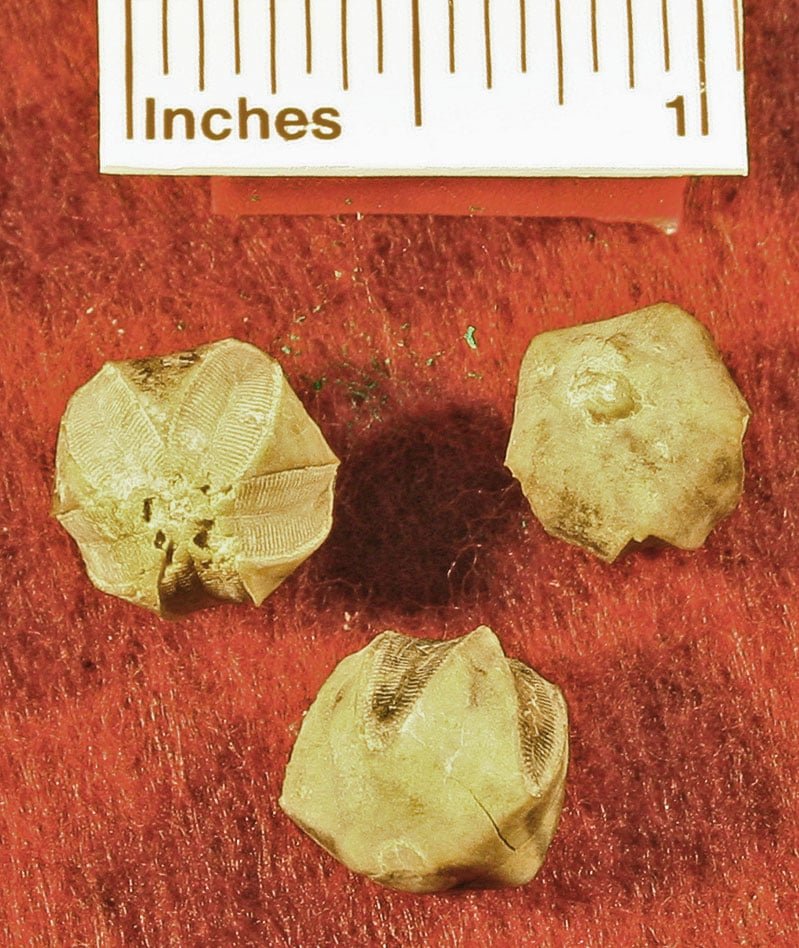
The physical anatomy of Pentremites godoni is characterized by its distinctively elegant, bud-like calyx, which typically measures between 1.5 and 3 centimeters in length, though some exceptional specimens may be slightly larger. This calyx, which housed the organism's vital organs, exhibits perfect pentameral (five-fold) symmetry, a hallmark of the echinoderm phylum. The main body is constructed from a rigid test of tightly interlocking calcareous plates, primarily the basals, radials, and deltoids. The most striking feature of the calyx is the presence of five deeply incised, petal-shaped ambulacral areas that radiate downward from the summit of the organism. In life, these ambulacra were lined with hundreds of tiny, hair-like appendages called brachioles, which formed a dense filtration fan used to capture microscopic food particles from the water column. Unlike the flexible arms of their crinoid cousins, the brachioles of Pentremites were relatively rigid and are rarely preserved in the fossil record due to their fragile nature. At the apex of the calyx sits the mouth, surrounded by five spiracles—openings that served as exhaust vents for the organism's unique hydrospire respiratory system. The entire calyx was elevated above the seafloor on a flexible stalk, or column, composed of stacked, circular ossicles called columnals, anchoring the animal to the substrate via a root-like holdfast. When compared to modern marine animals, Pentremites most closely resembled a small, rigid sea lily, though its compact, nut-like body was far more robust and less feathery than extant stalked crinoids.
In terms of paleobiology, Pentremites godoni was an obligate benthic suspension feeder, relying entirely on ambient ocean currents to deliver its microscopic prey. Its diet consisted primarily of plankton, organic detritus, and suspended microscopic organisms. The feeding strategy of Pentremites was highly specialized; the dense array of brachioles extending from the ambulacra acted as a biological sieve. Microscopic cilia lining the brachioles and ambulacral grooves created localized micro-currents, sweeping captured food particles down the grooves and upward toward the central mouth at the summit of the calyx. Because the organism was permanently tethered to the seafloor by its stalk, it lacked any capacity for active locomotion. Consequently, its survival was entirely dependent on selecting an optimal settlement site during its brief, free-swimming larval stage. Socially, Pentremites godoni was a gregarious organism, often forming dense, meadow-like aggregations on the seafloor, a behavior inferred from the massive accumulations of their fossils in specific limestone beds. This clustering likely enhanced reproductive success through synchronized broadcast spawning, a strategy common among modern echinoderms. Growth occurred through the continuous accretion of calcium carbonate along the margins of the calyx plates, allowing the organism to expand its internal volume while maintaining its rigid structural integrity. Metabolic rates are estimated to have been relatively low, consistent with a passive, sessile lifestyle in warm, nutrient-rich waters.
The ecological context of the Mississippian period provided an ideal environment for Pentremites godoni to flourish. During this time, the global climate was generally warm and tropical, and massive shallow epicontinental seas flooded the interior of the North American craton. These clear, sunlit waters were teeming with life, creating complex, multi-tiered benthic ecosystems often referred to as 'crinoid meadows' or 'pelmatozoan forests.' Pentremites godoni shared its habitat with a dazzling array of marine invertebrates, including fenestrate bryozoans, rugose and tabulate corals, articulate brachiopods, and an overwhelming diversity of crinoids. In this bustling food web, Pentremites occupied the role of a primary consumer of microplankton. Despite its rigid, calcareous armor, it was not immune to predation. The Carboniferous period saw a significant diversification of shell-crushing predators, including early holocephalian and elasmobranch sharks, such as the bradyodonts, whose specialized pavement-like teeth were perfectly adapted for crushing the hard tests of echinoderms. Additionally, fossil evidence suggests that Pentremites was frequently targeted by parasitic or predatory platyceratid gastropods, which would drill into the calyx to access the soft tissues within. The dense aggregations of Pentremites also provided microhabitats for smaller organisms, contributing to the overall structural complexity and biodiversity of the Mississippian reef-like communities.
The discovery history of Pentremites is deeply intertwined with the early development of paleontology and geology in North America. The genus was first formally described by the French naturalist Jacques-Louis de Bournon in the early 19th century, but it was the pioneering work of American geologists that brought the abundance of these fossils to light. Pentremites godoni, specifically, was named by Defrance in 1819, honoring the early collector Godon. Throughout the 1800s, as westward expansion and geological surveys mapped the interior of the United States, massive deposits of Pentremites were discovered in the limestone formations of the Illinois Basin, particularly in states like Illinois, Indiana, Kentucky, and Missouri. The fossils were so perfectly preserved and abundant that they were frequently collected by early settlers and Native Americans long before formal scientific classification. In the mid-19th century, prominent paleontologists such as David Dale Owen and later Charles Wachsmuth and Frank Springer conducted exhaustive studies on the blastoids of the American Midwest. The Glen Dean Formation and the broader Chesterian series became world-renowned for yielding thousands of perfectly preserved Pentremites calyces. These specimens became foundational to the study of echinoderm morphology, filling the cabinets of major natural history museums across the globe and establishing the North American midcontinent as the premier location for blastoid research.
From an evolutionary standpoint, Pentremites godoni is a crucial representative of the extinct class Blastoidea, a distinct lineage within the subphylum Pelmatozoa. Blastoids first appeared in the Ordovician period, but they remained a relatively minor component of marine ecosystems until the Carboniferous, when they experienced a massive evolutionary radiation, largely dominated by the genus Pentremites. The evolutionary significance of Pentremites lies in its highly specialized respiratory and feeding structures. The development of hydrospires—complex, folded internal structures used for gas exchange—represents a unique evolutionary innovation not seen in other echinoderm classes. By studying Pentremites, paleontologists can trace the divergent evolutionary paths taken by early echinoderms as they adapted to different ecological niches. While blastoids share a common ancestor with crinoids (sea lilies), they represent a distinct evolutionary branch that prioritized a rigid, compact body plan over the flexible, multi-armed morphology of their relatives. Unfortunately, the highly specialized nature of blastoids may have contributed to their ultimate downfall. They survived the minor extinction events of the Paleozoic but were completely eradicated during the catastrophic Permian-Triassic extinction event 252 million years ago. Today, they have no direct living descendants, making them a fascinating subject of study as a completely extinct branch of the echinoderm tree of life.
Scientific debates surrounding Pentremites godoni have primarily focused on the functional morphology of its unique anatomical features and its precise phylogenetic placement. For decades, paleontologists debated the exact hydrodynamics of the blastoid feeding mechanism. Some researchers argued that the brachioles functioned passively, relying entirely on ambient currents, while others proposed that the organism could actively manipulate its appendages to generate feeding currents. Advanced computational fluid dynamics modeling has recently provided evidence supporting a combination of both passive and active micro-current generation. Another ongoing controversy involves the exact function and efficiency of the hydrospires. While generally accepted as respiratory organs, some scientists have suggested they may have also played a role in reproduction or waste excretion. Taxonomically, the relationship between blastoids, crinoids, and the extinct cystoids remains a subject of cladistic debate. While traditionally grouped together as pelmatozoans, modern phylogenetic analyses using high-resolution micro-CT scanning of internal structures occasionally challenge these established relationships, suggesting that the evolutionary tree of early stalked echinoderms is far more complex and reticulated than previously understood.
The fossil record of Pentremites godoni is exceptionally rich, making it one of the most thoroughly studied invertebrate fossils in the world. Geographically, the vast majority of specimens are recovered from the Mississippian-aged limestone deposits of the United States, particularly the Illinois Basin. Tens of thousands of individual specimens have been collected, ranging from juvenile to fully mature adults. The preservation quality is typically excellent, owing to the robust nature of the solid calcite plates that make up the calyx. In many cases, the intricate details of the ambulacral grooves, spiracles, and plate sutures are preserved with microscopic fidelity. However, because the organism disarticulated rapidly after death, the delicate brachioles and the long, multi-segmented stalks are rarely found attached to the calyx. Complete specimens preserving the calyx, brachioles, and stalk intact are considered highly prized rarities. Famous fossil sites, such as the roadcuts and quarries in the vicinity of Floraville, Illinois, and the classic exposures of the Paint Creek and Glen Dean formations, continue to yield abundant material for both amateur collectors and professional paleontologists.
In terms of cultural impact, Pentremites godoni holds a special place in the world of amateur fossil collecting and public education. Due to their abundance, aesthetic appeal, and perfect symmetry, these 'fossil buds' or 'hickory nuts' are highly sought after by rockhounds and are a staple in introductory paleontology teaching kits. They frequently appear in museum dioramas depicting ancient Paleozoic seas, helping to visualize the alien landscapes of the Carboniferous period. The sheer volume of Pentremites fossils found in the American Midwest has cemented their status as a regional icon of natural history, sparking public fascination with deep time and serving as an accessible gateway for young students to engage with the earth sciences and the wonders of the prehistoric world.
Classification
Time Period
Discovery
Location
United States
Formation
Glen Dean Formation
Frequently Asked Questions
What is Pentremites?
Pentremites godoni is an extinct species of blastoid, a class of stalked, marine echinoderms that thrived during the Paleozoic era. Living approximately 340 to 325 million years ago during the Mississippian subperiod of the Carboniferous, this organism inhabited the warm, shallow epicontinental seas...
When did Pentremites live?
Pentremites lived during the carboniferous period of the paleozoic era approximately 340-325 million years ago.
Where was Pentremites discovered?
Fossils of Pentremites were discovered in United States in the Glen Dean Formation.
What did Pentremites eat?
Pentremites was a filter-feeder. It lived in marine habitats.
What type of fossil is Pentremites?
Pentremites is preserved as a body fossil. The preservation quality is excellent.
Related Specimens
From the paleozoic era · body fossils