Otodus
Otodus obliquus
Image: Image sourced via web search (Fair use / Educational)
About Otodus
Otodus obliquus was a formidable and massive extinct mackerel shark that prowled the world's oceans during the Paleocene and Eocene epochs, approximately 60 to 45 million years ago. As an apex predator of the early Cenozoic era, this cartilaginous giant played a critical role in shaping the marine ecosystems that recovered and flourished following the Cretaceous-Paleogene extinction event. Its widespread fossil distribution indicates a cosmopolitan range, thriving in the warm, shallow seas that characterized the global climate of the time. In the realm of paleontology, Otodus obliquus holds immense significance as the foundational member of the megatooth shark lineage, an evolutionary dynasty that would eventually culminate in the legendary Megalodon millions of years later. By studying Otodus, scientists gain crucial insights into the evolutionary trajectory of apex marine predators and the shifting dynamics of prehistoric oceans.
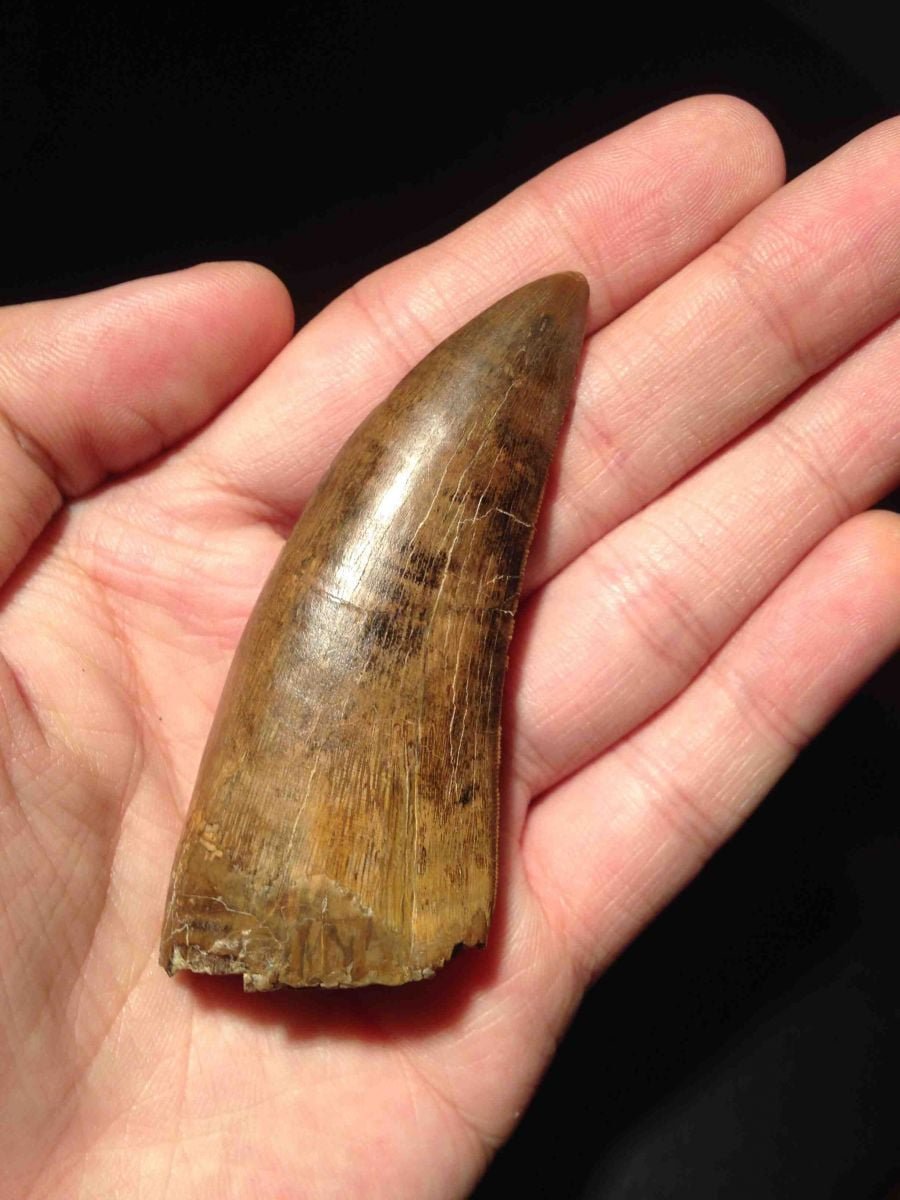
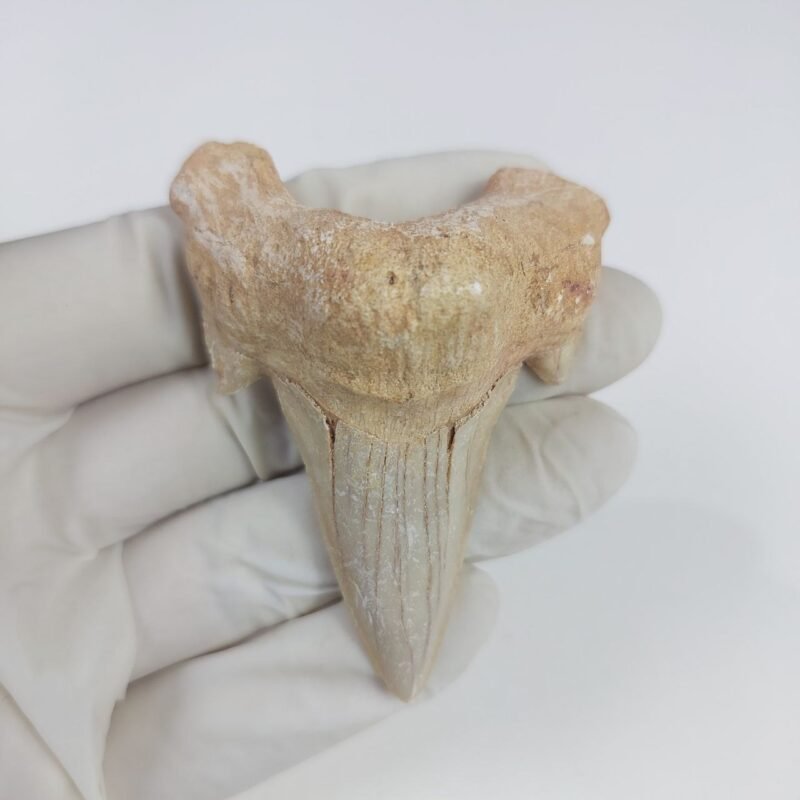
In terms of physical description, Otodus obliquus was a true leviathan of its time, dwarfing the vast majority of contemporary marine life. While exact measurements are difficult to ascertain due to the cartilaginous nature of shark skeletons, which rarely fossilize, paleontologists estimate that adult individuals could reach lengths of 9 to 10 meters (approximately 30 to 33 feet). This makes it significantly larger than the modern Great White Shark, which typically maxes out around 6 meters. Weight estimates suggest a robust, heavy-bodied animal weighing several tons, built for power rather than sustained, long-distance cruising. The most distinctive features of Otodus obliquus are its massive teeth. Unlike the serrated teeth of its later descendants, the teeth of O. obliquus possess smooth cutting edges, a broad, triangular central cusp, and prominent lateral cusplets flanking the main blade. These teeth, which can measure up to 10 centimeters (4 inches) in slant height, were deeply rooted in powerful jaws, designed to grasp and tear large prey. Inferences about its soft tissue, drawn from modern lamniform sharks, suggest a streamlined, torpedo-shaped body, a prominent dorsal fin, and a crescent-shaped caudal fin that provided explosive bursts of speed necessary for ambushing agile prey.
Paleobiological studies paint a picture of Otodus obliquus as a highly active, warm-blooded (regional endothermic) predator with a voracious appetite. Its diet was predominantly carnivorous, targeting a wide array of marine organisms. Given its size and dentition, it likely preyed upon large bony fish, early marine mammals such as primitive sirenians and early cetaceans, sea turtles, and other, smaller species of sharks. The smooth edges of its teeth, combined with the lateral cusplets, suggest a hunting strategy focused on grasping slippery prey and swallowing it whole or tearing off massive chunks through violent thrashing motions, rather than the precise slicing seen in later serrated-toothed sharks. Locomotion would have been characterized by powerful, sweeping movements of its tail, allowing it to patrol coastal waters and open pelagic zones alike. Socially, like most modern large sharks, Otodus was likely a solitary hunter, coming together with others of its kind only for mating or when drawn to a particularly abundant food source, such as a whale carcass. Growth patterns inferred from the rare fossilized vertebral centra indicate a rapid initial growth phase, allowing juveniles to quickly reach a size where they were safe from most other predators, followed by a slower, sustained growth throughout their adult lives. Its metabolic rate was likely high, necessitated by its large size and active predatory lifestyle, requiring a constant and abundant food supply.
The ecological context in which Otodus obliquus thrived was a world undergoing profound transformation. Following the demise of the large marine reptiles like mosasaurs and plesiosaurs at the end of the Cretaceous, the oceans were left with vacant apex predator niches. Otodus rapidly evolved to fill this void. The Paleogene period was characterized by a greenhouse climate, with global temperatures significantly higher than today, resulting in high sea levels and extensive shallow epicontinental seas. These warm, nutrient-rich waters supported a burgeoning diversity of marine life. Otodus shared its habitat with a variety of emerging groups, including early penguins, giant marine turtles, and the ancestors of modern whales and dolphins. As the undisputed apex predator of its time, Otodus sat firmly at the top of the food web. Its predatory pressure likely exerted a strong evolutionary influence on its prey, driving the development of larger body sizes, faster swimming speeds, and more complex social behaviors in early marine mammals as they sought to evade this formidable hunter. The relationship between Otodus and the early cetaceans is of particular interest, as it represents the beginning of an evolutionary arms race between megatooth sharks and whales that would span tens of millions of years.
The discovery history of Otodus obliquus is deeply intertwined with the early days of paleontology. The species was first formally described by the eminent Swiss-American naturalist Louis Agassiz in 1843, in his monumental work 'Recherches sur les poissons fossiles' (Research on Fossil Fishes). Agassiz based his description on fossilized teeth discovered in the London Clay Formation of the United Kingdom, a geological deposit dating back to the early Eocene. The name 'Otodus' translates to 'ear-shaped tooth,' referring to the prominent lateral cusplets that resemble small ears flanking the main cusp, while 'obliquus' refers to the slanted or oblique angle of the teeth in the jaw. Since Agassiz's initial description, remains of Otodus obliquus have been found on every continent except Antarctica. However, the most spectacular and abundant discoveries have been made in the vast phosphate mining basins of Morocco, particularly the Ouled Abdoun Basin. Here, commercial mining operations have unearthed millions of Otodus teeth, along with rare articulated dentitions and vertebral columns, providing an unprecedented wealth of material for scientific study. These Moroccan deposits have transformed our understanding of the species, offering a detailed look at population dynamics, individual variation, and ontogenetic (growth-related) changes in tooth morphology.
The evolutionary significance of Otodus obliquus cannot be overstated. It is widely recognized by paleontologists as the basal ancestor of the Otodontidae family, commonly known as the megatooth sharks. This lineage represents one of the most successful and spectacular radiations of marine predators in Earth's history. By studying the fossil record, scientists can trace a direct evolutionary lineage from the smooth-edged, cusplet-bearing teeth of Otodus obliquus, through transitional forms like Otodus auriculatus and Otodus angustidens, which gradually developed serrations and lost their cusplets, culminating in the massive, finely serrated teeth of Otodus megalodon. This evolutionary sequence provides a textbook example of directional selection, where environmental pressures and shifting prey availability drove the development of increasingly specialized dentition for hunting large marine mammals. Furthermore, the transition from Otodus to its descendants highlights the dynamic nature of marine ecosystems and the constant adaptation required to maintain apex predator status over millions of years. While the megatooth lineage ultimately went extinct, studying Otodus helps scientists understand the complex interplay of climate change, oceanic circulation, and food web dynamics that dictate the rise and fall of marine giants.
Despite its extensive fossil record, Otodus obliquus remains the subject of ongoing scientific debates and taxonomic revisions. One of the most significant controversies in recent years revolves around the generic assignment of the entire megatooth lineage. Historically, later megatooth sharks like Megalodon were placed in the genus Carcharodon, implying a close relationship with the modern Great White Shark. However, modern consensus, driven by detailed morphological analyses of teeth like those of Otodus obliquus, has shifted towards placing the entire lineage within the genus Otodus (e.g., Otodus megalodon). This reflects the understanding that the megatooth sharks represent a distinct, extinct family (Otodontidae) that evolved independently from the Great White Shark lineage. Debates also continue regarding the exact mechanisms of their hunting behavior, the extent of their endothermy, and the precise environmental factors that drove the evolutionary transition from smooth to serrated teeth. As new, more complete specimens are occasionally discovered, particularly those preserving cartilaginous elements, these debates are continually refined, highlighting the ever-evolving nature of paleontological science.
The fossil record of Otodus obliquus is both remarkably abundant and frustratingly incomplete. Because shark skeletons are composed primarily of cartilage, which decomposes rapidly after death, body fossils are exceedingly rare. Consequently, the vast majority of our knowledge about Otodus comes from its teeth, which are highly mineralized and fossilize readily. Sharks continuously shed and replace their teeth throughout their lives, meaning a single Otodus individual could produce thousands of fossilizable teeth. These teeth are found in near-shore marine deposits worldwide, with notable concentrations in the Paleogene sediments of North America (such as the Aquia Formation in Maryland), Europe, Asia, and Africa. The preservation quality of these teeth is often excellent, retaining sharp edges and detailed enamel structures. In exceptionally rare cases, such as in the anoxic phosphate beds of Morocco, associated dentitions (multiple teeth from a single individual) and calcified vertebral centra have been recovered. These rare finds are scientifically invaluable, allowing researchers to reconstruct the jaw architecture, estimate body size more accurately, and study the growth rings preserved within the vertebrae.
Culturally, Otodus obliquus has made a significant impact, primarily through the commercial fossil trade. Due to the sheer abundance of their teeth in locations like Morocco, Otodus teeth are among the most commonly sold vertebrate fossils in the world. They are a staple in rock shops, museum gift stores, and online marketplaces, making them highly accessible to the general public. For many amateur collectors and children, an Otodus tooth is their first tangible connection to the prehistoric world, sparking a lifelong fascination with paleontology and Earth's history. While not as famous in Hollywood as its descendant Megalodon, Otodus frequently appears in educational documentaries and museum exhibits detailing the evolution of sharks. Notable displays of Otodus fossils, particularly the rare associated dentitions and reconstructed jaws, can be found in major natural history museums globally, serving as powerful educational tools to illustrate the massive scale and evolutionary success of these ancient marine predators.
Classification
Time Period
Discovery
Location
United Kingdom and Morocco
Formation
London Clay Formation and Ouled Abdoun Basin
Frequently Asked Questions
What is Otodus?
Otodus obliquus was a formidable and massive extinct mackerel shark that prowled the world's oceans during the Paleocene and Eocene epochs, approximately 60 to 45 million years ago. As an apex predator of the early Cenozoic era, this cartilaginous giant played a critical role in shaping the marine e...
When did Otodus live?
Otodus lived during the paleogene period of the cenozoic era approximately 60-45 million years ago.
Where was Otodus discovered?
Fossils of Otodus were discovered in United Kingdom and Morocco in the London Clay Formation and Ouled Abdoun Basin.
What did Otodus eat?
Otodus was a carnivore. It lived in marine habitats.
What type of fossil is Otodus?
Otodus is preserved as a body fossil. The preservation quality is good.
Related Specimens
From the cenozoic era · body fossils