Elrathia
Elrathia kingii
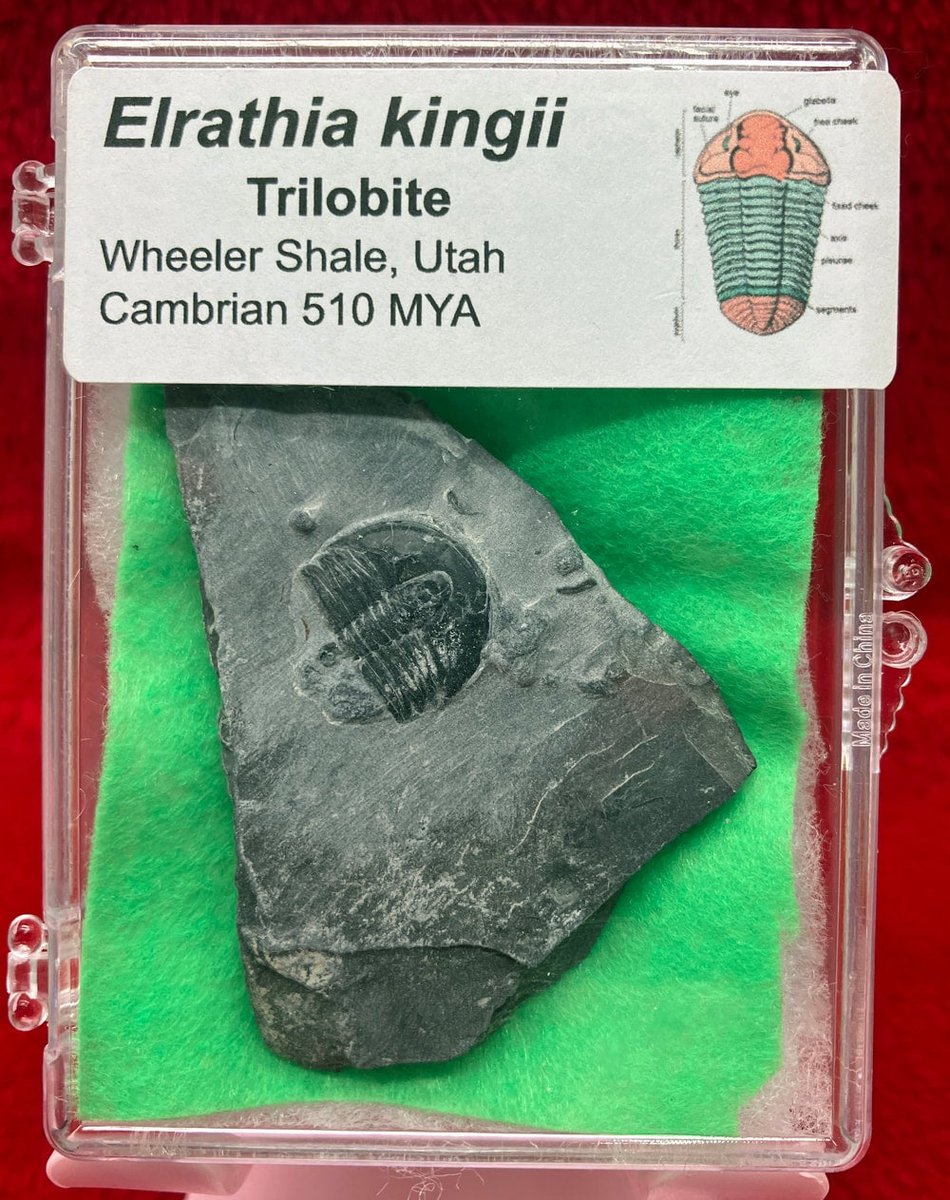
Image: Image sourced via web search (Fair use / Educational)
About Elrathia
Elrathia kingii is one of the most recognizable and abundant trilobite species in the global fossil record, representing a quintessential marine arthropod of the Middle Cambrian period. Thriving approximately 507 to 504 million years ago, this organism inhabited the warm, shallow seas that covered much of the ancient paleocontinent of Laurentia, specifically in what is now the Great Basin region of the western United States. As a member of the order Ptychopariida, Elrathia kingii serves as a standard reference point for trilobite morphology and Cambrian paleoecology. Its extraordinary abundance in the fossil record has made it a cornerstone species for biostratigraphic dating and a vital subject for understanding the dynamics of early marine ecosystems following the Cambrian Explosion. The sheer volume of perfectly preserved specimens has allowed paleontologists to study its ontogeny, population dynamics, and environmental preferences with a level of detail rarely achievable for organisms of such immense antiquity.
In terms of physical description, Elrathia kingii exhibits the classic, tripartite body plan that defines the Trilobita class, consisting of a distinct cephalon (head), a segmented thorax, and a pygidium (tail piece). Adult specimens typically range from 2 to 5 centimeters in length, though some exceptional individuals can reach slightly larger proportions. The cephalon is semi-circular and features a relatively smooth, moderately convex glabella that tapers slightly toward the front, flanked by distinct but modest eye ridges leading to small, crescentic holochroal eyes. These eyes, composed of tightly packed calcite lenses, provided the animal with a wide field of vision to detect movement in the dimly lit benthic environment. The thorax is composed of exactly 13 articulating segments in fully mature individuals, providing the animal with a high degree of flexibility that likely allowed it to roll up defensively, much like modern pillbugs or woodlice, though fully enrolled specimens of Elrathia are relatively uncommon. The pygidium is comparatively small (micropygous) and semi-circular, with a distinct axis and pleural fields. In life, beneath the dorsal exoskeleton, Elrathia possessed a series of biramous (two-branched) appendages. The inner branch served as a walking leg, while the outer branch consisted of feathery gills used for respiration and possibly filter-feeding. The exoskeleton itself was heavily calcified, which contributed significantly to its high preservation potential. Compared to modern marine arthropods like horseshoe crabs or deep-sea isopods, Elrathia was relatively small and lightweight, likely weighing only a few grams, but its armored dorsal shield provided crucial protection in a world where the first complex predators were beginning to evolve.
The paleobiology of Elrathia kingii reveals a highly specialized organism adapted to a specific ecological niche on the Cambrian seafloor. It is widely interpreted as a benthic (bottom-dwelling) detritivore or scavenger, feeding on organic matter, bacterial mats, and the remains of other organisms that drifted down from the water column above. Its biramous appendages were perfectly suited for scuttling across the soft, muddy substrate, while the specialized gnathobases (spiny bases of the legs) near its mouth were used to shred and process food particles before ingestion. One of the most fascinating aspects of Elrathia's biology is its apparent adaptation to dysoxic (low oxygen) environments. Research indicates that Elrathia kingii frequently inhabited the exaerobic zone—a boundary layer on the seafloor where oxygen levels were too low to support most other benthic organisms, but just high enough to sustain specialized life. This adaptation likely provided Elrathia with a refuge from predators and reduced competition for food resources. Like all arthropods, Elrathia grew by molting its rigid exoskeleton, a process known as ecdysis. The fossil record is replete with the discarded exuviae (molts) of Elrathia, often recognizable by the missing free cheeks (librigenae) of the cephalon, which split away to allow the soft-bodied animal to emerge. Analysis of thousands of specimens has allowed scientists to map its growth stages (ontogeny) from tiny, millimeter-sized protaspides to fully grown holaspides, revealing a relatively slow and steady growth rate characteristic of organisms living in stable, low-energy environments with limited metabolic resources.
The ecological context of the Middle Cambrian world in which Elrathia lived was vastly different from modern marine ecosystems, yet it laid the foundational architecture for all subsequent marine life. During this time, the landmass that would become North America (Laurentia) was situated near the equator, covered by a vast, shallow epicontinental sea. The climate was generally warm and equitable, with no polar ice caps. The Wheeler Shale and Marjum Formation environments were characterized by a muddy, soft-bottomed seafloor situated below the storm wave base, resulting in a quiet, low-energy habitat. Elrathia shared this environment with a diverse array of early marine life. Co-existing species included other trilobites such as Asaphiscus wheeleri, Bolaspidella, and the tiny, eyeless agnostid Peronopsis. The ecosystem also supported various sponges, primitive brachiopods, echinoderms, and early mollusks. In the water column above, formidable predators of the Cambrian seas, such as the anomalocaridids, patrolled for prey. While Elrathia's low-oxygen benthic habitat offered some protection, it was still part of a complex food web. It functioned as a primary consumer of detritus and bacterial mats, recycling nutrients back into the ecosystem, and in turn, likely served as prey for larger benthic predators or opportunistic scavengers when it ventured into more oxygenated waters or when its habitat was disturbed by underwater currents.
The discovery history of Elrathia kingii is deeply intertwined with the early exploration of the American West and the development of paleontology as a formal science in the United States. The species was first described by the eminent American paleontologist Fielding Bradford Meek in 1870, based on specimens collected during the geological surveys of the western territories. Meek originally assigned the organism to the genus Conocoryphe, naming it Conocoryphe kingii in honor of Clarence King, the influential geologist and first director of the United States Geological Survey, who led the Fortieth Parallel Survey during which the fossils were discovered. It was not until 1924 that the legendary paleontologist Charles Doolittle Walcott, famous for his discovery of the Burgess Shale, reassigned the species to the new genus Elrathia. The most significant fossil sites for Elrathia are located in the House Range and the Drum Mountains of Millard County, Utah. Here, the Wheeler Shale outcrops extensively, revealing layers of rock packed with millions of these trilobites. Over the decades, these sites have been extensively quarried, both by academic institutions for scientific study and by commercial collectors. The sheer abundance of Elrathia in these specific geographic locations has made it one of the most thoroughly collected and studied fossil organisms in history, providing a continuous stream of data for paleontologists investigating Cambrian life.
The evolutionary significance of Elrathia kingii lies in its position as a representative of the Ptychopariida, a massive and highly diverse order of trilobites that dominated the Cambrian and Ordovician periods. Ptychopariids are often considered the generalized, basal stock from which many other, more specialized trilobite orders evolved. Elrathia's unspecialized morphology—its simple glabella, standard number of thoracic segments, and modest pygidium—provides a baseline for understanding the evolutionary innovations that occurred in other trilobite lineages, such as the development of complex enrollment mechanisms, extreme spinosity, or specialized visual systems. By studying Elrathia, scientists can better understand the ancestral traits of the Trilobita class and the evolutionary radiation that occurred during the Cambrian Explosion. Furthermore, the extinction of the ptychopariids at the end of the Ordovician period marks a significant shift in marine ecosystems, and understanding the ecology of successful species like Elrathia helps paleontologists decipher the causes and consequences of these ancient mass extinction events. Although trilobites left no direct modern descendants, having gone entirely extinct at the end of the Permian period, their evolutionary history, as exemplified by Elrathia, offers profound insights into the mechanics of arthropod evolution, adaptation, and survival over hundreds of millions of years.
Despite its status as a well-known and extensively studied organism, Elrathia kingii remains the subject of ongoing scientific debates and research. One of the primary areas of contention involves its exact phylogenetic placement within the complex and often messy taxonomy of the order Ptychopariida. The family Alokistocaridae, to which Elrathia belongs, is considered by some paleontologists to be a 'wastebasket taxon'—a grouping of convenience for similar-looking trilobites that may not actually share a close evolutionary relationship. Modern cladistic analyses continually attempt to resolve these relationships, sometimes leading to proposals for reclassification. Another significant debate centers on the 'exaerobic zone' hypothesis proposed by researchers like Robert Gaines and Mary Droser. While many accept that Elrathia was specially adapted to thrive in dysoxic, sulfide-rich environments where other organisms perished, some scientists argue that the fossil accumulations represent mass mortality events caused by sudden influxes of anoxic water, rather than a preferred habitat. Resolving whether Elrathia lived its entire life in these extreme conditions or simply died there in massive numbers remains an active area of geochemical and taphonomic research.
The fossil record of Elrathia kingii is nothing short of spectacular, both in terms of quantity and quality of preservation. The primary geographic source for these fossils is the Middle Cambrian Wheeler Shale and the overlying Marjum Formation in western Utah. It is estimated that millions of Elrathia specimens have been collected from these formations. The preservation quality is frequently exceptional; while many trilobites are found only as disarticulated fragments, Elrathia is routinely found as complete, fully articulated dorsal shields. This is largely due to the quiet, low-energy depositional environment of the Wheeler Shale, which buried the organisms rapidly in fine mud without disturbing their remains. The fossils are typically preserved as dark, calcitic replacements against the lighter gray or buff-colored shale, providing striking visual contrast. In some specific layers, the fossils have undergone pyritization, where the original shell material has been replaced by iron sulfide (fool's gold), creating spectacular, metallic-looking specimens. The abundance and complete preservation of Elrathia make it a vital index fossil for correlating Middle Cambrian rock layers across North America.
The cultural impact of Elrathia kingii extends far beyond the realm of academic paleontology; it is arguably the most famous and widely recognized trilobite among the general public. Because of its immense abundance in the Wheeler Shale, Elrathia is commercially quarried on a large scale and is the standard trilobite found in rock shops, museum gift stores, and educational kits worldwide. It is frequently used in jewelry, embedded in belt buckles, or sold as inexpensive educational specimens for children, sparking an interest in paleontology for countless individuals. Major natural history museums across the globe feature Elrathia in their Cambrian dioramas and fossil displays. While the Allosaurus is the official state fossil of Utah, Elrathia is deeply embedded in the state's cultural and economic identity, drawing amateur rockhounds and professional collectors to the high deserts of the Great Basin year after year.
Classification
Time Period
Discovery
Location
Utah, USA
Formation
Wheeler Shale
Frequently Asked Questions
What is Elrathia?
Elrathia kingii is one of the most recognizable and abundant trilobite species in the global fossil record, representing a quintessential marine arthropod of the Middle Cambrian period. Thriving approximately 507 to 504 million years ago, this organism inhabited the warm, shallow seas that covered m...
When did Elrathia live?
Elrathia lived during the cambrian period of the paleozoic era approximately 507-504 million years ago.
Where was Elrathia discovered?
Fossils of Elrathia were discovered in Utah, USA in the Wheeler Shale.
What did Elrathia eat?
Elrathia was a detritivore. It lived in marine habitats.
What type of fossil is Elrathia?
Elrathia is preserved as a body fossil. The preservation quality is exceptional.
Related Specimens
From the paleozoic era · body fossils