Synthetoceras
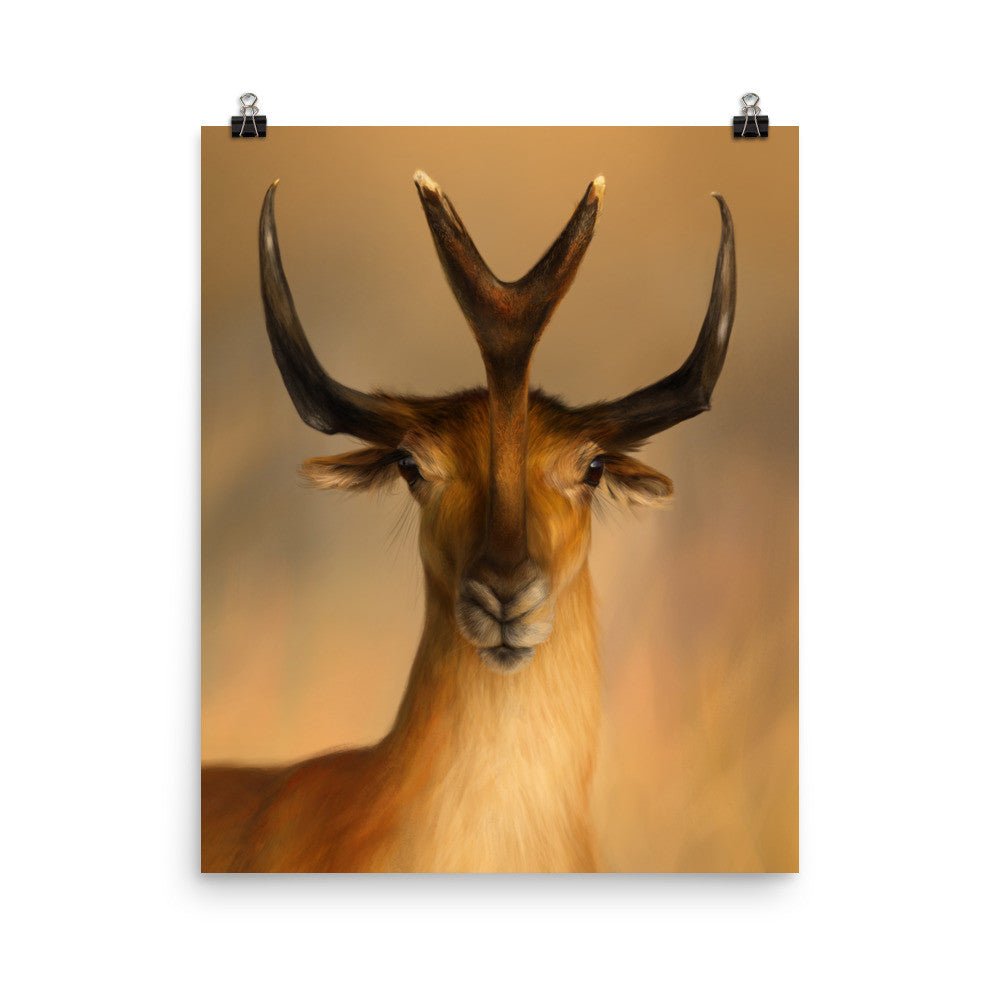
Synthetoceras tricornatus
Image: Image sourced via web search (Fair use / Educational)
About Synthetoceras
Synthetoceras tricornatus is an extinct species of artiodactyl mammal belonging to the enigmatic family Protoceratidae, which roamed the plains of North America during the late Miocene epoch, approximately 10 to 5 million years ago. This peculiar herbivore is renowned for its unique and complex cranial ornamentation, featuring a large, forked horn on its snout in addition to a pair of horns above its eyes, making it one of the most visually striking mammals of the Cenozoic Era. Its fossils provide critical insights into the diversity of North American ruminants and the ecological dynamics of the Neogene period.
Synthetoceras was a moderately large mammal, comparable in size to a modern caribou or a large deer. It stood approximately 1.2 meters (about 4 feet) tall at the shoulder and measured around 2 meters (6.5 feet) in body length, with an estimated weight of 200 to 350 kilograms (440 to 770 pounds). Its most defining characteristic was its extraordinary set of cranial appendages, which were present only in males. The most prominent of these was a long, bony horn situated on the rostrum (snout), which bifurcated at its tip, creating a Y-shaped or slingshot-like structure. This rostral horn was a true horn, covered in a keratinous sheath in life, unlike the skin-covered ossicones of giraffes. In addition to this nasal horn, males possessed a pair of smaller, backward-curving horns located just behind the orbits, similar in position to those of modern pronghorns or bovids. Females, by contrast, were hornless, a clear example of sexual dimorphism. The skull was elongated and dolichocephalic (long-headed), with a dental formula adapted for a herbivorous diet, featuring high-crowned (hypsodont) cheek teeth suitable for grinding tough, abrasive vegetation. Its postcranial skeleton was gracile and built for running, with long, slender limbs and fused metapodials (cannon bones) in both the forelimbs and hindlimbs, an adaptation for cursorial locomotion seen in many open-habitat ungulates.
As a specialized herbivore, Synthetoceras's paleobiology was shaped by its environment. The hypsodont dentition strongly suggests a diet composed primarily of abrasive grasses and other tough vegetation that became widespread during the Miocene. This indicates it was a grazer, well-suited to the expanding grasslands and savanna-like ecosystems of its time. Its long legs and cursorial adaptations point to a life spent in open country, where speed was essential for evading predators. Locomotion would have been swift and efficient, allowing it to cover large distances in search of forage and water. The extreme sexual dimorphism, with only males possessing the elaborate horns, strongly implies that these structures were used for intraspecific display and combat. The forked rostral horn and the supraorbital horns were likely employed in ritualized fights between males for mating rights, similar to the head-butting and necking behaviors seen in modern deer and giraffes. The horns could have been used for locking and wrestling, with the winner gaining access to females. This suggests a social structure that may have involved herds with a dominant male or seasonal congregations for breeding. Its growth patterns likely involved rapid development to maturity, with males developing their complex horns upon reaching sexual maturity.
Synthetoceras lived during a period of significant global cooling and drying, which led to the expansion of grasslands and open woodlands across North America, replacing the dense forests of earlier epochs. This environment, often referred to as a savanna mosaic, supported a diverse megafauna. Synthetoceras shared its habitat with a wide array of other mammals, including early horses like Neohipparion and Pliohippus, camels such as Aepycamelus and Megatylopus, various species of gomphotheres (extinct elephant relatives), and rhinos like Teleoceras. The food web was complex, and Synthetoceras occupied the niche of a medium-to-large grazing herbivore. It faced predation from a formidable suite of carnivores. These included large, bone-crushing dogs of the Borophaginae subfamily, such as Epicyon, as well as saber-toothed cats like Amphimachairodus and Barbourofelis. The cursorial adaptations of Synthetoceras were a direct evolutionary response to this high predation pressure, emphasizing speed and endurance as primary defense mechanisms. Its position in the food web was that of a primary consumer, playing a crucial role in converting plant biomass into a food source for the apex predators of the late Miocene plains.
The discovery of Synthetoceras is credited to the American paleontologist Erwin Hinckley Barbour, a prominent figure associated with the University of Nebraska State Museum. The type species, Synthetoceras tricornatus, was formally described by Barbour in 1905. The initial and most significant fossils were unearthed from the late Miocene deposits of Nebraska, a state renowned for its rich Cenozoic fossil beds. The holotype specimen, a nearly complete skull, was recovered from what is now known as the Ash Hollow Formation, part of the larger Ogallala Group. The name Synthetoceras is derived from Greek roots: 'syn' meaning 'together' or 'fused', 'keto' meaning 'horn', and 'ceras' meaning 'horn', which can be interpreted as 'combined horn', likely referencing the fused base of the rostral horn. The species name 'tricornatus' is Latin for 'three-horned', a direct and fitting description of the male's cranial armament. The University of Nebraska State Museum, often called Morrill Hall, houses some of the most important and complete specimens of Synthetoceras, and its collections have been fundamental to our understanding of this and other protoceratids. The discoveries made by Barbour and his teams in the early 20th century were instrumental in painting a picture of the vibrant ecosystems of Miocene Nebraska.
Synthetoceras belongs to the extinct family Protoceratidae, a uniquely North American group of artiodactyls. For many years, the evolutionary relationships of protoceratids were debated, with some researchers placing them close to camels (Tylopoda) and others linking them to the Pecora (the group including deer, giraffes, pronghorns, and bovids). Modern phylogenetic analyses, based on detailed cranial and postcranial anatomy, now firmly place the Protoceratidae as a sister group to the Tylopoda. This means they are more closely related to camels than to any other living artiodactyl group. The family itself shows a fascinating evolutionary trajectory, beginning with smaller, hornless forms in the Eocene and culminating in the large, spectacularly ornamented genera of the Miocene, such as Synthetoceras and its close relative, Syndyoceras. This progression demonstrates a clear evolutionary trend towards increased body size and more complex cranial weaponry, likely driven by sexual selection and ecological pressures. As an endemic North American lineage that survived for over 35 million years before going extinct, the protoceratids represent a remarkable and ultimately unsuccessful evolutionary experiment in ruminant-like herbivores, and Synthetoceras stands as the final and most specialized member of this unique family.
While the overall classification of Synthetoceras within the Protoceratidae is stable, some scientific debates have centered on the precise function of its bizarre horns. The primary interpretation is that they were tools for sexual selection, used in ritualized combat and display among males. However, alternative or secondary functions have been proposed, such as defense against predators, though their seemingly awkward placement and elaborate shape make them less than ideal for fending off a large saber-toothed cat. Another area of discussion involves the paleoecology of the protoceratids. While the dentition of Synthetoceras points strongly to a grazing lifestyle, some earlier, less specialized protoceratids may have been browsers or mixed-feeders. The transition from browsing to grazing within the family reflects the broader environmental shift from forests to grasslands in North America. The exact cause of their extinction around 5 million years ago remains uncertain but is likely linked to increasing competition from more advanced and successful artiodactyls, such as true deer and bovids that migrated into North America, combined with ongoing climatic changes at the end of the Miocene.
The fossil record of Synthetoceras is primarily concentrated in the Great Plains region of the United States, with significant finds in Nebraska, Texas, and Oklahoma. Fossils are typically recovered from fluvial (river) and lacustrine (lake) deposits within the Ogallala Group, particularly the Ash Hollow Formation. While complete, articulated skeletons are rare, numerous skulls, jaws, and postcranial elements have been discovered, providing a robust understanding of its anatomy. The preservation quality is generally good, with the dense bone of the skull and horns being particularly well-represented in the fossil record. The University of Nebraska State Museum and the American Museum of Natural History in New York hold some of the most important collections. The abundance of fossils in certain localities, sometimes found in close association, suggests that these animals may have lived in herds and perhaps perished together in localized events like droughts or floods, leading to concentrated fossil deposits.
Synthetoceras, with its unforgettable 'slingshot' horn, has captured the public imagination and is a staple in museum displays focusing on Cenozoic life. Its striking appearance makes it a memorable example of the strange and wonderful forms that mammalian evolution can produce. Skeletons and life-sized reconstructions of Synthetoceras are featured exhibits at major institutions, including the University of Nebraska State Museum (Morrill Hall) and the American Museum of Natural History. While not as famous as dinosaurs or saber-toothed cats, it frequently appears in books, documentaries, and educational materials about prehistoric mammals, serving as a key example of North America's unique extinct fauna and the power of sexual selection in shaping animal anatomy.
Classification
Time Period
Discovery
Location
United States (Nebraska)
Formation
Ogallala Group (specifically, formations like the Ash Hollow Formation)
Frequently Asked Questions
What is Synthetoceras?
Synthetoceras tricornatus is an extinct species of artiodactyl mammal belonging to the enigmatic family Protoceratidae, which roamed the plains of North America during the late Miocene epoch, approximately 10 to 5 million years ago. This peculiar herbivore is renowned for its unique and complex cran...
When did Synthetoceras live?
Synthetoceras lived during the neogene period of the cenozoic era approximately 10-5 million years ago.
Where was Synthetoceras discovered?
Fossils of Synthetoceras were discovered in United States (Nebraska) in the Ogallala Group (specifically, formations like the Ash Hollow Formation).
What did Synthetoceras eat?
Synthetoceras was a herbivore. It lived in terrestrial habitats.
What type of fossil is Synthetoceras?
Synthetoceras is preserved as a body fossil. The preservation quality is good.
Related Specimens
From the cenozoic era · body fossils