/e01cc4f7f656.jpg)
Pikaia gracilens
About Pikaia gracilens
Pikaia gracilens is a small, laterally compressed, worm-like organism from the Middle Cambrian period, approximately 508 million years ago, whose fossils are found in the renowned Burgess Shale of British Columbia, Canada. For decades, this enigmatic creature has been at the center of paleontological discussion, widely regarded as one of the earliest and most primitive known members of the phylum Chordata. Its discovery provided crucial fossil evidence for the deep evolutionary roots of the group that would eventually give rise to all vertebrates, including humans, making it a key player in understanding the explosive diversification of animal life during the Cambrian Explosion.
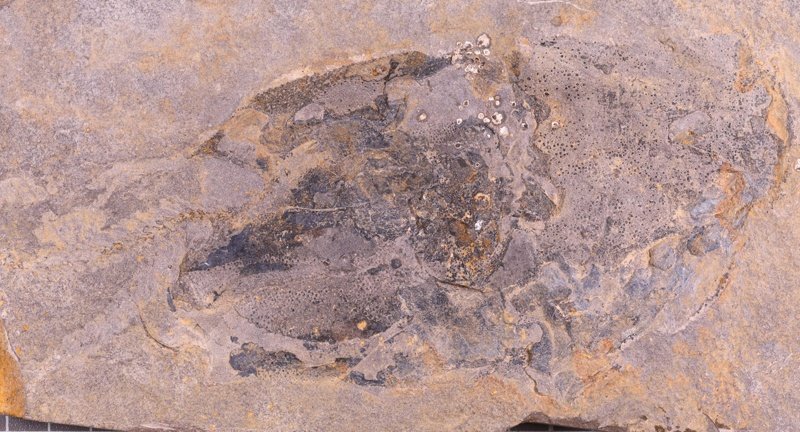
The physical anatomy of Pikaia gracilens reveals a fascinating mosaic of primitive and derived chordate features packed into a diminutive frame. Typically measuring between 1.5 and 6 centimeters in length, with an average around 4 centimeters, its body was slender and flattened from side to side, resembling a modern lancelet or a flattened eel. The most striking feature, clearly visible in well-preserved specimens, is a series of approximately one hundred V-shaped muscle blocks, known as myomeres, arranged segmentally along the length of its body. These myomeres, with the point of the 'V' directed towards the head, are a hallmark of chordates and would have facilitated controlled, undulatory swimming. Running dorsally along the body was a prominent, rod-like structure interpreted as a notochord, a flexible cartilaginous rod that provides skeletal support. This feature, though sometimes preserved only as a faint impression or a reflective carbonaceous film, is the primary reason for Pikaia's classification as a chordate. The head region was small and poorly defined, lacking obvious eyes but possessing a pair of slender, tentacle-like appendages that likely served a sensory function, helping it navigate and detect food. Just behind the head, a series of small slits or pores, possibly pharyngeal gill slits, have been identified, suggesting a mechanism for filter-feeding and respiration. The posterior end tapered to a simple, fin-like tail, which would have provided propulsion.
The paleobiology of Pikaia gracilens is inferred from its unique anatomy and the paleoenvironment of the Burgess Shale. Its streamlined, laterally compressed body and prominent myomeres strongly suggest it was an active swimmer, or nektonic. It likely propelled itself through the water column with rhythmic, side-to-side contractions of its muscle blocks, creating an undulating motion similar to that of modern eels or lancelets. This form of locomotion would have been efficient for moving short distances in search of food or escaping predators. However, some researchers have proposed an alternative or complementary lifestyle, suggesting it may have been epibenthic, spending at least part of its time on or near the seafloor. In this scenario, it might have burrowed into the soft sediment or wriggled along the substrate. Pikaia was almost certainly a filter feeder or a detritivore. It would have drawn water into its pharynx, where the pharyngeal slits could have trapped suspended organic particles or microorganisms, which were then passed into its digestive tract. The tentacles on its head may have helped guide food-rich water towards its mouth or sensed chemical cues in its environment. Its simple body plan suggests it did not engage in complex behaviors, but its mobility indicates it was an active participant in its ecosystem, not a passive, sedentary organism.
Pikaia lived in a shallow, tropical marine environment on a continental shelf off the coast of the ancient supercontinent Laurentia. During the Middle Cambrian, this region was situated near the equator, characterized by warm waters and a muddy seafloor composed of fine silt. The Burgess Shale fauna was preserved in an exceptional event where an entire community living at the base of a submarine cliff, known as the Cathedral Escarpment, was swept away by an underwater mudflow and rapidly buried in anoxic sediment. This lack of oxygen prevented decay and scavenging, leading to the remarkable preservation of soft tissues. Pikaia shared this ecosystem with a bizarre and diverse array of organisms, including the formidable predator Anomalocaris, the armored arthropod Trilobita, the five-eyed Opabinia, and the spiny, enigmatic Hallucigenia. As a small filter feeder, Pikaia would have occupied a low trophic level in the food web, consuming plankton and organic detritus. In turn, it would have been prey for various larger, mobile predators, relying on its swimming ability to evade capture in the complex and competitive Cambrian seas.
The discovery of Pikaia gracilens is intrinsically linked to the pioneering work of paleontologist Charles Doolittle Walcott. While systematically quarrying the Burgess Shale between 1909 and 1924, Walcott unearthed thousands of exquisitely preserved fossils. He first collected specimens of Pikaia in 1911 and formally described the genus and species, Pikaia gracilens, in a brief publication that same year. The name "Pikaia" is derived from Pika Peak, a mountain near the fossil locality, while "gracilens" is Latin for "slender" or "graceful," a nod to its delicate, streamlined form. Initially, Walcott classified Pikaia as an annelid worm due to its segmented appearance, a classification that went largely unchallenged for over half a century. The key specimens, including the holotype USNM 57628, are housed at the Smithsonian National Museum of Natural History. It wasn't until the 1970s that its true significance was recognized, fundamentally altering our understanding of early chordate evolution.
The evolutionary significance of Pikaia gracilens cannot be overstated; it represents a critical data point in the story of vertebrate origins. In the early 1970s, paleontologist Simon Conway Morris, as part of a comprehensive re-examination of the Burgess Shale fauna, reinterpreted Pikaia's anatomy. He recognized that the dorsal rod was not a digestive tract but a notochord, and the V-shaped segments were not annelid-like rings but chordate myomeres. This bold reclassification placed Pikaia firmly at or near the base of the chordate family tree, making it the oldest and most primitive known member of our own phylum at the time. It provided tangible fossil evidence that the fundamental chordate body plan had already evolved by the Middle Cambrian. Pikaia showcases a suite of transitional features: it possesses the defining notochord and myomeres of a chordate but lacks the more derived features of later vertebrates, such as a mineralized skeleton, a complex brain, or specialized paired fins. It serves as a powerful illustration of what a very early ancestor of all fish, amphibians, reptiles, birds, and mammals might have looked like, bridging the gap between invertebrates and the first vertebrates.
Despite its iconic status, Pikaia gracilens has been the subject of ongoing scientific debate, primarily concerning its precise phylogenetic placement. While its chordate affinity is now widely accepted, its position within the phylum has been contested. For many years, it was considered a stem-group cephalochordate, an early relative of modern lancelets (Amphioxus). However, a more detailed 2012 study by Simon Conway Morris and Jean-Bernard Caron, based on over one hundred specimens, identified additional features, including a potential vascular system and rudimentary gill structures, reinforcing its chordate identity but suggesting it might be an even more primitive chordate than previously thought, potentially predating the split between cephalochordates and vertebrates. Some paleontologists have argued that other Cambrian organisms, such as Myllokunmingia and Haikouichthys from the Chinese Chengjiang fossil beds, which are slightly older and possess more fish-like features like eyes and a distinct brain, represent the earliest true vertebrates, placing Pikaia as a more basal, non-vertebrate chordate. These discussions highlight the dynamic nature of paleontology, where new evidence continually refines our understanding of the tree of life.
The fossil record of Pikaia gracilens is geographically restricted but locally abundant. To date, all known specimens have been recovered from the Burgess Shale Formation in Yoho National Park, British Columbia, Canada, primarily from Walcott's original quarry on Fossil Ridge and nearby sites. Over 114 specimens have been cataloged, making it a relatively well-represented member of the Burgess Shale fauna. The quality of preservation is exceptional, a hallmark of this fossil lagerstätte. The fossils are typically preserved as flattened carbonaceous compressions on dark shale, often with a silvery, reflective sheen that highlights the soft-tissue anatomy, including the delicate myomeres and the faint outline of the notochord. This mode of preservation has allowed for detailed study of its internal and external structures, which would have been impossible with skeletal remains alone. The concentration of fossils in this single locality provides a remarkable snapshot of a specific Cambrian marine community but also means that our knowledge of Pikaia's broader geographic and temporal range is currently limited.
Pikaia gracilens has achieved a level of cultural recognition rare for an invertebrate fossil, largely due to its profound evolutionary implications as a potential ancestor of all vertebrates. It is prominently featured in natural history museums around the world, including the Smithsonian National Museum of Natural History and the Royal Ontario Museum, where it serves as a powerful educational tool to explain the concept of common descent and the Cambrian Explosion. Its story was popularized in Stephen Jay Gould's influential 1989 book "Wonderful Life," which celebrated the weird wonders of the Burgess Shale and cast Pikaia as the unlikely survivor whose lineage led to humanity. This narrative has cemented its place in popular science literature, documentaries, and educational materials as a symbol of the contingent nature of evolution.
Time Period
Discovery
Location
Burgess Shale, British Columbia, Canada
Formation
Burgess Shale Formation
Frequently Asked Questions
What is Pikaia gracilens?
Pikaia gracilens is a small, laterally compressed, worm-like organism from the Middle Cambrian period, approximately 508 million years ago, whose fossils are found in the renowned Burgess Shale of British Columbia, Canada. For decades, this enigmatic creature has been at the center of paleontologica...
When did Pikaia gracilens live?
Pikaia gracilens lived during the cambrian period of the paleozoic era approximately 508 million years ago.
Where was Pikaia gracilens discovered?
Fossils of Pikaia gracilens were discovered in Burgess Shale, British Columbia, Canada in the Burgess Shale Formation.
What did Pikaia gracilens eat?
Pikaia gracilens was a filter feeder. It lived in marine, likely nektonic (free-swimming) or epibenthic (living on the seafloor) in shallow waters. habitats.
Related Specimens
From the paleozoic era
/cc86f4a1bc00.jpg)