/bf5239087f6c.png)
Hallucigenia sparsa (Burgess Shale)
Hallucigenia sparsa
About Hallucigenia sparsa (Burgess Shale)
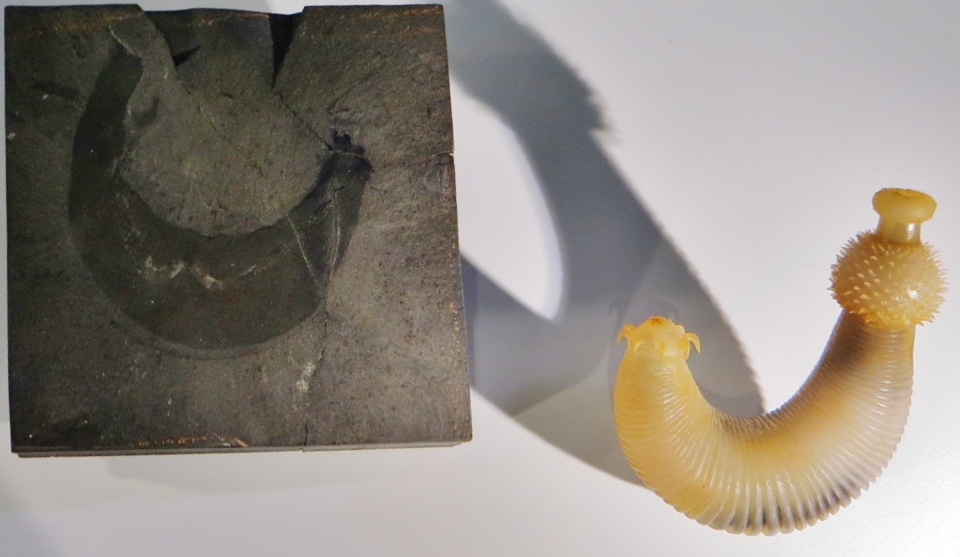
Hallucigenia sparsa is an iconic and highly enigmatic stem-group panarthropod that thrived in the deep-water marine environments of the middle Cambrian period, approximately 508 million years ago. First discovered in the celebrated Burgess Shale deposits of British Columbia, Canada, this bizarre, worm-like animal is renowned for its highly unusual body plan, which initially baffled scientists and fundamentally shaped our modern understanding of early animal evolution. As a key member of the Burgess Shale fauna, it provides a critical evolutionary link between ancient worm-like ancestors and modern arthropods, velvet worms, and water bears.
The physical anatomy of Hallucigenia sparsa is one of the most distinctive and widely recognized in the entire fossil record, characterized by a slender, elongated, and roughly cylindrical body that typically ranges from 0.5 to 5 centimeters in length. The organism is most famous for its formidable dorsal armature, consisting of a row of seven pairs of long, rigid, upward-pointing spines running along its back. These spines were likely composed of organic material, possibly chitinous in nature, and served a primary defensive function against the growing number of macroscopic predators in the Cambrian seas. On its ventral side, the animal possessed seven pairs of long, flexible, unjointed legs known as lobopods. Unlike the rigid spines above, these legs were soft and muscular, terminating in a pair of sharp, sclerotized claws. Anterior to these seven pairs of walking legs, Hallucigenia featured three pairs of smaller, thinner, clawless appendages near its neck region, which were likely used for feeding or sensory purposes. For decades, the head of Hallucigenia remained a mystery, often confused with a bulbous stain at the rear of the animal. However, advanced imaging techniques applied to exceptionally preserved specimens eventually revealed a tiny, elongated head equipped with a pair of simple, camera-type eyes. The mouth was positioned at the anterior tip and featured a ring of sharp, radiating teeth, followed by a pharynx lined with additional needle-like teeth pointing toward the gut. This complex oral apparatus is a hallmark of the ecdysozoan superphylum, linking Hallucigenia to a vast array of molting animals. Despite its fearsome appearance under a microscope, the animal was incredibly small and lightweight, weighing only a fraction of a gram, and its soft body would have been highly vulnerable were it not for its prominent dorsal spines.
In terms of paleobiology, Hallucigenia sparsa is generally interpreted as a benthic detritivore and scavenger, navigating the muddy substrates of its deep-water marine habitat. Its mode of locomotion relied on the seven pairs of lobopodous legs, which operated through hydrostatic pressure and muscular contraction, much like the legs of modern velvet worms. The sharp claws at the tips of these legs were perfectly adapted for gripping the uneven, slippery surfaces of microbial mats, sponge reefs, and decaying organic matter that blanketed the Cambrian seafloor. As it slowly crawled along the bottom, Hallucigenia likely used its three pairs of slender anterior appendages to probe the sediment, grasping particles of detritus, marine snow, or the decaying remains of other organisms. These anterior tentacles would then pass the gathered food toward the mouth. The sophisticated ring of teeth at the oral opening acted as a valve to generate suction, drawing food into the pharynx, where the secondary rows of pharyngeal teeth prevented the food from slipping back out as it was pushed into the gut tube for digestion. Like all members of the Ecdysozoa, Hallucigenia grew by periodically shedding its outer cuticle in a process called ecdysis. Fossil evidence suggests that the rigid dorsal spines and the sharp claws were molted along with the rest of the integument. The presence of multiple size classes in the fossil record indicates a gradual growth pattern, with juveniles possessing the same basic body plan as adults but on a miniature scale. The defensive spines suggest a life spent in constant peril from visual predators, prompting behaviors such as hiding among sponge colonies or remaining motionless to avoid detection.
The ecological context of Hallucigenia sparsa is deeply tied to the dynamic and rapidly diversifying world of the Cambrian Explosion. During the middle Cambrian, the global climate was significantly warmer than today, with high sea levels creating extensive, shallow epicontinental seas. However, the specific habitat of the Burgess Shale was situated along a steep submarine escarpment known as the Cathedral Escarpment. Hallucigenia lived at the base of this underwater cliff, in a relatively deep, quiet marine basin that was occasionally subjected to sudden, catastrophic mudslides. This benthic ecosystem was teeming with an unprecedented variety of life forms. Hallucigenia shared its environment with a diverse array of sponges, brachiopods, and early echinoderms, as well as an astonishing menagerie of mobile organisms. It crawled alongside heavily armored slug-like creatures such as Wiwaxia, the multi-legged arthropod Marella, and the five-eyed, proboscis-bearing Opabinia. In the food web, Hallucigenia occupied a lower trophic level as a primary consumer of detritus and carrion. Its primary ecological pressure came from the apex predators of the time, most notably the anomalocaridids. Creatures like Anomalocaris, with their large compound eyes and grasping appendages, patrolled the waters above. The prominent dorsal spines of Hallucigenia were a direct evolutionary response to this predation pressure, making the small lobopodian a difficult and painful meal to swallow. This predator-prey dynamic is a classic example of the evolutionary arms race that characterized the Cambrian period, driving the development of complex defensive structures and behaviors across multiple animal lineages.
The discovery and subsequent taxonomic history of Hallucigenia sparsa is one of the most fascinating and convoluted narratives in the history of paleontology. The first specimens were discovered in 1911 by the eminent American paleontologist Charles Doolittle Walcott, who was systematically excavating the Burgess Shale in Yoho National Park. Walcott, working under the assumption that most Cambrian organisms could be neatly categorized into modern phyla, initially classified the creature as a polychaete annelid worm, naming it Canadia sparsa. The fossil languished in relative obscurity for over six decades until the 1970s, when British paleontologist Simon Conway Morris undertook a comprehensive re-examination of the Burgess Shale fauna. In 1977, Conway Morris realized that the organism was entirely distinct from Canadia and erected a new genus, naming it Hallucigenia due to its bizarre, dream-like, and seemingly hallucinatory appearance. However, Conway Morris made a famous error in his reconstruction: he interpreted the rigid spines as stilt-like walking legs and the soft, flexible tentacles as a row of feeding tubes along the animal's back. He also mistook a bulbous, dark stain at one end of the fossil for a featureless head. This upside-down and backwards reconstruction presented an animal so profoundly strange that it was often cited by evolutionary biologist Stephen Jay Gould as evidence that the Cambrian Explosion produced fundamentally alien body plans that belonged to entirely extinct phyla. It was not until 1991 that researchers Lars Ramskold and Hou Xianguang, drawing on newly discovered, closely related fossils from the Chengjiang biota in China, such as Microdictyon, realized that Hallucigenia had been reconstructed upside down. They demonstrated that the tentacles were actually paired walking legs, and the spines were defensive structures on the back. The final piece of the puzzle was solved in 2015, when researchers Martin Smith and Jean-Bernard Caron used electron microscopy to reveal the true head of the animal at the end previously thought to be the tail, finally resolving the anatomy of this iconic creature after more than a century of study.
The evolutionary significance of Hallucigenia sparsa cannot be overstated, as it occupies a crucial position in the tree of life as a stem-group panarthropod. The panarthropod clade encompasses three modern phyla: the incredibly diverse Arthropoda (insects, crustaceans, arachnids), the Tardigrada (water bears), and the Onychophora (velvet worms). Hallucigenia belongs to an extinct, paraphyletic assemblage of animals known as lobopodians, which are widely considered to be the evolutionary grade from which all modern panarthropods emerged. By studying Hallucigenia, paleontologists can observe the step-by-step assembly of the arthropod body plan. The creature exhibits a mix of primitive and derived traits; its soft, unjointed legs and worm-like body are primitive features shared with early ecdysozoan ancestors, while its specialized claws and complex mouthparts point toward the more advanced structures seen in later arthropods. Detailed morphological analyses have revealed striking similarities between Hallucigenia and modern velvet worms. Specifically, the microscopic structure of Hallucigenia's claws, which are stacked in nested layers like Russian dolls, is virtually identical to the structure of the jaws and claws of extant onychophorans. This anatomical homology provides compelling evidence that Hallucigenia is closely related to the lineage that eventually gave rise to the velvet worms. Furthermore, the discovery of the circum-oral nerve ring and the pharyngeal teeth in Hallucigenia solidified the concept of the Cycloneuralia, a grouping of molting animals that includes nematodes and priapulid worms, demonstrating a deep, shared ancestry among all ecdysozoans. Hallucigenia thus stands as a perfect transitional fossil, bridging the morphological gap between simple, worm-like ancestors and the highly complex, jointed-limbed arthropods that dominate the planet today.
Scientific debates surrounding Hallucigenia sparsa have been intense and highly productive, driving significant advancements in paleontological methodologies. The most famous controversy, naturally, was the decades-long debate over its correct anatomical orientation. The upside-down reconstruction by Conway Morris sparked fierce arguments about the mechanics of its locomotion, with critics questioning how an animal could possibly walk on rigid, unjointed stilts. Even after the animal was flipped right-side up by Ramskold and Hou, debates continued regarding its exact phylogenetic placement. Some researchers argued it was a crown-group onychophoran, while others maintained it was a more basal stem-group panarthropod. The exact function of the anterior tentacles also remained a point of contention; while most agree they were used for feeding, some scientists proposed they might have housed sensory organs or gills. Additionally, the dark, bulbous stain that Conway Morris originally identified as the head was later debated; some argued it was an artifact of decay, specifically gut contents being squeezed out of the body during fossilization, while others suggested it might be a taphonomic artifact related to the decay of a specialized posterior organ. The 2015 discovery of the actual head and mouthparts by Smith and Caron largely put these anatomical debates to rest, but discussions continue regarding the precise evolutionary relationships among the various lobopodian families found across different Cambrian fossil sites globally.
The fossil record of Hallucigenia sparsa is primarily restricted to the Burgess Shale Formation in British Columbia, specifically within the renowned Walcott Quarry and surrounding outcrops. Despite its fame, Hallucigenia is a relatively rare component of the Burgess Shale fauna, representing only a small fraction of the total specimens collected. To date, a few hundred specimens have been recovered and cataloged by institutions such as the Royal Ontario Museum and the Smithsonian Institution. The preservation quality of these fossils is extraordinary, representing a classic example of Burgess Shale-type preservation. The organisms were buried rapidly in fine-grained, anoxic mud, which halted bacterial decay and allowed for the fossilization of soft tissues as thin, highly reflective carbonaceous films. This exceptional taphonomy preserved not only the rigid spines and claws but also the delicate gut trace, the musculature of the lobopods, and the microscopic teeth in the pharynx. The two-dimensional compression of these three-dimensional animals often resulted in fossils where the paired legs and spines are superimposed, which contributed to the early difficulties in interpreting its anatomy. While Hallucigenia sparsa is endemic to the Burgess Shale, closely related species of the genus Hallucigenia, such as Hallucigenia fortis and Hallucigenia hongmeia, have been discovered in the slightly older Chengjiang biota in Yunnan Province, China, indicating that this genus had a widespread geographic distribution across the Cambrian oceans.
The cultural impact of Hallucigenia sparsa extends far beyond the confines of academic paleontology, making it one of the few prehistoric invertebrates to achieve genuine pop culture icon status. It serves as the ultimate poster child for the Cambrian Explosion, symbolizing the sheer weirdness and boundless experimentation of early animal evolution. The creature gained widespread public attention through Stephen Jay Gould's bestselling 1989 book Wonderful Life, which, despite relying on the incorrect upside-down reconstruction, captivated readers with the idea of a lost world of bizarre, extinct phyla. Today, accurate reconstructions of Hallucigenia are prominent fixtures in natural history museums worldwide, including major exhibits at the Royal Ontario Museum and the Smithsonian National Museum of Natural History. It frequently appears in science documentaries, educational textbooks, and even popular media, including video games and animated series, where its alien appearance continues to inspire creature designers and artists. Through its fascinating history of misinterpretation and eventual scientific clarity, Hallucigenia stands as a powerful educational tool, illustrating the self-correcting nature of the scientific method and the enduring mysteries of our planet's deep past.
Time Period
Discovery
Location
Burgess Shale, Yoho National Park, British Columbia, Canada
Formation
Burgess Shale Formation
Frequently Asked Questions
What is Hallucigenia sparsa (Burgess Shale)?
Hallucigenia sparsa is an iconic and highly enigmatic stem-group panarthropod that thrived in the deep-water marine environments of the middle Cambrian period, approximately 508 million years ago. First discovered in the celebrated Burgess Shale deposits of British Columbia, Canada, this bizarre, wo...
When did Hallucigenia sparsa (Burgess Shale) live?
Hallucigenia sparsa (Burgess Shale) lived during the cambrian period of the paleozoic era approximately 508 million years ago.
Where was Hallucigenia sparsa (Burgess Shale) discovered?
Fossils of Hallucigenia sparsa (Burgess Shale) were discovered in Burgess Shale, Yoho National Park, British Columbia, Canada in the Burgess Shale Formation.
What did Hallucigenia sparsa (Burgess Shale) eat?
Hallucigenia sparsa (Burgess Shale) was a detritivore/scavenger. It lived in marine, deep-water habitats.
Related Specimens
From the paleozoic era