Myllokunmingia
Myllokunmingia fengjiaoa
Image: Image sourced via web search (Fair use / Educational)
About Myllokunmingia
Myllokunmingia fengjiaoa stands as one of the most profound and consequential discoveries in the annals of vertebrate paleontology, representing one of the earliest known basal vertebrates or stem-craniates to appear in the fossil record. Living approximately 530 to 520 million years ago during the Cambrian Period, this ancient marine organism inhabited the shallow, warm seas that once covered what is now the Yunnan Province of southwestern China. The emergence of Myllokunmingia coincides with the Cambrian Explosion, a pivotal epoch in Earth's history characterized by a rapid and unprecedented diversification of macroscopic, complex life forms. As a creature that bridges the evolutionary gap between simple invertebrate chordates and the vast lineage of vertebrates that would eventually dominate the planet's oceans, landmasses, and skies, Myllokunmingia holds a unique and revered place in evolutionary biology. Its discovery has provided scientists with a crucial empirical anchor for understanding the morphological innovations that defined the earliest ancestors of modern fish, amphibians, reptiles, birds, and mammals. By offering a rare glimpse into the soft-tissue anatomy of Cambrian chordates, Myllokunmingia has fundamentally reshaped our comprehension of how the vertebrate body plan was initially assembled, making it a cornerstone species for anyone studying the deep origins of the vertebrate lineage.
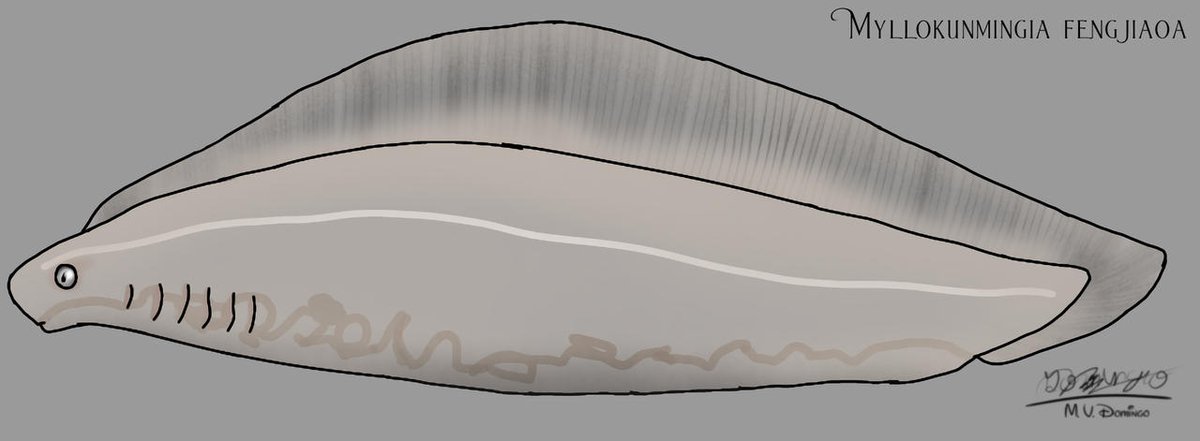
In terms of physical description, Myllokunmingia was a diminutive creature, measuring approximately 2.8 centimeters (about 1.1 inches) in length and roughly 6 millimeters in height. Despite its small stature, its anatomy was remarkably complex for its time, exhibiting a suite of features that clearly align it with the vertebrate lineage. The body was laterally compressed, giving it a ribbon-like or eel-like profile, somewhat reminiscent of modern lancelets or the larval stages of lampreys and hagfish. One of its most distinctive anatomical traits was the presence of a distinct dorsal fin that ran along the upper margin of its body, complemented by a ventral finfold extending further back along the lower margin. These fin structures lacked the complex, biomineralized fin rays seen in later fish, likely being supported by simple cartilaginous elements or stiffened connective tissue. The organism possessed a distinct head region, which is a defining characteristic of craniates, housing what is interpreted as a primitive cartilaginous skull or cranial skeletal elements. Behind the head, the fossil preserves evidence of five or six gill pouches, which were essential for both respiration and potentially filter-feeding. The musculature of Myllokunmingia was organized into distinct, V-shaped myomeres (muscle blocks), numbering around 25, which are a hallmark of chordate anatomy and indicate a sophisticated capacity for controlled, undulating swimming movements. Crucially, Myllokunmingia lacked any form of biomineralized skeleton; it had no true bones, jaws, or teeth. Instead, its structural integrity was maintained by a notochord—a flexible, rod-like structure that served as the primary axial support—and a cartilaginous framework. When compared to modern animals, its size and general body plan would make it look very much like a small, translucent minnow or a lancelet, though its internal organization was a critical step closer to true fish.
The paleobiology of Myllokunmingia suggests a lifestyle adapted to the dynamic and competitive marine environments of the early Cambrian. Given its lack of jaws and grasping appendages, it is highly probable that Myllokunmingia was a filter-feeder or a micro-carnivorous deposit feeder. It likely sustained itself by drawing in water through its mouth and passing it over its pharyngeal gill slits, trapping microscopic plankton, organic detritus, and small suspended particles in a mucous net before swallowing them. Its locomotion was almost certainly achieved through lateral undulation—the rhythmic, side-to-side flexing of its myomere-driven body against the water column. The presence of dorsal and ventral finfolds would have provided essential stability, preventing the animal from rolling as it swam and allowing for more efficient forward propulsion. While it was capable of active swimming, it may not have been a particularly fast or sustained swimmer compared to later, more derived fish. It likely spent much of its time hovering near the sea floor or navigating through the lower levels of the water column, perhaps resting on the soft, muddy substrate when not actively feeding. Inferences about its social behavior are speculative, but given the clustering of similar early chordate fossils in certain deposits, it is possible that Myllokunmingia lived in loose shoals or aggregations, a behavior that would have offered some degree of protection against predators through the dilution effect. Its metabolism was likely relatively low compared to modern active predatory fish, suited to a life of steady, low-energy filter-feeding in the oxygen-rich shallow waters of the Cambrian seas.
The ecological context in which Myllokunmingia existed was a world vastly different from our own, yet it was the crucible in which modern marine ecosystems were forged. During the early Cambrian, the Earth's landmasses were largely barren, devoid of complex plant or animal life, but the oceans were teeming with a newly evolved array of bizarre and wonderful creatures. Myllokunmingia inhabited the Chengjiang ecosystem, a shallow, tropical to subtropical marine environment characterized by a soft, muddy seafloor and periodic influxes of fine sediment. This ecosystem was incredibly diverse, hosting a complex food web that included some of the first true apex predators. Myllokunmingia shared its habitat with a multitude of arthropods, sponges, brachiopods, and priapulid worms. Most notably, it lived alongside fearsome predators like the anomalocaridids—massive, swimming arthropods with grasping appendages and circular, tooth-lined mouths that could reach up to a meter in length. In this perilous environment, Myllokunmingia occupied a position near the base of the macroscopic food web. As a small, soft-bodied filter-feeder, it would have been prime prey for a variety of larger, carnivorous invertebrates. Its primary defense mechanisms would have been its small size, its ability to swim away from slow-moving benthic threats, and perhaps a degree of translucency that provided rudimentary camouflage against the water column. The presence of Myllokunmingia and its relatives in this ecosystem highlights the early establishment of chordates as a minor but persistent component of Cambrian marine communities, carving out a niche that their descendants would eventually expand to dominate.
The discovery history of Myllokunmingia is a relatively recent and highly celebrated chapter in the field of paleontology. The first and most significant specimens were discovered in the late 1990s by a team of paleontologists led by Shu Degan of Northwest University in Xi'an, China. The fossils were unearthed near the village of Ercaicun, located in the Haikou area of Kunming, within the Yunnan Province. This region is famous for the Chengjiang biota, a fossil lagerstätte renowned for its exceptional preservation of soft-bodied Cambrian organisms. The discovery was formally announced to the scientific community in a landmark paper published in the journal Nature in 1999. The genus name, Myllokunmingia, is derived from the Greek word 'myllos', meaning a kind of fish, combined with 'Kunming', the capital city of Yunnan Province near where the fossils were found. The specific epithet, fengjiaoa, was chosen to honor the contributions of specific individuals or local geographic features associated with the find. The initial discovery was met with widespread excitement, as it provided the most compelling evidence to date of vertebrate life existing during the early Cambrian. The holotype specimen, carefully prepared to reveal the delicate impressions of its gills, myomeres, and notochord, remains one of the most heavily studied fossils of its kind. The meticulous excavation and preparation of these delicate fossils required immense skill, as the soft-tissue impressions are preserved as thin, highly compressed films on the surface of brittle mudstone.
The evolutionary significance of Myllokunmingia cannot be overstated; it is a critical transitional form that illuminates the deep origins of the vertebrate lineage. Before the discovery of Myllokunmingia and its contemporaries, the fossil record of early vertebrates was frustratingly sparse, with a significant gap between the invertebrate chordates (like modern tunicates and lancelets) and the heavily armored, jawless fish (ostracoderms) of the Ordovician and Silurian periods. Myllokunmingia helps to bridge this gap. It provides tangible evidence that the fundamental vertebrate body plan—characterized by a distinct head, a cranium, paired sensory organs, a notochord, and W-shaped or V-shaped myomeres—had already evolved by the early Cambrian. This pushes the origin of vertebrates back significantly further in time than was previously thought, aligning the fossil record more closely with the predictions of molecular clock estimates. Myllokunmingia demonstrates that the earliest vertebrates were small, soft-bodied, and jawless, relying on a cartilaginous endoskeleton rather than biomineralized bone. It represents a stage in evolution after the divergence of the cephalochordates (lancelets) but before the evolution of true bone, jaws, and paired appendages (pectoral and pelvic fins). By studying Myllokunmingia, scientists can better understand the sequence of anatomical innovations that led to the astonishing diversity of modern vertebrates, from the smallest fish to the largest whales, and ultimately, to human beings.
Despite its importance, Myllokunmingia has been the subject of ongoing scientific debates and taxonomic revisions. One of the primary controversies revolves around its exact phylogenetic placement. While there is a general consensus that it is a basal vertebrate or a stem-craniate, researchers debate whether it is more closely related to modern hagfish, lampreys, or the lineage that led to jawed vertebrates (gnathostomes). Another significant debate concerns its relationship to another famous Cambrian chordate found in the same deposits, Haikouichthys ercaicunensis. Some paleontologists have argued that Myllokunmingia and Haikouichthys might actually represent different life stages, sexes, or preservation variants of the exact same species. Those who argue for their synonymy point to their similar size, overall body shape, and shared anatomical features. However, other researchers maintain that they are distinct genera, citing differences in the shape of their myomeres, the structure of their dorsal fins, and the arrangement of their gill pouches. Furthermore, the interpretation of specific soft-tissue structures, such as the exact nature of the cranial cartilage and the presence of a true heart or liver, remains challenging due to the compressed nature of the fossils, leading to differing interpretations among experts.
The fossil record of Myllokunmingia is geographically restricted but exceptionally valuable. To date, fossils of this organism have only been found in the Qiongzhusi Formation, specifically within the Yu'anshan Member, which hosts the Chengjiang biota in Yunnan, China. The preservation quality of these fossils is categorized as exceptional (a true lagerstätte), as the fine-grained mudstone has captured the delicate impressions of soft tissues that would normally decay long before fossilization could occur. However, despite the high quality of preservation, Myllokunmingia remains a very rare find. Compared to the thousands of specimens of Cambrian arthropods and sponges recovered from the Chengjiang deposits, only a handful of well-preserved Myllokunmingia specimens are known to science. The fossils typically preserve the lateral profile of the animal, showcasing the myomeres, the notochord, the finfolds, and the gill pouches as dark, carbonaceous or iron-rich films against the lighter yellowish or grayish rock matrix. The rarity of these fossils makes each new specimen a highly prized discovery, offering potential new insights into the anatomy and biology of this ancient vertebrate ancestor.
The cultural impact of Myllokunmingia, while perhaps less pronounced than that of massive dinosaurs like Tyrannosaurus rex, is nonetheless significant within the realms of science education and evolutionary biology. It frequently appears in academic textbooks, popular science books, and documentaries discussing the Cambrian Explosion and the origins of vertebrate life. Although its close relative Haikouichthys was famously featured in the BBC documentary series 'Walking with Monsters', Myllokunmingia is often discussed in tandem or used interchangeably in popular media to represent the 'first fish'. Notable specimens and detailed models of Myllokunmingia are proudly displayed in major natural history museums, particularly in China, such as the Northwest University Museum in Xi'an and the Paleozoological Museum of China in Beijing. These exhibits play a crucial role in public education, helping to visualize the humble, tiny, and soft-bodied origins of the entire vertebrate lineage, fostering a deeper public appreciation for the vast and complex narrative of evolutionary history.
Classification
Time Period
Discovery
Location
Yunnan Province, China
Formation
Qiongzhusi Formation
Frequently Asked Questions
What is Myllokunmingia?
Myllokunmingia fengjiaoa stands as one of the most profound and consequential discoveries in the annals of vertebrate paleontology, representing one of the earliest known basal vertebrates or stem-craniates to appear in the fossil record. Living approximately 530 to 520 million years ago during the ...
When did Myllokunmingia live?
Myllokunmingia lived during the cambrian period of the paleozoic era approximately 530-520 million years ago.
Where was Myllokunmingia discovered?
Fossils of Myllokunmingia were discovered in Yunnan Province, China in the Qiongzhusi Formation.
What did Myllokunmingia eat?
Myllokunmingia was a filter-feeder. It lived in marine habitats.
What type of fossil is Myllokunmingia?
Myllokunmingia is preserved as a body fossil. The preservation quality is exceptional.
Related Specimens
From the paleozoic era · body fossils