Prionosuchus
Prionosuchus plummeri
Image: Image sourced via web search (Fair use / Educational)
About Prionosuchus
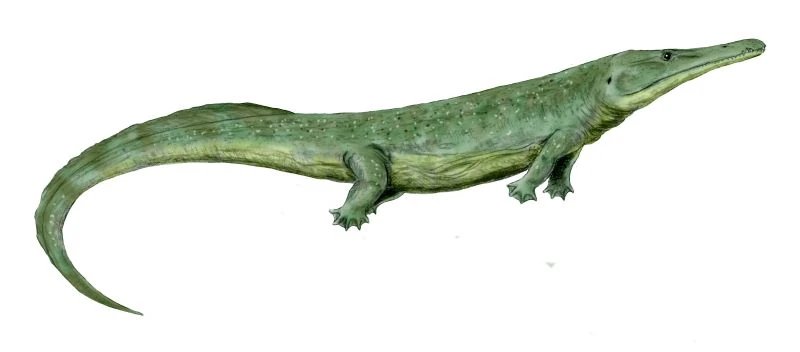
Prionosuchus plummeri represents one of the most remarkable and enigmatic creatures of the Paleozoic Era, a colossal amphibian that thrived in the freshwater ecosystems of what is now Brazil during the Middle Permian period, approximately 270 million years ago. As the largest known amphibian of all time, its immense size and specialized, crocodile-like form make it a subject of significant paleontological interest. Prionosuchus provides a unique window into the diversity of life before the rise of the dinosaurs and showcases the evolutionary extremes that amphibians could achieve in a world vastly different from our own.
The physical characteristics of Prionosuchus are nothing short of astounding, primarily defined by its sheer scale and its striking convergent evolution with modern crocodilians, particularly the gharial. Based on fragmentary fossil remains, paleontologists have extrapolated its total body length to be as much as 9 meters (approximately 30 feet), making it significantly larger than any living amphibian and rivaling the size of many large dinosaurs and modern saltwater crocodiles. Its weight is estimated to have been in the range of 1 to 2 metric tons. The most distinctive feature was its exceptionally long, slender snout, or rostrum, which was lined with numerous sharp, conical teeth, perfectly adapted for capturing fish. This elongated jaw structure, similar to that of a modern gharial, suggests a highly specialized piscivorous diet. The skull alone could have been over 1.6 meters long. Its body was elongated and streamlined, with relatively short, weak limbs positioned to the sides, indicating it was a predominantly aquatic animal, likely awkward and slow on land. The tail was long and powerful, probably flattened laterally to act as a primary means of propulsion through water, much like a crocodile's. Its skin was likely smooth and permeable like that of modern amphibians, requiring constant moisture, which would have further tethered it to its aquatic environment.
The paleobiology of Prionosuchus is inferred largely from its anatomy and the environment in which its fossils were found. Its gharial-like snout and sharp, needle-like teeth strongly indicate it was an ambush predator specializing in catching fish and possibly other small aquatic vertebrates. It likely lurked in the murky depths of rivers and lagoons, using its long jaws to snap up unsuspecting prey with a swift sideways motion of its head. Its eyes and nostrils were positioned high on its skull, allowing it to remain almost completely submerged while waiting for prey, a classic ambush predator adaptation seen in modern crocodilians and hippos. Locomotion in the water would have been achieved through powerful, serpentine undulations of its body and tail, with its small limbs used for steering or for pushing off the substrate. On the rare occasions it may have ventured onto land, perhaps to bask or move between bodies of water, its movement would have been slow and cumbersome. Due to its massive size, it is believed that Prionosuchus had a relatively slow metabolism, similar to that of modern large reptiles, allowing it to survive on infrequent large meals. There is no direct evidence for social behavior, but it is plausible that they were solitary hunters, given their predatory niche. Growth patterns were likely slow and extended over many years to reach such a colossal size.
Prionosuchus lived during the Cisuralian epoch of the Permian period, a time when the supercontinent of Pangea dominated the globe. The climate in the region of modern-day Brazil was likely warm and seasonally arid, characterized by extensive river systems, lakes, and lagoons that would swell during wet seasons and shrink during dry periods. The Pedra de Fogo Formation, where its fossils are found, preserves a rich freshwater and brackish water ecosystem. Prionosuchus was undoubtedly the apex predator of its aquatic environment. It shared this habitat with a variety of other organisms, including other temnospondyl amphibians, early reptiles, and a diverse array of fish, which formed its primary food source. The food web would have placed Prionosuchus at the very top, with no known predators capable of threatening a full-grown adult. It likely preyed upon lungfish, ancient coelacanths, and other large fish that populated these Permian waterways. The presence of such a large aquatic predator highlights the productivity of these freshwater ecosystems and the ecological niches available for amphibians to exploit before being largely outcompeted by the more adaptable and terrestrial archosaurs that rose to prominence in the subsequent Triassic period.
The discovery and history of Prionosuchus are rooted in the mid-20th century paleontological exploration of South America. The organism was first described and named by the renowned American paleontologist Llewellyn Ivor Price in 1948. The fossils were unearthed from the Pedra de Fogo (meaning 'Rock of Fire') Formation in the Parnaíba Basin of northeastern Brazil. The specific name, *plummeri*, honors F. B. Plummer, a geologist who had worked extensively in the region. The holotype specimen, and indeed all known material of Prionosuchus, is highly fragmentary. The initial description was based on a partial rostrum, vertebrae, and limb bone fragments. No complete or even partially articulated skeleton of Prionosuchus has ever been found. This scarcity of well-preserved material has made reconstructing the animal a significant challenge, with size estimates and life appearance being based on extrapolations from the proportions of its better-known, albeit much smaller, relatives within the Archegosauridae family, such as Archegosaurus. The fragmentary nature of the fossils is the primary reason why this giant of the Paleozoic is not more widely known to the public, as a complete skeletal mount cannot be constructed without significant artistic license.
In the grand tapestry of life, Prionosuchus holds a significant place as a member of the Temnospondyli, a large and diverse order of early amphibians that flourished for over 200 million years, from the Carboniferous to the Cretaceous. Temnospondyls are considered to be closely related to the ancestors of modern amphibians (lissamphibians), though the exact relationship is a subject of ongoing research. Prionosuchus, as a member of the family Archegosauridae, represents a highly specialized lineage within this group that adapted to a fully aquatic, predatory lifestyle, converging remarkably on the body plan of later crocodilians. This evolutionary path demonstrates how different vertebrate groups can independently arrive at similar anatomical solutions to occupy a specific ecological niche—in this case, that of a large, freshwater ambush predator. Prionosuchus is a testament to the evolutionary potential of early amphibians, showing they were not merely small, transitional creatures but could evolve into fearsome apex predators that dominated their ecosystems. Its existence pushes the known size limits for Amphibia to an extreme, showcasing a level of gigantism in the group that has never been achieved since.
Despite its impressive status, Prionosuchus is not without scientific debate, primarily centered on its classification and maximum size. While it is generally placed within the family Archegosauridae, the highly fragmentary nature of its fossils makes its precise phylogenetic relationships challenging to resolve with absolute certainty. Some early interpretations questioned whether all the referred fossil material truly belonged to a single species. The most significant area of debate, however, revolves around its estimated 9-meter length. This figure is an extrapolation based on the proportions of smaller, more complete archegosaurid skeletons. While widely cited, some paleontologists argue for a more conservative estimate, suggesting that Prionosuchus may have had a disproportionately large head for its body, which would result in a shorter total body length. Without the discovery of more complete skeletal remains, particularly a skull associated with a vertebral column, the true size and proportions of this Permian giant will remain a topic of discussion and revision. New fossil discoveries in the Parnaíba Basin could dramatically alter our understanding of this enigmatic creature.
The fossil record of Prionosuchus is exclusively confined to the Pedra de Fogo Formation in the states of Piauí and Maranhão in northeastern Brazil. This geological formation is known for preserving a unique assemblage of Permian fauna from a low-latitude, tropical region of Pangea. The fossils of Prionosuchus are considered rare and are always fragmentary. The known material consists of isolated pieces of the elongated snout, skull fragments, vertebrae, and parts of the limb girdles. The preservation quality is generally fair; the bones are often disarticulated and scattered, suggesting they were transported by water currents before burial. This taphonomic context makes finding an articulated skeleton highly unlikely. The lack of a single, substantially complete specimen means that our entire understanding of this animal is a composite picture pieced together from the remains of multiple individuals found at different times and locations within the formation. Despite the fragmentary evidence, the sheer size of the individual bones leaves no doubt as to the colossal dimensions of the living animal.
Due to the scarcity of its fossil remains and the lack of a complete skeleton for display, Prionosuchus has had a limited cultural impact compared to more famous prehistoric animals like Tyrannosaurus rex or Triceratops. It is not a household name and rarely appears in mainstream popular culture such as films or television series. However, it is well-regarded within paleontological circles and among enthusiasts of prehistoric life for its status as the largest amphibian ever known. Some natural history museums may feature illustrations or life-sized models of its head and snout to convey its immense scale. Its primary importance lies in its educational value, serving as a powerful example of convergent evolution, amphibian diversity, and the unique ecosystems that existed during the Permian period, long before the age of dinosaurs began.
Classification
Time Period
Discovery
Location
Brazil
Formation
Pedra de Fogo Formation
Frequently Asked Questions
What is Prionosuchus?
Prionosuchus plummeri represents one of the most remarkable and enigmatic creatures of the Paleozoic Era, a colossal amphibian that thrived in the freshwater ecosystems of what is now Brazil during the Middle Permian period, approximately 270 million years ago. As the largest known amphibian of all ...
When did Prionosuchus live?
Prionosuchus lived during the permian period of the paleozoic era approximately 270-260 million years ago.
Where was Prionosuchus discovered?
Fossils of Prionosuchus were discovered in Brazil in the Pedra de Fogo Formation.
What did Prionosuchus eat?
Prionosuchus was a carnivore. It lived in freshwater habitats.
What type of fossil is Prionosuchus?
Prionosuchus is preserved as a body fossil. The preservation quality is fair.
Related Specimens
From the paleozoic era · body fossils
/cc86f4a1bc00.jpg)
/929f881473a0.jpg)