Plateosaurus
Plateosaurus engelhardti
Image: File:Plateosaurus engelhardti.jpg - Wikimedia Commons (CC BY-SA)
About Plateosaurus
Plateosaurus engelhardti, a name translating to broad lizard, stands as one of the most fundamentally important and extensively studied dinosaurs of the Mesozoic Era, specifically dominating the terrestrial ecosystems of the Late Triassic period between approximately 214 and 204 million years ago. As an early and highly successful member of the sauropodomorph lineage, this large, strictly herbivorous dinosaur roamed across the prehistoric landscapes of what is now Europe, leaving behind an extraordinary fossil legacy that has profoundly shaped modern paleontology. Its abundant remains, particularly those recovered from the renowned Trossingen Formation in Germany, make Plateosaurus a critical cornerstone species for scientific inquiries regarding the evolutionary transition from small, agile, bipedal ancestors to the colossal, quadrupedal sauropod giants that would later shake the earth during the Jurassic and Cretaceous periods.
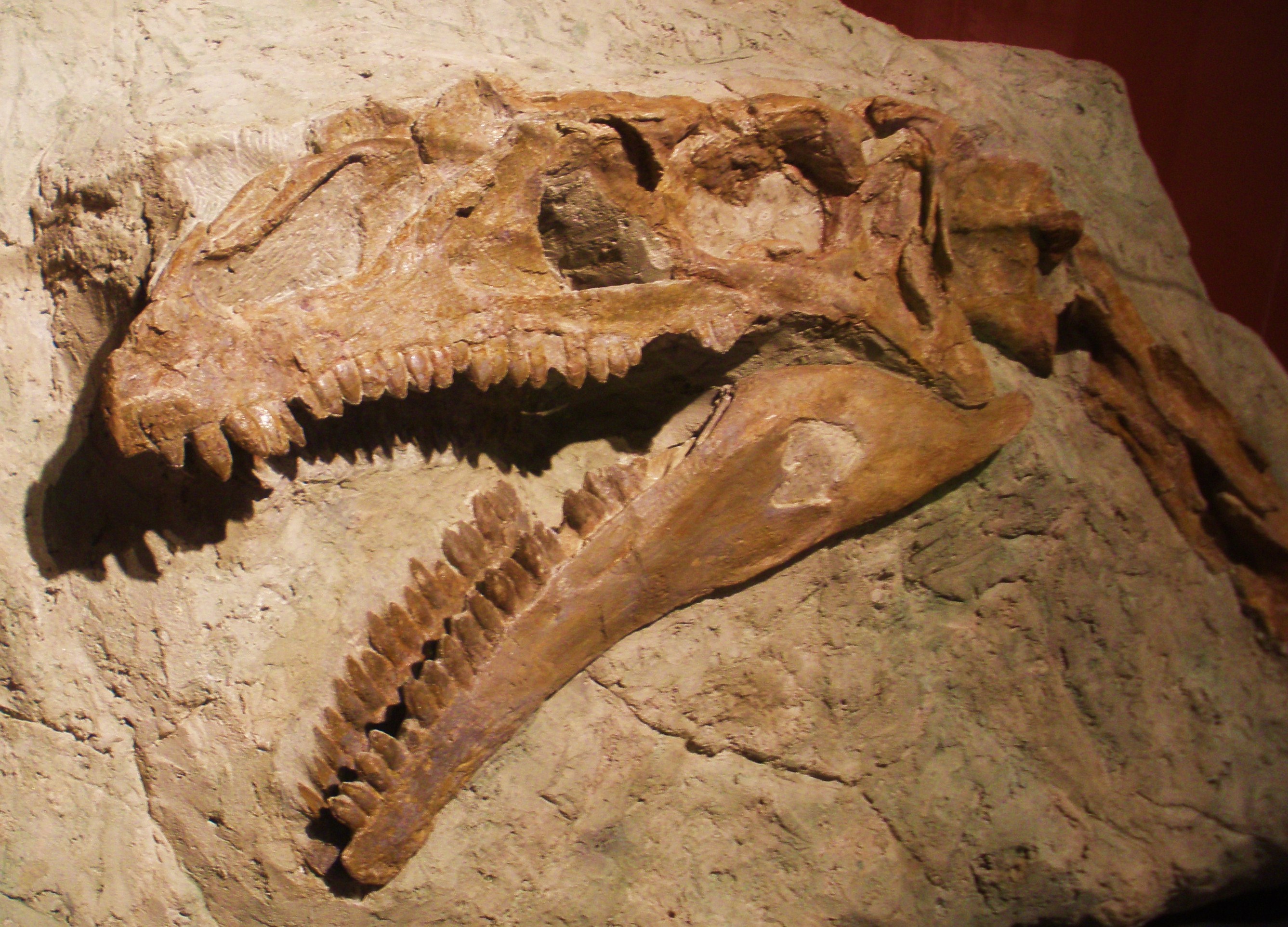
The physical anatomy of Plateosaurus presents a fascinating mosaic of primitive and advanced traits, characterizing an animal that was both massive and surprisingly dynamic. Adult individuals exhibited a remarkable range in body size, with fully grown specimens measuring anywhere from 480 to 1000 centimeters in length, and their weight is estimated to have varied drastically from 600 kilograms to over 4000 kilograms. This immense variation was not merely a result of sexual dimorphism but rather a unique physiological trait. The dinosaur possessed a characteristically small, narrow, and deep skull perched atop a remarkably long, flexible neck composed of elongated cervical vertebrae. Its jaws were lined with robust, leaf-shaped, coarsely serrated teeth perfectly adapted for stripping foliage from Triassic vegetation. Behind the neck, Plateosaurus featured a bulky, barrel-shaped torso designed to house the massive digestive tract necessary for fermenting tough, fibrous plant matter. Its forelimbs were notably shorter than its powerful hindlimbs and were equipped with highly specialized hands. The most prominent feature of the forelimb was a massive, sharp, recurved thumb claw on the first digit, which was likely utilized for defense against predators, for intraspecific combat, or for grasping and pulling down high branches during feeding. The hind legs were heavily muscled and supported the animal's entire weight in a digitigrade stance, meaning it walked on its toes much like modern birds. Extending behind the bulky body was a long, heavy, and highly mobile tail that comprised nearly half of the animal's total length, serving as a crucial counterbalance to the forward weight of the torso, neck, and head. In terms of overall proportions, one might compare Plateosaurus to a modern ostrich in its bipedal posture, but scaled up to the immense bulk and weight of a rhinoceros or a small elephant, creating a truly unique biomechanical profile.
The paleobiology of Plateosaurus has been the subject of intense scientific scrutiny, revealing a highly specialized herbivore with complex behaviors and unique physiological adaptations. Its diet consisted entirely of the dominant flora of the Late Triassic, which included tough cycads, bennettitales, seed ferns, and early conifers. Because its teeth were designed only for cropping and stripping rather than chewing, Plateosaurus swallowed plant matter whole. Unlike later sauropods, there is little evidence to suggest Plateosaurus relied heavily on swallowed stones, or gastroliths, to grind its food; instead, it likely depended entirely on prolonged microbial fermentation within its massive hindgut to extract nutrients. For decades, the locomotion of Plateosaurus was a subject of debate, with many early reconstructions depicting it walking on all fours. However, rigorous biomechanical analyses of its forelimb anatomy have conclusively demonstrated that its hands could not be pronated; that is, Plateosaurus could not turn its palms downward to support its weight on the ground. Consequently, it was an obligate biped, relying entirely on its powerful hind legs for walking and running, while its arms remained free for foraging and defense. Behaviorally, the sheer concentration of Plateosaurus fossils in localized areas strongly implies that these animals were gregarious, likely moving across the Triassic landscape in large herds or aggregations, perhaps migrating in search of food or water during seasonal shifts. One of the most astonishing discoveries regarding Plateosaurus paleobiology comes from the study of its bone histology. Paleontologist Martin Sander and his colleagues discovered that Plateosaurus exhibited developmental plasticity, a growth pattern more commonly seen in modern reptiles and fish than in other dinosaurs or mammals. Instead of reaching a fixed adult size, the final size of a Plateosaurus individual was highly dependent on environmental factors such as food availability and climate conditions. Some individuals ceased growing at just under five meters, while others living in more favorable conditions continued to grow until they reached ten meters, explaining the massive size disparities found in the fossil record.
During the Late Triassic, the ecological context in which Plateosaurus thrived was vastly different from the modern world. The Earth's landmasses were amalgamated into the supercontinent of Pangea, and the region that is now Europe was situated relatively close to the equator, forming a complex archipelago of islands and shallow inland seas known as the Germanic Basin. The climate of this era was generally hot and arid, characterized by strong monsoonal weather patterns with distinct, severe wet and dry seasons. Plateosaurus inhabited the semi-arid plains and river valleys of this environment, relying on the seasonal flush of vegetation along watercourses. As a primary consumer, it occupied a foundational position in the terrestrial food web, processing vast amounts of plant biomass. It shared its habitat with a diverse array of early Mesozoic fauna. Co-existing species included early turtles like Proganochelys, large amphibians, and various archosaurs. Plateosaurus would have needed to remain vigilant against the apex predators of its time, which included large, terrestrial pseudosuchians like the rauisuchians, as well as early theropod dinosaurs such as Liliensternus and Halticosaurus. The massive size of an adult Plateosaurus, combined with its formidable thumb claws and herd behavior, likely provided substantial protection against these predators, meaning that only the sick, young, or elderly individuals were typically vulnerable to predation.
The history of the discovery of Plateosaurus is deeply intertwined with the very dawn of paleontology as a scientific discipline. The first fossilized remains of this remarkable creature were unearthed in 1834 by physician Johann Friedrich Engelhardt in the red sandstones of Heroldsberg, located near Nuremberg, Germany. Recognizing the significance of the large, unfamiliar bones, Engelhardt sent them to the eminent German paleontologist Hermann von Meyer. In 1837, von Meyer formally described and named the specimen Plateosaurus engelhardti, honoring the discoverer in the specific epithet and deriving the genus name from Greek roots meaning broad lizard, likely in reference to the broad, robust nature of the fossilized limb bones. This naming occurred several years before Sir Richard Owen even coined the term Dinosauria in 1842, making Plateosaurus one of the earliest dinosaurs ever known to science. Following this initial discovery, the late 19th and early 20th centuries yielded an explosion of Plateosaurus fossils. Between 1911 and 1932, extensive excavations in the Trossingen Formation in southwestern Germany, led by paleontologists such as Eberhard Fraas and later Friedrich von Huene, uncovered massive bone beds containing dozens of beautifully preserved, articulated skeletons. These discoveries earned the dinosaur the local moniker of the Swabian Lindworm, referencing the mythical dragons of European folklore. Subsequent major excavations at Halberstadt in Saxony-Anhalt and the Frick clay pit in Switzerland further cemented Plateosaurus as one of the most abundantly represented dinosaurs in the global fossil record, providing an unprecedented wealth of material for anatomical and evolutionary study.
In the grand scheme of vertebrate evolution, Plateosaurus holds an incredibly significant position as a transitional form that illuminates the early radiation of the Dinosauria. Taxonomically classified as a basal sauropodomorph, it belongs to a group traditionally referred to as prosauropods. For many years, paleontologists debated whether prosauropods were the direct ancestors of the giant, quadrupedal sauropods of the Jurassic and Cretaceous, such as Brachiosaurus, Apatosaurus, and Diplodocus, or if they represented a specialized, dead-end sister lineage. Modern cladistic analyses generally indicate that while Plateosaurus itself may not be the direct, linear ancestor to the later giants, it is a very close relative to that ancestral line, perfectly illustrating the morphological steps required to evolve from small, carnivorous, bipedal ancestors into colossal, herbivorous quadrupeds. Plateosaurus demonstrates key transitional features, such as the elongation of the neck, the reduction in skull size relative to the body, and the expansion of the gut cavity for herbivory. By studying Plateosaurus, scientists can trace the evolutionary trajectory of the sauropodomorphs, observing how the shift to an obligate herbivorous diet necessitated profound changes in dental morphology, digestive physiology, and ultimately, body size and locomotion. It serves as a crucial biological bridge, connecting the dawn of the dinosaurs in the Triassic to the earth-shaking titans that would follow millions of years later.
Despite the abundance of fossil material, Plateosaurus has been at the center of several intense scientific debates over the decades. Beyond the aforementioned controversies regarding its locomotion and its exact phylogenetic placement, one of the most enduring debates concerns the nature of the massive bone beds in which it is frequently found. For a long time, the prevailing hypothesis, championed by Friedrich von Huene, was that these aggregations represented herds of Plateosaurus that perished together in catastrophic events, such as sudden flash floods or severe, prolonged droughts that forced them to congregate around shrinking water holes where they ultimately died of dehydration. However, a more recent and widely debated theory proposed by paleontologist David Weishampel and others is the mud miring hypothesis. This theory suggests that the bone beds do not represent single, catastrophic mass deaths, but rather the gradual accumulation of individuals over hundreds or thousands of years. According to this model, heavy, bipedal animals like Plateosaurus would occasionally wander into deep, treacherous mudflats during the wet season. Their immense weight and bipedal stance caused them to become hopelessly trapped in the mire, while lighter, quadrupedal animals could safely navigate the same terrain. The trapped dinosaurs would die of starvation or exhaustion, and their lower halves would be preserved in the anoxic mud, while their upper bodies were scavenged by predators, perfectly explaining the specific taphonomic preservation patterns observed at sites like Trossingen.
The fossil record of Plateosaurus is arguably one of the most complete and spectacular of any dinosaur, providing an unparalleled window into Triassic life. To date, the remains of well over one hundred individuals have been excavated, ranging from partial, disarticulated bone scatters to nearly complete, fully articulated skeletons. The geographic distribution of these fossils is primarily concentrated in Central Europe, with the most famous and productive sites located in Germany, specifically the Trossingen Formation and the Baake quarry in Halberstadt, as well as the Gruhalde clay pit in Frick, Switzerland. Fossils attributed to Plateosaurus or very closely related genera have also been reported from France and even as far away as the Fleming Fjord Formation in Greenland, suggesting a broad geographic range across the northern hemisphere of Pangea. The preservation quality at these sites is often exceptional, with three-dimensional preservation of bones that allows for detailed biomechanical modeling, histological sectioning, and even the reconstruction of the brain cavity and inner ear through advanced CT scanning. This sheer volume of high-quality data makes Plateosaurus a standard reference taxon in dinosaur paleontology, serving as the baseline against which other early dinosaurs are compared and analyzed.
The cultural impact of Plateosaurus is significant, particularly within Europe, where it is celebrated as a paleontological treasure. Because of the sheer number of complete skeletons recovered, Plateosaurus is a staple of museum exhibitions worldwide. Spectacular, mounted skeletons can be viewed at the State Museum of Natural History in Stuttgart, the Senckenberg Museum in Frankfurt, the Museum of Nature in Winterthur, Switzerland, and the American Museum of Natural History in New York. In popular culture, while it may not possess the cinematic fame of Tyrannosaurus rex or Velociraptor, Plateosaurus frequently appears in documentaries, educational literature, and paleontology books focusing on the Triassic period, often depicted defending itself against predators with its massive thumb claws. Educationally, it serves as the quintessential example of early dinosaur evolution, teaching generations of students about the concepts of deep time, anatomical adaptation, and the dynamic, ever-changing nature of life on Earth. Through its extensive fossil record and the centuries of scientific inquiry it has inspired, Plateosaurus engelhardti remains an enduring icon of the ancient world.
Classification
Time Period
Discovery
Location
Heroldsberg, near Nuremberg, Germany
Formation
Trossingen Formation
Frequently Asked Questions
What is Plateosaurus?
Plateosaurus engelhardti, a name translating to broad lizard, stands as one of the most fundamentally important and extensively studied dinosaurs of the Mesozoic Era, specifically dominating the terrestrial ecosystems of the Late Triassic period between approximately 214 and 204 million years ago. A...
When did Plateosaurus live?
Plateosaurus lived during the triassic period of the mesozoic era approximately 214-204 million years ago.
Where was Plateosaurus discovered?
Fossils of Plateosaurus were discovered in Heroldsberg, near Nuremberg, Germany in the Trossingen Formation.
What did Plateosaurus eat?
Plateosaurus was a herbivore. It lived in terrestrial habitats.
What type of fossil is Plateosaurus?
Plateosaurus is preserved as a body fossil. The preservation quality is good.
Related Specimens
From the mesozoic era · body fossils