Priscacara
Priscacara liops
Image: Image sourced via web search (Fair use / Educational)
About Priscacara
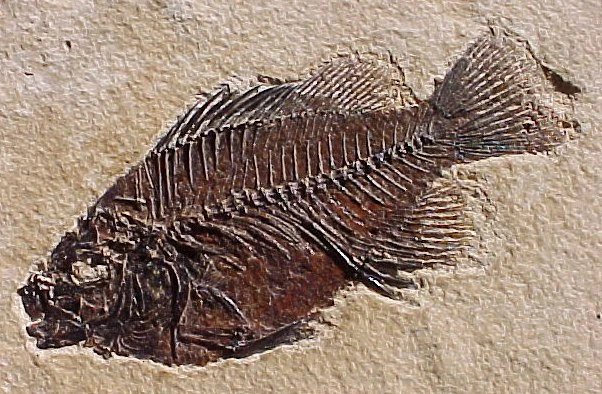
Priscacara liops is an extinct species of freshwater ray-finned fish that thrived during the Eocene epoch, approximately 52 to 48 million years ago. It is one of the most iconic and recognizable fossil vertebrates recovered from the world-renowned Green River Formation of western North America, specifically within the ancient lake systems that once covered parts of modern-day Wyoming, Utah, and Colorado. As a member of the diverse order Perciformes, Priscacara represents an important early lineage of advanced teleost fishes, offering paleontologists a remarkably clear window into the evolutionary history and ecological dynamics of early Cenozoic freshwater ecosystems. Its exceptional preservation in fine-grained limestone has made it a cornerstone species for understanding the rapid diversification of perch-like fishes following the Cretaceous-Paleogene extinction event. The physical anatomy of Priscacara liops is characterized by a deep, laterally compressed body profile that bears a striking superficial resemblance to modern centrarchids, such as the bluegill or crappie, though they are not directly related. Adult specimens of Priscacara liops typically measure between 10 and 15 centimeters in length, making them relatively small compared to their larger congener, Priscacara serrata, which could reach lengths of over 38 centimeters. The body of Priscacara was covered in small, overlapping ctenoid scales, which possessed tiny tooth-like projections on their posterior edges, giving the fish a rough texture in life and aiding in hydrodynamic efficiency. One of the most distinctive skeletal features of Priscacara is its robust dorsal and anal fins, which were armed with thick, sharp, and highly ossified spines. The dorsal fin typically featured 10 to 11 stout spines followed by a softer, rayed section, while the anal fin possessed three prominent spines. These defensive structures would have made the fish difficult for predators to swallow. The mouth was relatively small and positioned terminally, equipped with fine, conical teeth on the jaws and specialized, robust pharyngeal teeth located in the throat. Soft tissue inferences, drawn from the exceptional preservation of melanosomes and other organic residues in some Green River specimens, suggest that Priscacara may have possessed vertical banding or mottled coloration to help camouflage it within the dappled light of its aquatic habitat. The paleobiology of Priscacara liops reveals a highly adaptable and successful organism that occupied a specific mid-level niche within its ecosystem. Based on its functional morphology, particularly the presence of robust pharyngeal tooth plates, paleontologists have deduced that Priscacara liops was primarily a durophagous carnivore, meaning it specialized in crushing hard-shelled prey. Its diet likely consisted of freshwater snails, small bivalves, crustaceans, and aquatic insect larvae that inhabited the benthic and macrophytic zones of the ancient lakes. The small, terminal mouth suggests it was a precise picker rather than a ram-feeder, carefully selecting prey items from the substrate or aquatic vegetation. Its deep-bodied shape indicates that Priscacara was not built for sustained, high-speed cruising, but rather for high maneuverability in complex environments, such as submerged forests or dense algal beds. It could likely pivot quickly to snatch prey or dart into cover to avoid predators. Fossil evidence, including mass mortality layers containing numerous individuals of similar size, suggests that Priscacara liops may have exhibited schooling or shoaling behavior, at least during certain stages of its life cycle or during specific environmental events, such as seasonal spawning aggregations or in response to localized anoxic events in the lake bottom. Growth rings preserved in their otoliths (ear stones) and scales indicate seasonal variations in their environment, with rapid growth during the warm, productive summer months and slower growth during the cooler winter periods. The ecological context of Priscacara liops was defined by the spectacular Green River lake system, a series of three massive, interconnected endorheic lakes—Lake Gosiute, Lake Uinta, and Fossil Lake—that existed in a subtropical to warm-temperate climate during the Early Eocene Climatic Optimum. The landscape surrounding these lakes was lush and heavily forested, featuring palm trees, sycamores, ferns, and early angiosperms, supporting a diverse array of terrestrial life, including early primates, primitive horses like Eohippus, and large flightless birds. Within the lakes themselves, Priscacara liops was a vital component of a complex food web. It shared its habitat with billions of small, schooling clupeomorph fishes like Knightia and Diplomystus, which fed on plankton and served as the primary prey base for the ecosystem. Priscacara would have navigated the middle and lower water columns, foraging for invertebrates while constantly remaining vigilant for apex predators. These predators included massive, predatory fishes like the gar Lepisosteus, the bowfin Amia, and the giant osteoglossomorph Phareodus, which possessed formidable, toothy jaws capable of capturing a spiny Priscacara. Additionally, the waters and shorelines were patrolled by crocodilians, softshell turtles, and fish-eating birds such as the early frigatebird Limnofregata, all of which posed a threat to the fossil sunfish. The discovery history of Priscacara is deeply intertwined with the pioneering days of American vertebrate paleontology in the late 19th century. The genus was first formally described and named by the legendary paleontologist Edward Drinker Cope in 1877, during the intense period of scientific exploration often referred to as the Bone Wars. Cope based his description on specimens collected during the geological surveys of the American West, specifically those led by Ferdinand Vandeveer Hayden. The name Priscacara translates from Latin and Greek roots to mean 'primitive head' or 'ancient face,' reflecting its status as an early representative of the advanced teleost fishes. Over the subsequent decades, thousands of specimens of Priscacara liops were unearthed by both academic researchers and commercial fossil hunters, particularly from the famous '18-inch layer' and 'split-fish' layers of Fossil Butte in Wyoming. These layers represent distinct depositional environments within Fossil Lake, where unique chemical and biological conditions led to the rapid burial and mummification of organic remains. While there is no single famous specimen akin to the Tyrannosaurus 'Sue,' the sheer volume and perfection of Priscacara fossils have made them ubiquitous in museum collections worldwide, serving as standard reference material for Eocene ichthyology. The evolutionary significance of Priscacara lies in its position near the base of the massive evolutionary radiation of the Perciformes, the largest order of vertebrates, which today includes over 10,000 species ranging from cichlids and wrasses to tuna and gobies. As a basal percomorph, Priscacara exhibits a mosaic of primitive and derived anatomical traits that help researchers map the sequence of morphological changes that occurred as teleost fishes adapted to new ecological niches following the end-Cretaceous mass extinction. For many years, the exact phylogenetic placement of Priscacara was a subject of considerable debate, with various researchers suggesting affinities to modern centrarchids (sunfishes), cichlids, or moronids (temperate basses). Current consensus, based on detailed cladistic analyses of its osteology, places Priscacara within its own extinct family, the Priscacaridae, which is considered a stem group within the broader percomorph radiation. Studying Priscacara allows evolutionary biologists to understand how features like spiny fin rays, protrusible jaws, and specialized pharyngeal dentition evolved and contributed to the unparalleled success of modern perch-like fishes in both marine and freshwater environments across the globe. Scientific debates surrounding Priscacara have primarily focused on its taxonomy and the paleoenvironmental interpretations of its fossil deposits. One ongoing area of discussion is the precise delineation between species within the genus. While Priscacara liops and the larger Priscacara serrata are generally recognized as distinct species based on size, fin ray counts, and body proportions, some researchers have historically questioned whether they might represent sexual dimorphism or different ontogenetic (growth) stages of a single species. However, the discovery of distinct juvenile specimens of both morphotypes has largely supported their separation into two valid species. Another debate involves the specific mechanisms of preservation in the Green River Formation. While it is widely accepted that anoxic bottom waters prevented scavenging and decay, the exact causes of the mass mortality events that killed thousands of Priscacara and other fishes simultaneously remain contested. Hypotheses range from seasonal algal blooms producing neurotoxins, to sudden temperature overturns in the stratified lakes, to volcanic ash falls from nearby tectonic activity altering the water chemistry. The fossil record of Priscacara liops is almost entirely restricted to the Green River Formation of the western United States, but within this localized geographic area, it is incredibly abundant. Fossils are predominantly found in the Fossil Butte Member of southwestern Wyoming, which represents the deposits of the smallest but deepest of the three Eocene lakes, Fossil Lake. The preservation quality is routinely exceptional; specimens are often found fully articulated, with every bone, fin ray, and scale perfectly aligned in life position. In the finest-grained micritic limestones, even delicate structures like gill filaments, stomach contents, and the dark organic outlines of the skin and eyes are preserved. The fossils are typically recovered by splitting slabs of laminated limestone along their bedding planes, revealing the flattened, two-dimensional skeletons within. Because of the high volume of commercial quarrying in the region, Priscacara is one of the most thoroughly documented fossil vertebrates in the world, providing a statistically significant sample size that allows for detailed population studies and morphometric analyses. The cultural impact of Priscacara liops extends far beyond the halls of academic paleontology. Because of their aesthetic beauty, relatively small size, and abundance, Priscacara fossils have become highly sought after by private collectors and are a staple of rock shops, nature stores, and educational supply catalogs worldwide. They serve as accessible entry points for the public to engage with paleontology, often being the first 'real' fossil a young enthusiast might see or own. Museums across the globe feature Green River dioramas, with Priscacara prominently displayed alongside Knightia and palm fronds to illustrate the concept of a complete prehistoric ecosystem. Furthermore, the commercial fossil industry centered around these fishes provides significant economic support to local communities in Wyoming, while cooperative agreements between quarries and researchers ensure that scientifically important specimens, such as those with unique pathologies or preserved soft tissues, are saved for public trust and scientific study.
Classification
Time Period
Discovery
Location
Wyoming, USA
Formation
Green River Formation
Frequently Asked Questions
What is Priscacara?
Priscacara liops is an extinct species of freshwater ray-finned fish that thrived during the Eocene epoch, approximately 52 to 48 million years ago. It is one of the most iconic and recognizable fossil vertebrates recovered from the world-renowned Green River Formation of western North America, spec...
When did Priscacara live?
Priscacara lived during the paleogene period of the cenozoic era approximately 52-48 million years ago.
Where was Priscacara discovered?
Fossils of Priscacara were discovered in Wyoming, USA in the Green River Formation.
What did Priscacara eat?
Priscacara was a carnivore. It lived in freshwater habitats.
What type of fossil is Priscacara?
Priscacara is preserved as a body fossil. The preservation quality is exceptional.
Related Specimens
From the cenozoic era · body fossils