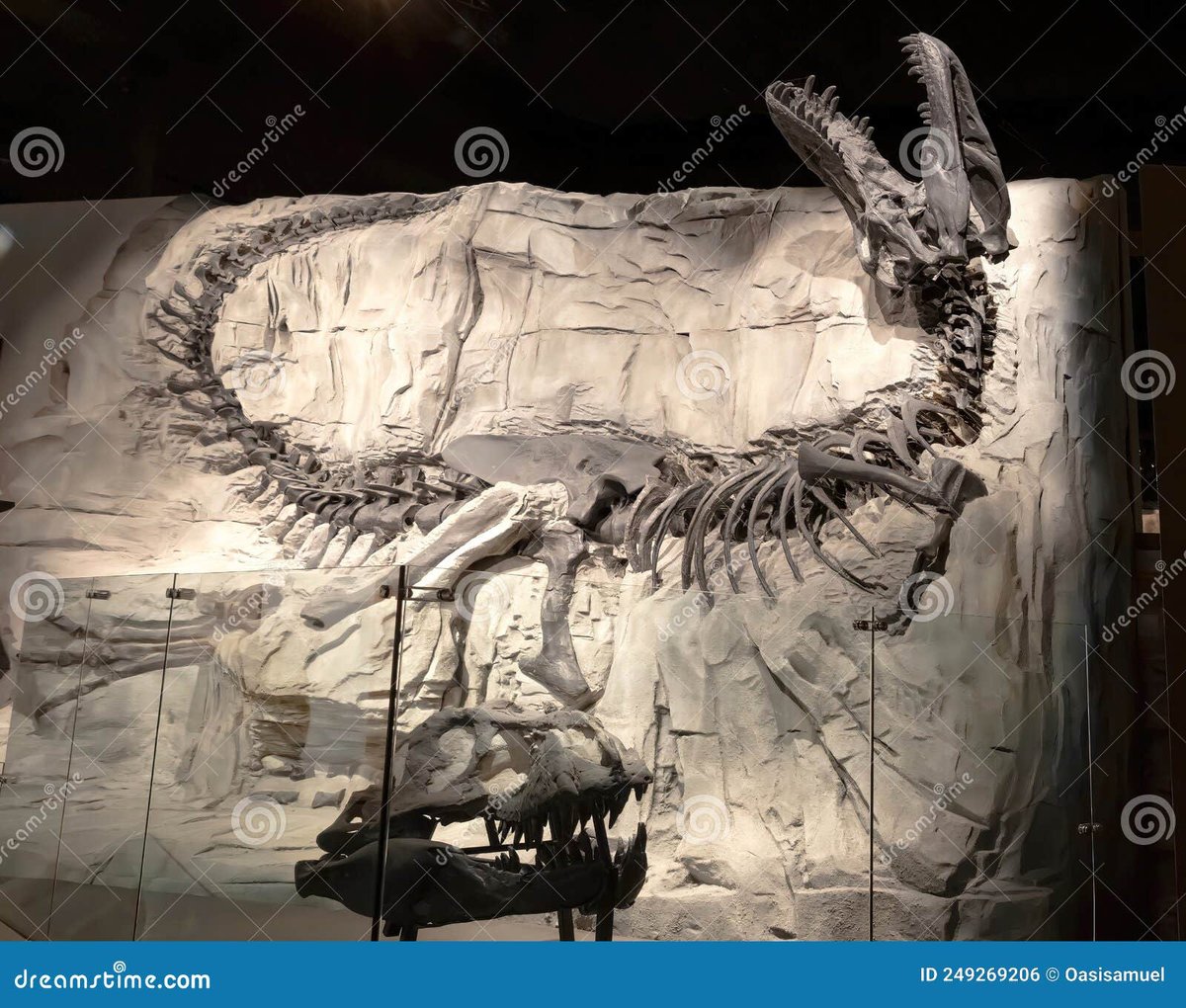
Trix the T. rex (RGM 792.000)
Tyrannosaurus rex
Image: Image sourced via web search (Fair use / Educational)
About Trix the T. rex (RGM 792.000)
Tyrannosaurus rex, often abbreviated as T. rex, was a colossal bipedal carnivore that roamed western North America during the final two million years of the Cretaceous Period, approximately 68 to 66 million years ago. As one of the last non-avian dinosaurs to exist before the Cretaceous-Paleogene extinction event, it represents the apex of dinosaur evolution in terms of predatory power and size. The specimen known as Trix (RGM 792.000) is a particularly significant individual, offering profound insights into the life, age, and pathology of this iconic species, solidifying its status as a keystone organism for understanding Late Cretaceous ecosystems.
The physical presence of Tyrannosaurus rex was nothing short of awe-inspiring. Adults like Trix reached lengths of up to 12.5 meters (about 41 feet) from snout to tail tip and stood nearly 4 meters (13 feet) tall at the hips. Weight estimates for a mature individual vary, but paleontological consensus places them in the range of 8 to 14 metric tons, comparable to a large African elephant. The skull was immense, up to 1.5 meters long, and uniquely adapted for immense bite forces, estimated to be the strongest of any terrestrial animal. Its teeth were large, conical, and serrated, with some reaching 30 centimeters in length including the root, designed for crushing bone rather than just slicing flesh. Its forelimbs were famously diminutive, possessing only two functional digits, yet were robust and heavily muscled, suggesting they may have played a role in grappling with prey or rising from a resting position. In stark contrast, its hind limbs were massive, pillar-like structures that supported its enormous weight and powered its locomotion. The skeleton was a masterpiece of biomechanical engineering, with a large, stiff tail acting as a counterbalance to its massive head and torso, and a system of hollow, air-filled bones (pneumatization) that reduced weight without sacrificing structural integrity, a feature shared with modern birds.
The paleobiology of T. rex paints a picture of a highly successful apex predator. Its diet consisted primarily of large herbivorous dinosaurs such as the hadrosaurid Edmontosaurus and the ceratopsian Triceratops. The debate over whether T. rex was an active predator or a scavenger has largely been resolved in favor of it being an opportunistic carnivore, capable of both hunting formidable prey and scavenging carcasses when available. Evidence for active predation includes healed T. rex bite marks on the fossils of its prey. Its forward-facing eyes provided excellent binocular vision, crucial for depth perception while hunting. Locomotion studies suggest it was not a fast runner, with top speeds likely around 17 to 25 kilometers per hour (10-15 mph), making it more of a powerful strider than a sprinter. Social behavior remains a topic of speculation, but fossil trackways and bonebeds of related tyrannosaurids suggest some species may have lived in family groups or packs. Growth patterns, determined from bone histology, show a rapid adolescent growth spurt, with individuals reaching near-adult size in about two decades. The specimen Trix is considered to be one of the oldest known T. rex individuals, estimated to have lived for over 30 years, providing a rare look at the species' full lifespan.
Tyrannosaurus rex inhabited a world vastly different from our own. During the Late Cretaceous, its habitat was a humid, subtropical coastal plain, part of the landmass known as Laramidia, which is now western North America. This environment was characterized by lush forests of conifers, ferns, and flowering plants, interspersed with rivers, swamps, and floodplains. The climate was warm, with less pronounced seasonal variation than today. T. rex occupied the undisputed top of the food web, a position with no modern terrestrial analogue. Its primary prey, Triceratops and Edmontosaurus, were abundant megaherbivores. Other contemporary dinosaurs included the armored Ankylosaurus, the dome-headed Pachycephalosaurus, and smaller theropods like Dakotaraptor and Struthiomimus. This complex ecosystem supported a diverse array of life, from crocodiles and turtles in the waterways to small mammals and birds in the undergrowth. The predator-prey dynamic between T. rex and its well-armed contemporaries like Triceratops represents one of the most dramatic and studied interactions in the history of life on Earth, a high-stakes battle between immense power and formidable defense.
The discovery history of Tyrannosaurus rex began in the late 19th century, but the species was officially named by Henry Fairfield Osborn in 1905 based on a partial skeleton found in Montana. The specimen known as Trix has a more recent history. It was unearthed in September 2013 in the Hell Creek Formation of Montana, a region famous for its rich dinosaur fossil deposits. The excavation was a collaborative effort between the Naturalis Biodiversity Center in Leiden, Netherlands, and the Black Hills Institute of Geological Research. The team, led by paleontologists Anne Schulp and Pete Larson, located the specimen after an amateur paleontologist reported finding bone fragments. The excavation was meticulous, yielding a remarkably complete and well-preserved skeleton. Approximately 80% of the skeleton by bone volume was recovered, making Trix one of the most complete T. rex specimens ever found, alongside famous counterparts like 'Sue' (FMNH PR 2081) and 'Stan' (BHI 3033). The specimen was named 'Trix' in honor of the former Queen Beatrix of the Netherlands and was acquired by Naturalis through a national fundraising campaign, becoming a centerpiece of their collection.
In the grand tapestry of life, Tyrannosaurus rex represents the culmination of a long evolutionary lineage of predatory dinosaurs known as tyrannosauroids. This group originated in the Jurassic Period as small, long-armed predators and gradually evolved into the giant, short-armed apex predators of the Late Cretaceous. T. rex's anatomy showcases numerous derived features, such as its massive skull, bone-crushing teeth, and reduced forelimbs, which distinguish it from its earlier relatives like Guanlong or Dilong. Its closest known relative is the slightly older and more slender Tarbosaurus bataar from Asia, a relationship that highlights the faunal interchange between North America and Asia during the Cretaceous. As a coelurosaurian theropod, T. rex is more closely related to modern birds than to other large dinosaurs like Allosaurus or Spinosaurus. This relationship is evident in features like its wishbone (furcula), hollow bones, and three-toed feet, providing a powerful link between the 'terrible lizards' of the Mesozoic and the avian life of today. The study of T. rex and its relatives is crucial for understanding the processes of macroevolution, including trends in body size increase (Cope's rule) and the development of specialized predatory adaptations.
Despite being one of the most studied dinosaurs, T. rex is still at the center of several scientific debates. One persistent controversy involves its taxonomy: some researchers, notably Gregory S. Paul, have proposed splitting the genus Tyrannosaurus into multiple species or even genera, suggesting that differences in skeletal robustness might represent distinct species like 'Tyrannosaurus imperator' and 'Tyrannosaurus regina' in addition to T. rex. However, this proposal has been met with significant skepticism from the broader paleontological community, which largely maintains that these variations represent individual or sexual dimorphism within a single species. Another area of debate concerns its biology, such as the question of whether it possessed feathers. While no direct fossil evidence of feathers has been found for T. rex itself, feathered integument is known from its earlier, smaller relatives like Yutyrannus, leading some scientists to infer that juvenile T. rex may have been feathered, possibly losing them as they grew larger and thermoregulation needs changed. The exact function of its tiny arms also remains a subject of ongoing discussion, with hypotheses ranging from holding prey to assisting in mating or pushing up from the ground.
The fossil record of Tyrannosaurus rex is geographically restricted to the western part of North America, with significant finds coming from the Hell Creek Formation (Montana, the Dakotas, Wyoming), the Lance Formation (Wyoming), and the Scollard Formation (Alberta, Canada). Over 50 partial to near-complete skeletons have been discovered, making it one of the best-represented large theropods. The quality of preservation varies, but specimens like Trix, Sue, and Stan are exceptionally complete, providing nearly full skeletal reconstructions. These fossils are often found in fluvial or floodplain deposits, suggesting the animals lived and died near river systems. The preservation of Trix is particularly noteworthy for its lack of distortion; the skull and other bones are three-dimensionally preserved, offering an unusually clear view of its anatomy. Pathological evidence on Trix's skeleton, including stress fractures, infections, and a bite mark on its jaw, provides a fossilized biography of a long and difficult life, further enriching our understanding of the species.
Tyrannosaurus rex holds an unparalleled position in global culture, symbolizing the power and majesty of the prehistoric world. It is arguably the most famous dinosaur, a staple of books, documentaries, and blockbuster films, most notably the 'Jurassic Park' franchise, which cemented its image as the ultimate predator in the public imagination. Major museums around the world feature T. rex casts or original skeletons as their star attractions, drawing millions of visitors. The specimen Trix has become a scientific and cultural ambassador, undertaking an extensive European tour before being permanently installed at the Naturalis Biodiversity Center in Leiden, where it serves as a powerful tool for public education and scientific outreach, inspiring new generations of scientists and enthusiasts and ensuring the 'tyrant lizard king' continues to reign over our collective fascination with the deep past.
Classification
Time Period
Discovery
Location
Montana, USA
Formation
Hell Creek Formation
Frequently Asked Questions
What is Trix the T. rex (RGM 792.000)?
Tyrannosaurus rex, often abbreviated as T. rex, was a colossal bipedal carnivore that roamed western North America during the final two million years of the Cretaceous Period, approximately 68 to 66 million years ago. As one of the last non-avian dinosaurs to exist before the Cretaceous-Paleogene ex...
When did Trix the T. rex (RGM 792.000) live?
Trix the T. rex (RGM 792.000) lived during the cretaceous period of the mesozoic era approximately 67-66 million years ago.
Where was Trix the T. rex (RGM 792.000) discovered?
Fossils of Trix the T. rex (RGM 792.000) were discovered in Montana, USA in the Hell Creek Formation.
What did Trix the T. rex (RGM 792.000) eat?
Trix the T. rex (RGM 792.000) was a carnivore. It lived in terrestrial habitats.
What type of fossil is Trix the T. rex (RGM 792.000)?
Trix the T. rex (RGM 792.000) is preserved as a body fossil. The preservation quality is excellent.
Related Specimens
From the mesozoic era · body fossils