Rhamphorhynchus
Rhamphorhynchus muensteri
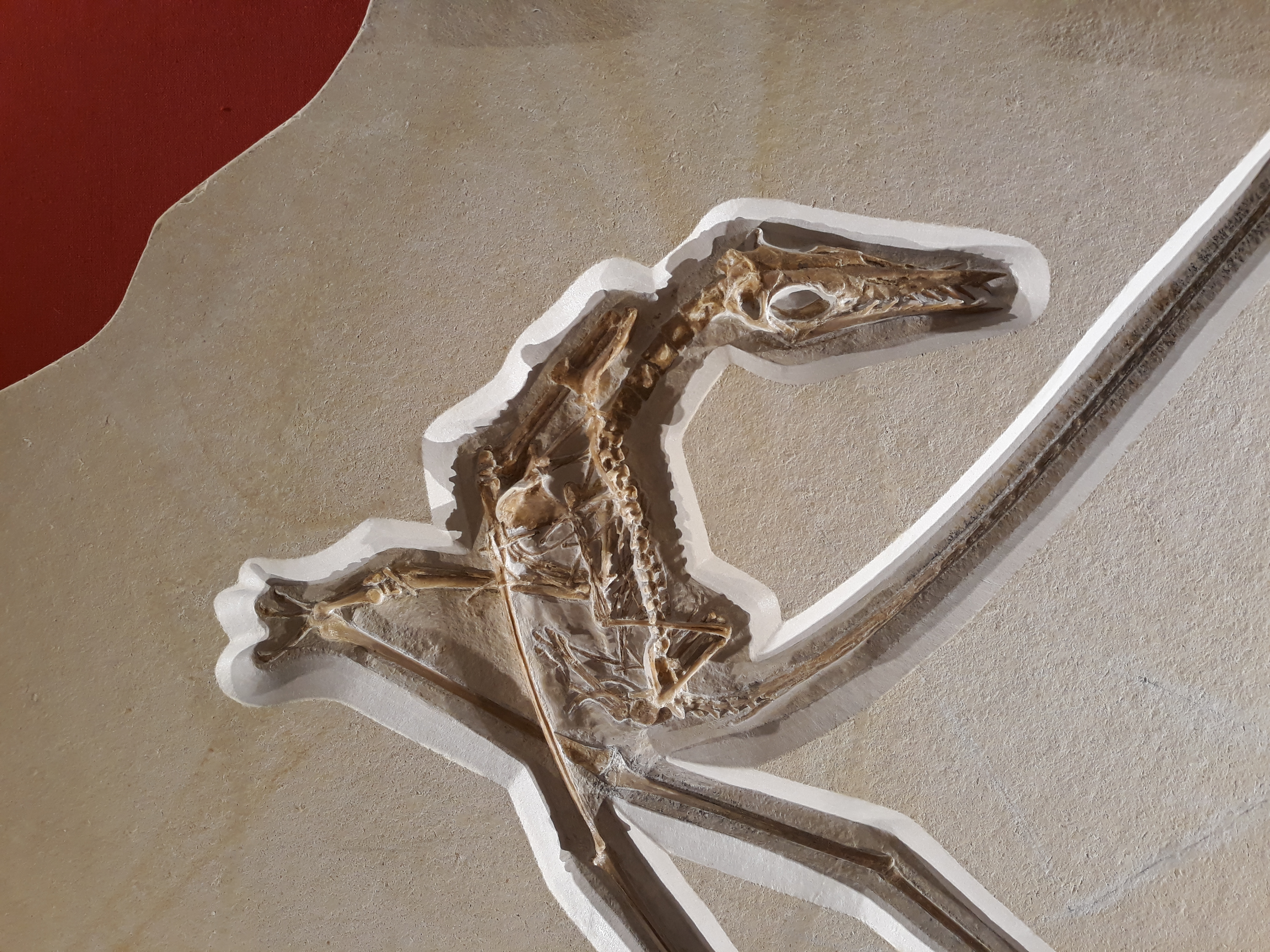
Image: File:Rhamphorhynchus muensteri fossil.jpg - Wikimedia Commons (CC BY-SA)
About Rhamphorhynchus
Rhamphorhynchus muensteri was a highly successful and anatomically distinct flying reptile that inhabited the warm, shallow coastal environments of the Late Jurassic period, approximately 150 to 148 million years ago. As one of the most iconic and thoroughly studied basal pterosaurs, this marine carnivore is celebrated for its exceptionally preserved fossil record, which has provided paleontologists with an unprecedented window into the biology, flight mechanics, and ecological roles of early aerial vertebrates. Its abundant remains, primarily recovered from the world-renowned Solnhofen Limestone of Bavaria, Germany, have made it a cornerstone species for understanding the evolutionary trajectory of the first vertebrates to achieve powered flight.
The physical anatomy of Rhamphorhynchus was a marvel of evolutionary engineering, perfectly adapted for a life spent soaring over the Jurassic seas. Adult specimens typically reached a wingspan of approximately 126 centimeters, though their lightweight, pneumatized skeletons meant they weighed only a few hundred grams, roughly comparable to a modern crow or small seagull. The skull was relatively large and robust, featuring a sharply pointed beak that housed a formidable array of needle-like, forward-pointing teeth. When the jaws closed, these teeth interlocked perfectly, creating an inescapable biological trap designed to secure slippery marine prey. Unlike the later, more derived pterodactyloid pterosaurs, Rhamphorhynchus retained several primitive anatomical characteristics. Its neck was relatively short and inflexible, and its most striking feature was an extraordinarily long, stiffened tail. This tail was composed of elongated caudal vertebrae reinforced by a complex network of ossified ligaments, rendering it highly rigid along most of its length. At the very tip of this tail sat a distinctive, diamond-shaped vertical vane made of soft tissue. The wings of Rhamphorhynchus were formed by a complex membrane of skin and muscle, known as the patagium, which stretched from the elongated fourth finger of the hand down to the ankles. Exceptional fossil preservation has revealed that this wing membrane was internally supported by a dense network of structural fibers called actinofibrils, which prevented the wing from fluttering in the wind and allowed the animal to dynamically adjust the shape of its airfoil during flight.
In terms of paleobiology, Rhamphorhynchus was a dedicated marine carnivore, specializing in a diet of small fish and cephalopods. For decades, paleontologists debated exactly how this animal captured its prey, but modern biomechanical analyses and fossil evidence have painted a vivid picture of its feeding strategies. It is highly likely that Rhamphorhynchus employed a dip-feeding or shallow plunge-diving strategy, swooping down from the sky to snatch prey from the upper water column rather than continuously skimming the surface. Its large eyes, supported by bony sclerotic rings, suggest excellent visual acuity, which would have been essential for spotting the silvery flashes of fish beneath the waves. Furthermore, the sheer abundance of Rhamphorhynchus fossils spanning various sizes has allowed researchers to conduct detailed studies on its ontogeny, or growth patterns. Paleontologist S. Christopher Bennett's extensive analysis of these fossils demonstrated that Rhamphorhynchus grew isometrically, meaning its bodily proportions remained largely the same as it transitioned from a yearling to a fully mature adult. Bone histology indicates that they grew rapidly during their early years, a trait characteristic of endothermic, or warm-blooded, animals, before their growth slowed significantly upon reaching sexual maturity.
The ecological context in which Rhamphorhynchus thrived was vastly different from the modern European landscape. During the Late Jurassic, the region that is now Bavaria was a tropical to subtropical archipelago situated on the northern margin of the Tethys Ocean. This environment consisted of numerous small islands surrounded by highly saline, warm, and shallow lagoons. The climate was generally arid, with intense evaporation contributing to the high salinity of the lagoonal waters. Rhamphorhynchus shared this vibrant ecosystem with a diverse array of prehistoric life. The skies were populated by other pterosaurs, such as the short-tailed Pterodactylus and the filter-feeding Ctenochasma, as well as the famous early bird Archaeopteryx. In the waters below, an abundance of marine life flourished, including ammonites, belemnites, horseshoe crabs, and a wide variety of bony fish and sharks. Rhamphorhynchus occupied a mid-level predatory niche within this complex food web, functioning ecologically much like modern seabirds such as terns or gannets. However, it was not at the top of the food chain; it was actively hunted by larger marine predators, a fact dramatically illustrated by fossil evidence of fatal encounters with large predatory fish.
The discovery and subsequent scientific description of Rhamphorhynchus played a foundational role in the nascent field of paleontology during the 19th century. The first fragmentary remains were unearthed in the early 1820s from the lithographic limestone quarries of Solnhofen. In 1831, the eminent German paleontologist Georg zu Münster acquired a particularly well-preserved specimen, which he initially referred to the genus Pterodactylus, naming it Pterodactylus muensteri in honor of himself, a practice that was later corrected by the scientific community. It was the pioneering paleontologist Hermann von Meyer who, in 1846, recognized that this long-tailed creature was fundamentally different from the short-tailed Pterodactylus. Meyer erected the new genus Rhamphorhynchus, derived from the Greek words for beak and snout, to accommodate these specimens. Throughout the late 19th and early 20th centuries, prominent scientists, including Richard Owen and Othniel Charles Marsh, studied Rhamphorhynchus fossils, using them to establish the fundamental anatomical differences between the two major groups of pterosaurs. The discovery of specimens with intact wing membranes in the late 1800s was particularly groundbreaking, as it provided the first undeniable proof that pterosaur wings were formed by skin membranes rather than feathers.
From an evolutionary standpoint, Rhamphorhynchus is of paramount significance as a representative of the basal pterosaurs, historically grouped together in the paraphyletic suborder Rhamphorhynchoidea. While modern cladistic taxonomy has largely abandoned this suborder in favor of more precise phylogenetic definitions, Rhamphorhynchus remains the type genus of the family Rhamphorhynchidae. This family represents an important evolutionary grade that flourished during the Jurassic before eventually giving way to the more derived Pterodactyloidea in the Cretaceous. Studying Rhamphorhynchus allows scientists to understand the primitive morphological condition of flying reptiles. Its skeletal architecture highlights the evolutionary transitions that later pterosaurs would undergo, such as the reduction and eventual loss of the tail, the elongation of the cervical vertebrae to create a longer neck, and the lengthening of the metacarpal bones in the wing. Although Rhamphorhynchus left no direct modern descendants, as all pterosaurs went extinct at the end of the Cretaceous period, its convergent evolution with modern seabirds provides a fascinating case study in how different groups of vertebrates have independently adapted to the biomechanical demands of marine aerial foraging.
Despite being one of the most intensely studied pterosaurs, Rhamphorhynchus has been at the center of several vigorous scientific debates. One of the most enduring controversies concerned its feeding behavior. For many years, it was widely depicted as a skim-feeder, flying low over the water with its lower jaw submerged to snap up fish, much like the modern black skimmer. However, biomechanical studies conducted in the early 21st century by researchers such as Stuart Humphries demonstrated that the drag forces exerted on the lower jaw during skimming would have been too immense for the animal's neck muscles to withstand, leading to a consensus that it was a plunge-diver instead. Another significant debate revolves around its daily activity patterns. In 2011, an analysis of the sclerotic rings of Rhamphorhynchus by Lars Schmitz and Ryosuke Motani suggested that it was highly nocturnal, hunting under the cover of darkness. Furthermore, the taxonomy of the genus was heavily disputed for decades, with over a dozen distinct species named based on minor size and proportional differences. It was not until S. Christopher Bennett's landmark 1995 study that these various species were recognized as different age classes of a single species, Rhamphorhynchus muensteri, radically simplifying the taxonomy and providing a new framework for understanding pterosaur growth.
The fossil record of Rhamphorhynchus is nothing short of spectacular, making it one of the best-represented pterosaurs in the world. The vast majority of the hundreds of known specimens originate from the Solnhofen Limestone in Bavaria, a Konservat-Lagerstätte famous for its exceptionally fine-grained lithographic limestone. This unique geological formation was created by anoxic, highly saline lagoons that prevented scavenging and bacterial decay, allowing for the preservation of delicate structures that are normally lost to time. Consequently, many Rhamphorhynchus fossils preserve exquisite soft tissue impressions, including the intricate actinofibrils of the wing membranes, the muscular structure of the tail, and the diamond-shaped tail vane. Perhaps the most famous and dramatic fossil of this genus is a specimen preserved in a fatal entanglement with a large predatory fish called Aspidorhynchus. The fossil shows the fish's jaws clamped around the pterosaur's wing, while the pterosaur itself has a smaller fish lodged in its throat, capturing a prehistoric three-way predator-prey interaction frozen in stone for 150 million years.
The cultural impact of Rhamphorhynchus is substantial, as its striking appearance and abundant fossil remains have made it a staple of museum exhibits and popular science. Casts and original specimens of Rhamphorhynchus are proudly displayed in major natural history museums across the globe, from the Bayerische Staatssammlung für Paläontologie und Geologie in Munich to the American Museum of Natural History in New York. In popular culture, it frequently appears in documentaries, paleontology books, and media franchises as the quintessential Jurassic pterosaur, often depicted soaring alongside Archaeopteryx or diving into the Tethys Sea. Educationally, Rhamphorhynchus serves as an accessible and visually captivating entry point for students and the public to learn about the mechanics of prehistoric flight, the process of fossilization, and the dynamic, ever-changing nature of life on Earth during the Mesozoic era.
Classification
Time Period
Discovery
Location
Bavaria, Germany
Formation
Solnhofen Limestone
Frequently Asked Questions
What is Rhamphorhynchus?
Rhamphorhynchus muensteri was a highly successful and anatomically distinct flying reptile that inhabited the warm, shallow coastal environments of the Late Jurassic period, approximately 150 to 148 million years ago. As one of the most iconic and thoroughly studied basal pterosaurs, this marine car...
When did Rhamphorhynchus live?
Rhamphorhynchus lived during the jurassic period of the mesozoic era approximately 150-148 million years ago.
Where was Rhamphorhynchus discovered?
Fossils of Rhamphorhynchus were discovered in Bavaria, Germany in the Solnhofen Limestone.
What did Rhamphorhynchus eat?
Rhamphorhynchus was a carnivore. It lived in marine habitats.
What type of fossil is Rhamphorhynchus?
Rhamphorhynchus is preserved as a body fossil. The preservation quality is exceptional.
Related Specimens
From the mesozoic era · body fossils