Teleoceras
Teleoceras major
Image: Image sourced via web search (Fair use / Educational)
About Teleoceras
Teleoceras was a genus of extinct rhinoceros that roamed the grasslands and riverbanks of North America during the Miocene and Pliocene epochs, from approximately 16 to 5 million years ago. This hippo-like rhino is one of the most common large mammal fossils found in North American Neogene deposits, providing paleontologists with an exceptionally detailed window into the ecology of the continent's past. Its unique anatomy and the extraordinary preservation of its remains at sites like the Ashfall Fossil Beds in Nebraska have made it a cornerstone for understanding mammalian evolution and paleoecology during a time of significant global climate change.
Teleoceras possessed a highly distinctive physique that set it apart from modern rhinoceroses. It was a large, robust animal, typically reaching about 4 meters (13 feet) in length and standing approximately 1.8 meters (6 feet) tall at the shoulder. Weight estimates for a mature adult range from 1.8 to 2.3 metric tons (4,000 to 5,000 pounds), placing it in a similar size class to the modern white rhinoceros, though with a very different body plan. The most striking feature of Teleoceras was its barrel-shaped torso and remarkably short, stout legs, a combination that gave it a low-slung, graviportal (weight-bearing) stance strongly convergent with that of a modern hippopotamus. Its feet were tridactyl, meaning they had three toes, a characteristic feature of rhinocerotids. The skull was brachycephalic, or short and wide, and possessed a single, small nasal horn situated on the tip of its nose, which was likely more prominent in males than females. Unlike modern rhinos, its horn was not a large, formidable weapon but a more modest protuberance. Its dentition included a pair of large, tusk-like lower incisors that projected forward and were likely used for defense, intraspecific combat, or possibly in foraging.
Analysis of its skeletal structure, dental morphology, and the isotopic composition of its tooth enamel provides a clear picture of Teleoceras's paleobiology. Its hippo-like build strongly suggests a semi-aquatic lifestyle, spending considerable time in or near water sources like rivers, lakes, and wetlands. The low-slung body would have been advantageous for navigating shallow waters and keeping cool. However, unlike hippos, which are primarily grazers of terrestrial grasses at night, the diet of Teleoceras was more complex. Isotopic studies on the enamel of its high-crowned (hypsodont) teeth indicate a diet primarily composed of C3 plants, which include leaves, forbs, and shrubs, rather than the C4 grasses that dominated the open savannas of the time. This suggests it was a browser or a mixed-feeder that foraged on vegetation along riverine corridors. The hypsodont teeth were well-suited for processing abrasive plant material, possibly including gritty aquatic plants or grasses consumed incidentally. Its powerful lower incisor tusks were likely used in dominance displays or fights with rivals, as evidenced by puncture wounds found on some fossil ribs that match the size and shape of these tusks. The massive bonebeds where Teleoceras is found suggest it was a social, herding animal, living in groups much like modern rhinos or hippos.
Teleoceras lived in a world undergoing dramatic environmental shifts. During the Miocene, global climates were cooling and drying, leading to the expansion of grasslands and savannas at the expense of forests. North America was a vast plain, crisscrossed by rivers and dotted with wetlands, creating a mosaic of habitats. The environment of the Great Plains, where Teleoceras was most abundant, resembled the modern African savanna, though with a different cast of characters. It shared this landscape with a diverse megafauna, including the three-toed horse Neohipparion, the camel Aepycamelus (the 'giraffe-camel'), the shovel-tusked gomphothere Amebelodon, and various saber-toothed cats like Barbourofelis and Nimravides, which were likely its primary predators, especially targeting the young or infirm. As a large herbivore, Teleoceras played a significant role in its ecosystem, shaping plant communities through its browsing and grazing activities. Its semi-aquatic habits would have also made it an important ecological engineer in wetland environments, similar to the role modern hippos play in African river systems. Its eventual extinction around 5 million years ago coincided with further cooling trends and the continued expansion of C4 grasslands, which may have outcompeted its preferred C3 food sources.
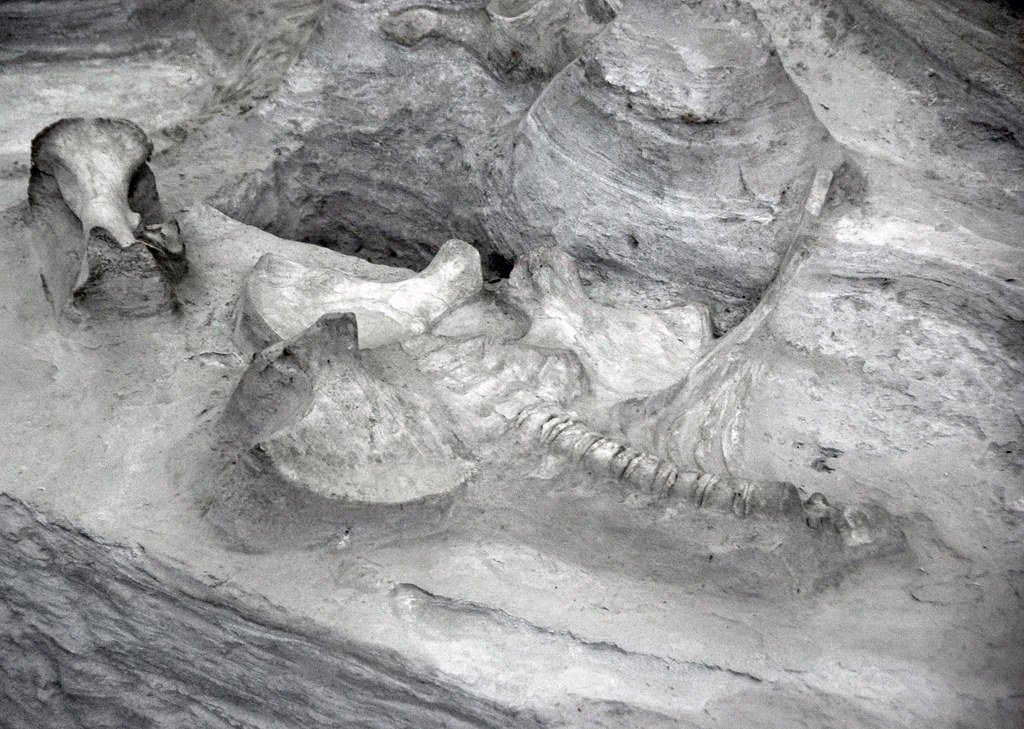
The discovery history of Teleoceras is intrinsically linked to the great fossil-hunting expeditions of the late 19th century in the American West. The genus was first named and described by the renowned American paleontologist Othniel Charles Marsh in 1877, based on fossils collected from the Ogallala Group in Nebraska. However, the most significant discoveries that cemented Teleoceras's fame came much later. In 1971, paleontologist Michael Voorhies was surveying a gully on a farm in Antelope County, Nebraska, when he discovered the skull of a baby rhino eroding from the hillside. Subsequent excavations, led by Voorhies and the University of Nebraska State Museum, uncovered one of the world's most spectacular fossil sites: the Ashfall Fossil Beds. This site preserves an entire, intact ecosystem from approximately 12 million years ago. A massive volcanic eruption in what is now Idaho blanketed the region in a thick layer of abrasive volcanic ash. A local waterhole became a death trap as hundreds of animals, including vast herds of Teleoceras, inhaled the ash, suffered severe lung damage, and perished over a period of weeks. The carcasses were then quickly buried by the accumulating ash, resulting in the preservation of complete, articulated skeletons in their death poses. This 'Pompeii of prehistoric animals' provides an unparalleled snapshot of life and death in the Miocene, with Teleoceras being the most numerous large animal preserved, with over one hundred complete skeletons unearthed.
Teleoceras belongs to the subfamily Aceratheriinae, a group of hornless or small-horned rhinos, and within that, the tribe Teleoceratini. This tribe is characterized by its members' distinctive hippo-like body plan with short, stout limbs and barrel-shaped torsos. This body form represents a fascinating case of convergent evolution, where unrelated animals (rhinos and hippos) independently evolve similar physical traits in response to similar ecological pressures or lifestyles, in this case, a semi-aquatic existence. While Teleoceras itself left no direct modern descendants, its lineage is part of the broader radiation of the family Rhinocerotidae, which originated in Eurasia and later spread to North America and Africa. The study of Teleoceras and its relatives helps paleontologists trace the complex evolutionary history of rhinos, showing how the group adapted to different environments and diversified into a wide array of forms, from swift-running runners to lumbering, semi-aquatic grazers. Its eventual extinction in North America marked the end of a long and successful history for rhinos on the continent, which would not be repopulated by the group again.
While the general understanding of Teleoceras is well-established thanks to the wealth of fossil evidence, some scientific debates persist. One area of ongoing discussion revolves around the precise nature of its lifestyle. While the hippo-like morphology strongly points to a semi-aquatic habit, the degree to which it was tied to water is debated. Some researchers argue it was as aquatic as a modern hippo, while others suggest it was more of a terrestrial animal that simply preferred wetland margins, using water primarily for thermoregulation. The dietary evidence also presents a complex picture; while isotopic data points to a diet of C3 plants, its hypsodont teeth are a classic adaptation for grazing abrasive C4 grasses. This has led to hypotheses that it was a highly adaptable, opportunistic mixed-feeder, or that its diet shifted seasonally or geographically. The exact cause of its extinction is also a topic of research, likely involving a combination of factors including climate change, habitat loss, and competition with newly evolving grazers that were better adapted to the expanding C4 grasslands of the Pliocene.
The fossil record of Teleoceras is exceptionally rich and widespread, making it one of the best-represented large mammals of the North American Miocene. Fossils are found across the Great Plains, from South Dakota and Nebraska down to Texas and across to Florida. The most famous and scientifically important locality is the Ashfall Fossil Beds State Historical Park in Nebraska, where dozens of complete, articulated skeletons are preserved in situ within a covered rhinocerotarium, allowing visitors to see the fossils exactly as they were found. The quality of preservation here is exceptional, including delicate bones of the inner ear and, in some cases, preserved remnants of their last meals in the throat and stomach region. Outside of Ashfall, numerous disarticulated but well-preserved skulls, jaws, and postcranial bones have been recovered from various formations within the Ogallala and Clarendon beds, making Teleoceras a staple of many museum collections.
Due to the spectacular displays at the Ashfall Fossil Beds, Teleoceras has achieved a notable public profile. The park is a major tourist and educational destination, offering a unique and powerful illustration of paleontological work and deep time. Skeletons and life-sized reconstructions of Teleoceras are featured exhibits in major natural history museums, including the University of Nebraska State Museum (Morrill Hall) and the American Museum of Natural History. While it has not reached the celebrity status of dinosaurs or saber-toothed cats in popular media, it serves as a critical educational tool for teaching concepts like evolution, extinction, and paleoecology. Its unusual, hippo-like appearance makes it a memorable example of the strange and diverse forms that mammalian life has taken through Earth's history.
Classification
Time Period
Discovery
Location
North America (specifically, Nebraska, USA)
Formation
Ashfall Fossil Beds (Ogallala Group)
Frequently Asked Questions
What is Teleoceras?
Teleoceras was a genus of extinct rhinoceros that roamed the grasslands and riverbanks of North America during the Miocene and Pliocene epochs, from approximately 16 to 5 million years ago. This hippo-like rhino is one of the most common large mammal fossils found in North American Neogene deposits,...
When did Teleoceras live?
Teleoceras lived during the neogene period of the cenozoic era approximately 16-5 million years ago.
Where was Teleoceras discovered?
Fossils of Teleoceras were discovered in North America (specifically, Nebraska, USA) in the Ashfall Fossil Beds (Ogallala Group).
What did Teleoceras eat?
Teleoceras was a herbivore. It lived in semi-aquatic, terrestrial (grasslands near water) habitats.
What type of fossil is Teleoceras?
Teleoceras is preserved as a body fossil. The preservation quality is exceptional.
Related Specimens
From the cenozoic era · body fossils