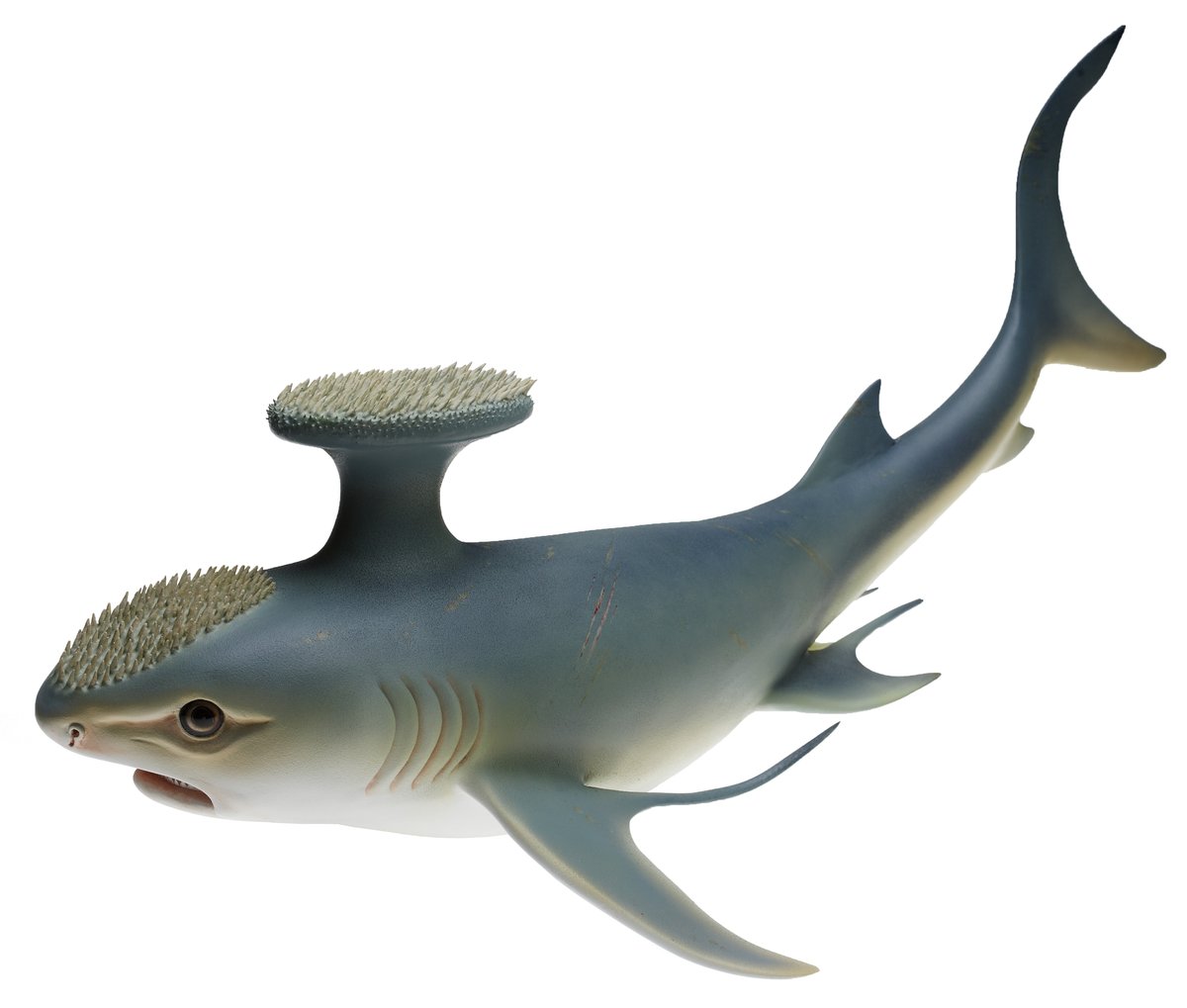
Stethacanthus
Stethacanthus altonensis
Image: Image sourced via web search (Fair use / Educational)
About Stethacanthus
Stethacanthus was a genus of extinct, shark-like cartilaginous fish that inhabited the shallow seas of the Late Devonian and Carboniferous periods, approximately 360 to 340 million years ago. Known for its bizarre and highly distinctive dorsal fin-spine complex, this small predator represents a fascinating branch of early chondrichthyan evolution. Its fossils, found in North America and Europe, provide crucial insights into the diversity and ecological roles of early sharks during a pivotal time in marine ecosystem development.
Stethacanthus was a relatively small fish, with most species, including the type species Stethacanthus altonensis, reaching an estimated total body length of 70 to 100 centimeters (about 2.3 to 3.3 feet) and weighing perhaps 5 to 10 kilograms. This is comparable in size to a modern-day small dogfish or catshark. Its overall body plan was fusiform, or torpedo-shaped, typical of an active swimming predator. The most striking and scientifically significant feature was the spine-brush complex, present only in mature males. This structure consisted of a flattened, anvil-shaped dorsal fin, the top surface of which was covered in a dense patch of enlarged, coarse dermal denticles, similar to the placoid scales covering a shark's body but much larger. A corresponding patch of these same enlarged denticles was also present on the top of its head. The function of this complex is highly debated but is widely believed to have been a secondary sexual characteristic used in courtship displays or for grasping females during mating. The rest of its skeleton was cartilaginous, which does not fossilize well, but exceptionally preserved specimens reveal details of its paired pectoral and pelvic fins, two dorsal fins (the anterior one being the modified anvil), and a heterocercal tail fin, where the upper lobe is larger than the lower, a common trait in early sharks.
As a carnivore, Stethacanthus was likely an opportunistic predator in its shallow marine environment. Its jaw structure and dentition, consisting of small, multi-cusped cladodont-style teeth, suggest it was not adapted for tackling very large prey. Instead, it probably fed on a variety of smaller animals, including bony fish, crustaceans, and cephalopods like ammonoids and belemnoids. Its streamlined body and well-developed fins indicate it was an agile and capable swimmer, though perhaps not a high-speed, open-ocean pursuit predator like some modern sharks. It likely employed ambush tactics or actively hunted in the complex, structured habitats of nearshore environments. The spine-brush complex, being a feature of males, points towards complex social behaviors, likely involving elaborate courtship rituals. Males may have used the structure to signal fitness to females or to intimidate rival males. The hypothesis that it was used to physically attach to a female during copulation remains a prominent theory. Growth patterns, inferred from the presence of the complex only in mature individuals, suggest a distinct transition to sexual maturity, a common trait in vertebrates.
The world of the Carboniferous period was vastly different from today's. Stethacanthus lived in the warm, shallow epicontinental seas that covered large parts of North America (Laurussia) and Europe. These marine ecosystems were rich and diverse, representing a significant recovery and radiation of life following the Late Devonian mass extinction. The climate was generally warm and humid, with high oxygen levels. Stethacanthus shared its habitat with a wide array of other marine life. It would have swam alongside other primitive sharks like Cladoselache and the larger, formidable Dunkleosteus in the Late Devonian, and later with a diverse assemblage of chondrichthyans in the Carboniferous, including the bizarre Helicoprion. Its prey would have included early actinopterygian (ray-finned) and sarcopterygian (lobe-finned) fishes. As a mid-level predator, Stethacanthus itself would have been prey for larger sharks and potentially large placoderms in the earlier part of its range. The sea floor was populated by crinoids, brachiopods, and bryozoans, forming complex habitats that would have provided cover for both Stethacanthus and its prey, placing it firmly within the nektonic predator guild of the Paleozoic food web.
The discovery history of Stethacanthus is rooted in the 19th-century explorations of Paleozoic fossil beds in North America. The genus was first named and described by the renowned American paleontologist John Strong Newberry in 1889. The initial fossils, primarily isolated spines and dental plates, were recovered from the Cleveland Shale of Ohio, a Late Devonian deposit famous for its well-preserved fish fossils. The name Stethacanthus translates to 'chest spine', which Newberry initially misinterpreted, believing the peculiar spine structure was located on the pectoral, or chest, region of the fish. It was not until the discovery of more complete, articulated specimens from the Bear Gulch Limestone in Montana, a Carboniferous Lagerstätte known for exceptional preservation, that the true nature and position of the spine-brush complex were understood. These remarkable fossils, studied extensively by paleontologists like Richard Lund in the latter half of the 20th century, provided a nearly complete picture of the animal's external anatomy, confirming the dorsal position of the fin and its presence only in males. No single specimen has been given a popular nickname, but the collective fossils from Bear Gulch represent the most important finds for understanding this genus.
Stethacanthus holds a significant place in the evolutionary history of Chondrichthyes (cartilaginous fishes). It belongs to a group of early shark-like fishes called the Symmoriiformes, which are considered to be stem-chondrichthyans, meaning they are part of the lineage leading to modern sharks, rays, and chimaeras, but branched off before the last common ancestor of these modern groups. Stethacanthus and its relatives demonstrate the incredible degree of experimentation that occurred in early chondrichthyan evolution. The spine-brush complex is a prime example of an evolutionary novelty, a unique and highly specialized trait not seen in any other known vertebrate. It highlights how sexual selection can drive the evolution of bizarre and seemingly non-adaptive structures. While not a direct ancestor of any modern shark, studying Stethacanthus helps paleontologists understand the ancestral body plans and the developmental plasticity from which the more familiar forms of modern sharks eventually evolved. It serves as a crucial data point for mapping the diversification of jawed vertebrates in the Paleozoic seas and illustrates that the path of shark evolution was not a simple, linear progression but a complex, branching bush with many strange and ultimately extinct side-branches.
Despite the wealth of information from well-preserved fossils, Stethacanthus remains the subject of scientific debate, primarily centered on the function of its unique spine-brush complex. The leading hypothesis posits a role in mating, where the male would use the rough surfaces on its head and dorsal fin to grip the female, possibly by pressing against her pectoral fin. Other interpretations suggest it was used for intimidating rivals or predators, perhaps by making the shark appear larger or more formidable. A more speculative idea, proposed by paleontologist John Maisey, suggests the structure could have functioned as a lure or even mimicked the gaping mouth of a larger creature to scare off threats. Another area of ongoing research is the precise phylogenetic placement of the Symmoriiformes, including Stethacanthus. While they are firmly placed within the broader chondrichthyan lineage, their exact relationship to holocephalans (chimaeras) and elasmobranchs (sharks and rays) is still being refined as new fossils are discovered and new analytical techniques are applied. The discovery of other related genera with strange dorsal appendages, like Akmonistion, has added complexity to this evolutionary puzzle.
The fossil record of Stethacanthus is quite good for a Paleozoic cartilaginous fish. Its remains are found primarily in Late Devonian and Early Carboniferous marine deposits in North America and Europe. The most significant and informative fossils come from the Bear Gulch Limestone in Montana, USA. This site has yielded numerous articulated skeletons, some with preserved soft tissue outlines, gill structures, and even stomach contents, offering an unparalleled window into the animal's biology. Other important localities include the Cleveland Shale of Ohio, where the genus was first identified, as well as sites in Scotland and Russia. Typically, due to their cartilaginous nature, only the more calcified elements like teeth, fin spines, and the dermal denticles of the spine-brush complex are found as isolated fossils. The exceptional preservation conditions at sites like Bear Gulch, which was likely a low-oxygen marine bay, are responsible for the complete body fossils that have made Stethacanthus one of the best-understood early sharks.
Due to its truly strange appearance, Stethacanthus has captured the public imagination and has become a moderately well-known prehistoric shark. It is frequently featured in documentaries about prehistoric life, most notably in the BBC's 'Walking with Monsters', where its unusual mating behavior was depicted. It also appears in various books, video games, and as a popular subject for paleoart. Several major museums, including the American Museum of Natural History and the Field Museum, hold and sometimes display fossils of Stethacanthus or related symmoriiforms. Its bizarre 'anvil' fin makes it a memorable and effective tool for teaching about the diversity of prehistoric life and the powerful role of sexual selection in evolution.
Classification
Time Period
Discovery
Location
United States (Ohio)
Formation
Cleveland Shale, Bear Gulch Limestone
Frequently Asked Questions
What is Stethacanthus?
Stethacanthus was a genus of extinct, shark-like cartilaginous fish that inhabited the shallow seas of the Late Devonian and Carboniferous periods, approximately 360 to 340 million years ago. Known for its bizarre and highly distinctive dorsal fin-spine complex, this small predator represents a fasc...
When did Stethacanthus live?
Stethacanthus lived during the carboniferous period of the paleozoic era approximately 360-340 million years ago.
Where was Stethacanthus discovered?
Fossils of Stethacanthus were discovered in United States (Ohio) in the Cleveland Shale, Bear Gulch Limestone.
What did Stethacanthus eat?
Stethacanthus was a carnivore. It lived in marine, shallow sea habitats.
What type of fossil is Stethacanthus?
Stethacanthus is preserved as a body fossil. The preservation quality is good.
Related Specimens
From the paleozoic era · body fossils
/e01cc4f7f656.jpg)