Productus
Productus productus
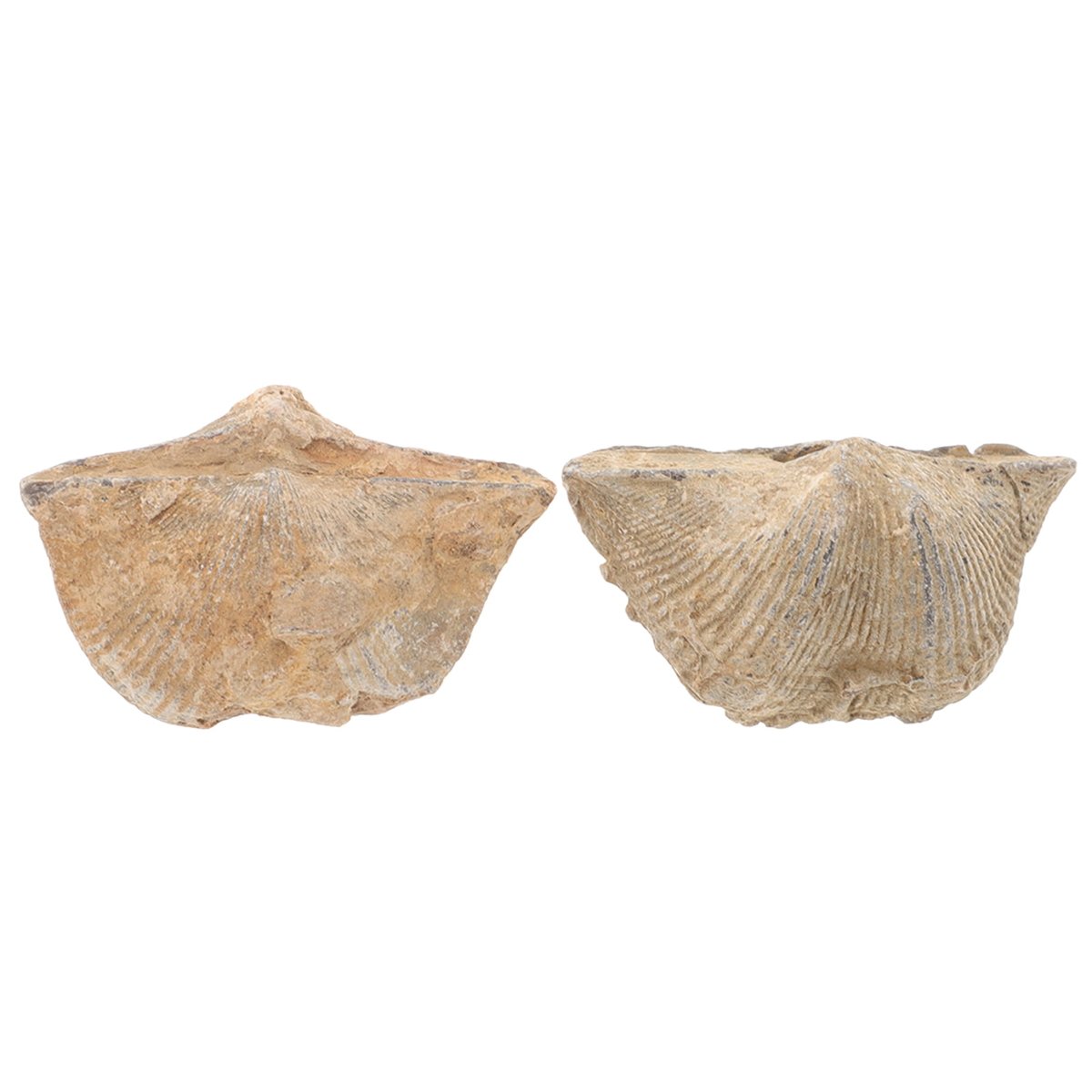
Image: Image sourced via web search (Fair use / Educational)
About Productus
Productus is a genus of extinct brachiopods that thrived in the shallow marine environments of the Carboniferous Period, approximately 350 to 300 million years ago. As one of the most common and widespread index fossils of its time, Productus provides paleontologists with a critical tool for dating rock layers and understanding the rich biodiversity of Paleozoic seas. Its distinctive, spiny shell and sessile lifestyle made it a highly successful filter-feeder that dominated benthic communities worldwide before the great Permian-Triassic extinction event.
The physical anatomy of Productus is defined by its bivalved shell, or valves, which are unequal in size and shape, a condition known as inequivalved. The shell typically measured between 5 and 10 centimeters in width, making it a medium- to large-sized brachiopod for its time, comparable in size to a modern large scallop or oyster. The larger of the two valves, the ventral or pedicle valve, was deeply convex, sometimes almost conical, giving the animal a somewhat dome-like appearance. The smaller dorsal or brachial valve was flat or slightly concave, fitting neatly against the ventral valve to form a protective enclosure for the soft tissues within. The most striking feature of the genus was the presence of numerous hollow spines that radiated from the exterior of the ventral valve. These spines, which could be long and slender, served multiple functions, most critically as anchoring structures. By embedding these spines into the soft muddy or sandy substrate of the seafloor, Productus could stabilize itself against currents, a crucial adaptation for a sessile organism lacking a functional pedicle in adulthood. The shell itself was composed of calcite and featured a complex microstructure that provided strength. Internally, the dorsal valve possessed the delicate, calcite-supported feeding organ known as the lophophore, though this structure is only rarely preserved in the fossil record. Muscle scars on the interior surfaces of the valves indicate the placement of adductor and diductor muscles, which controlled the opening and closing of the shell.
The paleobiology of Productus reveals a highly specialized, sessile, filter-feeding lifestyle. As an adult, Productus was a benthic organism, living on the seafloor. Unlike many other brachiopods that attached to hard surfaces via a fleshy stalk called a pedicle, adult Productus lost this organ and instead relied on its extensive network of spines to anchor itself in soft sediment. This strategy, known as quasi-infaunal, allowed it to colonize vast areas of muddy and sandy seabeds that were unsuitable for other epifaunal organisms. The animal would have oriented itself with the commissure (the opening between the valves) facing upwards, slightly elevated from the substrate to avoid ingesting sediment. By slightly opening its valves, it would draw in water using a current generated by the cilia on its lophophore. This complex, coiled organ acted as a sophisticated sieve, trapping microscopic food particles like phytoplankton and organic detritus from the water column while allowing the filtered water to be expelled. This feeding method was highly efficient and enabled Productus to thrive in the nutrient-rich waters of the Carboniferous. Growth patterns, visible as concentric lines on the shell exterior, suggest that these animals grew incrementally throughout their lives, adding new shell material along the mantle edge. Their metabolism was likely slow and ectothermic, typical of marine invertebrates, allowing them to survive in a wide range of water temperatures.
Productus lived during the Carboniferous Period, a time of significant global environmental change. The world's continents were coalescing to form the supercontinent Pangaea, creating vast, shallow epicontinental seas that teemed with life. The climate was generally warm and humid, with high atmospheric oxygen levels, often referred to as the 'Age of Amphibians' on land and the 'Age of Crinoids' in the sea. In these marine ecosystems, Productus was a dominant member of the benthic community. It shared its habitat with a diverse array of other organisms, including vast meadows of crinoids (sea lilies), fenestrate bryozoans, rugose and tabulate corals, trilobites, gastropods, and other brachiopod species. Productus occupied a low-level position in the food web as a primary consumer, filtering plankton from the water. Its hard, spiny shell provided considerable defense against predators, which may have included early sharks like Hybodus, shell-crushing fish, and possibly large cephalopods. The dense accumulations of Productus shells, often forming extensive beds or 'biostromes', created complex, three-dimensional habitats on the seafloor. These shell beds would have served as a hard substrate for other organisms like corals, bryozoans, and encrusting algae to colonize, making Productus an important ecosystem engineer that helped structure Paleozoic marine communities.
The discovery and classification of Productus have a long history deeply intertwined with the foundational years of geology and paleontology. The genus was formally described by British naturalist James Sowerby in his seminal work, 'Mineral Conchology of Great Britain', published in parts between 1812 and 1846. Sowerby, a meticulous illustrator and observer, was among the first to systematically document British fossils. He established the genus Productus in 1821 based on specimens collected from the Carboniferous Limestone formations of England. The type species, *Productus productus*, was originally described by John Martin in 1809 as *Anomites productus*. Sowerby's work provided a clear definition for the genus, emphasizing its spiny, convex-concave shell structure. Because of their abundance and distinctiveness, Productus fossils were quickly recognized by geologists across Europe and North America as valuable tools for correlating rock strata. Nineteenth-century paleontologists like James Hall in North America and Laurent-Guillaume de Koninck in Belgium further expanded the understanding of the genus and its related family, Productidae, describing numerous new species. Unlike dinosaurs or hominids, there are no single 'famous' individual specimens of Productus; rather, its significance lies in its sheer abundance and the countless fossils that have collectively informed our understanding of the Carboniferous period.
Productus and its relatives within the order Productida represent a major evolutionary success story within the phylum Brachiopoda. They are a key branch of the Strophomenata, a class of brachiopods characterized by their strophic (straight) hinge line and pseudopunctate shells (containing calcite rods called taleolae). The evolutionary innovation of using shell spines for stabilization instead of a pedicle was a pivotal adaptation that allowed productids to radiate into and dominate soft-substrate environments previously inaccessible to many other brachiopods. This shift away from pedicle attachment is a classic example of adaptive radiation, where a new morphological trait opens up a wealth of ecological niches. The productids became one of the most diverse and abundant brachiopod groups of the late Paleozoic, with hundreds of genera evolving before their near-total annihilation during the Permian-Triassic extinction event. While the brachiopod phylum as a whole survived this mass extinction, the highly specialized productids did not. Today, brachiopods are far less common, but their living relatives, such as Lingula and Terebratulina, provide comparative anatomical insights into the biology of their extinct Paleozoic cousins like Productus.
Despite being a well-established genus, Productus has been at the center of significant taxonomic revision and debate. In the 19th and early 20th centuries, the name 'Productus' was used as a 'wastebasket taxon'—a catch-all category for a wide variety of spiny, concavo-convex brachiopods from the late Paleozoic. As paleontological techniques became more sophisticated, researchers began to recognize that this broad grouping contained many distinct evolutionary lineages. Starting in the mid-20th century, paleontologists like G. Arthur Cooper and Richard E. Grant undertook a massive revision of the productids. They re-examined type specimens and analyzed internal shell structures, such as the nature of the muscle scars and brachial ridges, leading to the subdivision of the old, overly broad 'Productus' into dozens of new, more narrowly defined genera (e.g., *Dictyoclostus*, *Linoproductus*, *Gigantoproductus*). This ongoing process of taxonomic refinement has greatly improved the biostratigraphic utility of these fossils, allowing for more precise dating of Carboniferous and Permian rocks. Today, the genus *Productus* is restricted to a much smaller group of species that closely match Sowerby's original type specimen, *Productus productus*.
The fossil record of Productus is exceptionally rich and globally distributed. Fossils are found in marine sedimentary rocks of Carboniferous age on every modern continent, a testament to their cosmopolitan distribution in the shallow seas that covered much of the globe during this period. Major fossil sites are located in the classic Carboniferous exposures of the United Kingdom, Belgium, and Russia, as well as throughout the central and eastern United States (in what are known as Pennsylvanian and Mississippian-aged rocks). The fossils are typically preserved as complete or fragmented shells. Because of their robust calcite composition, they are often preserved with remarkable detail, showing fine growth lines and the bases of the delicate spines. In many locations, they are so abundant that they form coquinas or shell beds that constitute a significant portion of the limestone rock layer itself. This abundance and excellent preservation make Productus one of the most common fossils available to both professional paleontologists and amateur collectors, providing a readily accessible window into Paleozoic marine life.
While not a household name like Tyrannosaurus or Triceratops, Productus holds a significant place in paleontological education and museum collections. Its distinctive shape and commonness make it a staple fossil in university geology courses and a frequent 'first fossil' for amateur collectors. Major natural history museums around the world, including the Natural History Museum in London, the Smithsonian National Museum of Natural History in Washington D.C., and the Field Museum in Chicago, feature excellent specimens of Productus and its relatives in their Paleozoic marine life displays. These exhibits use the dense fossil beds of productids to illustrate the concept of ancient reefs and the incredible richness of life in the Carboniferous seas, highlighting a world profoundly different from our own.
Classification
Time Period
Discovery
Location
Global, with key early descriptions from Europe (e.g., United Kingdom, Belgium)
Formation
Widespread in Carboniferous marine formations, such as the Carboniferous Limestone of Europe and the Pennsylvanian System formations of North America.
Frequently Asked Questions
What is Productus?
Productus is a genus of extinct brachiopods that thrived in the shallow marine environments of the Carboniferous Period, approximately 350 to 300 million years ago. As one of the most common and widespread index fossils of its time, Productus provides paleontologists with a critical tool for dating ...
When did Productus live?
Productus lived during the carboniferous period of the paleozoic era approximately 350-300 million years ago.
Where was Productus discovered?
Fossils of Productus were discovered in Global, with key early descriptions from Europe (e.g., United Kingdom, Belgium) in the Widespread in Carboniferous marine formations, such as the Carboniferous Limestone of Europe and the Pennsylvanian System formations of North America..
What did Productus eat?
Productus was a filter-feeder. It lived in marine, reef, shallow-sea floor habitats.
What type of fossil is Productus?
Productus is preserved as a body fossil. The preservation quality is excellent.
Related Specimens
From the paleozoic era · body fossils