Champsosaurus
Champsosaurus gigas
Image: Image sourced via web search (Fair use / Educational)
About Champsosaurus
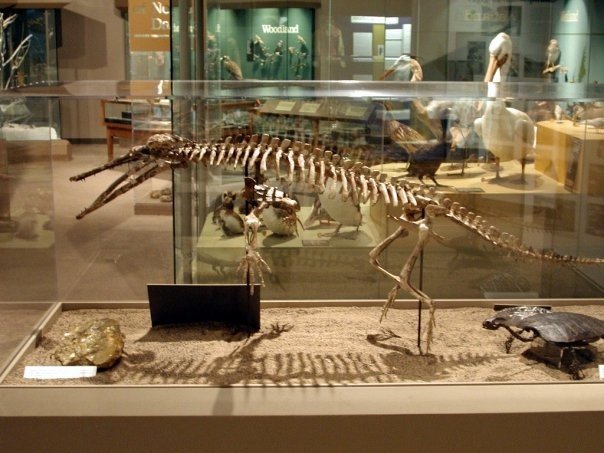
Champsosaurus gigas represents a remarkably fascinating and highly specialized chapter in the history of vertebrate life, standing as a testament to the resilience of certain reptilian lineages across major extinction boundaries. This organism was a large, semi-aquatic, crocodile-like reptile belonging to the order Choristodera, a group that is entirely extinct today and has no direct living descendants. It lived primarily during the Paleocene epoch of the Paleogene period, approximately 66 to 56 million years ago, emerging in the immediate aftermath of the catastrophic Cretaceous-Paleogene (K-Pg) extinction event that wiped out the non-avian dinosaurs. Geographically, Champsosaurus gigas inhabited the extensive freshwater systems, swamps, and river basins of what is now North America, with significant fossil concentrations found in the northern United States and western Canada. Its survival across the K-Pg boundary and subsequent diversification into the largest species of its genus makes it a subject of immense significance in paleontology. It provides crucial insights into how freshwater ecosystems recovered and how certain ecological niches were rapidly filled by surviving clades in a post-apocalyptic world devoid of large dinosaurian predators. The physical anatomy of Champsosaurus gigas was highly adapted for a life spent predominantly in the water, exhibiting a striking case of convergent evolution with modern gharials, despite not being closely related to true crocodilians. As the largest known species within its genus, an adult Champsosaurus gigas could reach impressive body lengths of approximately 300 to 350 centimeters (about 10 to 11.5 feet), making it a formidable apex predator in its localized freshwater habitats. Weight estimates suggest that a fully grown individual could have weighed anywhere from 100 to 150 kilograms, depending on its nutritional state and exact length. The most distinctive feature of this animal was its highly elongated, narrow, and tubular snout, which was densely lined with sharp, conical teeth perfectly suited for piercing and gripping slippery aquatic prey. The skull was uniquely constructed, featuring a wide, heavily expanded temporal region at the back of the head that provided massive attachment sites for powerful jaw-closing muscles, contrasting sharply with the delicate-looking rostrum. Skeletally, Champsosaurus possessed a streamlined, dorsoventrally flattened body with a long, powerful tail that served as the primary organ of propulsion through the water. Its ribs were massive and dense, a condition known as pachyostosis, which acted as biological ballast to help the animal remain submerged with minimal effort, much like modern manatees or certain diving birds. The limbs were relatively short and stout, suggesting that while it was an agile and swift swimmer, it was likely clumsy and slow on land. Soft tissue inferences, drawn from the structure of the palate and the positioning of the internal nares, suggest that it could breathe while keeping its mouth open underwater, a crucial adaptation for an ambush predator lying in wait for passing fish. In terms of paleobiology, Champsosaurus gigas was undeniably a specialized carnivore, with a diet that consisted almost exclusively of fish, amphibians, and perhaps small aquatic reptiles or mammals that ventured too close to the water's edge. Its hunting strategy likely mirrored that of the modern Indian gharial: lying motionless in the murky water or resting on the river bottom, relying on its camouflage and the sensory capabilities of its elongated snout to detect the hydrodynamic wakes of passing prey. When a target came within range, Champsosaurus would execute a lightning-fast lateral sweep of its head, snapping its jaws shut to impale the victim on its needle-like teeth before swallowing it whole. Locomotion was primarily achieved through lateral undulations of its muscular tail, while the limbs were likely used for steering or crawling along the muddy bottoms of rivers and lakes. Social behavior inferences are difficult to draw from the fossil record, but the frequent discovery of multiple individuals in close proximity in certain fossil beds suggests they may have congregated in areas of high prey density or during specific mating seasons, much like modern crocodilians. Growth patterns analyzed through bone histology indicate that Champsosaurus had a relatively slow but continuous growth rate, typical of many ectothermic reptiles, and it likely took several years to reach sexual maturity. Metabolism estimates strongly point to an ectothermic (cold-blooded) physiology, meaning it relied on the ambient temperature of its environment to regulate its body heat, which explains its restriction to the warm, subtropical climates of the Paleocene. The ecological context in which Champsosaurus gigas thrived was vastly different from the modern world, characterized by a rapidly recovering biosphere following the K-Pg mass extinction. During the Paleocene, the global climate was significantly warmer and more humid than today, with lush, dense, subtropical forests extending far into the northern latitudes of North America. The geography of the region featured vast coastal plains, meandering river systems, and extensive wetlands that provided the perfect habitat for a specialized aquatic ambush predator. Co-existing species in these vibrant ecosystems included a wide variety of early mammals, which were beginning their rapid evolutionary radiation, as well as numerous species of turtles, amphibians, and surviving lineages of fish. In the food web, adult Champsosaurus gigas occupied the position of an apex aquatic predator, facing virtually no competition from the relatively small crocodilians of the time in its specific niche. However, juvenile champsosaurs would have been vulnerable to predation from larger fish, wading birds, and early carnivorous mammals. The predator-prey dynamics of this era were defined by the absence of large terrestrial dinosaurs, allowing aquatic and semi-aquatic predators like Champsosaurus to exploit the abundant aquatic resources without the threat of massive terrestrial carnivores encroaching on their territory. The discovery history of Champsosaurus is a compelling narrative that dates back to the late 19th century, during the golden age of North American paleontology. The genus was first discovered and named by the eminent paleontologist Edward Drinker Cope in 1876, based on fragmentary remains recovered from the Judith River Formation in Montana. The specific species Champsosaurus gigas, however, was identified and described much later, as paleontologists began to explore the younger, Paleocene deposits of the Tullock Formation and the Fort Union Group in the early to mid-20th century. The naming history reflects its size; 'gigas' is derived from Latin, meaning giant, acknowledging its status as the largest known member of the Choristodera. Key specimens have been unearthed in various states of articulation, with some of the most spectacular finds occurring in the badlands of North Dakota and Montana, as well as in the Canadian provinces of Alberta and Saskatchewan. One particularly notable specimen, often referred to in academic literature for its nearly complete skull and postcranial skeleton, provided the definitive evidence for the pachyostotic ribs and the unique biomechanics of its jaw. The circumstances of these discoveries often involved painstaking excavation in remote, rugged terrain, where the fragile, elongated skulls required extensive stabilization with plaster and burlap before they could be safely transported to museums for preparation and study. The evolutionary significance of Champsosaurus gigas is profound, as it represents a highly successful, yet ultimately doomed, branch on the reptilian tree of life. The order Choristodera is an enigmatic clade of diapsid reptiles whose exact phylogenetic placement has been a subject of intense study; they are generally considered to be basal archosauromorphs or closely related to the ancestors of lizards and snakes (lepidosauromorphs). Champsosaurus tells us a great deal about the mechanics of evolution, particularly the concept of convergent evolution, where unrelated organisms evolve similar traits in response to similar environmental pressures. Its striking resemblance to crocodilians, despite a distant common ancestry, highlights the evolutionary effectiveness of the long-snouted, aquatic ambush predator morphotype. Furthermore, the survival of the Champsosaurus lineage across the K-Pg extinction boundary provides critical data on extinction selectivity; it suggests that freshwater ecosystems were somewhat buffered from the worst effects of the asteroid impact, allowing aquatic organisms that relied on detritus-based food webs to survive while terrestrial primary consumers perished. Despite their success in the Paleogene, the choristoderes eventually went extinct during the Miocene, leaving no modern descendants, making Champsosaurus a fascinating example of a 'dead end' in vertebrate evolution. Scientific debates surrounding Champsosaurus gigas and its relatives have been vibrant and ongoing, reflecting the dynamic nature of paleontological inquiry. One of the primary controversies involves the exact taxonomic placement of the Choristodera within the broader reptile family tree. While morphological studies have traditionally placed them near the base of the Archosauromorpha, some recent cladistic analyses incorporating new anatomical data have suggested potential affinities with the Lepidosauromorpha, sparking lively debates at academic conferences. Another area of active discussion concerns the reproductive behavior of Champsosaurus. Because their pelvic girdles were heavily ossified and their limbs seemingly ill-suited for terrestrial locomotion, some researchers have hypothesized that females may not have been able to haul themselves onto land to lay eggs, leading to speculation about viviparity (live birth) in this aquatic group. However, without direct fossil evidence of embryos within a mother's body, this remains a contentious and unresolved issue. Additionally, there are debates regarding the precise mechanics of their feeding; while the piscivorous diet is widely accepted, the exact bite force and the structural limits of the delicate-looking snout are subjects of ongoing biomechanical modeling and finite element analysis. The fossil record of Champsosaurus gigas is relatively robust for a Paleocene reptile, offering paleontologists a wealth of data to reconstruct its life and environment. Fossils are predominantly found in the geographical regions corresponding to the ancient Laramidia landmass, specifically in the western interior of North America. Dozens of specimens, ranging from isolated vertebrae and teeth to nearly complete, articulated skeletons, have been cataloged in museum collections. The quality of preservation is often good to excellent, particularly in the fine-grained mudstones and siltstones of ancient river channels and oxbow lakes, which provided the rapid burial necessary to protect the bones from scavenging and weathering. The most typically preserved parts are the dense, pachyostotic ribs, the robust vertebrae, and the heavily built posterior portion of the skull. The fragile, elongated snout is frequently found broken or crushed, requiring meticulous preparation to reconstruct. Famous fossil sites yielding Champsosaurus gigas include the Tullock Formation in Montana and the Ravenscrag Formation in Saskatchewan, which have provided some of the most comprehensive snapshots of Paleocene freshwater ecosystems known to science. The cultural impact of Champsosaurus, while perhaps not as massive as that of the dinosaurs it outlived, remains significant within the realm of natural history education and museum exhibitions. It frequently appears in popular science books, documentaries, and paleoart as a prime example of a K-Pg survivor, illustrating the concept that not all giant reptiles vanished with the asteroid. Museums with notable displays, such as the Royal Tyrrell Museum in Canada and the American Museum of Natural History, often feature mounted skeletons or life-sized dioramas of Champsosaurus to educate the public about convergent evolution and the strange, transitional world of the Paleocene. Public fascination with this creature stems from its bizarre, crocodile-like appearance and its status as a resilient survivor of Earth's most famous mass extinction, making it an enduring symbol of life's tenacity in the face of global catastrophe.
Classification
Time Period
Discovery
Location
North America
Formation
Tullock Formation
Frequently Asked Questions
What is Champsosaurus?
Champsosaurus gigas represents a remarkably fascinating and highly specialized chapter in the history of vertebrate life, standing as a testament to the resilience of certain reptilian lineages across major extinction boundaries. This organism was a large, semi-aquatic, crocodile-like reptile belong...
When did Champsosaurus live?
Champsosaurus lived during the paleogene period of the cenozoic era approximately 66-56 million years ago.
Where was Champsosaurus discovered?
Fossils of Champsosaurus were discovered in North America in the Tullock Formation.
What did Champsosaurus eat?
Champsosaurus was a carnivore. It lived in freshwater habitats.
What type of fossil is Champsosaurus?
Champsosaurus is preserved as a body fossil. The preservation quality is good.
Related Specimens
From the cenozoic era · body fossils