Glossopteris
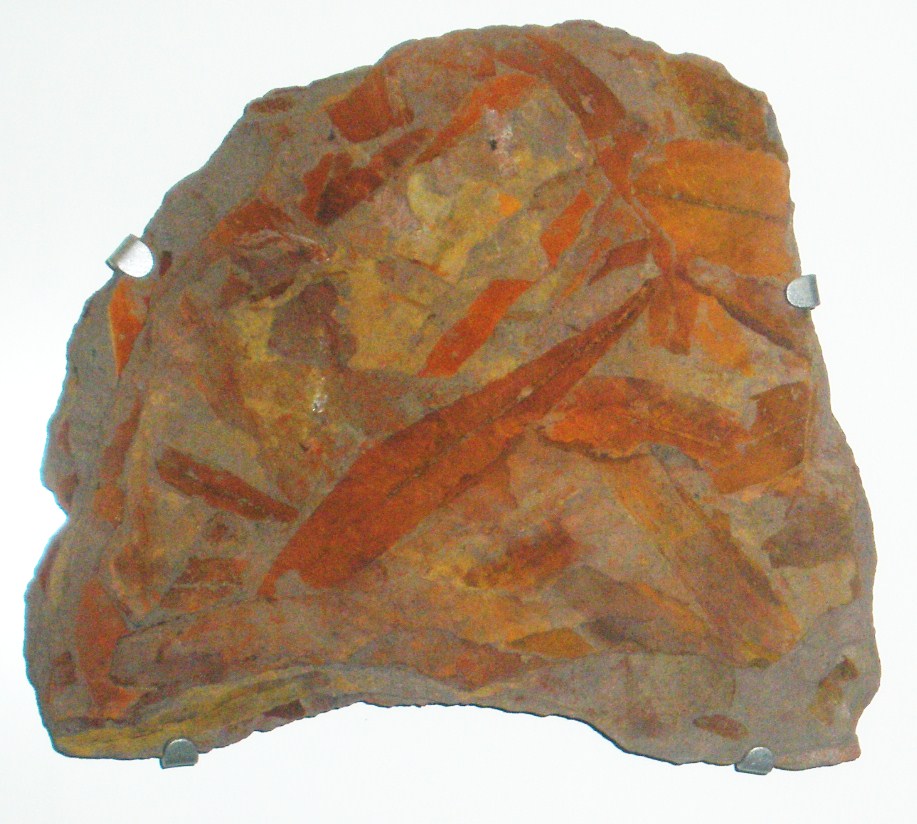
Glossopteris indica
Image: File:Glossopteris.jpg - Wikimedia Commons (CC BY-SA)
About Glossopteris
Glossopteris was a dominant and widespread genus of woody, seed-bearing plants that flourished during the Permian Period, from approximately 299 to 252 million years ago. Often referred to as a 'seed fern,' it was not a true fern but a member of the extinct order Pteridospermatophyta, a group of early seed plants. Its distinctive tongue-shaped leaves are among the most common plant fossils from the Paleozoic Era, and their discovery across widely separated southern continents provided foundational evidence for the theory of continental drift and the existence of the supercontinent Gondwana.
The physical form of Glossopteris is primarily reconstructed from fossilized leaves, wood, roots, and reproductive structures, which are often found disarticulated. The most recognizable feature was its leaves, from which the genus derives its name (Greek 'glossa' for tongue and 'pteris' for fern). These leaves were simple, entire-margined, and typically ranged from 2 to 30 centimeters in length, although some specimens exceed this. They were characteristically spathulate or lanceolate (tongue- or spear-shaped) with a prominent, thickened midrib that ran from the base to the tip. A distinctive network of reticulate, or net-like, veins branched off from this midrib, a key diagnostic feature separating them from other Paleozoic flora. While individual leaves are the most common fossils, evidence from petrified trunks suggests that Glossopteris grew into a substantial tree, with estimates placing its maximum height at around 30 meters. The wood, classified under the morphogenus Dadoxylon, shows distinct growth rings, indicating that the tree experienced seasonal growth cycles. Its root system, known from fossils classified as Vertebraria, was also unique, featuring a distinctive chambered or ladder-like internal structure, possibly an adaptation for anchoring the tree in waterlogged, anoxic soils.
As a photosynthetic organism, Glossopteris was a primary producer, converting sunlight into energy and forming the base of its terrestrial ecosystem. Its growth patterns, inferred from the distinct growth rings in fossilized wood, strongly suggest a deciduous or semi-deciduous life habit. This means the trees likely shed their leaves seasonally, a behavior consistent with the high-latitude, temperate to cool climates they inhabited, which would have experienced significant variations in light and temperature, including long, dark polar winters. The sheer abundance of fossilized leaf litter in Permian coal seams supports this interpretation. The reproductive biology of Glossopteris was complex and for a long time, enigmatic. It was not a spore-bearing fern but a gymnosperm, producing seeds. The ovule-bearing (female) structures, known as megasporophylls, and pollen-bearing (male) structures were attached to the petioles of the leaves, a highly unusual arrangement. The seeds were relatively large and heavy, lacking adaptations for long-distance dispersal by wind or water, a crucial detail in its biogeographical significance. The plant's overall structure and deciduous nature suggest it was a fast-growing, opportunistic tree adapted to colonizing vast floodplains and swampy environments.
Glossopteris was the keystone species of the vast temperate forests that covered the southern supercontinent of Gondwana throughout the Permian. This biome, often called the Glossopteris flora, thrived in cool, moist, high-latitude environments that were subject to seasonal extremes, including potential glaciation early in the period and pronounced wet and dry seasons later on. These forests were ecologically complex, forming a multi-layered canopy that provided food and shelter for a diverse array of organisms. Co-existing flora included other seed ferns, horsetails like Schizoneura, and conifers. This vast floral biomass was the primary food source for a burgeoning community of terrestrial herbivores. Early synapsids (mammal ancestors) such as the dicynodonts, with their turtle-like beaks, likely fed on Glossopteris foliage, roots, and seeds. The rich organic matter produced by these forests, particularly the thick mats of shed leaves, accumulated in swampy basins over millions of years, eventually becoming the massive coal deposits now mined in Australia, South Africa, India, and Antarctica. Glossopteris was therefore not just a plant, but a critical ecosystem engineer that shaped the Permian landscape and fueled its food webs.
The discovery and interpretation of Glossopteris fossils are deeply intertwined with the development of modern geology. The genus was first formally described in 1828 by the French botanist Adolphe-Théodore Brongniart, based on specimens from India. The name he chose, combining 'glossa' and 'pteris', reflected the leaf's tongue-like shape and its superficial resemblance to a fern. Over the following decades, paleontologists began uncovering identical-looking leaf fossils in geographically disparate locations. The British geologist William Thomas Blanford noted the striking similarity between Indian and Australian coal flora in the 1870s. By the early 20th century, the same distinctive fossils had been found in South America, South Africa, and, most remarkably, in Antarctica by expeditions led by Robert Falcon Scott and Ernest Shackleton. This perplexing distribution became a central pillar of Alfred Wegener's revolutionary theory of continental drift, which he first proposed in 1912. Wegener argued that the presence of a non-aquatic, heavy-seeded plant like Glossopteris on continents now separated by thousands of kilometers of ocean was irrefutable proof that these landmasses were once joined. His ideas were initially met with skepticism, but the accumulating Glossopteris evidence, championed by geologists like Alexander Du Toit, eventually led to the widespread acceptance of plate tectonics.
Glossopteris belongs to the extinct order Pteridospermatophyta, the "seed ferns," which represent a pivotal transitional stage in plant evolution. This group was among the first to develop the seed, a revolutionary adaptation that freed plant reproduction from the need for standing water, allowing for greater colonization of terrestrial environments. While they possessed fern-like foliage, their method of reproduction was far more advanced, aligning them with gymnosperms like conifers and cycads. Glossopteris itself is placed within the family Glossopteridaceae. Its exact evolutionary relationships to modern seed plants remain a subject of research, but it is considered part of the broad lineage that eventually gave rise to modern gymnosperms and, more distantly, flowering plants (angiosperms). Some paleobotanists have proposed a link between glossopterids and angiosperms, citing certain structural similarities in their reproductive organs, though this remains a contentious hypothesis. Regardless of its precise placement, Glossopteris exemplifies a successful and highly specialized lineage of early seed plants that dominated an entire hemisphere for tens of millions of years before succumbing to the Permian-Triassic extinction event.
Despite its iconic status, Glossopteris remains the subject of scientific debate, primarily concerning its taxonomy and life habits. The genus Glossopteris was originally defined based solely on the distinctive leaf fossils. However, different parts of the same plant—roots (Vertebraria), wood (Dadoxylon), and various reproductive structures (e.g., Lidgettonia, Eretmonia)—were initially given separate generic names because they were found disarticulated. The painstaking process of reassembling the whole Glossopteris plant is ongoing, and the exact association between the more than 200 named species of Glossopteris leaves and their corresponding reproductive organs is often uncertain. This taxonomic complexity makes it difficult to fully understand the diversity and evolution within the group. Furthermore, while the deciduous nature of the tree is widely accepted, the precise environmental triggers and the speed of its growth cycle are still debated. Some researchers argue for a very rapid, almost weed-like growth to maturity, while others envision a slower, more K-selected life strategy. These discussions continue to refine our understanding of how this ancient plant thrived in its challenging polar environment.
The fossil record of Glossopteris is exceptionally rich and geographically widespread, making it one of the most thoroughly documented prehistoric plants. Its fossils are found in Permian-aged sedimentary rocks across all the continents that once formed Gondwana: South America, Africa, Madagascar, India, Australia, and Antarctica. The preservation quality varies from simple impressions of leaves in shale and sandstone to exquisitely detailed compressions that retain cellular structure and cuticles, allowing for microscopic analysis. In some locations, entire petrified forests of Glossopteris stumps have been found, most notably in Antarctica's Transantarctic Mountains, providing direct evidence of high-latitude forests. Famous fossil sites include the Damodar Valley in India, the Bowen Basin in Australia, and the Beaufort Group of the Karoo Supergroup in South Africa. The sheer abundance of its remains is a testament to its ecological dominance; in many Permian coal seams, Glossopteris leaf fossils constitute over 90% of the identifiable plant macrofossils, highlighting its role as the primary contributor to these vast fossil fuel reserves.
The profound significance of Glossopteris in proving continental drift has cemented its place in both scientific and popular culture. It is a staple exhibit in natural history museums worldwide, often displayed alongside fossils of Lystrosaurus and other Gondwanan fauna to illustrate the concept of a connected southern supercontinent. As a classic textbook example of evidence for plate tectonics, it is a cornerstone of geology and biology education at all levels, from elementary school to university. Its distinctive and easily recognizable leaf shape makes it an accessible and compelling symbol of deep time and the dynamic nature of our planet's geography, representing a crucial piece of the puzzle that unlocked our modern understanding of Earth's history.
Classification
Time Period
Discovery
Location
India, Australia, South Africa, South America, Antarctica
Formation
Various, including the Beaufort Group (South Africa) and Damodar Valley (India)
Frequently Asked Questions
What is Glossopteris?
Glossopteris was a dominant and widespread genus of woody, seed-bearing plants that flourished during the Permian Period, from approximately 299 to 252 million years ago. Often referred to as a 'seed fern,' it was not a true fern but a member of the extinct order Pteridospermatophyta, a group of ear...
When did Glossopteris live?
Glossopteris lived during the permian period of the paleozoic era approximately 299-252 million years ago.
Where was Glossopteris discovered?
Fossils of Glossopteris were discovered in India, Australia, South Africa, South America, Antarctica in the Various, including the Beaufort Group (South Africa) and Damodar Valley (India).
What did Glossopteris eat?
Glossopteris was a photosynthetic. It lived in terrestrial habitats.
What type of fossil is Glossopteris?
Glossopteris is preserved as a impression fossil. The preservation quality is good.
Related Specimens
From the paleozoic era · impression fossils