Triarthrus
Triarthrus eatoni
Image: Image sourced via web search (Fair use / Educational)
About Triarthrus
Triarthrus eatoni is an extinct species of trilobite, a highly successful group of marine arthropods that thrived during the Paleozoic Era. This particular species lived during the Late Ordovician Period, approximately 450 to 445 million years ago, in the deep-water environments of what is now North America. Triarthrus is one of the most significant fossils in the history of paleontology, not for its size or ferocity, but for the extraordinary quality of its preservation, which has provided unparalleled insights into the soft-tissue anatomy of trilobites, a group known almost exclusively from their mineralized exoskeletons.
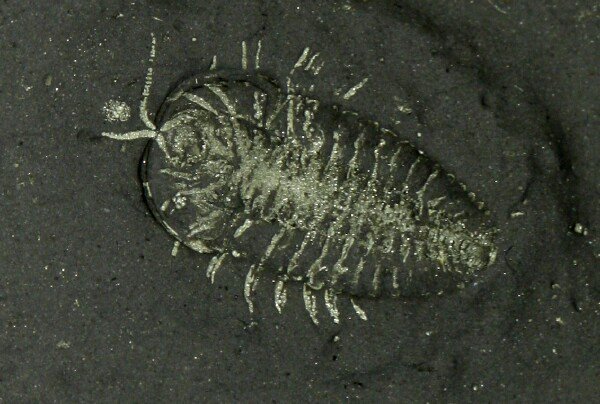
Triarthrus eatoni was a relatively small trilobite, typically reaching a maximum length of about 5 centimeters (approximately 2 inches). Its body plan followed the classic trilobite form, divided longitudinally into three lobes (hence the name 'trilobite'): a central axial lobe and two flanking pleural lobes. The exoskeleton, or carapace, was further divided from head to tail into a cephalon (head), a segmented thorax, and a pygidium (tail shield). The cephalon of Triarthrus was semi-circular with prominent genal spines extending backward from its corners. It possessed a distinctive glabella (the central raised part of the cephalon) that was subquadrate in shape and expanded anteriorly. Unlike many trilobites, Triarthrus lacked visual organs, an adaptation consistent with its life in the aphotic zone of deep marine basins where light could not penetrate. The thorax was composed of 13 to 16 articulating segments, allowing for a degree of flexibility, likely for enrollment as a defensive posture. The pygidium was small and triangular. What makes Triarthrus truly remarkable are the pyritized soft tissues found in specimens from the Frankfort Shale. These fossils preserve delicate structures rarely seen, including a pair of long, multi-segmented antennae extending from the front of the cephalon, which were likely used for sensory perception. Beneath the carapace, each thoracic segment bore a pair of biramous (two-branched) limbs. One branch, the walking leg (telopodite), was used for locomotion across the seafloor, while the other, a feathery gill branch (exite), was used for respiration. Even the digestive tract, including the crop and gut, has been identified through these exceptional fossils, providing a complete picture of its internal and external anatomy.
The extraordinary preservation of Triarthrus has allowed for detailed reconstructions of its paleobiology. Its diet is inferred to have consisted of organic detritus and microorganisms found in the soft, muddy substrate of its deep-sea habitat. Lacking eyes and robust mouthparts for predation, Triarthrus was not an active hunter. Instead, it likely used its numerous walking legs to stir up sediment as it moved across the seafloor. The feathery gill branches on its limbs would have created currents, drawing water and suspended food particles towards the midline of its body, where they could be passed forward to the mouth. This method of feeding, known as filter-feeding or deposit-feeding, is common in modern arthropods like crustaceans that inhabit similar environments. Its locomotion was achieved through the coordinated movement of its many legs, allowing it to crawl along the ocean bottom. While capable of enrollment for defense, its primary predators are not well-known, though potential threats in the Ordovician seas could have included large eurypterids (sea scorpions) and early cephalopods like nautiloids. Fossil evidence, including the preservation of eggs, suggests that Triarthrus, like other trilobites, reproduced sexually. One remarkable specimen shows unhatched eggs clustered underneath the cephalon of an adult, indicating a form of brood care, a complex behavior not previously confirmed in trilobites. Growth occurred through molting (ecdysis), where the animal would shed its exoskeleton to increase in size, a vulnerable process during which it would have been susceptible to predation.
Triarthrus eatoni lived during the Late Ordovician, a time of significant geological and biological change. The continents were arranged very differently, with most landmasses clustered in the Southern Hemisphere, forming the supercontinent Gondwana. North America, known as Laurentia, was an isolated continent situated near the equator, surrounded by warm, shallow seas. The habitat of Triarthrus was not in these sunlit shallows but in the deeper, oxygen-poor (dysoxic) waters of the Taconic foreland basin, an ancient sea that existed east of Laurentia. The climate was generally warmer than today, but the Late Ordovician was marked by a major glaciation event centered on Gondwana, which led to a dramatic drop in sea levels and one of the largest mass extinctions in Earth's history. Triarthrus lived just before the peak of this extinction event. Its ecosystem was dominated by other invertebrates adapted to low-oxygen conditions. It shared its environment with various graptolites (colonial filter-feeders), brachiopods, and other trilobite species. The lack of scavengers and the anoxic conditions of the muddy seafloor were crucial for the exceptional preservation of Triarthrus, as they prevented the rapid decay of its soft tissues after death. In the food web, Triarthrus occupied a low trophic level as a detritivore, processing organic matter and forming a food source for any potential predators capable of surviving in the deep-water environment.
The discovery history of Triarthrus's exceptional fossils is a cornerstone of invertebrate paleontology. While the genus Triarthrus was first described by Jacob Green in 1832, the most significant finds occurred much later. In the early 1890s, a quarry worker named William S. Valiant discovered fossils with unusual preservation near Rome, New York. He brought these specimens to the attention of paleontologist Charles Doolittle Walcott, who was then with the U.S. Geological Survey. Recognizing their immense scientific value, Walcott began a systematic excavation of the site, which was located in a geological layer known as the Frankfort Shale (sometimes referred to as the Utica Shale). Between 1892 and 1895, Walcott's meticulous work uncovered thousands of specimens. The fossils were preserved in pyrite, a mineral that replaced the organic tissues under the anoxic conditions of the seafloor, creating perfect, three-dimensional casts of the delicate antennae, limbs, and gills. This specific type of preservation is known as the 'Beecher's Trilobite Bed' lagerstätte, named after Charles Emerson Beecher, Walcott's contemporary who performed the initial, groundbreaking studies on the soft-part anatomy of these specimens. Beecher's detailed descriptions and illustrations, published in the 1890s, revolutionized the understanding of trilobites, transforming them from mere mineralized shells into fully realized, complex animals. These specimens, many of which are now housed at the Yale Peabody Museum and the Smithsonian National Museum of Natural History, remain the definitive reference for trilobite anatomy.
Triarthrus eatoni holds a pivotal position in the evolutionary history of arthropods. As a member of the Class Trilobita, it belongs to one of the earliest and most successful groups of arthropods, which dominated marine ecosystems for over 250 million years before going extinct at the end of the Permian Period. The exceptionally preserved soft tissues of Triarthrus provide a crucial link for understanding the anatomy and evolution of all arthropods. Its biramous limbs, with both a walking and a gill branch, are considered a primitive (plesiomorphic) feature for the phylum, providing a model for the ancestral arthropod limb from which the more specialized limbs of modern insects, crustaceans, and chelicerates evolved. For example, the limbs of modern crustaceans are also typically biramous, highlighting a shared ancestry. The detailed anatomy of Triarthrus has allowed scientists to confidently place trilobites within the Subphylum Artiopoda, a group that also includes other extinct Paleozoic arthropods. By providing a near-complete anatomical blueprint, Triarthrus helps calibrate our understanding of other, less well-preserved trilobite species and informs functional morphology studies, allowing paleontologists to infer how different trilobites moved, fed, and breathed based on the structure of their exoskeletons alone. It serves as an essential data point for constructing the arthropod family tree and understanding the major evolutionary transitions within this incredibly diverse phylum.
Despite the clarity provided by the Beecher's Trilobite Bed fossils, some scientific debates regarding Triarthrus persist. One area of ongoing research involves the precise function of its biramous limbs. While the respiratory function of the exites (gill branches) is widely accepted, the exact mechanics of how they generated feeding currents and contributed to locomotion are still being modeled and refined. More recent studies using advanced imaging techniques like CT scanning on the pyritized fossils have revealed even finer details of the internal structures, leading to new interpretations. For instance, the 2021 discovery of preserved eggs associated with an adult specimen has ignited discussions about reproductive strategies and parental care in trilobites, behaviors that were previously highly speculative. The find suggests that at least some trilobites may have protected their young, challenging the assumption that they all employed a strategy of releasing vast numbers of eggs into the water column. These new discoveries continually refine our understanding of this ancient arthropod's life.
The fossil record of Triarthrus eatoni is geographically concentrated but scientifically abundant. The most famous and important fossils come from the Late Ordovician Frankfort Shale in Oneida County, New York, specifically from the Beecher's Trilobite Bed locality. This site has yielded thousands of specimens, many with the exceptional pyritization of soft tissues that makes the species so famous. The preservation is so remarkable because the dead trilobites were rapidly buried in anoxic mud on the seafloor. The combination of low oxygen, which inhibited bacterial decay, and the presence of sulfur-reducing bacteria in the sediment led to the replacement of soft tissues by pyrite (fool's gold) before they could decompose. This process preserved not just the hard exoskeleton but also the delicate, non-mineralized appendages in three dimensions. While the genus Triarthrus is found in Ordovician rocks elsewhere in North America and other parts of the world, it is the specimens from this specific New York lagerstätte that are scientifically priceless and have made the species a textbook example of exceptional fossil preservation.
Due to its scientific importance, Triarthrus eatoni has had a significant cultural and educational impact. It is a staple in university paleontology courses and is featured prominently in museum exhibits worldwide that discuss trilobite biology and fossil preservation. The Yale Peabody Museum of Natural History and the Smithsonian National Museum of Natural History hold the most important collections, and their displays of the pyritized fossils with delicate antennae and legs intact often captivate the public. While it may not have the blockbuster appeal of a Tyrannosaurus rex, for those interested in the diversity of ancient life, Triarthrus offers a rare and intimate glimpse into the world of the Paleozoic Era. It serves as a powerful example of how a small, unassuming creature can revolutionize scientific understanding through the rare circumstance of its exceptional preservation.
Classification
Time Period
Discovery
Location
New York, USA
Formation
Frankfort Shale
Frequently Asked Questions
What is Triarthrus?
Triarthrus eatoni is an extinct species of trilobite, a highly successful group of marine arthropods that thrived during the Paleozoic Era. This particular species lived during the Late Ordovician Period, approximately 450 to 445 million years ago, in the deep-water environments of what is now North...
When did Triarthrus live?
Triarthrus lived during the ordovician period of the paleozoic era approximately 450-445 million years ago.
Where was Triarthrus discovered?
Fossils of Triarthrus were discovered in New York, USA in the Frankfort Shale.
What did Triarthrus eat?
Triarthrus was a detritivore. It lived in marine, deep-sea habitats.
What type of fossil is Triarthrus?
Triarthrus is preserved as a body fossil. The preservation quality is exceptional.
Related Specimens
From the paleozoic era · body fossils