Kosmoceratops
Kosmoceratops richardsoni
Image: Image sourced via web search (Fair use / Educational)
About Kosmoceratops
Kosmoceratops richardsoni was a remarkable chasmosaurine ceratopsid dinosaur that lived during the Late Cretaceous period, approximately 76 to 75 million years ago, in what is now southern Utah. Renowned for possessing the most ornate skull of any known dinosaur, this extraordinary herbivore roamed the ancient island continent of Laramidia. Its discovery has significantly enriched our understanding of ceratopsian diversity and the high degree of dinosaur endemism that characterized Laramidia during the Campanian age. The sheer complexity of its cranial ornamentation has made it a focal point for studies regarding sexual selection and species recognition in non-avian dinosaurs, cementing its status as one of the most important paleontological discoveries of the early twenty-first century. By providing a spectacular example of evolutionary radiation in an isolated landmass, Kosmoceratops serves as a crucial data point in reconstructing the complex biogeography of Late Cretaceous North America.
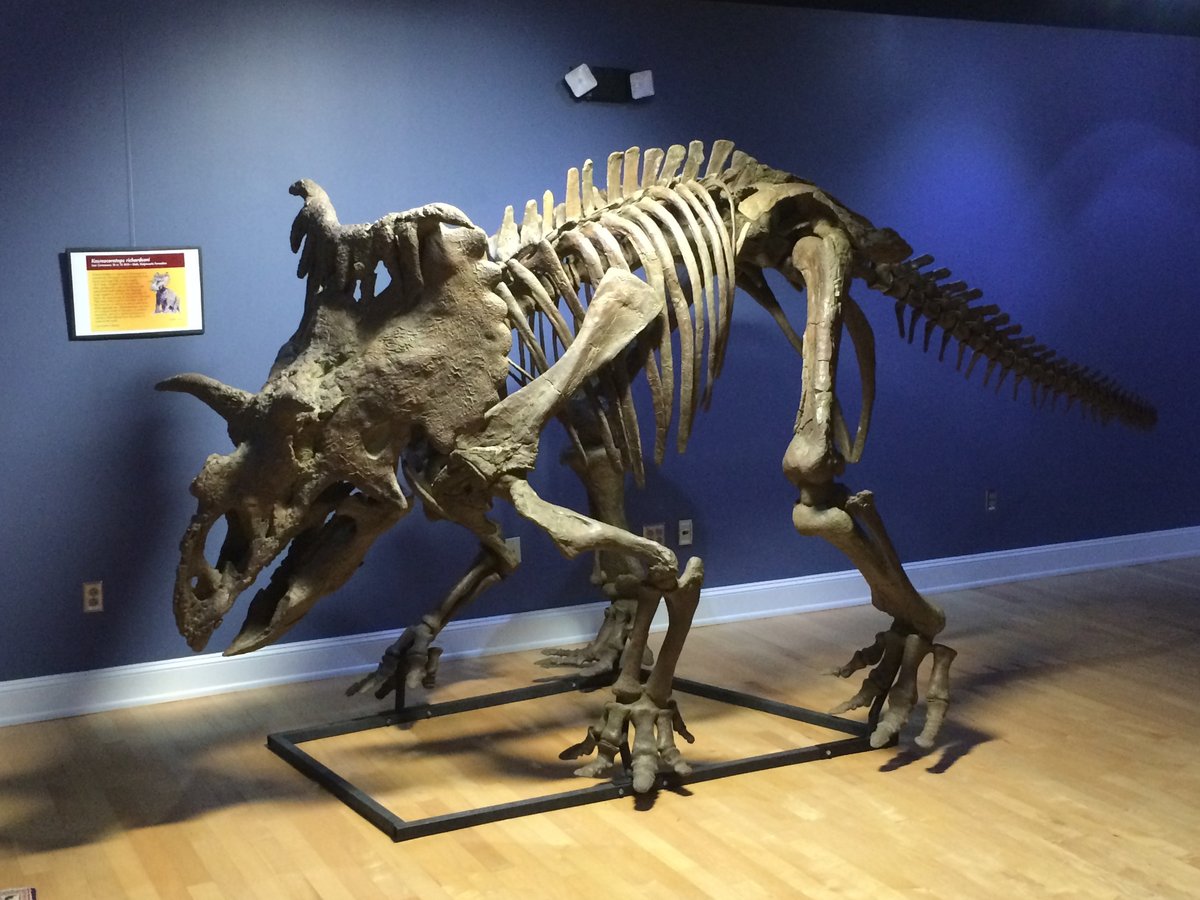
The physical anatomy of Kosmoceratops is nothing short of spectacular, primarily due to its incredibly elaborate skull. Measuring approximately 4.5 meters in total body length and weighing an estimated 1.2 to 2 tons, Kosmoceratops was a medium-sized ceratopsid, roughly comparable in bulk to a modern black rhinoceros, though somewhat longer due to its heavy tail and massive head. The most distinctive feature of this animal is its cranial ornamentation, which boasts a record-breaking fifteen well-developed horns and horn-like structures. These include a single horn over the nose, a horn over each eye, a horn at the tip of each cheekbone, and ten hook-like projections curling forward along the posterior margin of its bony frill. Unlike many of its chasmosaurine relatives, which typically feature long, expansive frills, the frill of Kosmoceratops is relatively short and wide, with the parietal bones at the back folding forward to create a unique, overhanging shelf of bone. The postcranial skeleton, while less bizarre than the skull, demonstrates the classic ceratopsid bauplan: a robust, barrel-shaped ribcage supported by four sturdy legs, with the forelimbs slightly splayed to support the immense weight of the head. Soft tissue inferences, drawn from related ceratopsids, suggest it possessed a tough, scaly hide, possibly featuring larger, tubercle-like scales interspersed among smaller basement scales, providing protection against both the environment and potential predators.
In terms of paleobiology, Kosmoceratops was an obligate quadrupedal herbivore, highly adapted for processing tough, fibrous vegetation. Its narrow, beak-like snout was ideal for selective browsing, allowing it to crop specific ferns, cycads, and early angiosperms that grew close to the ground. Once the vegetation was cropped, it was processed by complex dental batteries located in the back of the jaw. These batteries consisted of hundreds of tightly packed teeth that continually replaced themselves, acting like self-sharpening shears to slice through tough plant matter before swallowing. The sheer extravagance of its cranial ornamentation strongly points toward complex social behaviors. Paleontologists widely agree that the fifteen horns and the forward-curling frill hooks were not primarily for defense against predators, as they were relatively fragile and poorly positioned for combat. Instead, these structures were almost certainly used for intraspecific display, playing a critical role in attracting mates, establishing dominance hierarchies within a herd, and ensuring species recognition in an environment crowded with other large herbivores. Growth patterns inferred from bone histology of related ceratopsids suggest Kosmoceratops grew rapidly during its juvenile years, reaching adult size and sexual maturity within a decade or two, a high metabolic rate consistent with the active, dynamic lifestyles increasingly attributed to Late Cretaceous dinosaurs.
The ecological context of Kosmoceratops is rooted in the Kaiparowits Formation, a geological treasure trove that preserves a vibrant, ancient ecosystem. During the Campanian age, North America was bisected by the Western Interior Seaway, creating the western landmass of Laramidia. The environment of southern Laramidia, where Kosmoceratops lived, was a lush, humid, and swampy coastal plain, characterized by meandering rivers, dense floodplains, and abundant rainfall. The climate was subtropical to warm-temperate, supporting a dense canopy of conifers and a rich understory of ferns and flowering plants. Kosmoceratops shared this verdant habitat with a diverse array of spectacular dinosaurs. Its contemporary herbivores included the giant crested hadrosaur Parasaurolophus cyrtocristatus, the armored ankylosaur Akainacephalus, and another large ceratopsid, the massive Utahceratops. This high diversity of megaherbivores suggests niche partitioning was at play, with Kosmoceratops likely feeding on different plants or at different heights than its neighbors. The primary threat to Kosmoceratops was Teratophoneus, a formidable tyrannosaurid apex predator that prowled the Kaiparowits ecosystem. To survive in a landscape shared with such dangerous predators, Kosmoceratops likely relied on herd behavior, using the collective vigilance of the group to detect and deter threats.
The discovery history of Kosmoceratops is a testament to the rich paleontological potential of the American Southwest. The first fossils of this remarkable animal were discovered in 2006 within the rugged badlands of the Grand Staircase-Escalante National Monument in southern Utah. The discovery was made by Scott Richardson, a dedicated volunteer and paleontology enthusiast working alongside a team from the University of Utah and the Natural History Museum of Utah. Recognizing the unique nature of the find, the team, led by prominent paleontologist Dr. Scott Sampson, undertook a meticulous excavation process to extract the fragile skull and associated postcranial elements from the hard sandstone matrix. In 2010, the animal was formally described and named Kosmoceratops richardsoni. The genus name translates to 'ornate horned face,' derived from the Ancient Greek words 'kosmos' (meaning ornament or decoration), 'keras' (horn), and 'ops' (face). The specific epithet, richardsoni, honors Scott Richardson for his crucial role in discovering the holotype specimen. The holotype, designated UMNH VP 17000, consists of a nearly complete skull and partial postcranial skeleton, providing an exceptionally clear picture of the animal's anatomy and immediately establishing it as a paleontological icon.
The evolutionary significance of Kosmoceratops lies in its profound implications for our understanding of dinosaur biogeography and evolutionary radiation. As a member of the Chasmosaurinae, a subfamily of ceratopsids typically characterized by long frills and prominent brow horns, Kosmoceratops exhibits a highly derived and specialized morphology. Its existence, alongside other unique Laramidian dinosaurs, provides strong evidence for the hypothesis of dinosaur endemism during the Late Cretaceous. This hypothesis suggests that Laramidia was divided into distinct northern and southern faunal provinces, separated by unknown geographical or climatic barriers. Kosmoceratops, restricted to the southern province, demonstrates how isolated populations of dinosaurs underwent rapid evolutionary radiation, developing bizarre and highly specialized display structures in a relatively short geological timeframe. Furthermore, the forward-folding parietal bone of its frill represents a unique evolutionary trajectory within the ceratopsian family tree, showing how plastic and adaptable the ceratopsid skull was under the pressures of sexual selection. By comparing Kosmoceratops to its northern relatives, such as Chasmosaurus, scientists can better map the evolutionary pathways and migratory patterns of horned dinosaurs across the Laramidian continent.
Scientific debates surrounding Kosmoceratops primarily focus on the mechanics of Laramidian endemism and the specific functions of its bizarre cranial anatomy. While the endemism hypothesis is widely supported, some researchers debate the nature of the barriers that separated northern and southern dinosaur populations. Since there is no evidence of a physical mountain range or seaway bisecting Laramidia latitudinally, some scientists argue that climatic zones or differences in regional flora created invisible boundaries that these highly specialized herbivores rarely crossed. Another area of ongoing discussion involves the biomechanics of the frill and horns. While the consensus strongly favors sexual display, some researchers have proposed that the forward-curling hooks might have played a secondary role in species recognition or even thermoregulation, though the latter is considered less likely given the thick, bony nature of the structures. Additionally, the exact phylogenetic placement of Kosmoceratops within Chasmosaurinae is occasionally debated as new ceratopsid species are discovered, with some cladistic analyses placing it closer to Vagaceratops, while others suggest a more complex web of relationships among the Laramidian horned dinosaurs.
The fossil record of Kosmoceratops is currently restricted to the Kaiparowits Formation in the Grand Staircase-Escalante National Monument of Utah. While not as abundant as some other ceratopsids like Triceratops or Centrosaurus, the known specimens of Kosmoceratops are of remarkably high preservation quality. The holotype specimen includes a beautifully preserved, nearly complete skull, which is crucial for understanding its complex ornamentation, along with a significant portion of the postcranial skeleton, including vertebrae, ribs, and limb bones. A few other partial specimens and isolated bones have been referred to the genus, helping to confirm the consistency of its unique anatomical features. The fossils are typically found in mudstone and sandstone deposits, indicative of the ancient river channels and floodplains where these animals lived and died. The exceptional preservation of the holotype skull, which avoided the severe crushing and distortion that often plagues ceratopsid fossils, has allowed paleontologists to create highly accurate three-dimensional reconstructions of the animal's head, providing invaluable data for biomechanical and evolutionary studies.
The cultural impact of Kosmoceratops has been significant, particularly within the realm of science communication and museum exhibitions. Dubbed the 'most ornate dinosaur ever found,' it quickly captured the public's imagination following its announcement in 2010. The spectacular holotype skull is a centerpiece exhibit at the Natural History Museum of Utah in Salt Lake City, where it draws thousands of visitors and serves as a powerful educational tool for teaching concepts of evolution, sexual selection, and ancient ecosystems. Kosmoceratops frequently appears in popular science books, paleoart, and dinosaur documentaries, often used to illustrate the incredible diversity and bizarre adaptations of Late Cretaceous life. Its striking appearance has made it a favorite among dinosaur enthusiasts and toy manufacturers, ensuring that this extraordinary Laramidian herbivore continues to inspire wonder and curiosity about the prehistoric world.
Classification
Time Period
Discovery
Location
Utah, USA
Formation
Kaiparowits Formation
Frequently Asked Questions
What is Kosmoceratops?
Kosmoceratops richardsoni was a remarkable chasmosaurine ceratopsid dinosaur that lived during the Late Cretaceous period, approximately 76 to 75 million years ago, in what is now southern Utah. Renowned for possessing the most ornate skull of any known dinosaur, this extraordinary herbivore roamed ...
When did Kosmoceratops live?
Kosmoceratops lived during the cretaceous period of the mesozoic era approximately 76-75 million years ago.
Where was Kosmoceratops discovered?
Fossils of Kosmoceratops were discovered in Utah, USA in the Kaiparowits Formation.
What did Kosmoceratops eat?
Kosmoceratops was a herbivore. It lived in terrestrial habitats.
What type of fossil is Kosmoceratops?
Kosmoceratops is preserved as a body fossil. The preservation quality is good.
Related Specimens
From the mesozoic era · body fossils