Rafinesquina
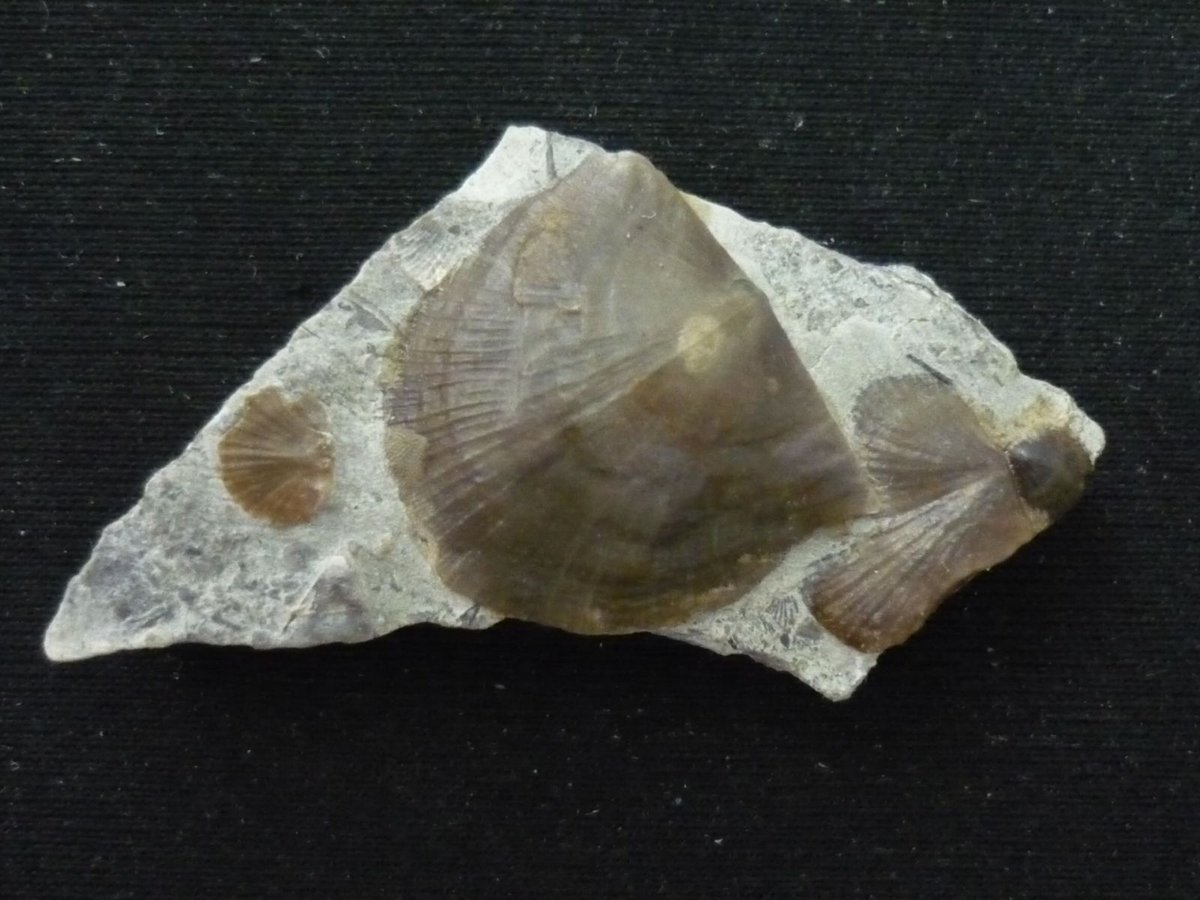
Rafinesquina alternata
Image: Image sourced via web search (Fair use / Educational)
About Rafinesquina
Rafinesquina alternata is an extinct species of strophomenid brachiopod that thrived in the shallow, warm epicontinental seas of the Late Ordovician Period, approximately 460 to 443 million years ago. As one of the most abundant and characteristic fossils of the Cincinnatian Series in North America, it serves as a crucial index fossil, helping geologists and paleontologists date and correlate rock layers across vast distances. Its distinctive shell morphology and widespread distribution make it a cornerstone for understanding the rich marine ecosystems that flourished just before the end-Ordovician mass extinction event.
Rafinesquina alternata possessed a bivalved shell, or conch, typically measuring between 3 to 5 centimeters in width, though some exceptional specimens can reach up to 7 centimeters. The shell is concavo-convex, meaning one valve (the brachial valve) is concave, fitting snugly into the other, larger convex valve (the pedicle valve). This shape is a hallmark of the Strophomenida order. The shell's exterior is ornamented with fine, radiating ribs, or costae, of alternating thickness—a prominent and thicker rib followed by several finer ones—which gives the species its name, 'alternata'. This pattern of ornamentation is a key diagnostic feature. The hinge line is long and straight, often representing the widest part of the shell. A small opening, the pedicle foramen, was present in juvenile shells near the hinge, through which a fleshy stalk called the pedicle would emerge to anchor the animal. However, in mature individuals, this foramen often closed, suggesting a change in lifestyle from attached to free-lying on the seafloor. The shell itself was composed of low-magnesium calcite, a robust material that contributes to its excellent preservation potential in the fossil record. Compared to a modern bivalve like a clam, Rafinesquina's shell structure is superficially similar, but its internal anatomy and symmetry were fundamentally different, with the plane of symmetry running perpendicular to the hinge line, unlike the parallel symmetry of clams.
As a brachiopod, Rafinesquina was a sessile, marine filter-feeder. It lived on the seafloor, likely preferring soft, muddy, or silty substrates in shallow to moderately deep water. The animal's primary feeding apparatus was the lophophore, a complex, coiled organ lined with ciliated tentacles, housed entirely within the shell cavity. By creating water currents with its cilia, the lophophore would draw in seawater through the gape of the shell, filtering out microscopic organic particles and plankton for sustenance. The concavo-convex shell shape was highly adaptive for this lifestyle. By lying on the seafloor with its convex pedicle valve down, it could elevate the gape of the shell slightly above the substrate. This orientation would have minimized the intake of sediment and maximized the efficiency of its filter-feeding currents. The transition from a juvenile, attached lifestyle (using a pedicle) to a free-lying adult stage is a significant aspect of its paleobiology. This life history strategy, known as 'strophomenoid reclining', allowed the organism to colonize vast areas of soft seafloor that might have been unsuitable for permanently attached organisms. Growth patterns are visible on the shell exterior as fine concentric lines, indicating incremental additions of calcite along the shell margin as the animal matured.
The world of the Late Ordovician was a vastly different place, characterized by a supercontinent, Gondwana, situated over the South Pole, and a collection of smaller continents, including Laurentia (ancient North America), clustered around the equator. Rafinesquina lived in the warm, tropical Cincinnatian Sea that covered much of Laurentia. This shallow epicontinental sea was teeming with life, creating one of the most diverse marine ecosystems of the Paleozoic Era. The climate was generally warm and greenhouse-like, with high sea levels. Rafinesquina shared its habitat with an astonishing array of other invertebrates. Its neighbors included other brachiopod species (like Hebertella and Leptaena), bryozoans (both encrusting and branching forms), crinoids (sea lilies), trilobites (such as Flexicalymene and Isotelus), horn corals, and cephalopods (like the straight-shelled nautiloids). Rafinesquina was a primary consumer, occupying a low trophic level in the food web by feeding on suspended organic matter. It, in turn, would have been prey for durophagous (shell-crushing) predators, which may have included certain species of trilobites, nautiloids, and early jawed fish. Its abundance made it a foundational part of the benthic community structure.
The discovery and naming of Rafinesquina alternata are intertwined with the early history of American paleontology. The species was first formally described as Strophomena alternata in 1838 by the American naturalist Timothy Abbott Conrad in his report for the Second Annual Report on the Paleontological Department of the Survey of New York. However, the genus Rafinesquina was established later, in 1843, by the paleontological duo James Hall and James Dwight Dana. They named the genus in honor of Constantine Samuel Rafinesque, an eccentric and brilliant but often controversial 19th-century naturalist who had done extensive work on the natural history of the Ohio River Valley. Hall and Dana recognized that Conrad's Strophomena alternata, along with similar species, represented a distinct group deserving of its own genus. The type specimens and countless subsequent fossils were collected from the famously fossil-rich strata of the Cincinnati Arch region in Ohio, Kentucky, and Indiana, an area that has been a training ground for paleontologists for nearly two centuries. Due to its extreme abundance, there is no single 'famous' specimen akin to a dinosaur skeleton; rather, its importance lies in its collective presence in countless museum and university collections worldwide.
Rafinesquina holds significant evolutionary importance as a quintessential example of the brachiopod radiation during the Great Ordovician Biodiversification Event (GOBE). This period saw a dramatic increase in marine biodiversity at all taxonomic levels, and brachiopods were among the most successful groups. As a member of the order Strophomenida, Rafinesquina showcases key adaptations, such as the concavo-convex shell and the reclining life habit, that allowed this group to dominate soft-substrate benthic environments for millions of years. The strophomenids were one of the most diverse and long-lasting brachiopod orders of the Paleozoic, and Rafinesquina represents a classic early form. While the direct lineage of brachiopods that includes Rafinesquina went extinct during the Permian-Triassic mass extinction, the phylum Brachiopoda itself survived. Modern brachiopods (like Lingula and Terebratulina) are often considered 'living fossils', but they represent different evolutionary branches. Studying Rafinesquina provides critical insight into the morphology, ecology, and evolutionary success of a major clade that has no direct modern analogue, highlighting the profound changes in marine community structure over geologic time.
Despite being a well-known and extensively studied fossil, Rafinesquina is not without scientific debate. Much of the discussion revolves around its paleoecology and functional morphology. For instance, the precise mechanics of its feeding currents and the hydrodynamic stability of its shell on the seafloor have been subjects of biomechanical modeling and analysis. Some researchers have debated the exact function of the alternating rib size, suggesting it may have played a role in strengthening the shell against predators or in baffling currents near the shell margin to improve feeding efficiency. Furthermore, subtle variations in shell shape and ornamentation across different rock layers have led to taxonomic debates about whether certain populations represent distinct species or subspecies, or simply ecophenotypic variations in response to local environmental conditions. The classification within the family Rafinesquinidae itself has undergone revisions as new phylogenetic analyses are conducted, clarifying the relationships between Rafinesquina and its close relatives like Sowerbyella.
The fossil record of Rafinesquina alternata is exceptionally robust and widespread. Its fossils are found in immense numbers throughout the Upper Ordovician rocks of eastern and midwestern North America, particularly within the Cincinnatian Series of Ohio, Kentucky, and Indiana. In some limestone and shale beds, the shells of Rafinesquina are so densely packed that they form the primary component of the rock, creating coquinas or 'brachiopod pavements'. The preservation quality is typically excellent, with fine details of the shell's ornamentation, muscle scars on the interior, and even the delicate hinge structures often perfectly intact. Both the pedicle and brachial valves are commonly found, sometimes still articulated. Famous fossil collecting sites include Caesar Creek State Park in Ohio and various road cuts and creek beds throughout the tri-state Cincinnati Arch region. Its abundance and excellent preservation make it a staple of fossil collections, from major museums to the private collections of amateur enthusiasts.
While not a dinosaur, Rafinesquina alternata has a significant cultural and educational impact, especially in the American Midwest. It is one of the most recognizable and commonly collected fossils in the world, often serving as a 'first fossil' for aspiring young paleontologists in the Cincinnati area. Museums with major Ordovician collections, such as the Cincinnati Museum Center, the Orton Geological Museum at The Ohio State University, and the Smithsonian National Museum of Natural History, feature prominent displays of Rafinesquina-rich fossil assemblages to illustrate the concept of an ancient seafloor. Its role as an Ohio state invertebrate fossil further cements its local importance. In educational settings, its abundance and distinctiveness make it an ideal tool for teaching fundamental geological principles like stratigraphy, index fossils, and the concept of ancient marine ecosystems.
Classification
Time Period
Discovery
Location
North America (specifically, the Cincinnati Arch region of Ohio, Indiana, and Kentucky)
Formation
Cincinnatian Series (e.g., Kope Formation, Fairview Formation, Bellevue Formation)
Frequently Asked Questions
What is Rafinesquina?
Rafinesquina alternata is an extinct species of strophomenid brachiopod that thrived in the shallow, warm epicontinental seas of the Late Ordovician Period, approximately 460 to 443 million years ago. As one of the most abundant and characteristic fossils of the Cincinnatian Series in North America,...
When did Rafinesquina live?
Rafinesquina lived during the ordovician period of the paleozoic era approximately 460-443 million years ago.
Where was Rafinesquina discovered?
Fossils of Rafinesquina were discovered in North America (specifically, the Cincinnati Arch region of Ohio, Indiana, and Kentucky) in the Cincinnatian Series (e.g., Kope Formation, Fairview Formation, Bellevue Formation).
What did Rafinesquina eat?
Rafinesquina was a filter-feeder. It lived in marine, reef, shallow-sea habitats.
What type of fossil is Rafinesquina?
Rafinesquina is preserved as a body fossil. The preservation quality is excellent.
Related Specimens
From the paleozoic era · body fossils