/cc86f4a1bc00.jpg)
Opabinia regalis (Burgess Shale)
Opabinia regalis
About Opabinia regalis (Burgess Shale)
Opabinia regalis stands as one of the most enigmatic and iconic creatures to have emerged from the fossil record of the Cambrian Period. This extinct marine organism, which lived approximately 508 million years ago, is celebrated for its bizarre and unique anatomy that initially baffled the scientific community. First discovered in the world-renowned Burgess Shale of British Columbia, Canada, Opabinia's strange combination of features, including five eyes and a frontal proboscis, has made it a symbol of the explosive and often experimental nature of early animal evolution during the Cambrian Explosion.
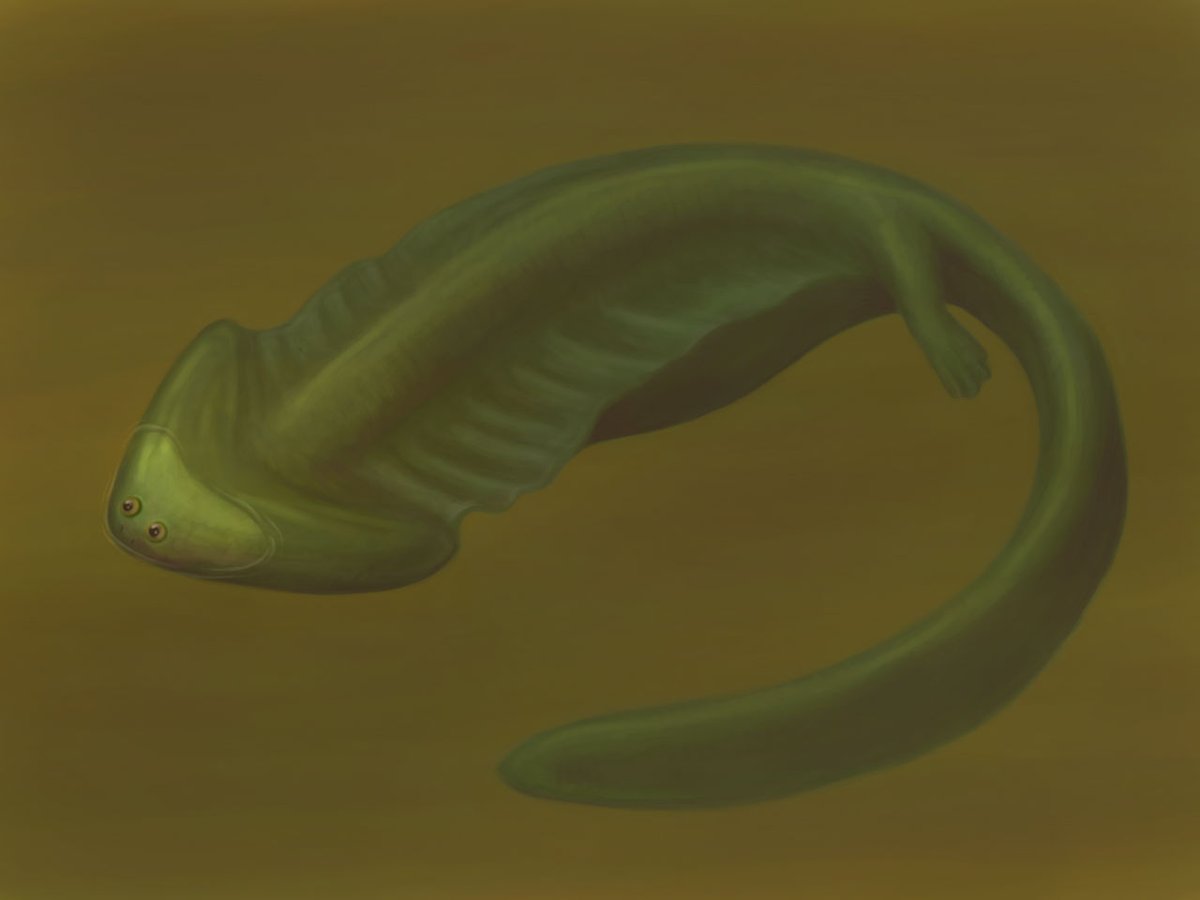
The physical appearance of Opabinia regalis is so unusual that it defies easy comparison with any living animal. Typically measuring between 4 and 7 centimeters in length, this soft-bodied creature possessed a segmented trunk composed of approximately 15 sections. Each of these body segments bore a pair of downward-pointing, gill-bearing lobes on its sides, which likely served a respiratory function, absorbing oxygen from the seawater. Overlapping these gill structures were larger, flap-like lobes that extended laterally from the body. These flaps, which decreased in size towards the rear of the animal, were likely used for propulsion, beating in a coordinated, wave-like motion to move it through the water. The posterior end of the body terminated in a distinctive fan-like tail, composed of three pairs of upward-facing flaps, which probably acted as a stabilizer or rudder during locomotion. The most startling features, however, were located on its head. Opabinia sported five stalked eyes that protruded from the top of its head, arranged in a forward-facing pentagonal pattern, which would have provided an excellent, possibly panoramic, field of vision. Extending from the front of its head was a long, flexible, and hollow proboscis, nearly a third of the animal's total body length, which ended in a grasping claw-like structure armed with spines. This entire anatomical arrangement presents a creature seemingly assembled from disparate parts, a true testament to the evolutionary experimentation of the Cambrian.
The unique morphology of Opabinia regalis provides significant clues about its paleobiology and lifestyle as an active predator or scavenger on the Cambrian seafloor. Its five prominent eyes suggest a visually oriented animal, capable of spotting prey or potential threats in the dimly lit benthic environment. The long, highly mobile proboscis was almost certainly its primary feeding apparatus. It is hypothesized that Opabinia would have used this appendage to search for and grasp soft-bodied prey, such as worms or other small invertebrates, hidden in the muddy substrate. Once captured by the terminal claw, the proboscis would have been flexible enough to bend backwards and deliver the food directly to the mouth, which was located ventrally, beneath the head. Its method of locomotion was likely a graceful undulation of its lateral flaps, allowing it to swim or hover just above the seabed. This combination of keen eyesight, a specialized feeding tool, and controlled mobility paints a picture of a sophisticated and successful hunter within its ecosystem. While direct evidence of its diet is absent, its anatomy strongly supports a carnivorous lifestyle, placing it among the more advanced predators of its time.
Opabinia lived in a deep-water marine environment on a continental slope adjacent to the ancient continent of Laurentia. The Burgess Shale fauna inhabited a muddy seafloor at the base of a large submarine cliff, known as the Cathedral Escarpment. The climate during the Middle Cambrian was significantly warmer than today, with no polar ice caps, resulting in higher sea levels. The ecosystem was teeming with a diverse array of newly evolved life forms, many of which are preserved with exceptional detail in the fine-grained sediment. Opabinia shared its habitat with a host of other famous Cambrian creatures, including the formidable apex predator Anomalocaris, the ubiquitous trilobites such as Olenoides, the armored slug-like Wiwaxia, and the enigmatic Hallucigenia. Within this complex food web, Opabinia likely occupied a mid-tier predatory niche. It was large enough to prey on smaller, soft-bodied benthic organisms but was itself a potential target for the much larger Anomalocaris. Its existence highlights the rapid development of predator-prey relationships and the establishment of complex ecological structures shortly after the initial burst of animal diversification.
The discovery of Opabinia regalis is intrinsically linked to the pioneering work of paleontologist Charles Doolittle Walcott. While exploring the Burgess Shale in the Canadian Rockies, Walcott collected the first specimens of Opabinia between 1911 and 1917. He formally described the species in 1912, giving it the name Opabinia regalis, derived from Opabin Pass and the Latin word for "regal" or "royal," perhaps in reference to its striking appearance. In his initial assessment, Walcott classified Opabinia as an anostracan crustacean, a type of "fairy shrimp," attempting to fit its unusual features into a known arthropod framework. For decades, this classification was largely accepted, and the organism remained a relatively obscure fossil. It was not until the comprehensive reinvestigation of the Burgess Shale fauna, led by paleontologist Harry B. Whittington and his team at Cambridge University in the 1970s, that the true nature of Opabinia was revealed. Whittington's meticulous dissection and reconstruction of the fossils, published in a landmark 1975 paper, demonstrated its five eyes, frontal proboscis, and other bizarre features, concluding that it could not be placed in any known phylum. This shocking reconstruction famously drew laughter when first presented at a scientific meeting, underscoring just how alien the creature appeared.
The evolutionary significance of Opabinia regalis cannot be overstated, as it fundamentally altered our understanding of early animal evolution and the scope of the Cambrian Explosion. Whittington's reconstruction challenged the long-held belief that Cambrian fossils could all be neatly placed within the lineages of modern animal groups. Opabinia seemed to represent a failed evolutionary experiment, a distinct body plan that left no living descendants. This idea was popularized by Stephen Jay Gould in his book "Wonderful Life," where he used Opabinia as a prime example of the contingency of evolution. However, subsequent discoveries and analyses have revised this view. The discovery of related organisms like Anomalocaris and other radiodonts, which also possessed lateral flaps and complex head appendages, helped place Opabinia within a broader evolutionary context. It is now understood to be part of an extinct group known as the stem-group arthropods, or dinocaridids, which represent an early offshoot from the lineage that would eventually lead to modern arthropods like insects, crustaceans, and chelicerates. Opabinia thus serves as a crucial transitional fossil, showcasing a combination of primitive and derived traits that illuminate the step-by-step assembly of the arthropod body plan.
Despite decades of study, Opabinia regalis continues to be the subject of scientific debate, primarily concerning its precise phylogenetic placement. While its position as a stem-group arthropod is now widely accepted, its exact relationship to other early arthropod relatives, such as the radiodonts (like Anomalocaris) and the gilled lobopodians (like Kerygmachela), remains a topic of active research and discussion. The functional morphology of its proboscis has also been debated, with some researchers questioning its flexibility and the exact mechanics of its grasping claw. Furthermore, interpretations of its behavior are inferential; while a predatory lifestyle is the consensus, the possibility that it was also a scavenger cannot be entirely ruled out. These ongoing discussions highlight the challenges of reconstructing the biology of an organism so far removed from any living analogue and underscore the dynamic nature of paleontological science, where new fossil finds and analytical techniques continually refine our understanding of ancient life.
The fossil record of Opabinia regalis is exceptionally rare and geographically restricted, with all known and confirmed specimens originating from the Burgess Shale Formation in British Columbia, Canada. Specifically, they are found within the Phyllopod Bed on Fossil Ridge, a layer renowned for its exquisite soft-tissue preservation. To date, only about 30 specimens of Opabinia have been discovered, making it one of the rarer members of the Burgess Shale fauna. The quality of preservation, however, is often remarkable. The fine-grained siltstone of the formation captured not only the creature's outline but also delicate internal structures, such as traces of its gut, and the fine details of its gills and eyes. This high-fidelity preservation, known as Burgess Shale-type preservation, is the sole reason we have such a detailed understanding of this soft-bodied animal. The primary repository for these invaluable fossils is the Smithsonian National Museum of Natural History in Washington, D.C., where Walcott's original collection is housed, with other key specimens held at the Royal Ontario Museum in Toronto.
Due to its utterly alien appearance, Opabinia regalis has captured the public imagination and has become a celebrity of the Cambrian Period. It is prominently featured in museum exhibits on early life around the world, often depicted in detailed dioramas and reconstructions that emphasize its strangeness. Its role as a key player in Stephen Jay Gould's "Wonderful Life" brought it to a wide audience, making it a textbook example of Cambrian oddities and evolutionary contingency. Opabinia frequently appears in documentaries, books, and educational materials about prehistoric life, serving as a powerful tool for teaching concepts about evolution, extinction, and the sheer diversity of life that has existed on Earth.
Time Period
Discovery
Location
Burgess Shale, Canadian Rockies, British Columbia, Canada
Formation
Burgess Shale Formation
Frequently Asked Questions
What is Opabinia regalis (Burgess Shale)?
Opabinia regalis stands as one of the most enigmatic and iconic creatures to have emerged from the fossil record of the Cambrian Period. This extinct marine organism, which lived approximately 508 million years ago, is celebrated for its bizarre and unique anatomy that initially baffled the scientif...
When did Opabinia regalis (Burgess Shale) live?
Opabinia regalis (Burgess Shale) lived during the cambrian period of the paleozoic era approximately 508 million years ago.
Where was Opabinia regalis (Burgess Shale) discovered?
Fossils of Opabinia regalis (Burgess Shale) were discovered in Burgess Shale, Canadian Rockies, British Columbia, Canada in the Burgess Shale Formation.
What did Opabinia regalis (Burgess Shale) eat?
Opabinia regalis (Burgess Shale) was a predator/scavenger. It lived in marine (benthic, likely in deep-water environments) habitats.
What type of fossil is Opabinia regalis (Burgess Shale)?
Opabinia regalis (Burgess Shale) is preserved as a impression fossil. The preservation quality is exceptional.
Related Specimens
From the paleozoic era · impression fossils