Spinosaurus
Spinosaurus aegyptiacus
Image: File:Spinosaurus aegyptiacus.jpg - Wikimedia Commons (CC BY-SA)
About Spinosaurus
Spinosaurus aegyptiacus, whose name translates to the spined lizard from Egypt, was a colossal theropod dinosaur that lived during the mid-Cretaceous period of the Mesozoic era, approximately 112 to 93.5 million years ago. It holds immense paleontological significance as the largest known predatory dinosaur to have ever roamed the Earth, and more importantly, as the first non-avian dinosaur to show definitive skeletal adaptations for a primarily semi-aquatic lifestyle. Inhabiting the ancient river systems and sprawling delta environments of what is now North Africa, particularly within the Bahariya Oasis of Egypt and the Kem Kem beds of Morocco, this magnificent creature fundamentally altered humanity's understanding of dinosaur ecology and evolutionary adaptability.
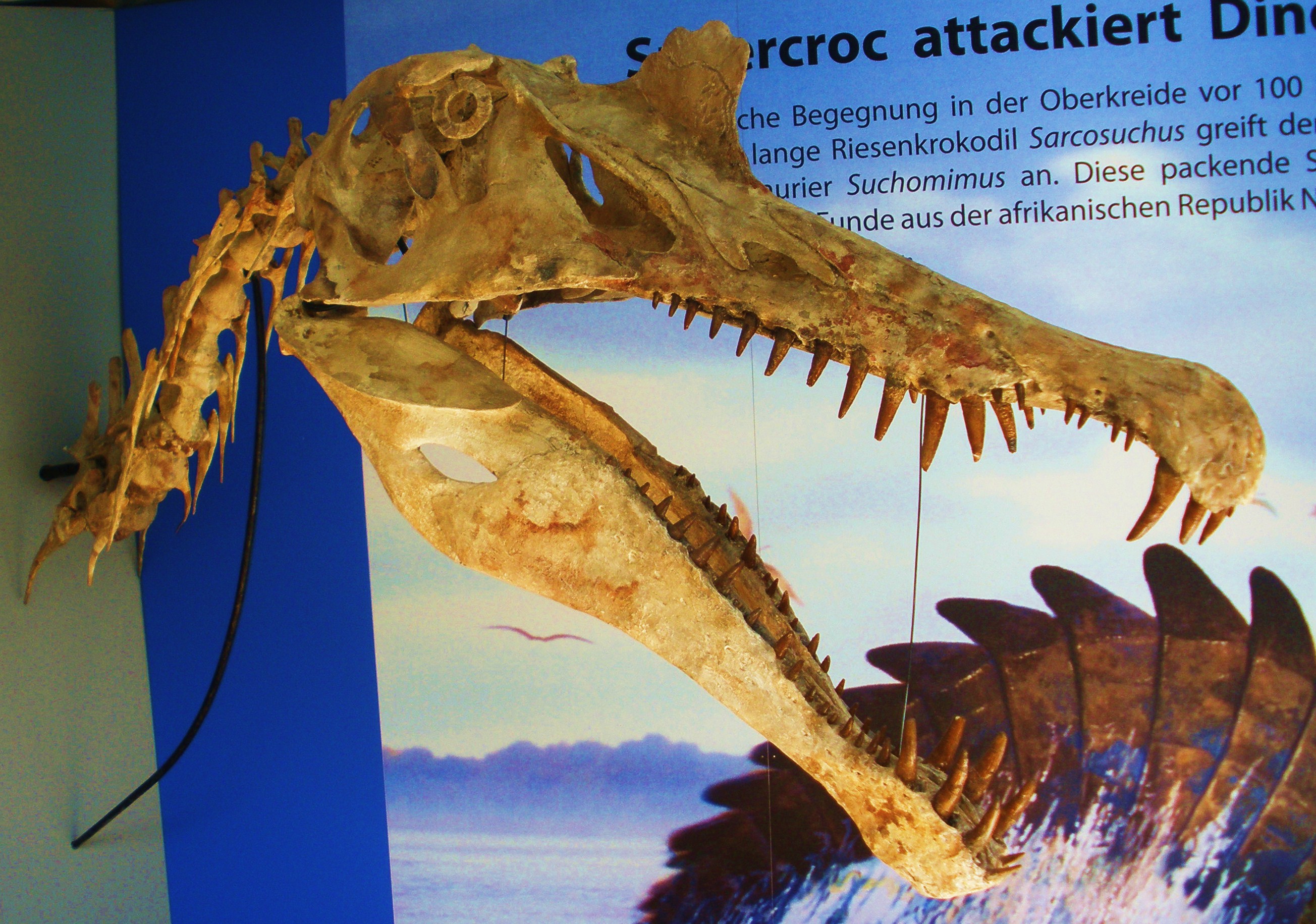
The physical description of Spinosaurus aegyptiacus reveals an animal of staggering proportions and highly specialized anatomy, setting it apart from virtually all other known theropods. Reaching estimated lengths of up to 1500 centimeters, or 15 meters, it surpassed even the massive Tyrannosaurus rex and Giganotosaurus in sheer linear dimension. Its body mass is estimated to have been anywhere from seven to twenty tons, though the exact weight remains a subject of ongoing biomechanical analysis due to its unique skeletal density. The most visually arresting feature of Spinosaurus was the enormous, sail-like structure running down its back, which was supported by elongated neural spines projecting from its dorsal vertebrae. Some of these bony struts reached over 1.6 meters in height. Unlike the hollow, lightweight bones typical of most large theropods, Spinosaurus possessed highly osteosclerotic, or dense, bones. This heavy skeletal framework acted as biological ballast, allowing the massive animal to control its buoyancy in the water, much like modern penguins or manatees. Its skull was elongated, narrow, and distinctly crocodilian in shape, terminating in a rosette of interlocking, conical teeth that lacked the serrations found in terrestrial hypercarnivores. The nostrils were retracted far back on the skull, positioned near the eyes, which allowed the animal to breathe while the majority of its snout was submerged. Furthermore, its postcranial anatomy was highly unusual; it featured disproportionately short, heavily muscled hind limbs ending in broad, flat feet that likely bore webbing, and a remarkably flexible, fin-like tail with elongated neural spines and chevrons that provided powerful lateral propulsion through the water, akin to the tail of a modern crocodile or a crested newt.
In terms of paleobiology, Spinosaurus aegyptiacus was primarily a piscivore, uniquely adapted to exploit the abundant aquatic resources of its environment. Its feeding strategies were highly specialized for capturing slippery, fast-moving aquatic prey. The conical teeth were perfectly evolved for piercing and gripping rather than slicing, and the tip of its snout contained a complex network of neurovascular foramina. These tiny holes housed pressure sensors similar to those found in modern crocodilians, allowing Spinosaurus to detect the subtle hydrodynamic vibrations of swimming fish in murky, sediment-rich waters. When prey was detected, the dinosaur would employ a rapid lateral strike of its elongated neck and jaws to secure its meal. Locomotion for Spinosaurus was a complex affair; while its massive, paddle-like tail and dense bones made it an incredibly efficient and powerful swimmer, its terrestrial locomotion was likely awkward. The center of gravity was shifted far forward due to the massive torso and long neck, leading many researchers to infer that it may have been an obligate quadruped when on land, resting on its knuckles or walking with a low, sprawling gait, though this remains debated. Growth patterns analyzed from bone histology indicate that Spinosaurus grew rapidly during its early years, quickly reaching a size that would deter terrestrial predators, before its growth rate slowed as it reached somatic maturity. Its behavior likely mirrored that of modern apex semi-aquatic predators, spending the vast majority of its time patrolling the waterways, hunting, and perhaps only hauling out onto the muddy banks to bask, digest massive meals, or lay eggs.
The ecological context in which Spinosaurus thrived was a lush, tropical, and highly dynamic environment vastly different from the arid deserts that characterize North Africa today. During the Cenomanian stage of the Late Cretaceous, the region encompassing the Bahariya Formation in Egypt and the Kem Kem Group in Morocco was a vast, low-lying coastal plain crisscrossed by massive, meandering river systems, sprawling mangrove forests, and expansive tidal flats bordering the ancient Tethys Ocean. The climate was sweltering and humid, supporting a rich and diverse ecosystem. Spinosaurus occupied the very apex of the aquatic food web in this habitat. It shared its environment with a staggering array of massive creatures, a phenomenon sometimes referred to as Stromers Riddle, which notes the unusual overabundance of large predators compared to large terrestrial herbivores in these fossil beds. Spinosaurus coexisted with other giant theropods like the terrestrial apex predator Carcharodontosaurus and the abelisaurid Rugops, though they likely avoided direct competition through strict niche partitioning, with Spinosaurus dominating the waterways and the others ruling the land. The rivers themselves were teeming with massive aquatic life that served as the primary food source for Spinosaurus. Its diet heavily featured Onchopristis, a giant prehistoric sawfish that could reach lengths of eight meters, as well as massive coelacanths like Mawsonia, lungfish, and various species of ancient turtles and crocodylomorphs. The sheer abundance of this colossal aquatic prey was the energetic foundation that allowed a predator as massive as Spinosaurus to evolve and thrive.
The discovery history of Spinosaurus is one of the most dramatic and tragic narratives in the annals of paleontology. The first remains of this magnificent creature were unearthed in 1912 by Richard Markgraf, an Austrian fossil collector working for the aristocratic German paleontologist Ernst Stromer. Deep in the Bahariya Oasis of western Egypt, Markgraf discovered a partial skeleton that included the iconic, towering neural spines, fragments of the lower jaw, and several teeth. Stromer formally described and named the animal Spinosaurus aegyptiacus in 1915, recognizing it as a bizarre and entirely new type of dinosaur. These holotypic fossils were transported to the Paleontological Museum in Munich, Germany, where they were mounted and displayed, captivating the scientific community. Tragically, during the height of World War II, Stromers pleas to move the irreplaceable fossils to a secure bunker were ignored by the museum director. On the night of April 24, 1944, an Allied bombing raid decimated the museum, obliterating the only known fossils of Spinosaurus and reducing them to dust. For over half a century, Spinosaurus became a paleontological ghost, known only from Stromers surviving sketches, photographs, and detailed monographs. It was not until the late twentieth and early twenty-first centuries that the ghost materialized once more. In 2014, a team led by paleontologists Nizar Ibrahim and Paul Sereno announced the discovery of a new, relatively complete subadult specimen from the Kem Kem beds of Morocco. This neotype specimen, along with subsequent discoveries of its paddle-like tail in 2020, revolutionized the scientific understanding of the animal, confirming its semi-aquatic nature and filling in the massive gaps left by the destruction of Stromers original find.
The evolutionary significance of Spinosaurus cannot be overstated, as it represents one of the most extreme examples of ecological adaptation within the Dinosauria clade. Taxonomically, it belongs to the family Spinosauridae, a specialized group of megalosauroid theropods that diverged from the typical terrestrial predatory body plan early in their evolutionary history. Spinosaurus sits at the terminal end of the spinosaurine lineage, representing the ultimate culmination of a gradual evolutionary trend toward a semi-aquatic lifestyle. By tracing its lineage through earlier and more basal relatives, such as the European Baryonyx and the African Suchomimus, paleontologists can observe a clear transitional sequence. These earlier spinosaurids possessed the elongated snouts and conical teeth indicative of a piscivorous diet, but they retained the longer hind limbs and lighter bone structure of terrestrial hunters, suggesting they waded into shallow water to catch fish like modern grizzly bears or herons. Spinosaurus, however, pushed this evolutionary trajectory to its absolute limit, developing the dense bones, shortened hind limbs, and propulsive tail necessary for active, submerged swimming. This remarkable evolutionary path highlights a spectacular instance of convergent evolution, wherein a bipedal dinosaur independently evolved anatomical solutions strikingly similar to those of early amphibious whales and modern crocodilians to exploit the aquatic realm. It fundamentally shattered the long-held scientific paradigm that non-avian dinosaurs were strictly confined to terrestrial ecosystems, proving that they were capable of invading and dominating aquatic niches as well.
Despite the wealth of new fossil material, Spinosaurus remains the subject of intense and sometimes contentious scientific debates. One of the primary controversies revolves around its exact mode of aquatic locomotion and hunting behavior. While the Ibrahim and Sereno teams argue that Spinosaurus was a highly specialized, fully aquatic pursuit predator capable of chasing down fast-moving fish in deep water, other researchers, such as David Hone and Thomas Holtz, have published counter-studies suggesting it was more of an ambush predator. They argue that its body shape would have created too much drag for efficient high-speed swimming, proposing instead that it hunted like a giant heron, standing in the shallows and plunging its head into the water to snatch passing prey. The function of the massive dorsal sail also remains heavily debated. Early theories suggested it was a thermoregulatory device used to absorb or dissipate heat, similar to the sail of the Permian synapsid Dimetrodon. However, modern consensus leans heavily toward it being a display structure used for species recognition, intimidating rivals, or attracting mates, especially since the sail would have been highly visible above the water line while the animal was swimming. Furthermore, debates continue regarding its terrestrial posture, with biomechanical models clashing over whether its center of mass would have forced it to walk on all fours, a posture entirely unique among theropod dinosaurs.
The fossil record of Spinosaurus, while vastly improved since the days of Stromer, remains frustratingly fragmentary and presents unique challenges for paleontologists. The geographic distribution of Spinosaurus fossils is restricted to the mid-Cretaceous rock formations of North Africa, primarily the Bahariya Formation in Egypt and the Kem Kem Group in southeastern Morocco, though isolated teeth attributed to the genus have been found in Algeria and Tunisia. The total number of definitively assigned specimens is relatively low, and a completely articulated skeleton has never been found. This scarcity is largely due to the taphonomic realities of the environment in which they lived. The high-energy river systems of Cretaceous North Africa were chaotic environments; when a Spinosaurus died, its carcass was often scavenged by crocodilians and other dinosaurs, and its bones were subsequently scattered, rolled, and abraded by powerful river currents before they could be buried and fossilized. Consequently, the fossil record is dominated by isolated, robust elements such as shed teeth, which are incredibly common in the Kem Kem beds, as well as dense jaw fragments and the thick neural spines. The preservation quality of the 2014 neotype specimen was a rare exception, likely representing an individual that was rapidly buried in a quiet, muddy backwater, preserving the delicate associations of its bizarre postcranial skeleton and allowing scientists to finally piece together the true form of this enigmatic predator.
The cultural impact of Spinosaurus has been profound, cementing its status as one of the most recognizable and iconic dinosaurs in the public consciousness. Its rise to global fame was largely catalyzed by its appearance as the primary antagonist in the 2001 film Jurassic Park III, where it was famously depicted battling and defeating a Tyrannosaurus rex. While the cinematic portrayal was highly sensationalized and scientifically inaccurate regarding its anatomy and behavior, it successfully introduced the massive sail-backed predator to a worldwide audience. In the realm of education and public science, Spinosaurus has become a centerpiece for major museum exhibitions, most notably the National Geographic societys traveling exhibits that showcased the groundbreaking Moroccan discoveries. These life-sized skeletal mounts and digital reconstructions have played a crucial role in science communication, visually demonstrating to the public how paleontological knowledge is not static, but constantly evolving with new discoveries. Spinosaurus serves as the ultimate educational tool to illustrate concepts of convergent evolution, ecological niche adaptation, and the sheer, unexpected diversity of the dinosaurian world.
Classification
Time Period
Discovery
Location
Bahariya Oasis, Egypt
Formation
Bahariya Formation
Frequently Asked Questions
What is Spinosaurus?
Spinosaurus aegyptiacus, whose name translates to the spined lizard from Egypt, was a colossal theropod dinosaur that lived during the mid-Cretaceous period of the Mesozoic era, approximately 112 to 93.5 million years ago. It holds immense paleontological significance as the largest known predatory ...
When did Spinosaurus live?
Spinosaurus lived during the cretaceous period of the mesozoic era approximately 112-93.5 million years ago.
Where was Spinosaurus discovered?
Fossils of Spinosaurus were discovered in Bahariya Oasis, Egypt in the Bahariya Formation.
What did Spinosaurus eat?
Spinosaurus was a piscivore. It lived in semi-aquatic habitats.
What type of fossil is Spinosaurus?
Spinosaurus is preserved as a body fossil. The preservation quality is poor.
Related Specimens
From the mesozoic era · body fossils