Elasmosaurus
Elasmosaurus platyurus
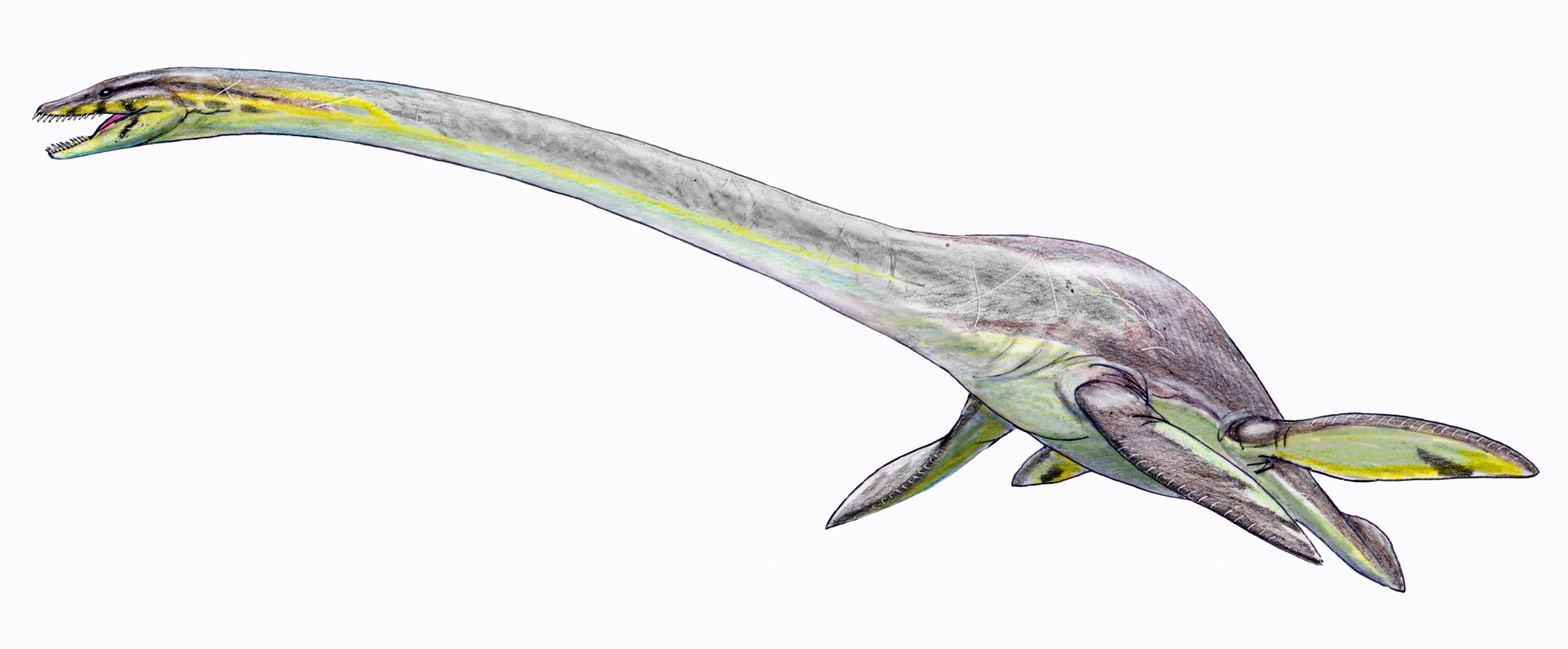
Image: File:Elasmosaurus platyurus.jpg - Wikimedia Commons (CC BY-SA)
About Elasmosaurus
Elasmosaurus platyurus stands as one of the most iconic and recognizable marine reptiles of the Mesozoic Era, a testament to the extreme evolutionary adaptations that life can achieve. Renowned for its extraordinarily long neck, this massive plesiosaur navigated the Western Interior Seaway approximately 80.5 million years ago during the Campanian age of the Late Cretaceous period. Its fossils, primarily unearthed from the Pierre Shale formation in Kansas, USA, have provided invaluable insights into the diverse and complex marine ecosystems that thrived when a shallow continental sea divided North America.
The physical anatomy of Elasmosaurus was a marvel of biological engineering, dominated by its almost impossibly elongated neck. Reaching an estimated total body length of 10.3 meters (approximately 34 feet), this creature was a formidable presence in the Cretaceous seas. Its body was streamlined and teardrop-shaped, a hydrodynamic form that would have minimized drag while moving through the water. Propulsion was generated by four large, powerful, oar-like flippers, each supported by a robust limb girdle. Unlike the propulsive tails of many other marine reptiles like mosasaurs, the tail of Elasmosaurus was relatively short and likely served more as a rudder for steering than as a primary means of locomotion. The most defining feature, however, was its neck, which measured over half the animal's total length. This structure was supported by an astonishing 72 cervical vertebrae, a number that far exceeds that of any other known animal, including the famously long-necked sauropod dinosaurs. For comparison, a giraffe has only seven cervical vertebrae, the same number as a human. At the end of this serpentine neck was a disproportionately small, triangular skull, roughly 60 centimeters (2 feet) long, equipped with long, conical, interlocking teeth perfectly suited for ensnaring small, fast-moving prey. The entire animal is estimated to have weighed around 2,000 kilograms (2.2 tons), combining a bulky torso with its incredibly gracile and extended neck.
The paleobiology of Elasmosaurus was intrinsically linked to its unique anatomy. As a carnivore, its diet consisted primarily of small to medium-sized fish, squid-like belemnites, and ammonites that were abundant in the Western Interior Seaway. Its feeding strategy likely involved a form of ambush predation. The animal could have moved its large, dark body slowly through the deeper, murkier waters, extending its long neck horizontally to allow its small head to approach unsuspecting schools of fish without alarming them. Once in range, it could have darted its head into the swarm with a swift, sideways motion, using its needle-like teeth to trap slippery prey. This "stalk-and-strike" method would have been highly efficient, allowing it to exploit a food source that might have been inaccessible to larger, less stealthy predators. Locomotion was likely achieved through a form of underwater flight, with the four flippers beating in a coordinated, figure-eight pattern similar to that of modern sea turtles or penguins, providing a powerful yet graceful means of movement. It is unlikely that Elasmosaurus was capable of raising its neck high out of the water in a "swan-like" posture, as often depicted in older illustrations; biomechanical studies suggest the weight and structure of the neck would have made this impossible, restricting it to a more horizontal or gently arching range of motion. Gastroliths, or stomach stones, have been found in association with plesiosaur skeletons, suggesting they were intentionally swallowed to aid in buoyancy control or to help grind up food in the digestive tract.
Elasmosaurus lived in a dynamic and highly productive marine environment. During the Late Cretaceous, high global sea levels led to the formation of the Western Interior Seaway, a vast, shallow epicontinental sea that stretched from the Arctic Ocean to the Gulf of Mexico, effectively splitting North America into two landmasses, Laramidia to the west and Appalachia to the east. The climate was warmer and more equable than today, supporting a rich and diverse ecosystem. The waters of the seaway were teeming with life, and Elasmosaurus occupied a high trophic level as a specialized pelagic predator. It shared its habitat with a host of other marine creatures, including the giant mosasaur Tylosaurus, the formidable predatory fish Xiphactinus, and the massive sea turtle Archelon. The skies above were patrolled by the flying pterosaur Pteranodon, which likely preyed on the same fish stocks. In the water column below, ammonites, belemnites, and various bivalves thrived. As a large predator, Elasmosaurus played a crucial role in maintaining the ecological balance of this open-water community, likely preying on smaller fish and cephalopods while potentially being a target for the very largest apex predators like Tylosaurus, especially when young or vulnerable.
The discovery and subsequent history of Elasmosaurus are legendary in the annals of paleontology, deeply intertwined with the infamous "Bone Wars." The holotype specimen was discovered in 1867 by army surgeon Dr. Theophilus Turner near Fort Wallace, Kansas. He found the fossilized vertebrae eroding from a ravine within the Pierre Shale formation and, recognizing their importance, sent them to the prominent Philadelphia paleontologist Edward Drinker Cope. In his haste to describe this spectacular new creature, Cope made a monumental error in his 1869 reconstruction. Misinterpreting the animal's extreme proportions, he placed the skull on the end of the short tail and identified the elongated neck as the tail. When his rival, Othniel Charles Marsh of Yale University, examined the specimen, he famously pointed out the mistake, noting that the vertebrae of the long appendage were oriented incorrectly for a tail and that the true tail vertebrae were present at the opposite end. This public humiliation deeply embarrassed Cope and is often cited as the catalyst that ignited the "Bone Wars," a period of intense and often ruthless competition between the two paleontologists to discover and name more fossils than the other. Cope attempted to recall all copies of the scientific paper containing the error, but the damage was done, and the story became a lasting symbol of their bitter rivalry.
From an evolutionary perspective, Elasmosaurus represents the pinnacle of a specialized lineage within the Plesiosauria. It belongs to the family Elasmosauridae, a group of plesiosaurs characterized by their extremely elongated necks and small heads. This family is part of the larger clade Plesiosauroidea, one of the two major divisions of plesiosaurs, the other being the short-necked, large-headed Pliosauroidea. The extreme neck elongation seen in Elasmosaurus is the culmination of a long evolutionary trend within its lineage, with earlier relatives showing progressively fewer cervical vertebrae. This adaptation highlights a successful evolutionary pathway for a particular feeding niche, allowing these animals to exploit resources in a way other marine reptiles could not. While plesiosaurs as a group have no direct living descendants, they belong to the broader clade Sauropterygia, which arose in the Triassic period. Their evolutionary journey showcases the remarkable diversity of reptilian forms that adapted to marine life during the Mesozoic, developing unique solutions for locomotion, feeding, and survival that paralleled, but were distinct from, those of the ichthyosaurs and mosasaurs. Elasmosaurus and its relatives ultimately went extinct at the end of the Cretaceous period, 66 million years ago, as part of the mass extinction event that also wiped out the non-avian dinosaurs.
Despite its fame, Elasmosaurus has been the subject of considerable scientific debate, particularly concerning its taxonomy. For many years, the genus Elasmosaurus became a "wastebasket taxon," with numerous long-necked plesiosaur species from around the world being assigned to it. However, rigorous re-evaluation of the fossil material, particularly by paleontologist Kenneth Carpenter in the 1990s, has led to a significant revision. Many species once called Elasmosaurus have since been reassigned to new or different genera, such as Styxosaurus and Albertonectes. Today, the genus Elasmosaurus is considered by most experts to be monotypic, containing only the original species, E. platyurus. The biomechanics of its neck also remain a topic of active discussion. While the "swan-like" posture has been largely debunked, the precise degree of flexibility—whether it was stiff and rod-like or capable of gentle, sweeping curves—is still debated based on interpretations of vertebral anatomy and musculature. These ongoing discussions highlight the dynamic nature of paleontological science, where new analyses continually refine our understanding of these ancient animals.
The fossil record of Elasmosaurus, in its strict, modern definition, is primarily confined to the Pierre Shale of western Kansas, USA. The holotype specimen, ANSP 10081, remains the most famous and historically significant find. While many other elasmosaurid fossils have been discovered globally, from North America to Asia, their specific assignment to the genus Elasmosaurus is now considered incorrect. The Pierre Shale, where the original specimen was found, is a Late Cretaceous geological formation known for its exceptional preservation of marine fossils, offering a detailed snapshot of the Western Interior Seaway's ecosystem. Fossils of other elasmosaurids, however, are more widespread. For instance, the related Albertonectes, found in Alberta, Canada, holds the record for the most cervical vertebrae at 76. The quality of preservation for these large marine reptiles can vary dramatically, from isolated vertebrae and paddle bones to nearly complete, articulated skeletons that provide a wealth of anatomical information. These discoveries continue to be crucial for piecing together the diversity, distribution, and evolution of this remarkable group of marine reptiles.
Thanks to its bizarre and unforgettable appearance, Elasmosaurus has secured a prominent place in popular culture and public imagination. Its distinctive silhouette, with the impossibly long neck and serpentine grace, has made it a staple in books, documentaries, and museum exhibits about prehistoric life. It is often featured alongside Tyrannosaurus and Triceratops as a key representative of the Cretaceous period, serving as the quintessential example of a plesiosaur. Major natural history museums, including the Academy of Natural Sciences of Drexel University in Philadelphia, display casts or original fossil material of Elasmosaurus and its relatives, allowing the public to marvel at the sheer scale and strange proportions of this ancient sea creature. Its dramatic discovery story further cements its legacy, providing a compelling narrative of scientific passion, rivalry, and the corrective process of discovery that defines the field of paleontology.
Classification
Time Period
Discovery
Location
Kansas, USA
Formation
Pierre Shale
Frequently Asked Questions
What is Elasmosaurus?
Elasmosaurus platyurus stands as one of the most iconic and recognizable marine reptiles of the Mesozoic Era, a testament to the extreme evolutionary adaptations that life can achieve. Renowned for its extraordinarily long neck, this massive plesiosaur navigated the Western Interior Seaway approxima...
When did Elasmosaurus live?
Elasmosaurus lived during the cretaceous period of the mesozoic era approximately 80.5 million years ago.
Where was Elasmosaurus discovered?
Fossils of Elasmosaurus were discovered in Kansas, USA in the Pierre Shale.
What did Elasmosaurus eat?
Elasmosaurus was a carnivore. It lived in marine habitats.
What type of fossil is Elasmosaurus?
Elasmosaurus is preserved as a permineralized fossil. The preservation quality is good.
Related Specimens
From the mesozoic era · permineralized fossils