Saurolophus
Saurolophus osborni
Image: Image sourced via web search (Fair use / Educational)
About Saurolophus
Saurolophus is a genus of large hadrosaurid, or 'duck-billed' dinosaur, that roamed the floodplains of North America and Asia during the Late Cretaceous period, approximately 70 to 66 million years ago. As one of the few hadrosaur genera known from multiple continents, it provides crucial insights into dinosaur biogeography and the ecosystems that existed just before the Cretaceous-Paleogene extinction event. Its most defining feature, a solid, spike-like crest projecting from its skull, has made it a recognizable and significant subject of paleontological study since its discovery in the early 20th century.
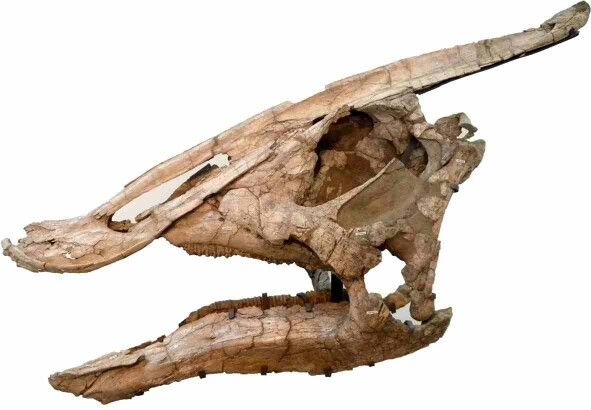
Saurolophus was a large and robustly built hadrosaurid, with the North American species, Saurolophus osborni, estimated to have reached lengths of 9 to 10 meters (about 30 to 33 feet) and a weight of around 2 to 3 metric tons. Its Asian counterpart, Saurolophus angustirostris, was even larger, potentially reaching up to 12 meters (40 feet) in length and weighing over 10 tons, making it one of the largest known hadrosaurs. For comparison, S. osborni was roughly the size of a modern African bush elephant, though more elongated. The most distinctive feature of Saurolophus was its cranial crest, a solid, spike-like projection that extended backward and upward from the top of its skull, originating above the eyes. Unlike the hollow crests of lambeosaurine hadrosaurs like Parasaurolophus, the crest of Saurolophus was solid bone, a characteristic of the Saurolophinae subfamily to which it gives its name. This crest likely served as a display structure for species recognition or social signaling. The skull itself was long and low, ending in a broad, flattened, duck-like beak or rhamphotheca, which was toothless and likely used for cropping vegetation. Deep within its jaws, Saurolophus possessed complex dental batteries, with hundreds of tightly packed, continuously replacing teeth designed for grinding tough plant material. Its skeleton was typical of a large hadrosaur, featuring a sturdy frame, powerful hind limbs that supported most of its weight, and shorter, but still strong, forelimbs. The spine was stiffened by ossified tendons, particularly along the back and tail, which provided support for its massive torso and acted as a counterbalance while walking. Skin impressions found with some specimens reveal a uniform pattern of non-overlapping, polygonal scales, providing a rare glimpse into its external appearance.
As a hadrosaurid, Saurolophus was a highly specialized herbivore, well-adapted to processing large quantities of fibrous vegetation. Its broad, toothless beak was ideal for snipping off leaves, twigs, and other plant parts, while its sophisticated dental batteries in the cheeks provided a powerful grinding surface. These batteries contained columns of teeth, with only a few in each column being used at any one time, ensuring a constant supply of sharp grinding surfaces as older teeth wore down and were replaced from below. This arrangement allowed it to efficiently break down tough plant matter like conifers, cycads, and early flowering plants that were common in its environment. Saurolophus was primarily a bipedal animal, moving on its powerful hind legs, but it was also capable of quadrupedal locomotion, likely dropping to all fours to graze on low-lying vegetation or to move at slower speeds. The stiffened tail would have provided a crucial counterbalance during bipedal movement. Evidence from large bonebeds, particularly for the Asian species S. angustirostris, suggests that Saurolophus was a gregarious animal that lived in large herds. This social behavior would have offered protection against predators and may have been linked to seasonal migrations in search of food and suitable nesting grounds. Its solid crest, likely brightly colored in life, would have been a key tool for social communication, used for species identification, indicating sexual maturity, or establishing dominance within the herd.
Saurolophus lived during the late Campanian to Maastrichtian stages of the Late Cretaceous, a time when the world was warmer than today and lacked polar ice caps. The North American species, S. osborni, inhabited the western coastal plain of the Western Interior Seaway, a vast inland sea that divided North America into two landmasses, Laramidia and Appalachia. Its fossils are found in the Horseshoe Canyon Formation of Alberta, Canada, which represents a diverse ecosystem of coastal plains, river deltas, and swampy lowlands. The climate was warm and humid, supporting lush forests of conifers, ferns, and flowering plants. Saurolophus shared this environment with a rich dinosaur fauna, including other ornithischians like the horned dinosaurs Anchiceratops and Pachyrhinosaurus, and the armored dinosaur Edmontonia. Apex predators in this ecosystem included the formidable tyrannosaurid Albertosaurus, which would have been a primary threat to both juvenile and adult Saurolophus. In Asia, S. angustirostris lived in the Nemegt Formation of Mongolia, an environment characterized by large river systems and extensive floodplains. It coexisted with a different suite of dinosaurs, including the giant tyrannosaurid Tarbosaurus bataar (its likely main predator), the ornithomimosaur Gallimimus, the therizinosaurid Therizinosaurus, and the titanosaurian sauropod Nemegtosaurus. In both ecosystems, Saurolophus occupied the niche of a large-bodied, bulk-feeding herbivore, playing a crucial role in the food web by converting vast amounts of plant biomass into a food source for large carnivores.
The history of Saurolophus begins in 1911 with its discovery by Barnum Brown of the American Museum of Natural History. While leading an expedition along the Red Deer River in Alberta, Canada, Brown's team excavated a nearly complete, articulated skeleton from the deposits of what is now known as the Horseshoe Canyon Formation. This remarkable specimen, designated AMNH 5220, became the holotype for the new genus and species, which Brown officially named Saurolophus osborni in 1912. The generic name translates to 'lizard crest,' a direct reference to its prominent head ornamentation, while the specific name honors his mentor and the museum's president, Henry Fairfield Osborn. Decades later, paleontological work shifted to the other side of the globe. During the 1940s, a series of joint Soviet-Mongolian expeditions to the Gobi Desert uncovered a wealth of dinosaur fossils in the Nemegt Formation. Among these were numerous skeletons of a large hadrosaur that closely resembled the Canadian find but was noticeably larger and more robust. In 1952, Soviet paleontologist Anatoly Rozhdestvensky described these remains as a new species, Saurolophus angustirostris, meaning 'narrow-snouted lizard crest.' The discovery of this second species was significant, confirming that the Saurolophus genus had a wide geographic distribution across two continents, a rare occurrence among non-avian dinosaurs. The sheer abundance of S. angustirostris fossils, including individuals of various ages found together, has made the Nemegt Formation a key site for studying hadrosaur paleobiology and social behavior.
Saurolophus holds a pivotal position in the evolutionary tree of dinosaurs, specifically within the family Hadrosauridae. It is the type genus for the subfamily Saurolophinae (sometimes called Hadrosaurinae), one of the two major clades of hadrosaurs, the other being the hollow-crested Lambeosaurinae. The saurolophines are characterized by their solid or absent cranial crests and broad, duck-like bills. As a 'classic' saurolophine, Saurolophus exhibits the key features of this group, including its solid, spike-like crest and robust build. Its closest relatives include other North American and Asian genera such as Edmontosaurus, Shantungosaurus, and Augustynolophus. The existence of Saurolophus species on both continents provides strong evidence for a land bridge connection between Asia and North America during the Late Cretaceous, most likely the Beringian land bridge across what is now the Bering Strait. This connection allowed for faunal interchange, with dinosaur lineages migrating between the two landmasses. The close relationship between S. osborni and S. angustirostris suggests that their common ancestor likely lived in one continent and its descendants later migrated to the other, or that the ancestral population was widespread across both. Studying the subtle anatomical differences between the two species helps paleontologists understand the pace and patterns of evolution and speciation in these large, mobile animals over millions of years.
While the classification of Saurolophus as a saurolophine hadrosaur is firmly established, some scientific debates have centered on its relationships and the validity of other related genera. For a time, the Californian hadrosaur Augustynolophus morrisi was considered by some researchers to be a third species of Saurolophus. This was based on similarities in its solid crest structure. However, more detailed phylogenetic analyses have since confirmed that Augustynolophus is a distinct genus, albeit a very close relative, representing one of the last known hadrosaurs in North America. Another area of ongoing research involves the precise function of its solid crest. While display is the most widely accepted hypothesis, other possibilities, such as its use in thermoregulation or as a point of attachment for soft tissue structures like a resonating nasal sac (though less likely than in hollow-crested forms), continue to be explored. The discovery of exceptionally preserved skin impressions has also fueled discussion about hadrosaur integument, confirming a scaly texture but leaving open questions about coloration and its potential role in camouflage or social signaling. The vast bonebeds of S. angustirostris in Mongolia provide a rich dataset for studying hadrosaur population dynamics, but interpreting the cause of these mass mortality events—whether from drought, flood, or disease—remains a topic of active investigation.
The fossil record of Saurolophus is extensive and geographically widespread, a testament to its success as a genus. In North America, S. osborni is known primarily from the Horseshoe Canyon Formation in Alberta, Canada. The holotype specimen (AMNH 5220) is one of the best-preserved hadrosaur skeletons ever found, providing a nearly complete anatomical blueprint. Several other partial skeletons and skulls have since been recovered from the same region, making it a well-represented, though not overly abundant, component of its fauna. The fossil record in Asia is even more impressive. S. angustirostris is one of the most common dinosaurs in the Nemegt Formation of Mongolia. Dozens of skeletons, ranging from juveniles to large adults, have been excavated, including several massive bonebeds that contain the remains of numerous individuals who perished together. The preservation quality of these Mongolian fossils is often excellent, with many articulated skeletons and even rare skin impressions. These rich fossil sites, particularly the 'Dragon's Tomb' locality, have made S. angustirostris one of the most completely known hadrosaurs and a cornerstone for understanding the paleoecology of Late Cretaceous Asia.
Saurolophus, with its distinctive spike-like crest, is a recognizable and frequently featured hadrosaur in popular culture and museum exhibits. The magnificent holotype skeleton of Saurolophus osborni is a centerpiece display at the American Museum of Natural History in New York City, where it has been viewed by millions. Similarly, skeletons of the giant Saurolophus angustirostris are prominently displayed in museums around the world, including the Paleontological Institute in Moscow. It has appeared in numerous books, documentaries, and video games about dinosaurs, often representing the 'classic' duck-billed dinosaur archetype. Its presence on two continents makes it an important educational tool for teaching concepts of paleobiogeography and continental drift to the public, illustrating a dynamically connected prehistoric world.
Classification
Time Period
Discovery
Location
Canada (Alberta)
Formation
Horseshoe Canyon Formation
Frequently Asked Questions
What is Saurolophus?
Saurolophus is a genus of large hadrosaurid, or 'duck-billed' dinosaur, that roamed the floodplains of North America and Asia during the Late Cretaceous period, approximately 70 to 66 million years ago. As one of the few hadrosaur genera known from multiple continents, it provides crucial insights i...
When did Saurolophus live?
Saurolophus lived during the cretaceous period of the mesozoic era approximately 70-66 million years ago.
Where was Saurolophus discovered?
Fossils of Saurolophus were discovered in Canada (Alberta) in the Horseshoe Canyon Formation.
What did Saurolophus eat?
Saurolophus was a herbivore. It lived in terrestrial habitats.
What type of fossil is Saurolophus?
Saurolophus is preserved as a body fossil. The preservation quality is good.
Related Specimens
From the mesozoic era · body fossils