Sauropelta
Sauropelta edwardsorum
Image: Image sourced via web search (Fair use / Educational)
About Sauropelta
Sauropelta edwardsorum was a heavily armored, herbivorous dinosaur that roamed the floodplains of western North America during the Early Cretaceous Period, approximately 115 to 108 million years ago. As a member of the Nodosauridae family, it is renowned for its extensive body armor and prominent shoulder spikes, making it one of the best-understood nodosaurids due to the quality and completeness of its fossil remains. Its fossils provide a crucial window into the diverse ecosystems of the mid-Mesozoic, illustrating the complex defensive strategies that evolved among herbivorous dinosaurs in response to large predatory threats.
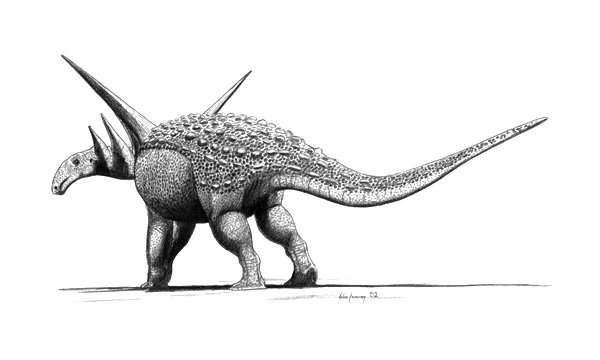
Sauropelta was a medium-sized ankylosaurian, reaching an estimated length of 5 to 6 meters (about 16 to 20 feet) and weighing approximately 1.5 to 2 metric tons (3,300 to 4,400 pounds). For a modern comparison, it was roughly the size of a large rhinoceros but built much lower to the ground. Its most striking feature was its formidable armor, composed of osteoderms—bony plates and nodules embedded in the skin. These osteoderms formed a mosaic-like shield over its back, hips, and neck. The arrangement consisted of smaller, pebble-like ossicles filling the gaps between larger, keeled scutes, creating a flexible yet robust defensive covering. The skull was narrow and pear-shaped when viewed from above, with a relatively small brain cavity. Its teeth were small and leaf-shaped, suited for stripping vegetation rather than heavy grinding. Perhaps its most dramatic anatomical feature was the pair of exceptionally long, sharp spines that projected outwards and backwards from its shoulder region. These parascapular spines could have reached up to a meter in length and served as a potent deterrent against predators. The tail of Sauropelta was long and muscular but, unlike its ankylosaurid cousins, lacked a bony tail club, a key distinguishing feature of the nodosaurid family.
As a low-browsing herbivore, Sauropelta's diet likely consisted of ferns, cycads, and other low-growing plants that were abundant in its environment. Its narrow snout suggests a selective feeding strategy, allowing it to carefully choose specific plants. The simple, leaf-shaped teeth were not designed for extensive chewing; instead, it would have stripped foliage and relied on a large, complex gut to break down tough plant material through fermentation, a process similar to that seen in modern herbivorous mammals like cows. Its robust, pillar-like legs and broad feet supported its heavy, armored body. While not built for speed, its quadrupedal stance provided a stable, low center of gravity, making it difficult for a predator to overturn. It is generally believed that Sauropelta was a solitary animal, as multiple skeletons are rarely found together. Its primary defense was its passive armor; when threatened, it would likely have crouched low to the ground, protecting its vulnerable underbelly and presenting a nearly impenetrable shield of bone and keratin to an attacker. The massive shoulder spines would have provided an additional active defense, capable of inflicting serious injury on any predator that got too close.
Sauropelta lived in a world characterized by a warm, seasonal climate. Its fossils are primarily found in the Cloverly Formation of Wyoming and Montana, which represents a vast floodplain environment with meandering rivers, forests, and open fern savannas. This ecosystem supported a rich and diverse fauna. Sauropelta shared its habitat with other herbivorous dinosaurs, including the large ornithopod Tenontosaurus, which was a common prey item for the apex predator of the region, the formidable carnosaur Acrocanthosaurus. The smaller but highly intelligent dromaeosaurid Deinonychus also patrolled this landscape, likely hunting in packs. Sauropelta's position in the food web was that of a primary consumer, a heavily defended herbivore. Its armor would have been a crucial defense against the powerful jaws of Acrocanthosaurus, and it is unlikely that even a pack of Deinonychus could have successfully preyed upon a healthy adult. This predator-prey dynamic is a classic example of an evolutionary arms race, with the defensive capabilities of herbivores like Sauropelta evolving in response to the offensive weaponry of large theropods.
The history of Sauropelta's discovery begins in the 1930s with the work of the famed paleontologist Barnum Brown of the American Museum of Natural History. Brown and his team discovered several partial skeletons in the Cloverly Formation of Montana. Although he informally referred to the animal as "Peltosaurus," he never formally published a description. It wasn't until decades later that another prominent paleontologist, John Ostrom of Yale University's Peabody Museum of Natural History, revisited the material. In 1970, Ostrom formally described and named the genus Sauropelta, meaning "shielded lizard," from the Greek words 'sauros' (lizard) and 'pelte' (shield). The species name, 'edwardsorum', honors the Edwards family on whose land some of the key fossils were discovered. Ostrom's work was based on several specimens, providing a comprehensive view of the dinosaur's anatomy. The holotype specimen, AMNH 3032, consists of a partial skeleton, but it was the discovery of other, more complete skeletons, such as AMNH 3035 and AMNH 3036, that cemented Sauropelta's status as one of the best-known nodosaurids from North America.
Sauropelta holds a significant position within the evolutionary tree of dinosaurs. It is a classic representative of the Nodosauridae, one of the two major families within the infraorder Ankylosauria. Nodosaurids are distinguished from their relatives, the Ankylosauridae, by their narrower skulls, lack of a tail club, and often more elaborate shoulder or cervical spines. Sauropelta's well-preserved fossils provide a key anatomical baseline for understanding the evolution and diversity of this group during the Early to mid-Cretaceous. It showcases the peak of passive armor defense before the evolution of the active, weaponized tail clubs seen in later ankylosaurids like Ankylosaurus. Its existence helps paleontologists trace the lineage of armored dinosaurs, demonstrating how different groups experimented with various defensive strategies. As a basal nodosaurid, it provides crucial data points for phylogenetic analyses that seek to unravel the complex relationships between different ankylosaurian species and their divergence from a common ancestor shared with the stegosaurs within the broader clade Thyreophora.
Despite being well-studied, some aspects of Sauropelta's biology remain subjects of scientific discussion. The precise function and orientation of its massive parascapular spines are still debated. While their primary role was almost certainly defensive, some researchers have proposed they could also have been used for intraspecific display, such as for mating rituals or territorial disputes between males. The exact range of motion of its limbs and its top speed are also areas of ongoing biomechanical research, with computer models helping to simulate its gait and posture. Furthermore, the classification of certain fragmentary ankylosaur fossils from the same period and region is sometimes debated, with questions arising as to whether they represent juvenile Sauropelta, a different species, or even a different genus entirely. As new analytical techniques are developed, the existing fossil material is often re-examined, leading to revised interpretations of its lifestyle and anatomy.
The fossil record of Sauropelta is considered quite good for a dinosaur of its kind. Dozens of specimens have been recovered, primarily from the Cloverly Formation in Montana and Wyoming, with some possible remains found in the Cedar Mountain Formation of Utah. This makes it the best-represented nodosaurid from the Early Cretaceous of North America. The fossils range from isolated osteoderms and teeth to partial and nearly complete skeletons, often found disarticulated but with a significant portion of the animal preserved. The quality of preservation is generally good, allowing for detailed study of its skeletal anatomy and armor arrangement. The Big Horn Basin in Wyoming is a particularly famous locality for Sauropelta fossils, where many of the key specimens described by Ostrom were unearthed. The abundance of its remains has been instrumental in reconstructing not only the animal itself but also the broader paleoenvironment of the Cloverly Formation.
Sauropelta has made a notable impact on public consciousness and is a staple in museum exhibits featuring Cretaceous dinosaurs. Its impressive armor and dramatic shoulder spikes make it a visually compelling subject. High-quality skeletal mounts and life-sized reconstructions of Sauropelta can be seen in major institutions such as the American Museum of Natural History in New York and the Peabody Museum of Natural History at Yale University. It frequently appears in dinosaur books, documentaries, and educational materials as a prime example of a nodosaurid and the concept of passive defense in the prehistoric world. While it may not have the same level of fame as Tyrannosaurus or Triceratops, Sauropelta serves as a vital educational tool for illustrating the incredible diversity of dinosaur forms and the complex ecological relationships that existed millions of years ago.
Classification
Time Period
Discovery
Location
Wyoming and Montana, USA
Formation
Cloverly Formation
Frequently Asked Questions
What is Sauropelta?
Sauropelta edwardsorum was a heavily armored, herbivorous dinosaur that roamed the floodplains of western North America during the Early Cretaceous Period, approximately 115 to 108 million years ago. As a member of the Nodosauridae family, it is renowned for its extensive body armor and prominent sh...
When did Sauropelta live?
Sauropelta lived during the cretaceous period of the mesozoic era approximately 115-108 million years ago.
Where was Sauropelta discovered?
Fossils of Sauropelta were discovered in Wyoming and Montana, USA in the Cloverly Formation.
What did Sauropelta eat?
Sauropelta was a herbivore. It lived in terrestrial habitats.
What type of fossil is Sauropelta?
Sauropelta is preserved as a body fossil. The preservation quality is good.
Related Specimens
From the mesozoic era · body fossils