Kentrosaurus
Kentrosaurus aethiopicus
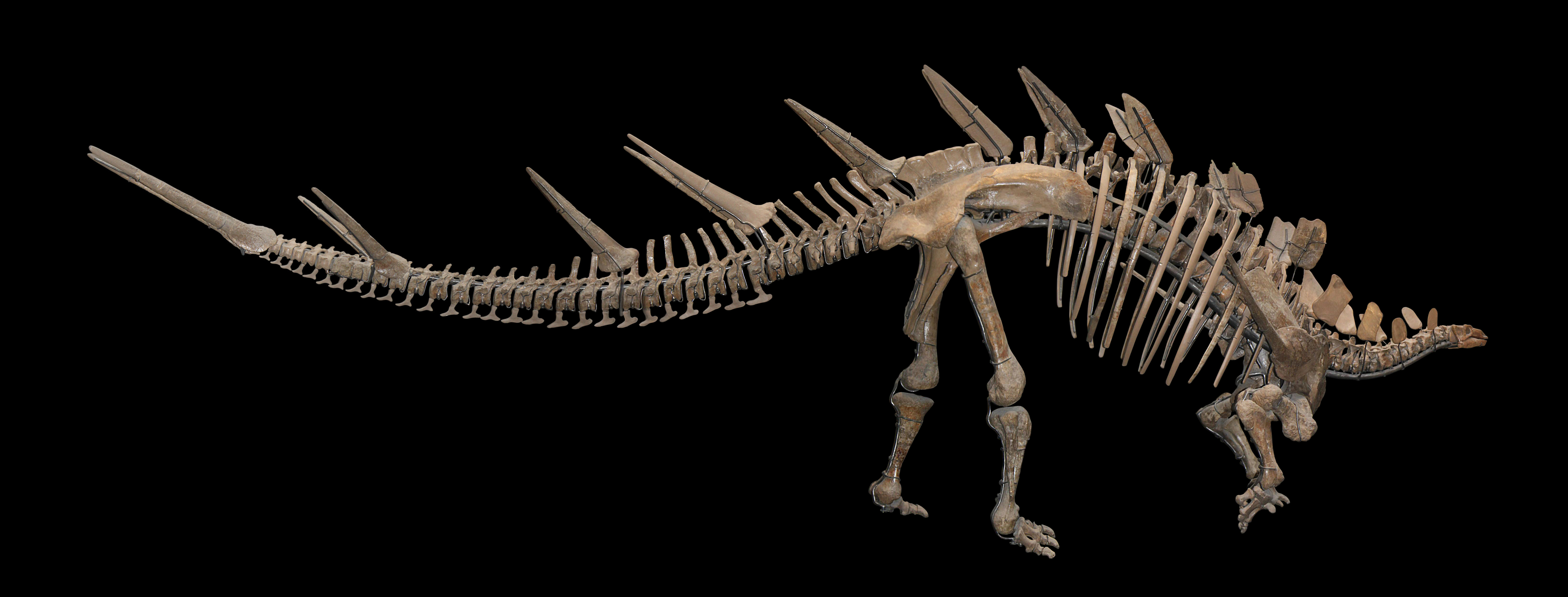
Image: File:Kentrosaurus aethiopicus 01.jpg - Wikimedia Commons (CC BY-SA)
About Kentrosaurus
Kentrosaurus aethiopicus was a medium-sized, herbivorous stegosaurid dinosaur that inhabited the floodplains and coastal environments of what is now Tanzania, Africa, during the Late Jurassic period, approximately 155 to 150 million years ago. As one of the most completely known stegosaurs, its fossils provide invaluable insight into the diversity, distribution, and defensive strategies of armored dinosaurs on the southern supercontinent of Gondwana. Its name, meaning "pointed lizard" or "prickle lizard" from the Greek "kentron" (point) and "sauros" (lizard), aptly describes its most prominent feature: a formidable array of spikes that distinguished it from its more famous North American relative, Stegosaurus.
Measuring approximately 4.5 meters (15 feet) in length and standing about 2 meters (6.5 feet) tall at the hips, Kentrosaurus was a relatively compact but robustly built dinosaur. Weight estimates for an adult individual typically range from 1 to 1.5 metric tons (2,200 to 3,300 pounds), making it comparable in mass to a modern rhinoceros, though with a vastly different body plan. Its skull was small and elongated, typical of stegosaurs, housing a proportionally tiny brain and a beak-like structure at the front of its jaws for cropping vegetation. The teeth were small, leaf-shaped, and simple, suggesting they were used for stripping foliage rather than heavy chewing. Its forelimbs were significantly shorter than its hindlimbs, creating a distinctly arched back that sloped downwards from the hips to the shoulders. This posture positioned its head low to the ground, ideal for a low-browsing herbivore. The most defining characteristics of Kentrosaurus were its osteoderms, the bony structures embedded in its skin. Along its neck and anterior torso, it possessed small, paired bony plates. These plates transitioned into long, sharp spines that ran down its lower back, hips, and the majority of its tail. The most spectacular of these were the "parascapular" spikes, a pair of exceptionally long spines that projected outwards and backwards from the shoulder region, providing a powerful lateral defense. The tail terminated in a thagomizer, a cluster of at least two pairs of long, sharp spikes used as an active weapon.
The paleobiology of Kentrosaurus reveals a creature well-adapted to its environment and the predatory pressures it faced. As a low-browsing herbivore, its diet would have consisted primarily of ferns, cycads, horsetails, and the low-lying foliage of conifers that flourished in the Jurassic landscape. Its narrow beak was suited for selective plucking of plant matter, which was likely processed in a large gut, aided by gastroliths (swallowed stones) to help break down tough plant fibers. The dinosaur's locomotion was quadrupedal, but its skeletal structure suggests a unique degree of mobility. The center of mass was located far back, directly over the powerful hindlimbs, which bore most of the animal's weight. This anatomical arrangement would have allowed Kentrosaurus to rear up on its hind legs to reach slightly higher vegetation and, more importantly, to pivot quickly. This agility was crucial for defense, enabling it to swing its heavily armed tail with speed and precision to fend off attacks from large theropods like Allosaurus and Ceratosaurus. Studies of its bone histology suggest a relatively rapid growth rate during its juvenile stages, reaching near-adult size within a decade, a common strategy among dinosaurs to quickly outgrow the most vulnerable stages of life.
Kentrosaurus lived within the rich and diverse ecosystem preserved in the Tendaguru Formation of Tanzania. During the Late Jurassic, this region was a subtropical coastal plain, characterized by lagoons, estuaries, and river deltas, with a climate that was likely warm and seasonally arid. This environment supported a lush flora and a remarkable fauna, making it one of the most significant fossil localities from the Southern Hemisphere. Kentrosaurus shared this habitat with a variety of other dinosaurs, placing it within a complex food web. It was a primary consumer, occupying a niche similar to other medium-sized herbivores. It co-existed with gigantic sauropods such as Giraffatitan brancai and Dicraeosaurus hansemanni, which browsed on higher vegetation, thus avoiding direct competition for food. The primary predatory threats to an adult Kentrosaurus would have come from large theropods whose fossils have also been found at Tendaguru, including species of Allosaurus, Ceratosaurus, and the potentially larger Elaphrosaurus. The formidable armor of Kentrosaurus was a direct evolutionary response to this high-predation environment, making it a well-defended, albeit not invulnerable, member of its community.
The discovery of Kentrosaurus is intrinsically linked to the German Tendaguru Expeditions, one of the largest and most ambitious paleontological undertakings in history. Between 1909 and 1912, German teams led by paleontologists such as Werner Janensch and Edwin Hennig excavated a massive quarry in German East Africa (present-day Tanzania). During these expeditions, they unearthed a treasure trove of dinosaur fossils, including the first and most complete remains of Kentrosaurus. The species was formally named and described by Edwin Hennig in 1915. The specific name, aethiopicus, refers to its African origin. The expeditions recovered hundreds of Kentrosaurus bones from various individuals, representing nearly every part of the skeleton. This wealth of material allowed for a remarkably complete reconstruction, a rarity for many dinosaur species. The most significant specimen, a composite skeleton assembled from the bones of several individuals, was mounted at the Museum für Naturkunde in Berlin. Although this original mount was partially destroyed by Allied bombing during World War II in 1943, it was later restored, and a new, more accurate mount was constructed in 2005, which remains a centerpiece of the museum's collection.
The evolutionary significance of Kentrosaurus is profound, particularly in understanding the global distribution and diversification of the Stegosauria clade. As one of the best-known stegosaurs from Gondwana, its presence in Africa provides crucial evidence that this group of dinosaurs was widespread across the supercontinent Pangaea before it fully separated. Kentrosaurus is classified within the family Stegosauridae and is often placed in its own subfamily, Kentrosaurinae, reflecting its unique combination of primitive and derived traits. It is considered more basal, or primitive, than Stegosaurus, possessing a longer body and more spike-like osteoderms compared to the broad plates of its North American cousin. This suggests that the large plates of Stegosaurus may have been a more derived feature that evolved later, possibly for display purposes, while the spikes of Kentrosaurus represent a more ancestral, purely defensive function. The detailed anatomy of Kentrosaurus serves as a vital reference point for phylogenetic analyses, helping paleontologists map the evolutionary relationships between different stegosaur species from North America, Europe, Africa, and Asia, and trace the development of their iconic armor.
Despite the completeness of its fossil record, Kentrosaurus has been the subject of several scientific debates. One long-standing controversy revolved around the exact placement and orientation of its distinctive parascapular spikes. Early reconstructions placed them on the hips, but later analysis by paleontologists like Peter Galton in the 1980s demonstrated that they almost certainly originated from the shoulder region, a conclusion now widely accepted. Another area of discussion concerns the function of its dorsal plates and spikes. While the defensive role of the tail and shoulder spikes is clear, the smaller plates along the back may have also served a role in thermoregulation, species recognition, or mating displays, similar to the proposed functions for the much larger plates of Stegosaurus. The exact number and arrangement of the tail spikes in the thagomizer have also been debated, with evidence suggesting some variation between individuals. These ongoing discussions highlight how even well-preserved fossils can leave room for interpretation and refinement as new analytical techniques and comparative anatomical data become available.
The fossil record of Kentrosaurus aethiopicus is exceptionally robust but geographically constrained. All known fossils have been recovered exclusively from the Middle and Upper Saurian Beds of the Tendaguru Formation in southeastern Tanzania. This formation is a Lagerstätte, a site of exceptional fossil preservation, which accounts for the high quality and quantity of the recovered material. The German expeditions excavated the remains of over 50 different individuals, ranging from juveniles to adults, providing a comprehensive sample for studying growth and individual variation. The disarticulated nature of many of the finds suggests that the carcasses were transported by water before burial, accumulating in river channels or coastal deposits. This abundance of material has made Kentrosaurus one of the most thoroughly studied stegosaurs, with its anatomy known in almost complete detail. The fossils are primarily housed at the Museum für Naturkunde in Berlin, with some material also located in the collections of the University of Tübingen.
While not as globally famous as Stegosaurus, Kentrosaurus holds a significant place in paleontological history and public education. The mounted skeleton at the Museum für Naturkunde in Berlin is an iconic display, drawing visitors from around the world and serving as a powerful symbol of Africa's rich prehistoric heritage. It is frequently featured in dinosaur books, documentaries, and museum exhibits as a prime example of stegosaur diversity and the unique fauna of Gondwana. Its striking appearance, with its bristling array of spikes, makes it a memorable and compelling subject for popular science, effectively communicating key evolutionary concepts such as adaptation, defensive weaponry, and the ancient connections between continents.
Classification
Time Period
Discovery
Location
Tanzania, Africa
Formation
Tendaguru Formation
Frequently Asked Questions
What is Kentrosaurus?
Kentrosaurus aethiopicus was a medium-sized, herbivorous stegosaurid dinosaur that inhabited the floodplains and coastal environments of what is now Tanzania, Africa, during the Late Jurassic period, approximately 155 to 150 million years ago. As one of the most completely known stegosaurs, its foss...
When did Kentrosaurus live?
Kentrosaurus lived during the jurassic period of the mesozoic era approximately 155-150 million years ago.
Where was Kentrosaurus discovered?
Fossils of Kentrosaurus were discovered in Tanzania, Africa in the Tendaguru Formation.
What did Kentrosaurus eat?
Kentrosaurus was a herbivore. It lived in terrestrial habitats.
What type of fossil is Kentrosaurus?
Kentrosaurus is preserved as a permineralized fossil. The preservation quality is excellent.
Related Specimens
From the mesozoic era · permineralized fossils