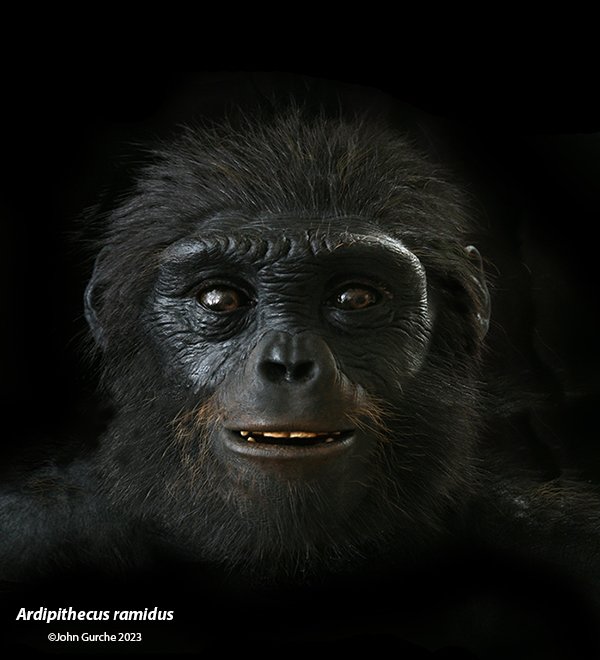
Ardi (ARA-VP-6/500)
Ardipithecus ramidus
Image: Image sourced via web search (Fair use / Educational)
About Ardi (ARA-VP-6/500)
Ardi, formally cataloged as ARA-VP-6/500, represents one of the most significant and paradigm-shifting discoveries in the history of paleoanthropology. Belonging to the species Ardipithecus ramidus, this extraordinary fossilized skeleton dates back approximately 4.4 million years to the Pliocene epoch of the Neogene period. Discovered in the Afar Depression of Ethiopia, Ardi provides an unprecedented window into the early stages of human evolution, specifically the critical anatomical and behavioral transitions that occurred shortly after the divergence of the hominin lineage from the common ancestor we share with modern chimpanzees. As a remarkably complete specimen for its immense antiquity, comprising over 125 individual bone fragments including a largely intact skull, pelvis, hands, and feet, Ardi has fundamentally challenged and reshaped long-held scientific assumptions regarding the origins of bipedalism, the ancestral morphology of early hominins, and the ecological conditions under which our earliest ancestors evolved. Her existence demonstrates that the last common ancestor of humans and chimpanzees was not highly chimpanzee-like, as previously assumed, but rather possessed a unique mosaic of primitive and derived traits that set the stage for the subsequent evolution of Australopithecus and, eventually, the genus Homo.
The physical description of Ardi reveals a fascinating and highly unusual mosaic of anatomical features that blend ape-like and human-like characteristics in ways that scientists had not previously anticipated. Standing at an estimated height of approximately 120 centimeters (about 3 feet 11 inches) and weighing roughly 50 kilograms (110 pounds), Ardi was comparable in size to a large modern female chimpanzee. However, her bodily proportions and skeletal architecture were distinctly different. Her cranial capacity was relatively small, estimated at between 300 and 350 cubic centimeters, which is similar to that of a modern bonobo or female chimpanzee, indicating that significant brain expansion had not yet occurred in this phase of hominin evolution. The skull exhibits a relatively prognathic (projecting) lower face, though less pronounced than in modern African apes, and the basicranium is short from front to back, a trait often associated with an upright posture. One of the most striking features of Ardi's dentition is the dramatic reduction in the size of the canine teeth, particularly the absence of the honing complex—the sharpening mechanism between the upper canine and lower premolar seen in all other apes. Her postcranial skeleton is equally remarkable. The pelvis is a complex mosaic: the upper part (the ilium) is short and broad, flaring outward in a manner that would have supported the gluteal muscles necessary for bipedal walking, while the lower part (the ischium) remains long and ape-like, suited for powerful climbing muscles. Her hands were disproportionately large with long, curved fingers, yet they lacked the specialized anatomical adaptations seen in the knuckles of modern African apes, suggesting she did not knuckle-walk. Most surprisingly, her feet featured a fully divergent, opposable big toe (hallux) adapted for grasping branches, combined with a relatively stiff midfoot that could have acted as a lever for bipedal walking, a combination of traits previously thought to be biomechanically incompatible.
The paleobiology of Ardipithecus ramidus, as inferred from Ardi's skeleton and associated dental evidence, points to a highly versatile and adaptable organism capable of exploiting multiple ecological niches. Dietary analysis based on the size, shape, and enamel thickness of her teeth, as well as stable carbon isotope analysis of the tooth enamel, indicates that Ardi was a generalized omnivore. Her enamel was intermediate in thickness between the thin enamel of chimpanzees (who eat mostly soft fruits) and the thick enamel of later Australopithecus species (who consumed harder, more abrasive foods). This suggests a diet consisting of a variety of woodland resources, including fruits, nuts, leaves, roots, and perhaps small animals or insects, but lacking the heavy reliance on tough, abrasive savanna vegetation seen in later hominins. Locomotion is arguably the most fascinating aspect of Ardi's paleobiology. She practiced a unique form of positional behavior that researchers have termed 'facultative bipedalism' combined with 'arboreal quadrupedalism.' On the ground, the structure of her pelvis and the positioning of her foramen magnum indicate she walked upright on two legs, albeit in a less efficient and more primitive manner than later hominins, likely with a somewhat bent-hip, bent-knee gait. In the trees, however, she moved on all fours, using her opposable big toes and long fingers to carefully grasp branches, moving deliberately rather than swinging beneath branches (brachiation) or leaping like modern monkeys. The reduction of the canine teeth in males of the species, a trait strongly associated with male-to-male aggression in other primates, has led some researchers to infer profound changes in the social behavior of Ardipithecus. It is hypothesized that this reduction reflects a shift away from intense male competition for mates, possibly indicating the early emergence of pair-bonding, increased male parental investment, and more cooperative social structures, though such behavioral inferences remain a subject of ongoing study.
The ecological context in which Ardi lived provides crucial clues to the evolutionary pressures that shaped her unique anatomy, directly challenging the long-standing 'savanna hypothesis' of human evolution. For decades, the prevailing theory posited that the emergence of bipedalism was driven by a dramatic climatic shift that transformed dense African forests into open, grassy savannas, forcing our ancestors to stand upright to see over tall grass, minimize sun exposure, or travel efficiently between distant patches of trees. However, the extensive paleoenvironmental data recovered from the Aramis site in the Middle Awash completely contradicts this narrative. The geological, botanical, and zoological evidence—including fossilized wood, seeds, and the remains of thousands of co-existing animals—paints a vivid picture of a closed, wooded environment, ranging from dense forests to more open grassy woodlands, but certainly not an open savanna. Ardi shared her habitat with a diverse array of fauna, including woodland-adapted monkeys (such as colobines), forest-dwelling antelopes (like tragelaphins), early elephants, rhinos, and a variety of birds and small mammals. Predators in this ecosystem included large, extinct carnivores such as saber-toothed cats, hyenas, and early bears, which would have posed a significant threat to a relatively slow-moving, small-brained hominin like Ardi. Her unique locomotor repertoire—capable of walking upright on the forest floor to forage or carry food, while retaining the ability to quickly ascend into the canopy to escape predators, sleep, or harvest fruit—appears to be a direct adaptation to this specific woodland environment. The discovery that bipedalism originated in the woods rather than the savanna has forced a complete re-evaluation of the ecological drivers of human evolution.
The discovery history of Ardi is a testament to the patience, meticulousness, and collaborative nature of modern paleoanthropology. The first fragmentary fossils of Ardipithecus ramidus were discovered in 1992 and 1993 by a team led by paleoanthropologist Tim White of the University of California, Berkeley, along with Ethiopian researchers Berhane Asfaw and Gen Suwa. These initial finds, consisting mainly of teeth and jaw fragments, were published in 1994, establishing the new genus and species. However, it was the subsequent discovery of the partial skeleton ARA-VP-6/500—soon dubbed 'Ardi'—that would truly revolutionize the field. Found in 1994 at the Aramis locality in the Middle Awash region of the Afar Depression in Ethiopia, the skeleton was in an incredibly fragile state. The bones had been heavily crushed and fragmented by the weight of overlying sediments and millennia of geological pressure, earning the nickname 'roadkill' among the research team. Excavating, cleaning, and reconstructing Ardi was a monumental task that required unprecedented care. It took an international team of over 40 scientists from various disciplines a staggering 15 years to painstakingly extract the fossils from the surrounding matrix, stabilize them, CT-scan the fragments, and digitally reconstruct the crushed skull and pelvis. Because of the extreme fragility of the specimen and the desire to present a comprehensive, multidisciplinary analysis, the team kept the details of the skeleton largely under wraps until 2009. In October of that year, the team published a special issue of the journal Science containing 11 detailed papers describing every aspect of Ardi's anatomy, her environment, and her evolutionary implications, a monumental release that was hailed as one of the most important scientific events of the decade.
The evolutionary significance of Ardi cannot be overstated, as she occupies a crucial and highly informative position on the hominin family tree. Dating to 4.4 million years ago, Ardi sits temporally between the older, more fragmentary putative hominins like Sahelanthropus tchadensis (approx. 7 million years ago) and Orrorin tugenensis (approx. 6 million years ago), and the later, well-known Australopithecus species, such as Australopithecus afarensis (represented by the famous 'Lucy' skeleton, dating to about 3.2 million years ago). Ardi's most profound evolutionary contribution is the demolition of the 'troglodytian model' of human evolution, which assumed that the last common ancestor of humans and chimpanzees was essentially a knuckle-walking, fruit-eating, chimpanzee-like ape. Ardi demonstrates that modern chimpanzees and gorillas have evolved highly specialized traits of their own—such as knuckle-walking and specialized suspensory anatomy—since their lineages diverged from ours. Because Ardi lacks these specialized ape traits, researchers conclude that the last common ancestor also lacked them. Instead, Ardi presents a primitive, generalized anatomy from which both the human and chimpanzee lineages diverged in radically different directions. Her anatomy provides a clear transitional model showing how a generalized, arboreal primate could gradually evolve the traits necessary for obligate bipedalism. The presence of a grasping big toe alongside a pelvis adapted for upright walking illustrates the mosaic nature of evolution, where different parts of the body evolve at different rates. Ardi effectively bridges the anatomical gap between the earliest, ape-like ancestors and the fully bipedal Australopithecines, solidifying our understanding of the sequence of anatomical changes that ultimately led to the genus Homo.
Despite the exhaustive analysis published by the discovery team, the interpretation of Ardi has not been without scientific debates and controversies. The primary point of contention revolves around her status as a hominin and the extent of her bipedalism. While the discovery team firmly places Ardipithecus ramidus on the hominin lineage, some independent researchers have argued that the evidence for bipedalism—particularly the reconstruction of the heavily crushed pelvis—is open to alternative interpretations. Critics have suggested that Ardi might represent an extinct lineage of apes that evolved some convergent traits, rather than a direct human ancestor. Furthermore, the biomechanics of walking upright with a fully divergent big toe have been heavily debated, with some biomechanists questioning how efficiently Ardi could have moved on the ground. There is also ongoing discussion regarding the interpretation of her environment; while the discovery team strongly advocates for a closed woodland habitat, other paleoecologists analyzing the same isotopic and faunal data have argued for a slightly more open, savanna-woodland mosaic. These debates are a normal and healthy part of the scientific process, highlighting the challenges of interpreting fragmentary and crushed fossils from deep time, and they continue to drive further research, biomechanical modeling, and the search for new fossil evidence.
The fossil record for Ardipithecus ramidus is heavily concentrated in the Middle Awash region of Ethiopia, specifically within the Aramis Member of the Sagantole Formation. While Ardi (ARA-VP-6/500) is by far the most famous and complete specimen, she is not the only one. The Aramis site has yielded the remains of over 100 individuals of Ardipithecus ramidus, making it one of the best-represented early hominin species in the fossil record. However, the preservation quality of these fossils is generally poor to fair, with bones often found heavily fragmented, crushed, and scattered by ancient predators and geological processes. Ardi herself is an exception in terms of completeness, but her bones were still severely crushed, requiring extensive digital reconstruction. The fossils typically preserved include teeth, jaw fragments, and isolated postcranial bones. The precise dating of the Aramis fossils to 4.4 million years ago is highly reliable, achieved through argon-argon radiometric dating of the volcanic ash layers situated immediately above and below the fossil-bearing sediments. This robust chronological framework, combined with the sheer volume of specimens, makes the Middle Awash one of the most critical fossil sites in the world for understanding early human evolution.
The cultural impact of Ardi has been profound, capturing the public imagination and significantly altering the way human evolution is taught and understood. Upon the publication of her comprehensive description in 2009, the journal Science named the Ardipithecus ramidus research the 'Breakthrough of the Year.' Ardi has been featured in numerous documentaries, magazine cover stories, and science news articles, often presented as the fossil that dethroned 'Lucy' as the most important early hominin skeleton. While the original fossils remain carefully curated in the National Museum of Ethiopia in Addis Ababa, high-quality casts and digital reconstructions of Ardi's skeleton are displayed in major natural history museums worldwide. Her discovery has become a staple in university curricula and biology textbooks, serving as the premier educational example of mosaic evolution and the complex, non-linear nature of human origins.
Classification
Time Period
Discovery
Location
Middle Awash, Ethiopia
Formation
Sagantole Formation
Frequently Asked Questions
What is Ardi (ARA-VP-6/500)?
Ardi, formally cataloged as ARA-VP-6/500, represents one of the most significant and paradigm-shifting discoveries in the history of paleoanthropology. Belonging to the species Ardipithecus ramidus, this extraordinary fossilized skeleton dates back approximately 4.4 million years to the Pliocene epo...
When did Ardi (ARA-VP-6/500) live?
Ardi (ARA-VP-6/500) lived during the neogene period of the cenozoic era approximately 4.4-4.4 million years ago.
Where was Ardi (ARA-VP-6/500) discovered?
Fossils of Ardi (ARA-VP-6/500) were discovered in Middle Awash, Ethiopia in the Sagantole Formation.
What did Ardi (ARA-VP-6/500) eat?
Ardi (ARA-VP-6/500) was a omnivore. It lived in arboreal and terrestrial woodland habitats.
What type of fossil is Ardi (ARA-VP-6/500)?
Ardi (ARA-VP-6/500) is preserved as a body fossil. The preservation quality is exceptional.
Related Specimens
From the cenozoic era · body fossils