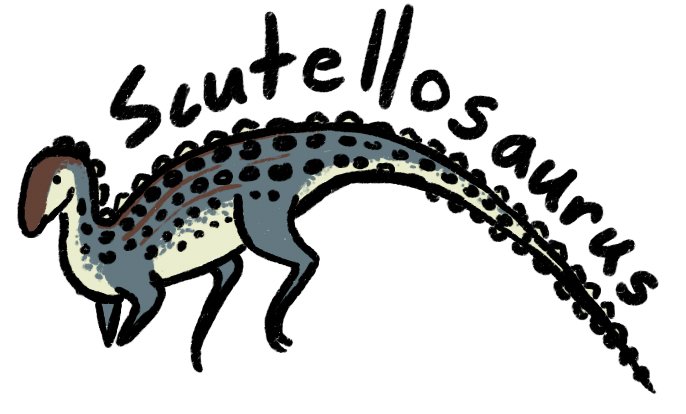
Scutellosaurus
Scutellosaurus lawleri
Image: Image sourced via web search (Fair use / Educational)
About Scutellosaurus
Scutellosaurus lawleri represents one of the earliest known members of the armored dinosaurs, or Thyreophora, a group that would later include iconic giants like Stegosaurus and Ankylosaurus. This small, bipedal herbivore lived during the Early Jurassic period, approximately 196 to 183 million years ago, in what is now the southwestern United States. Its discovery provided crucial insights into the initial evolutionary stages of ornithischian dinosaurs, particularly the development of dermal armor, making it a key taxon for understanding the diversification of this major dinosaur lineage.
Scutellosaurus was a diminutive dinosaur, especially when compared to its later thyreophoran relatives. It measured approximately 1.2 meters (about 4 feet) in length from snout to tail, stood roughly 0.5 meters (1.6 feet) tall at the hips, and likely weighed only around 10 kilograms (22 pounds), comparable in size to a modern-day turkey or a medium-sized dog like a beagle. Its most defining characteristic was the presence of hundreds of small, bony plates, called osteoderms or scutes, embedded in its skin along its neck, back, and tail. These scutes, from which the dinosaur derives its name meaning 'little shield lizard', varied in shape and size, ranging from small, flattened pebbles to larger, keeled, and asymmetrical plates. Unlike the massive, integrated armor of later ankylosaurs, the scutes of Scutellosaurus were not fused together, forming a flexible but protective covering. Its skeleton was lightly built, featuring a long, slender tail that constituted more than half of its total body length and likely served as a counterbalance. The skull was small and triangular, equipped with simple, leaf-shaped teeth adapted for shredding plant material. Its hind limbs were significantly longer and more robust than its forelimbs, a clear indication of a primarily bipedal stance, though it may have been capable of quadrupedal movement when resting or feeding low to the ground.
As a basal ornithischian, the paleobiology of Scutellosaurus reveals an animal adapted to a specific niche in the Early Jurassic ecosystem. Its simple, leaf-shaped teeth with coarse serrations suggest a diet of low-growing, soft vegetation such as ferns, cycads, and horsetails. The teeth were not designed for extensive chewing; instead, Scutellosaurus likely nipped off plant matter and processed it further in its gut, possibly with the aid of gastroliths (stomach stones), although none have been found in direct association with its fossils. Its long hind legs and lightweight build indicate it was a relatively fast and agile runner, a crucial adaptation for evading predators. This bipedal locomotion, combined with its protective dermal armor, suggests a defensive strategy reliant on both flight and passive protection. The long tail would have acted as a dynamic stabilizer during rapid movements. There is no direct fossil evidence for social behavior, but like many small herbivores, it is plausible that Scutellosaurus lived in small groups or herds for mutual protection, though it could also have been a solitary animal. Its metabolism was likely higher than that of modern reptiles but lower than that of birds or mammals, a condition often described as mesothermic, allowing for periods of sustained activity.
Scutellosaurus inhabited a world recovering and diversifying after the Triassic-Jurassic extinction event. It lived in the region of western North America that would become the Kayenta Formation, an environment characterized by a semi-arid to arid climate with distinct wet and dry seasons. The landscape was a mosaic of braided river systems, floodplains, sand dunes, and sparse woodlands. This habitat supported a diverse fauna, placing Scutellosaurus within a complex food web. It shared its environment with other early dinosaurs, including the larger herbivorous sauropodomorph Sarahsaurus and the formidable carnivorous theropods Dilophosaurus and Kayentavenator, which would have been its primary predators. The presence of Scutellosaurus's armor, even in its rudimentary form, was likely a direct evolutionary response to the predatory pressures exerted by these theropods. The ecosystem also included a variety of other reptiles, such as crocodylomorphs like Protosuchus in the waterways, pterosaurs in the skies, and early synapsids, including tritylodonts, which were small, mammal-like herbivores that may have competed with Scutellosaurus for similar food resources. Scutellosaurus occupied the niche of a small, ground-level browser, feeding on the understory vegetation that thrived along the riverbanks and in the more humid parts of the landscape.
The history of Scutellosaurus begins in the 1970s in northern Arizona. The fossils were discovered by David Lawler, a student at the University of California, Berkeley, in the Silty Facies of the Kayenta Formation. The material was subsequently studied and described by paleontologist Edwin H. Colbert in a 1981 monograph. Colbert named the genus Scutellosaurus, from the Latin 'scutellum' meaning 'little shield' and the Greek 'sauros' meaning 'lizard', in reference to the hundreds of osteoderms found with the skeleton. The species name, lawleri, honors its discoverer, David Lawler. The holotype specimen, cataloged as MNA P1.175, consists of a partial skeleton including parts of the skull, vertebrae, limb bones, and over 300 associated osteoderms. A second, more fragmentary specimen (UCMP 130580) was also recovered from the same area. These two specimens remain the only known fossils of Scutellosaurus, but they provide a remarkably complete picture of this early armored dinosaur's anatomy. Colbert's detailed description established the animal's phylogenetic position and provided the first concrete evidence of a small, bipedal, armored ornithischian from the Early Jurassic, filling a significant gap in the fossil record.
Scutellosaurus holds a pivotal position in the evolutionary history of dinosaurs. It is widely recognized as one of the most basal members of the Thyreophora, the clade that encompasses both the stegosaurs (plated dinosaurs) and the ankylosaurs (armored dinosaurs). Its anatomy displays a fascinating mosaic of primitive and derived features. The bipedal stance and lightly built skeleton are ancestral traits for ornithischians, while the presence of osteoderms is the key derived feature that defines the thyreophoran lineage. Scutellosaurus is considered a sister taxon to Emausaurus, another early armored dinosaur from Germany, and together they represent the earliest offshoots of the thyreophoran family tree, predating the divergence of Stegosauria and Ankylosauria. It demonstrates that the first step in the evolution of these heavily armored quadrupeds was the development of dermal armor in a small, bipedal ancestor. The transition from a bipedal runner like Scutellosaurus to the large, quadrupedal 'tanks' of the Late Jurassic and Cretaceous involved a significant increase in body size, a shift to a four-legged stance, and the elaboration of osteoderms into the complex plates, spikes, and tail clubs seen in its more famous descendants. Thus, Scutellosaurus provides a crucial snapshot of the humble beginnings of one of the most successful and recognizable dinosaur groups.
While the placement of Scutellosaurus as a basal thyreophoran is widely accepted, some scientific debate has centered on its exact relationship to other early ornithischians and the nature of its locomotion. Some early analyses questioned whether it might be more closely related to other ornithischian groups like the ornithopods, but the clear presence of dermal armor has solidified its thyreophoran identity. More recent discussions have focused on its posture and gait. While primarily bipedal, the structure of its forelimbs has led some researchers to suggest it was a 'facultative quadruped,' meaning it could walk on all fours when moving slowly, browsing, or resting. This interpretation paints a picture of a more versatile animal and provides a potential behavioral link to the obligate quadrupedalism of its later, much larger relatives. The precise function and arrangement of its diverse scutes also remain a topic of study, with ongoing research attempting to reconstruct their exact placement on the body to better understand their defensive capabilities and potential role in species recognition or thermoregulation.
The fossil record of Scutellosaurus is geographically and temporally restricted. To date, all known specimens have been unearthed from the Kayenta Formation in Coconino County, Arizona, USA. This geological formation is renowned for its rich collection of Early Jurassic terrestrial fossils. Only two partial skeletons have been formally described, the holotype (MNA P1.175) and a second, less complete specimen (UCMP 130580). The holotype is particularly significant as it preserves elements from across the skeleton, including cranial fragments, vertebrae from the neck, back, and tail, ribs, parts of the shoulder and pelvic girdles, limb bones, and, crucially, more than 300 osteoderms found in association. The preservation quality is considered good, allowing for detailed anatomical study, although the skeletons are disarticulated. The abundance of osteoderms is a key feature of its fossil record, providing direct evidence of its armored nature. The rarity of Scutellosaurus fossils suggests it may not have been a dominant component of its ecosystem, or that the specific environments it preferred were less conducive to fossilization.
Despite its scientific importance, Scutellosaurus has a relatively modest cultural impact compared to its larger relatives like Stegosaurus. It is not a staple of popular media, but it is well-represented in paleontological literature and educational materials as a key example of early dinosaur evolution. Museums with strong North American paleontology collections, such as the Museum of Northern Arizona where the holotype is housed, often feature Scutellosaurus in displays on the Early Jurassic or the evolution of armored dinosaurs. Its small size and unique combination of bipedalism and armor make it a fascinating subject for illustrating the concept of transitional fossils and the diversity of dinosaur body plans. It serves as an important educational tool, demonstrating that not all armored dinosaurs were giant, lumbering quadrupeds and highlighting the humble origins from which these iconic groups evolved.
Classification
Time Period
Discovery
Location
Arizona, USA
Formation
Kayenta Formation
Frequently Asked Questions
What is Scutellosaurus?
Scutellosaurus lawleri represents one of the earliest known members of the armored dinosaurs, or Thyreophora, a group that would later include iconic giants like Stegosaurus and Ankylosaurus. This small, bipedal herbivore lived during the Early Jurassic period, approximately 196 to 183 million years...
When did Scutellosaurus live?
Scutellosaurus lived during the jurassic period of the mesozoic era approximately 196-183 million years ago.
Where was Scutellosaurus discovered?
Fossils of Scutellosaurus were discovered in Arizona, USA in the Kayenta Formation.
What did Scutellosaurus eat?
Scutellosaurus was a herbivore. It lived in terrestrial habitats.
What type of fossil is Scutellosaurus?
Scutellosaurus is preserved as a body fossil. The preservation quality is good.
Related Specimens
From the mesozoic era · body fossils