Shunosaurus
Shunosaurus lii
Image: Image sourced via web search (Fair use / Educational)
About Shunosaurus
Shunosaurus lii was a medium-sized sauropod dinosaur that roamed the floodplains of what is now China during the Middle Jurassic period, approximately 170 to 160 million years ago. Its name, meaning 'Shu Lizard,' pays homage to the ancient name for the Sichuan province where its remarkably complete fossils were first unearthed. Shunosaurus is one of the most completely known sauropods, providing paleontologists with an invaluable window into the anatomy, biology, and evolution of these colossal herbivores at a crucial stage in their development.
Shunosaurus was a relatively small sauropod by later standards, measuring approximately 9.5 to 11 meters (about 31 to 36 feet) in length and weighing an estimated 3 to 4 metric tons. For comparison, it was roughly the length of a large school bus but significantly lighter than the truly gigantic sauropods like Argentinosaurus that would evolve millions of years later. Its most striking and unique feature was its tail, which terminated in a bony, spiked club, known as a thagomizer-like structure, reminiscent of the weaponized tails of stegosaurs. This club consisted of two pairs of fused osteoderms, forming short, sharp spikes, and was likely used as a formidable defensive weapon against predators. The skeleton of Shunosaurus was robustly built. It possessed the classic sauropod body plan: a long neck, a bulky torso supported by four pillar-like legs, and a long tail. However, its neck was proportionally short for a sauropod, suggesting it was a low-browser. Its skull is one of the best-preserved among early sauropods, revealing a short, deep snout filled with spatulate (spoon-shaped) teeth, well-suited for stripping foliage from low-growing plants. The forelimbs were slightly shorter than the hindlimbs, giving it a somewhat downward-sloping posture. The completeness of its fossil record, including nearly complete skeletons, has allowed for detailed anatomical studies that are rare for many other sauropod species.
Based on its dental morphology and relatively short neck, Shunosaurus was undoubtedly a herbivore specializing as a low-level browser. Its spatulate teeth were not designed for heavy chewing but were efficient at raking or stripping leaves and shoots from ferns, cycads, and conifers that dominated the Jurassic undergrowth. It likely swallowed vegetation whole, relying on a large gut and possibly gastroliths (stomach stones), which have been found in association with some sauropod skeletons, to aid in digestion. Its sturdy, columnar legs supported its weight and allowed for slow, steady locomotion across the landscape. While not built for speed, this quadrupedal gait was energy-efficient for a large animal constantly on the move in search of food. The discovery of multiple individuals in close proximity suggests that Shunosaurus may have lived in herds or family groups. This social behavior would have offered protection against predators, particularly for younger, more vulnerable individuals. The tail club was a key aspect of its paleobiology, likely swung with considerable force to inflict serious injury on attacking theropods like Gasosaurus or Yangchuanosaurus. Growth studies based on bone histology are still developing, but like other sauropods, it likely experienced a rapid growth spurt during its juvenile years to quickly reach a size that would deter most predators. Its metabolism was likely a form of gigantothermy, where its large body size helped maintain a stable internal temperature, a state intermediate between modern cold-blooded reptiles and warm-blooded mammals.
Shunosaurus lived in a warm, humid, subtropical environment characterized by vast, seasonally wet floodplains, meandering rivers, and lush forests. This ecosystem is preserved in what is known as the Dashanpu Formation in China's Sichuan Basin. The flora was rich with non-flowering plants, including towering conifers, ginkgoes, cycads, and dense understories of ferns and horsetails, providing ample food for large herbivores. Shunosaurus shared this vibrant world with a diverse array of other dinosaurs, creating a complex and dynamic food web. It was part of a sauropod-dominated fauna, coexisting with other herbivores like the long-necked Omeisaurus and the smaller sauropod Datousaurus, as well as the stegosaur Huayangosaurus. This suggests a degree of niche partitioning, with Shunosaurus feeding on low-level vegetation while longer-necked sauropods browsed higher in the canopy. The primary threats to Shunosaurus were large predatory theropods. Fossil evidence from the same formation reveals the presence of carnivores such as Gasosaurus, a medium-sized predator, and the much larger, Allosaurus-like Yangchuanosaurus, which would have been the apex predator capable of taking down an adult Shunosaurus. The evolution of its tail club was a direct response to this intense predation pressure, making it a well-defended herbivore within its ecosystem.
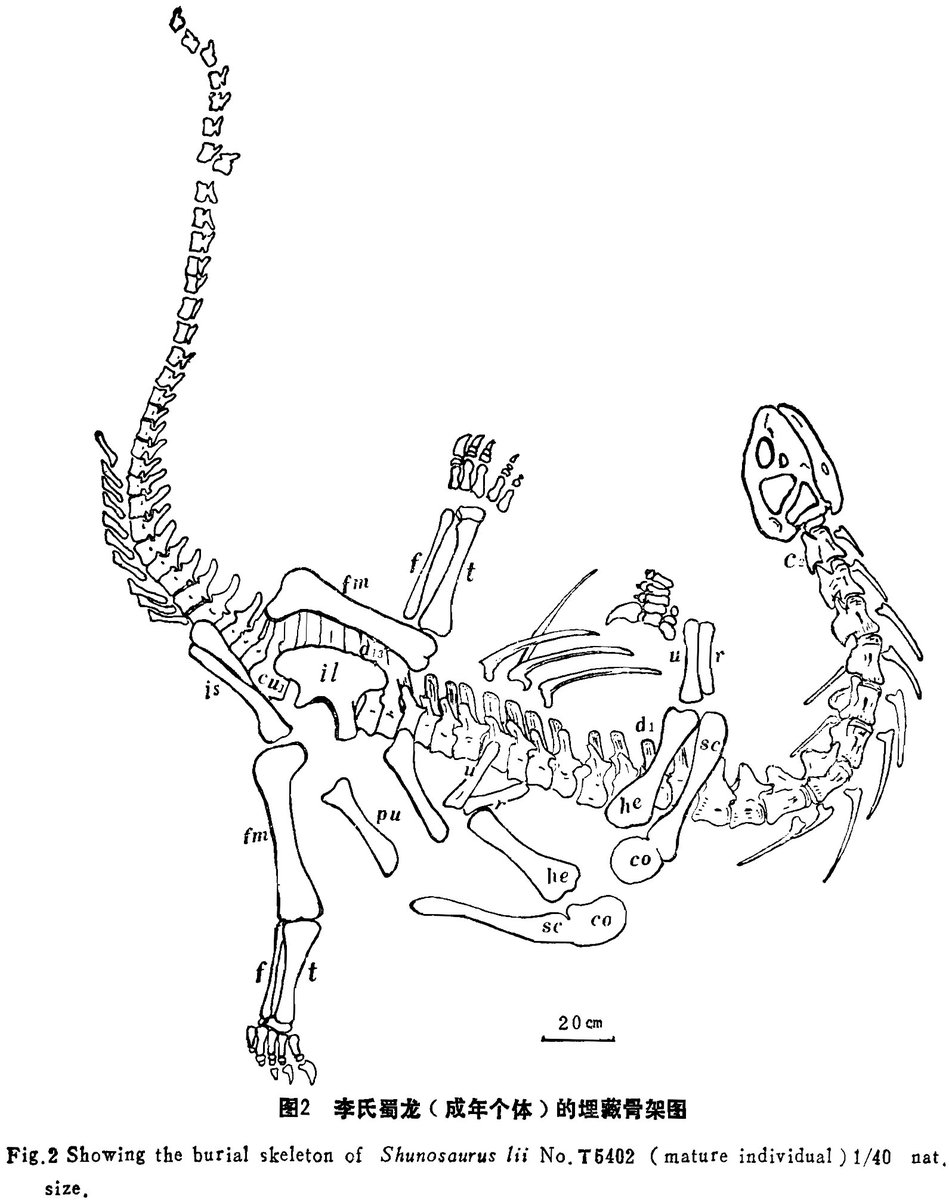
The history of Shunosaurus is intrinsically linked to the Dashanpu Quarry near Zigong, Sichuan Province, one of the world's most productive dinosaur fossil sites. The first fossils were discovered in 1977 by a group of students during a geological survey. This led to systematic excavations that unearthed a treasure trove of Jurassic life. The dinosaur was formally named and described in 1983 by a team of Chinese paleontologists including Dong Zhiming, Zhou Shiwu, and Zhang Yihong. The generic name, Shunosaurus, refers to 'Shu,' an ancient name for Sichuan, while the specific name, 'lii,' honors Li Bing, a famous hydrologist and administrator of the Shu state from the 3rd century BCE. The sheer abundance of fossils is remarkable; over twenty nearly complete or partial skeletons have been recovered from the Dashanpu Quarry alone. One of the most significant specimens is ZDM T5401, a nearly complete mounted skeleton that serves as a primary reference for the species' anatomy. This wealth of material has made Shunosaurus one of the most thoroughly studied of all sauropods, providing a detailed anatomical blueprint that helps paleontologists understand more fragmentary sauropod remains from around the world.
Shunosaurus holds a crucial position in the evolutionary history of sauropods. It is considered a basal or early-branching eusauropod, placing it near the foundation of the lineage that would later give rise to the giant titanosaurs and diplodocids of the Late Jurassic and Cretaceous. Its combination of primitive features (like the relatively short neck) and more derived traits provides critical insights into the early stages of sauropod diversification. The most significant evolutionary feature is its tail club. While weaponized tails are famous in ankylosaurs and stegosaurs (which belong to a different dinosaur group, the Ornithischia), the presence of a similar structure in a sauropod is highly unusual. This is a striking example of convergent evolution, where two unrelated groups independently evolve similar features to solve a similar problem—in this case, defense against large predators. The only other sauropod known to possess a similar, albeit more complex, tail club is the later titanosaur Shingopana. The well-preserved skull of Shunosaurus has also been vital for understanding the evolution of sauropod heads and feeding mechanisms, bridging a gap between very early sauropodomorphs and the more specialized sauropods of the Late Jurassic.
Despite the completeness of its fossil record, Shunosaurus is not without scientific debate. Its precise placement within the sauropod family tree has been a subject of discussion. While often classified as a basal eusauropod, some analyses have placed it within the family Mamenchisauridae, alongside other long-necked Chinese sauropods, though its neck is not exceptionally long. This debate centers on subtle anatomical features of the vertebrae and skull. Another area of discussion involves the exact function and biomechanics of its tail club. While its defensive purpose is widely accepted, studies continue to model the range of motion, the force of impact it could generate, and whether it was used primarily for interspecific combat (against predators) or intraspecific combat (for mating rights or territory), or both. The discovery of so many individuals together has fueled debates about the complexity of its social structure, with ongoing research trying to determine if these were mass-death assemblages or evidence of sophisticated, long-term herding behavior. These questions ensure that Shunosaurus remains a subject of active paleontological research.
The fossil record of Shunosaurus is exceptionally rich but geographically constrained. Virtually all known specimens have been excavated from the Dashanpu Quarry and surrounding areas within the Lower Shaximiao Formation (part of the larger Dashanpu Formation) in Sichuan, China. This site represents a 'log jam' in an ancient river system, where the carcasses of numerous dinosaurs washed together and were rapidly buried, leading to extraordinary preservation. Over 90% of the skeleton is known, including delicate skull bones, which are often missing in other sauropod fossils. The sheer number of individuals found—representing various age groups from juvenile to adult—provides a rare opportunity to study population dynamics and growth patterns in a single dinosaur species. The Zigong Dinosaur Museum, built directly over a section of the Dashanpu Quarry, showcases this incredible fossil wealth, with multiple mounted skeletons of Shunosaurus lii forming the centerpiece of its exhibits, allowing visitors to see the fossils in situ.
Shunosaurus has achieved significant recognition, particularly within China, where it is celebrated as a paleontological national treasure. Its fame is largely due to the spectacular displays at the Zigong Dinosaur Museum, a world-renowned institution that attracts hundreds of thousands of visitors annually. The image of its skeleton, with its distinctive tail club, is iconic and frequently featured in books, documentaries, and educational materials about dinosaurs. While it may not have the global household-name status of Tyrannosaurus or Triceratops, Shunosaurus is a staple in comprehensive dinosaur encyclopedias and a key subject in university-level paleontology courses due to its anatomical completeness and evolutionary importance. Its unique tail club makes it a memorable and fascinating example of dinosaur diversity and adaptation.
Classification
Time Period
Discovery
Location
Sichuan Province, China
Formation
Dashanpu Formation (specifically the Lower Shaximiao Formation)
Frequently Asked Questions
What is Shunosaurus?
Shunosaurus lii was a medium-sized sauropod dinosaur that roamed the floodplains of what is now China during the Middle Jurassic period, approximately 170 to 160 million years ago. Its name, meaning 'Shu Lizard,' pays homage to the ancient name for the Sichuan province where its remarkably complete ...
When did Shunosaurus live?
Shunosaurus lived during the jurassic period of the mesozoic era approximately 170-160 million years ago.
Where was Shunosaurus discovered?
Fossils of Shunosaurus were discovered in Sichuan Province, China in the Dashanpu Formation (specifically the Lower Shaximiao Formation).
What did Shunosaurus eat?
Shunosaurus was a herbivore. It lived in terrestrial habitats.
What type of fossil is Shunosaurus?
Shunosaurus is preserved as a body fossil. The preservation quality is excellent.
Related Specimens
From the mesozoic era · body fossils
/c81e708ee030.png)