Irish Elk
Megaloceros giganteus
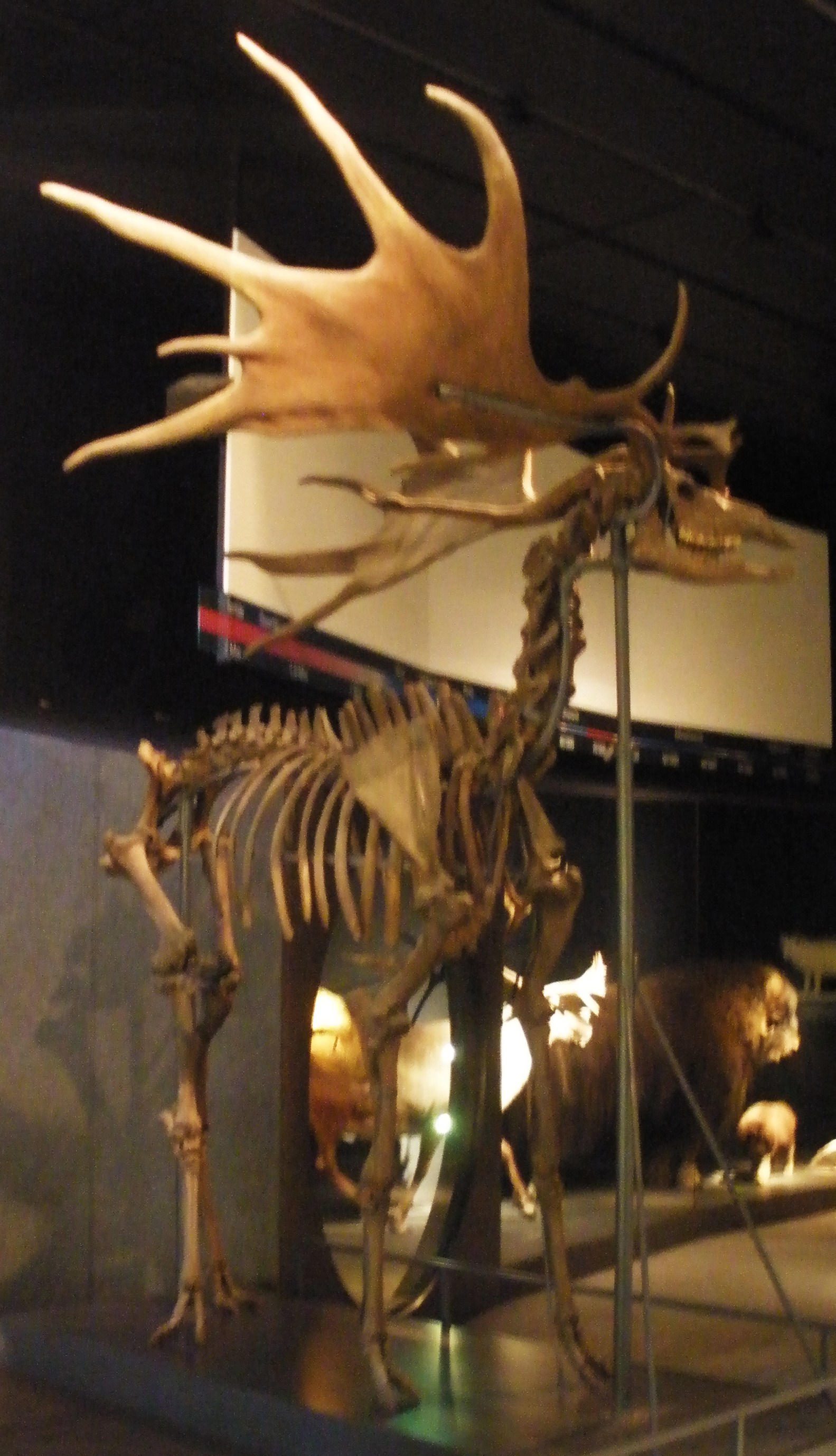
Image: File:Megaloceros giganteus.JPG - Wikimedia Commons (CC BY-SA)
About Irish Elk
The Irish Elk, known scientifically as *Megaloceros giganteus*, stands as one of the most magnificent and iconic megafaunal mammals of the Pleistocene epoch. This giant deer, the largest cervid ever to have lived, roamed a vast territory across Eurasia from approximately 400,000 to just under 8,000 years ago. Its immense size and, most notably, its colossal antlers have captivated both scientific and public imagination for centuries, making it a key subject for understanding evolutionary processes, megafaunal extinction, and the dramatic environmental shifts of the Quaternary period.
The physical presence of *Megaloceros giganteus* was truly formidable. Standing approximately 2.1 meters (7 feet) tall at the shoulder, it surpassed the height of a modern moose, its closest living counterpart in terms of scale. Large males could weigh between 500 and 700 kilograms (1,100 to 1,540 pounds), with some estimates suggesting exceptional individuals may have exceeded this range. Its body was robust and powerfully built, supported by long, sturdy legs adapted for traversing the open steppe-tundra and parkland environments it favored. The most defining feature, however, was the male's set of antlers. These were the largest of any known deer, spanning up to 3.65 meters (12 feet) from tip to tip and weighing as much as 40 kilograms (88 pounds). The antlers were palmate, meaning they featured broad, flattened sections similar to those of a moose, but with a more complex and elegant structure of tines and points. The skull was elongated and deep, necessary to support the powerful neck muscles required to carry such a massive head ornament. Its coat, inferred from cave paintings and genetic studies, was likely light in color, possibly with a dark dorsal stripe and a lighter patch around the neck, providing camouflage in its open habitat.
The paleobiology of *Megaloceros giganteus* reveals a highly specialized herbivore adapted to a specific ecological niche. Isotopic analysis of its fossilized teeth and bones indicates a diet primarily composed of nutrient-rich grasses and forbs, supplemented by browsing on the foliage of shrubs and trees like willow and birch. This mixed-feeding strategy allowed it to exploit the productive, open landscapes of interglacial periods. The sheer size of the animal demanded a high-quality diet rich in calcium and phosphates, not only for general metabolism but specifically for the immense physiological cost of growing its massive antlers annually. Each year, males would shed their old antlers and regrow a new, often larger set, a process requiring an enormous diversion of mineral resources. The primary function of these antlers was not for defense against predators but for intraspecific competition. They served as powerful visual signals of a male's fitness and were used in ritualized combat with rivals during the rutting season to establish dominance and secure mating rights, a behavior mirrored in modern deer species.
*Megaloceros giganteus* lived within the dynamic and often harsh ecological context of the Pleistocene. Its range expanded and contracted with the cyclical advance and retreat of continental ice sheets. During warmer interglacial periods, it thrived in the vast, open steppe-tundra and sparse woodlands that stretched from Ireland across Europe and into Siberia. This habitat provided the abundant, high-quality forage it required. It shared this ecosystem with a diverse cast of other megafauna, including the Woolly Mammoth (*Mammuthus primigenius*), Woolly Rhinoceros (*Coelodonta antiquitatis*), Steppe Bison (*Bison priscus*), and Cave Lion (*Panthera spelaea*). As a large herbivore, *Megaloceros* occupied a crucial position in the food web, serving as prey for major predators like the Cave Lion, Cave Hyena (*Crocuta crocuta spelaea*), and packs of wolves. Early humans, including Neanderthals and later *Homo sapiens*, also hunted this giant deer, as evidenced by butchery marks found on some fossil remains. Its survival was intrinsically linked to the health of these open ecosystems, making it highly vulnerable to the rapid climatic and vegetational changes that marked the end of the last Ice Age.
The discovery history of *Megaloceros giganteus* is deeply rooted in the peat bogs of Ireland, which provided the perfect anaerobic conditions for preserving its skeletons. The first documented scientific description was made by Irish physician Thomas Molyneux in 1697, who correctly identified the remains as a type of deer, dispelling earlier notions that they belonged to an American moose or a biblical creature. For much of the 18th and 19th centuries, it was commonly referred to as the "Irish Elk" due to the abundance of spectacular specimens found in Ireland and the superficial resemblance of its palmate antlers to those of the North American elk (wapiti) or moose. The formal scientific name, *Megaloceros giganteus*, was established by Johann Friedrich Blumenbach in 1799. One of the most famous and influential figures in its study was the French naturalist Georges Cuvier, who used the Irish Elk as a prime example to champion his theory of extinction, arguing that such a creature could not possibly still exist hidden somewhere on Earth. The sheer number and completeness of skeletons recovered from Irish bogs, particularly at sites like Ballybetagh Bog near Dublin, provided an unparalleled resource for paleontological study.
The evolutionary significance of *Megaloceros giganteus* is profound, particularly in the context of debates surrounding evolutionary mechanisms. It belongs to the family Cervidae, the deer family, but its precise relationship to modern deer was long debated. Early classifications placed it close to fallow deer (*Dama dama*), and recent ancient DNA analysis has confirmed this close genetic link, placing *Dama* as its sister taxon. This relationship is supported by morphological similarities, such as the presence of palmate antlers. The most significant aspect of its evolutionary story, however, involves its antlers. For decades, they were presented as a classic example of orthogenesis, a discredited theory suggesting that evolution proceeds in a predetermined, linear direction, sometimes leading to traits that become so exaggerated they drive a species to extinction. Modern evolutionary theory, however, explains the antler size through the principle of allometry—the disproportionate growth of a body part relative to the body as a whole—driven by intense sexual selection. Larger-bodied males could support larger antlers, which in turn made them more successful in mating, creating a powerful selective pressure that favored ever-increasing size in both body and antlers.
This interpretation of its antler development has been central to scientific debates surrounding the species. While the orthogenesis theory has been thoroughly debunked, the exact role the antlers played in the species' extinction remains a topic of discussion. The traditional view held that the immense antlers became a maladaptive burden, hindering movement through newly forested environments and dooming the species. However, the modern consensus points to a more complex scenario. The extinction of *Megaloceros giganteus* is now primarily attributed to habitat loss driven by rapid climate change at the end of the Pleistocene, around 11,000 years ago. As temperatures rose, the open steppe-grasslands it depended on were replaced by dense, closed-canopy forests. This new environment not only restricted the movement of such a large, wide-antlered animal but, more critically, it replaced its high-quality forage with less nutritious forest vegetation. This ecological shift would have created severe nutritional stress, making it impossible for the deer to acquire the resources needed to sustain their large bodies and, especially for males, to regrow their antlers annually. Hunting pressure from early modern humans likely acted as a compounding factor, pushing already stressed populations over the brink. A final, isolated population survived in the Ural Mountains of Siberia until about 7,700 years ago before finally vanishing.
The fossil record of *Megaloceros giganteus* is exceptionally rich, particularly in northwestern Europe. The peat bogs of Ireland have yielded an unparalleled collection of well-preserved, often fully articulated skeletons, making it one of the best-represented Pleistocene mammals. Famous sites like Ballybetagh Bog have produced remains of over 100 individuals, predominantly males, suggesting these areas may have been seasonal congregation points or natural traps. Beyond Ireland, significant fossil finds have been made across Great Britain, continental Europe (from France and Germany to the Balkans), and eastward across the Russian plains to as far as Lake Baikal in Siberia. These widespread fossils have allowed paleontologists to track the species' geographic range, population dynamics, and morphological variations over hundreds of thousands of years. The quality of preservation, especially in bog and permafrost environments, has been so high that it has enabled detailed studies of bone histology, isotopic geochemistry, and the extraction of ancient DNA, providing deep insights into the animal's life history and evolutionary relationships.
The imposing skeleton of the Irish Elk has had a lasting cultural impact, becoming a quintessential symbol of Ice Age megafauna and the concept of extinction. Its mounted skeletons are prized, centerpiece exhibits in natural history museums around the world, including the Natural History Museum in Dublin, the Natural History Museum in London, and the American Museum of Natural History in New York. These dramatic displays serve as powerful educational tools, illustrating the scale of past life and the profound effects of environmental change. The Irish Elk frequently appears in popular science books, documentaries, and paleoart, where its majestic form continues to inspire awe and curiosity about the lost worlds of the Pleistocene.
Classification
Time Period
Discovery
Location
Ireland
Formation
Irish Peat Bogs
Frequently Asked Questions
What is Irish Elk?
The Irish Elk, known scientifically as *Megaloceros giganteus*, stands as one of the most magnificent and iconic megafaunal mammals of the Pleistocene epoch. This giant deer, the largest cervid ever to have lived, roamed a vast territory across Eurasia from approximately 400,000 to just under 8,000 ...
When did Irish Elk live?
Irish Elk lived during the quaternary period of the cenozoic era approximately 0.4-0.008 million years ago.
Where was Irish Elk discovered?
Fossils of Irish Elk were discovered in Ireland in the Irish Peat Bogs.
What did Irish Elk eat?
Irish Elk was a herbivore. It lived in terrestrial habitats.
What type of fossil is Irish Elk?
Irish Elk is preserved as a body fossil. The preservation quality is exceptional.
Related Specimens
From the cenozoic era · body fossils