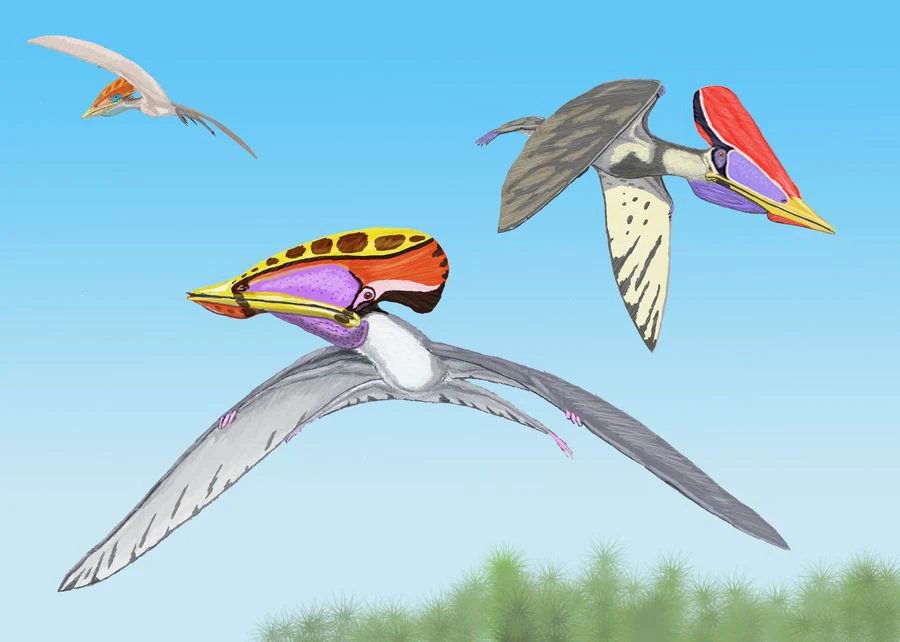
Tupuxuara
Tupuxuara leonardii
Image: Image sourced via web search (Fair use / Educational)
About Tupuxuara
Tupuxuara is a genus of large, crested, toothless pterodactyloid pterosaur that lived during the Early Cretaceous period, approximately 112 to 108 million years ago. Found primarily in the fossil-rich Araripe Basin of northeastern Brazil, specifically within the Romualdo Formation, Tupuxuara represents one of the most striking examples of cranial ornamentation in the pterosaur fossil record. Its discovery has significantly advanced paleontological understanding of pterosaur diversity, crest evolution, and the complex ecosystems of prehistoric South America. As a member of the clade Azhdarchoidea, it provides a crucial evolutionary link between earlier, smaller pterosaurs and the massive, terrestrial-stalking azhdarchids that would come to dominate the Late Cretaceous skies. The physical anatomy of Tupuxuara leonardii is defined by its spectacular cranial crest and impressive overall size. Adult specimens of Tupuxuara leonardii are estimated to have possessed a wingspan ranging from 4.5 to 5.5 meters (approximately 15 to 18 feet), making them comparable in size to a small modern aircraft and vastly larger than any extant flying bird, such as the wandering albatross. The most distinctive feature of Tupuxuara is undoubtedly its massive, sail-like head crest. Unlike the crests of some relatives which were restricted to the front of the snout or the back of the skull, the crest of Tupuxuara leonardii swept continuously from the tip of its toothless upper jaw all the way to the back of its head, forming a large, semi-circular profile. This crest was composed of bone and likely extended even further in life by a covering of keratin or soft tissue. The skull itself was highly elongated and lightweight, featuring large fenestrae (openings) that reduced the overall weight of the massive head, allowing the animal to fly efficiently. Its postcranial skeleton was robust, with strong forelimbs adapted for powered flight and relatively long hindlimbs that suggest a high degree of terrestrial competence. The paleobiology of Tupuxuara is a subject of fascinating complexity, particularly regarding its diet and feeding strategies. Early interpretations suggested that, like many pterosaurs found in coastal deposits, Tupuxuara was a piscivore that skimmed the water's surface for fish. However, the morphology of its toothless beak and the biomechanics of its neck suggest a different lifestyle. Many paleontologists now believe that Tupuxuara was an omnivore or a specialized frugivore, using its large beak to pluck fruits from early angiosperms (flowering plants) or to forage for small terrestrial animals, insects, and carrion on the ground. Its terrestrial locomotion was likely quadrupedal, walking efficiently on its folded wings and hind legs, much like modern storks or ground hornbills. The growth patterns of Tupuxuara are also well-documented; juvenile specimens show that the massive cranial crest grew allometrically, meaning it developed rapidly as the animal reached sexual maturity, strongly suggesting that the crest functioned primarily as a display structure for species recognition and mate attraction rather than for thermoregulation or aerodynamic steering. The ecological context of Early Cretaceous Brazil was a dynamic and thriving environment. During the Aptian and Albian stages, the Araripe Basin was characterized by a large, shallow inland sea or lagoonal system surrounded by semi-arid coastal environments. This region was a hotspot for pterosaur diversity. Tupuxuara shared its habitat with a spectacular array of other flying reptiles, including the closely related Thalassodromeus, the bizarrely crested Tapejara, and the fish-eating anhanguerids like Anhanguera and Tropeognathus. The waters were teeming with diverse fish species, which supported the coastal food web. On land, the ecosystem was populated by various dinosaurs, including the spinosaurid Irritator and the coelurosaurian Santanaraptor, as well as early crocodiles and turtles. In this complex web, Tupuxuara likely occupied a niche similar to modern large ground-foraging birds, exploiting both the coastal margins and the inland vegetation, avoiding direct competition with the strictly piscivorous pterosaurs that hunted over the open water. The discovery history of Tupuxuara is rooted in the rich paleontological heritage of Brazil. The genus was first described in 1988 by prominent paleontologists Alexander Kellner and Diogenes de Almeida Campos, based on a partial skull found in the Santana Group. They named the genus Tupuxuara after a familiar spirit in the mythology of the indigenous Tupi people of Brazil. The specific species, Tupuxuara leonardii, was later named in 1994 by Kellner and Campos in honor of Giuseppe Leonardi, a paleontologist who made significant contributions to the study of trace fossils in South America. The holotype of T. leonardii consists of a nearly complete skull that perfectly preserves the sweeping nature of the crest, providing the definitive look of the animal. Over the years, several more specimens, including partial postcranial skeletons, have been recovered from the limestone nodules of the Romualdo Formation, allowing for a highly accurate reconstruction of this magnificent creature. The evolutionary significance of Tupuxuara lies in its placement within the complex family tree of the Pterodactyloidea. It is classified within the clade Azhdarchoidea, a group that includes the tapejarids, the thalassodromids, and the azhdarchids. Tupuxuara is the type genus of the family Thalassodromidae (sometimes considered a subfamily, Thalassodrominae, within Tapejaridae). Its anatomy exhibits transitional features that bridge the gap between the shorter-faced, highly crested tapejarids and the incredibly long-necked, giant azhdarchids like Quetzalcoatlus. By studying the skull mechanics and postcranial adaptations of Tupuxuara, paleontologists can trace the evolutionary steps that led to the extreme terrestrial adaptations seen in the latest Cretaceous pterosaurs. It demonstrates how early azhdarchoids began experimenting with large body sizes, toothless beaks, and terrestrial foraging behaviors long before the end of the Mesozoic era. Scientific debates surrounding Tupuxuara have primarily focused on its precise taxonomic placement and its dietary habits. For many years, there was a fierce debate over whether Tupuxuara and its relative Thalassodromeus should be grouped with the tapejarids or if they represented a distinct lineage closer to the azhdarchids. Recent cladistic analyses generally support their placement in a distinct family, Thalassodromidae, which is closely allied with the Azhdarchidae in a group called Neoazhdarchia. Another ongoing controversy involves the exact function of the crest. While the consensus heavily favors sexual display and species recognition due to its allometric growth, some biomechanical studies have explored whether such a massive structure could have influenced flight dynamics, acting as a rudder or a forward-facing sail, though these aerodynamic theories are often met with skepticism due to the sheer drag such a structure would create. The fossil record of Tupuxuara is exceptionally rich compared to many other pterosaurs, thanks to the unique taphonomic conditions of the Araripe Basin. Fossils in the Romualdo Formation are typically found encased in calcareous concretions (limestone nodules). When carefully prepared, these nodules yield three-dimensionally preserved bones, a rarity for pterosaurs whose hollow, fragile skeletons are usually found crushed flat in two dimensions. Dozens of specimens of Tupuxuara, ranging from isolated skull fragments to nearly complete skeletons, have been recovered. These fossils preserve microscopic details of the bone structure, allowing for histological studies that have revealed the growth rates and metabolic strategies of these animals. The exceptional preservation has even allowed researchers to identify the network of blood vessels that coursed through the bony core of the crest. The cultural impact of Tupuxuara is notable within the realm of paleoart and museum exhibitions. Because of its dramatic, sail-like crest and large size, it is a favorite subject for paleoartists illustrating the skies of the Mesozoic. Reconstructions of Tupuxuara can be found in major natural history museums around the world, including the American Museum of Natural History in New York and the Museu Nacional in Rio de Janeiro. It serves as a vital educational tool, helping to dispel the outdated notion that all pterosaurs were simple, leathery-winged fish-eaters, and instead showcasing them as a highly diverse, colorful, and ecologically complex group of animals that successfully conquered a variety of niches before their eventual extinction.
Classification
Time Period
Discovery
Location
Brazil
Formation
Romualdo Formation
Frequently Asked Questions
What is Tupuxuara?
Tupuxuara is a genus of large, crested, toothless pterodactyloid pterosaur that lived during the Early Cretaceous period, approximately 112 to 108 million years ago. Found primarily in the fossil-rich Araripe Basin of northeastern Brazil, specifically within the Romualdo Formation, Tupuxuara represe...
When did Tupuxuara live?
Tupuxuara lived during the cretaceous period of the mesozoic era approximately 112-108 million years ago.
Where was Tupuxuara discovered?
Fossils of Tupuxuara were discovered in Brazil in the Romualdo Formation.
What did Tupuxuara eat?
Tupuxuara was a omnivore. It lived in aerial habitats.
What type of fossil is Tupuxuara?
Tupuxuara is preserved as a body fossil. The preservation quality is excellent.
Related Specimens
From the mesozoic era · body fossils
/929f881473a0.jpg)