Stegosaurus
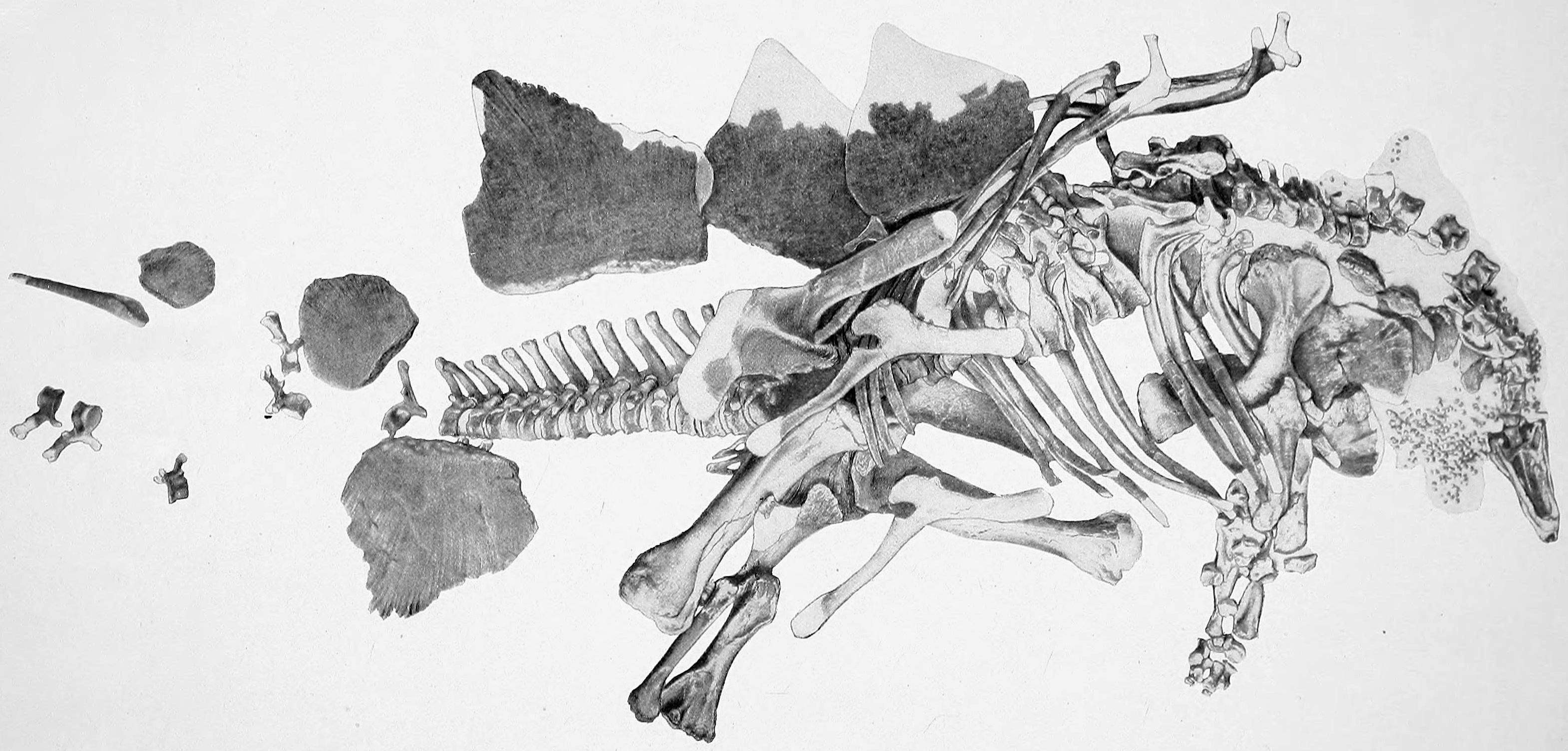
Stegosaurus stenops
Image: File:Stenops.jpg - Wikimedia Commons (CC BY-SA)
About Stegosaurus
Stegosaurus, a name synonymous with the age of dinosaurs, represents one of the most iconic and easily recognizable genera from the Late Jurassic period. This large, herbivorous quadruped roamed the terrestrial landscapes of what is now western North America approximately 155 to 150 million years ago, during the Kimmeridgian and early Tithonian stages. Its profound significance in both paleontology and popular culture stems from its bizarre and unique anatomy, particularly the double row of large plates along its back and the formidable spiked tail, which have captivated scientists and the public alike for over a century.
Stegosaurus was a heavily built dinosaur, characterized by a highly distinctive and unusual body plan. The most common species, *Stegosaurus stenops*, reached lengths of up to 9 meters (approximately 30 feet) and stood about 4 meters (13 feet) tall at the highest point of its arched back. Estimates of its body mass vary, but most paleontologists place a mature adult between 5,000 and 7,000 kilograms (5.5 to 7.7 short tons), comparable in weight to a large African elephant. Its posture was unique, with short, stout forelimbs and much longer, more powerful hindlimbs, creating a dramatically arched back that sloped steeply downwards towards a small, low-slung head. This configuration suggests a slow-moving, deliberate gait. The skull itself was remarkably small and narrow in proportion to its massive body, housing a brain cavity no larger than that of a medium-sized dog. This disparity historically led to misguided theories about its intelligence, including the now-discredited notion of a "second brain" in its hip region, which was actually an enlargement of the spinal cord known as the sacral ganglion. The most defining features, however, were its dermal armor. Running along its spine were seventeen to twenty-two large, kite-shaped bony plates, or osteoderms, which were not directly attached to the skeleton but embedded in the skin. At the end of its muscular tail was the thagomizer, a formidable weapon consisting of four dermal spikes, each capable of reaching lengths of 60 to 90 centimeters (2 to 3 feet).
The paleobiology of Stegosaurus reveals a specialized low-browsing herbivore adapted to the specific flora of its environment. Its low-slung head and weak, toothless beak (rhamphotheca) were well-suited for cropping vegetation close to the ground. Its small, peg-like cheek teeth were not designed for extensive chewing but rather for slicing or crushing soft plant matter. It is believed that Stegosaurus swallowed its food with minimal oral processing, possibly relying on gastroliths (stomach stones) to help break down tough plant material in a gizzard-like organ, a strategy common in many herbivorous dinosaurs and modern birds. Its diet likely consisted of ferns, cycads, horsetails, and possibly low-lying conifers that were abundant in the Morrison Formation ecosystem. Locomotion was entirely quadrupedal, and trackways suggest it moved slowly, with a maximum speed estimated at around 6-8 kilometers per hour (4-5 mph). The function of its famous dorsal plates has been a subject of intense scientific debate. Early theories suggesting they were for passive defense have been largely dismissed, as their thin structure and rich vascularization would have made them vulnerable to damage. More widely accepted hypotheses include thermoregulation, with the plates acting as radiators to dissipate heat, and species recognition or socio-sexual display, where their size and shape could signal fitness to mates or intimidate rivals and predators.
Stegosaurus inhabited the vast, semi-arid floodplains of the Morrison Formation, a geological unit that stretches across the western United States. During the Late Jurassic, this region was characterized by a seasonal climate with distinct wet and dry periods, supporting a landscape of river channels, gallery forests, and open fern savannas. Stegosaurus was a key component of a complex and diverse ecosystem, occupying the niche of a large, low-browsing herbivore. It shared this environment with a spectacular array of other dinosaurs. Fellow herbivores included the colossal sauropods such as *Diplodocus*, *Apatosaurus*, and *Brachiosaurus*, which browsed on high-level vegetation, and the bipedal ornithopod *Camptosaurus*, which likely competed for some of the same food sources. The primary predatory threat came from large theropods, most notably *Allosaurus*, a fearsome carnivore whose fossils are frequently found in the same deposits. Evidence of violent encounters between these two species exists in the fossil record, including an *Allosaurus* vertebra with a puncture wound that perfectly matches the dimensions of a Stegosaurus tail spike, and a Stegosaurus neck plate bearing a U-shaped bite mark consistent with an *Allosaurus* jaw. This predator-prey dynamic underscores the defensive function of the thagomizer as a critical survival tool.
The discovery of Stegosaurus is deeply intertwined with the "Bone Wars," a period of intense and competitive fossil hunting in the late 19th century between paleontologists Othniel Charles Marsh and Edward Drinker Cope. The first scientifically described remains were unearthed in 1877 by Marsh's collectors at Morrison, Colorado. Marsh initially misinterpreted the scattered plates, believing they lay flat on the animal's back like shingles, which led him to coin the name *Stegosaurus*, meaning "roofed lizard." He named the first species *Stegosaurus armatus*. Shortly thereafter, in 1887, remains of a more complete and better-preserved specimen were discovered by Marshall Felch at Garden Park, Colorado. This specimen, which included a nearly complete articulated skeleton and skull, became the basis for the most well-known species, *Stegosaurus stenops*, meaning "narrow-faced roofed lizard," also named by Marsh. This particular fossil, now housed at the Smithsonian's National Museum of Natural History, provided crucial information about the animal's true appearance, including the upright, alternating arrangement of its plates. Over the years, several other species were named, but many have since been reclassified or synonymized with *S. stenops*, which remains the most robustly supported species in the genus.
Within the grand evolutionary tree of life, Stegosaurus is a prominent member of the Thyreophora, a clade of armored, herbivorous dinosaurs that also includes the ankylosaurs. It belongs to the family Stegosauridae, which flourished during the Middle to Late Jurassic. Stegosaurids are characterized by their quadrupedal stance, small heads, and rows of dorsal plates or spikes. Stegosaurus represents one of the largest and most specialized members of this family, showcasing the peak of its evolutionary adaptations before the group's decline in the Early Cretaceous. While thyreophorans have no direct modern descendants, their lineage branched off early in ornithischian ("bird-hipped") dinosaur evolution. Their closest living relatives, like those of all dinosaurs, are modern birds, though the evolutionary distance is immense, spanning over 200 million years. The unique combination of dermal plates and a thagomizer is a hallmark of the stegosaurid lineage, an evolutionary experiment in defense and display that proved highly successful for millions of years but ultimately left no surviving heirs into the Cenozoic Era. Its anatomy provides a key case study in the evolution of complex osteoderms and the diverse strategies herbivorous dinosaurs developed to cope with predation pressure.
Despite its fame, Stegosaurus is not without its scientific controversies. The precise arrangement of the dorsal plates was a long-standing puzzle. Early reconstructions depicted them in a single row, as a paired double row, or lying flat. The discovery of articulated specimens, such as the "Sophie" specimen in Wyoming, has largely confirmed that they were arranged in two staggered, alternating rows down the animal's back. The function of these plates continues to be debated, with evidence supporting both thermoregulation (due to internal blood vessel channels) and display (their prominent, visually striking nature). Another area of contention involves the number of valid species within the genus *Stegosaurus*. While numerous species have been named over the past century, rigorous modern analysis by paleontologists like Susannah Maidment has suggested that many of these may represent individual variation or different growth stages of a single species, *S. stenops*. The debate highlights the challenges of dinosaur taxonomy, where incomplete fossil evidence often complicates the clear delineation of distinct species.
The fossil record of Stegosaurus is primarily concentrated in the Upper Morrison Formation of the western United States, with significant finds in Colorado, Wyoming, and Utah. Over 80 individual specimens have been discovered, ranging from isolated bones to several nearly complete and articulated skeletons. This relative abundance makes Stegosaurus one of the better-understood dinosaurs from this period. The quality of preservation is often excellent, providing detailed anatomical information. Famous fossil sites include the Cleveland-Lloyd Dinosaur Quarry in Utah, which has yielded numerous disarticulated Stegosaurus bones, and Como Bluff and the Red Canyon Ranch in Wyoming, where more complete skeletons have been unearthed. The most complete specimen ever found, nicknamed "Sophie," was discovered in 2003 at Red Canyon Ranch. It is approximately 85% complete, offering unprecedented insights into the anatomy and biomechanics of *Stegosaurus stenops*. This specimen, now displayed at the Natural History Museum in London, has been instrumental in refining our understanding of the animal's weight, posture, and feeding mechanics.
Beyond its scientific importance, Stegosaurus holds a powerful and enduring place in global culture. As one of the first dinosaurs to be widely recognized by the public, its distinctive silhouette has become a staple in popular media, from early films like "King Kong" (1933) to modern franchises like "Jurassic Park." It is a fixture in museum exhibits worldwide, with mounted skeletons serving as star attractions that inspire awe and curiosity in visitors of all ages. Its image adorns everything from children's toys and books to postage stamps, making it a key educational tool and a cultural ambassador for the science of paleontology. For many, Stegosaurus is one of the first dinosaurs they learn to identify, sparking a lifelong fascination with the prehistoric world and the scientific process of discovery.
Classification
Time Period
Discovery
Location
Colorado, USA
Formation
Morrison Formation
Frequently Asked Questions
What is Stegosaurus?
Stegosaurus, a name synonymous with the age of dinosaurs, represents one of the most iconic and easily recognizable genera from the Late Jurassic period. This large, herbivorous quadruped roamed the terrestrial landscapes of what is now western North America approximately 155 to 150 million years ag...
When did Stegosaurus live?
Stegosaurus lived during the jurassic period of the mesozoic era approximately 155-150 million years ago.
Where was Stegosaurus discovered?
Fossils of Stegosaurus were discovered in Colorado, USA in the Morrison Formation.
What did Stegosaurus eat?
Stegosaurus was a herbivore. It lived in terrestrial habitats.
What type of fossil is Stegosaurus?
Stegosaurus is preserved as a body fossil. The preservation quality is excellent.
Related Specimens
From the mesozoic era · body fossils