Allosaurus
Allosaurus fragilis
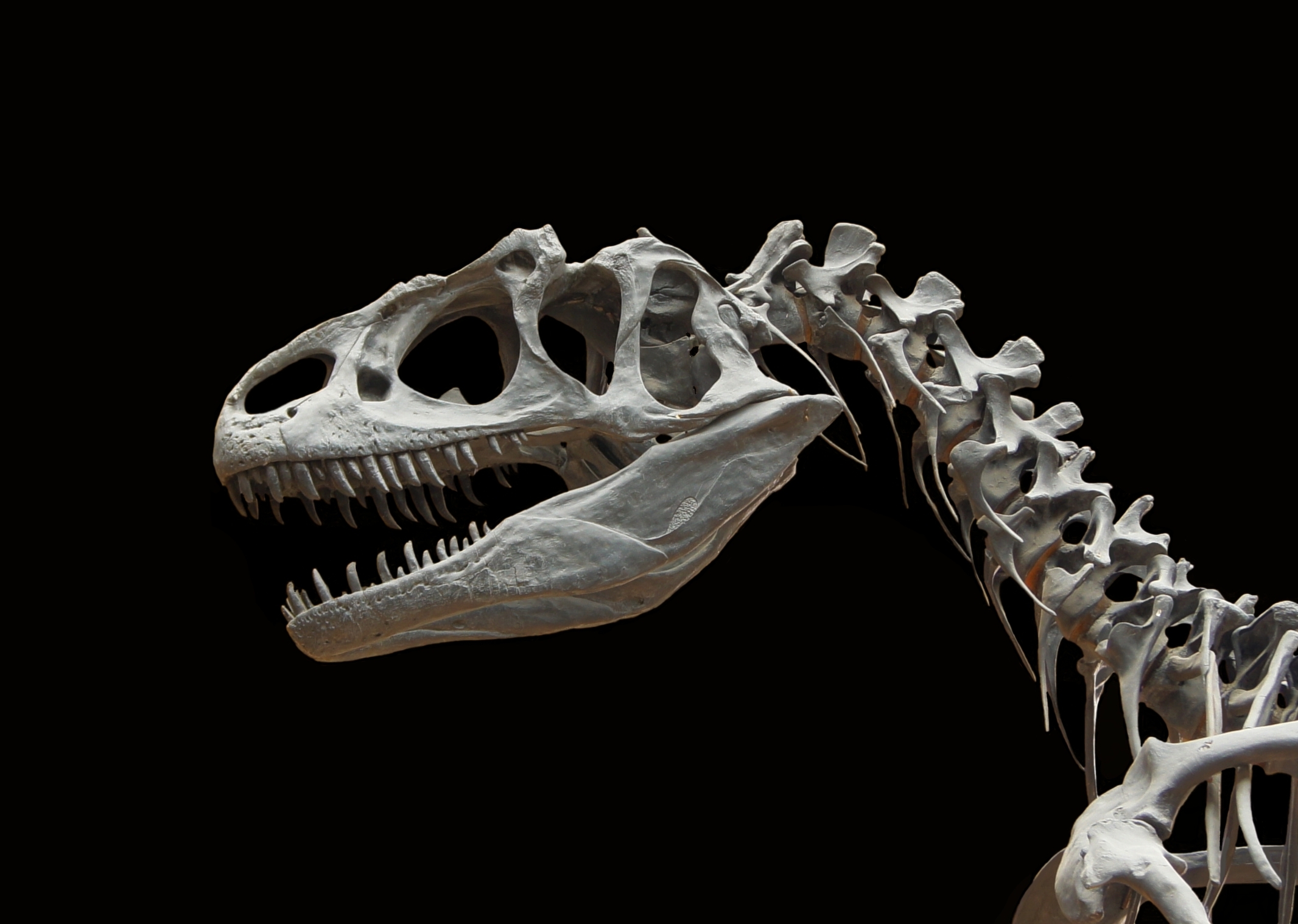
Image: File:Allosaurus fragilis moulage MNHN paleontologie 1.JPG - Wikimedia Commons (CC BY-SA)
About Allosaurus
Allosaurus fragilis was a large, bipedal theropod dinosaur that dominated the terrestrial ecosystems of North America during the Late Jurassic period, approximately 155 to 145 million years ago. As the apex predator of its time and place, this formidable carnivore played a crucial ecological role, shaping the communities of the famed Morrison Formation. Its abundance in the fossil record has made it one of the most thoroughly studied and best-understood large predatory dinosaurs, providing invaluable insights into the anatomy, behavior, and evolution of theropods.
The physical anatomy of Allosaurus presents a classic example of a large theropod predator, a bipedal carnivore built for power and agility. A typical adult Allosaurus fragilis measured around 8.5 meters (28 feet) in length, though some fragmentary remains suggest exceptional individuals may have approached 12 meters (39 feet), rivaling later giants like Tyrannosaurus. Body mass estimates for an average adult hover around 1.5 to 2.5 metric tons, comparable to a large modern rhinoceros or hippopotamus. Its most striking feature was its massive, yet lightly constructed skull, which could reach nearly a meter in length. This skull was fenestrated with large openings, reducing weight without significantly compromising structural strength. Above and in front of each eye was a pair of distinctive bony crests or horns, the size and shape of which likely varied between individuals and may have served as display structures for species recognition or attracting mates. Its jaws were lined with dozens of large, sharp, and recurved teeth that were serrated like steak knives, perfectly adapted for slicing flesh. These teeth were constantly shed and replaced throughout the animal's life. Its forelimbs, while small relative to its body size, were robust and powerful, ending in three large, sharply curved claws, which were formidable weapons for grasping and restraining prey. The hind limbs were long and muscular, supporting the animal's weight and enabling powerful locomotion, while a long, stiffened tail acted as a dynamic counterbalance for agility and stability during high-speed pursuit.
The paleobiology of Allosaurus reveals a highly successful and active predator. Its diet consisted primarily of the large herbivorous dinosaurs with which it shared its environment, including ornithopods like Camptosaurus and Dryosaurus, armored stegosaurs such as Stegosaurus, and even the colossal sauropods like Apatosaurus, Diplodocus, and Camarasaurus. Fossil evidence, including Allosaurus tooth marks found on the bones of these herbivores and even a Stegosaurus tail spike wound found in an Allosaurus vertebra, confirms these predator-prey interactions. Biomechanical studies of its skull suggest that while its bite force was considerable, it was not as powerful as that of Tyrannosaurus rex. Instead of a bone-crushing bite, Allosaurus may have employed a "slash-and-tear" feeding strategy, using its powerful neck muscles to drive its serrated teeth into prey like a saw, causing massive blood loss and shock. This method would have been particularly effective against the immense sauropods, allowing it to inflict grievous wounds without needing to overpower the entire animal at once. Locomotion studies indicate it was a capable runner, though likely not a sprinter over long distances. Social behavior remains a topic of debate; while the congregation of many individuals at sites like the Cleveland-Lloyd Dinosaur Quarry has led to speculation of pack hunting, it could also represent a predator trap where individuals were drawn to and became mired while scavenging already trapped animals. Growth studies based on bone histology show that Allosaurus reached sexual maturity at around 15 years of age and full adult size in its early twenties, a relatively rapid growth rate for such a large animal.
Allosaurus lived within the semi-arid, floodplain environment of the Morrison Formation, a vast expanse of western North America during the Late Jurassic. This ecosystem was characterized by a monsoonal climate with distinct wet and dry seasons, supporting a landscape of river channels, floodplains, and open woodlands dominated by conifers, cycads, and ferns. Allosaurus was the undisputed apex predator of this environment, occupying the top of the food web. It shared this habitat with a diverse and iconic dinosaur fauna. Its primary prey included the heavily armored Stegosaurus, the bipedal ornithopod Camptosaurus, and the juveniles of immense sauropods like Apatosaurus, Brachiosaurus, and Diplodocus. The presence of such enormous herbivores suggests a rich and productive ecosystem capable of supporting multiple large predator species. Indeed, Allosaurus was not alone; it coexisted with other large theropods, including the powerful Torvosaurus and the slightly smaller Ceratosaurus. Niche partitioning likely allowed these predators to coexist, with Allosaurus possibly specializing in different prey sizes or employing different hunting strategies compared to its contemporaries. This complex and dynamic food web, with Allosaurus at its pinnacle, represents one of the most well-documented and famous prehistoric ecosystems in Earth's history.
The discovery and scientific history of Allosaurus are deeply intertwined with the "Bone Wars" of the late 19th century, a period of intense and competitive fossil hunting between rival paleontologists Othniel Charles Marsh and Edward Drinker Cope. The first officially recognized remains were described by Marsh in 1877 based on fragmentary fossils from Garden Park, Colorado. He named the genus Allosaurus, meaning "different lizard," in reference to its vertebrae, which were lighter and different from those of other dinosaurs known at the time. Over the subsequent years, both Marsh and Cope named several other large theropods from the Morrison Formation, such as Creosaurus and Labrosaurus, which were later determined to be synonymous with Allosaurus, a result of the hasty and often incomplete descriptions characteristic of the era. One of the most significant early finds was a nearly complete skeleton discovered by M. P. Felch in 1883, which provided a much clearer picture of the animal's anatomy. However, the most important specimen for establishing the modern understanding of the genus is the holotype of Allosaurus fragilis, USNM 4734, a partial skeleton also collected from Garden Park. This specimen, along with the vast collections from sites discovered in the 20th century, cemented the identity and anatomy of this quintessential Jurassic predator.
In the grand scheme of dinosaur evolution, Allosaurus holds a critical position within the theropod family tree. It belongs to the clade Allosauroidea, a group of large carnivorous dinosaurs that were part of the larger group Tetanurae, or "stiff-tailed" theropods. The allosauroids were the dominant large predators for much of the Jurassic and early Cretaceous periods, preceding the rise of the tyrannosaurids in the Late Cretaceous. Allosaurus itself is the archetypal member of the family Allosauridae. It showcases many of the advanced features that characterize tetanuran theropods, including a complex, air-filled (pneumatic) skeleton that lightened the body, a stiffened tail for balance, and a three-fingered hand. These features represent a significant evolutionary step away from more primitive theropods. While not a direct ancestor, Allosaurus is a close relative of the lineage that would eventually give rise to the massive carcharodontosaurids, such as Giganotosaurus and Carcharodontosaurus, which became the apex predators of the Southern Hemisphere during the Cretaceous. Its evolutionary relationship to birds, the only living dinosaurs, is more distant. Allosaurus is on a separate branch of the theropod tree from the Coelurosauria, the group that includes tyrannosaurs, dromaeosaurs (raptors), and ultimately, birds. Nevertheless, studying Allosaurus provides a vital comparative framework for understanding the anatomical and behavioral innovations that occurred across the diverse spectrum of predatory dinosaurs.
Despite being one of the best-known dinosaurs, Allosaurus is still the subject of ongoing scientific debate. One of the most persistent controversies revolves around its taxonomy and the number of valid species. For decades, paleontologists have debated whether specimens assigned to other genera, such as Epanterias and Saurophaganax, represent distinct, larger types of allosaurids or are simply exceptionally large individuals of Allosaurus fragilis. The current consensus leans toward recognizing Saurophaganax as a separate, albeit closely related, genus, but the debate highlights the difficulty of defining species boundaries from fossil remains. Another area of intense discussion is its hunting behavior. The hypothesis of cooperative pack hunting, largely fueled by the mass death assemblage at the Cleveland-Lloyd Dinosaur Quarry, remains contentious. Many researchers argue that this site is better explained as a predator trap, where the struggles of a mired animal attracted successive carnivores who also became trapped, rather than evidence of coordinated social behavior. The function of its distinctive cranial crests is also debated, with proposed functions ranging from species recognition and sexual display to weapons for intraspecific combat or even shades for the eyes.
The fossil record of Allosaurus is exceptionally rich, making it one of the most completely understood non-avian theropods. Its remains are found almost exclusively in the Upper Jurassic Morrison Formation of the western United States, with fossils unearthed in states including Colorado, Utah, Wyoming, New Mexico, and Montana. A potential species has also been described from Portugal, suggesting a wider geographic range across the supercontinent of Laurasia. The sheer number of specimens is remarkable; the Cleveland-Lloyd Dinosaur Quarry in Utah alone has yielded the remains of at least 46, and perhaps as many as 70, individual Allosaurus, ranging from small juveniles to large adults. This site has provided an unparalleled sample for studying population structure, growth patterns, and paleopathology. Many Allosaurus skeletons show evidence of a tough life, with healed fractures, infections, and combat-related injuries, including puncture wounds from Stegosaurus tail spikes. The preservation quality of many specimens is excellent, including several nearly complete and articulated skeletons, such as the famous "Big Al" (MOR 693) and "Big Al II," which have allowed for detailed biomechanical and physiological studies.
Due to its fearsome appearance and status as a top predator, Allosaurus has secured a prominent place in public consciousness and popular culture. It is a staple exhibit in natural history museums around the world, with impressive mounted skeletons on display at institutions like the American Museum of Natural History in New York, the Smithsonian National Museum of Natural History in Washington, D.C., and the Museum of the Rockies in Montana. Its role as the quintessential Jurassic predator has been cemented through appearances in numerous books, films, and television documentaries, most notably in the BBC's landmark series "Walking with Dinosaurs" and its special "The Ballad of Big Al," which brought the life of a single Allosaurus to a global audience. As the state fossil of Utah, Allosaurus also holds regional significance and serves as a powerful educational tool, captivating the public imagination and inspiring new generations of paleontologists.
Classification
Time Period
Discovery
Location
Colorado, USA
Formation
Morrison Formation
Frequently Asked Questions
What is Allosaurus?
Allosaurus fragilis was a large, bipedal theropod dinosaur that dominated the terrestrial ecosystems of North America during the Late Jurassic period, approximately 155 to 145 million years ago. As the apex predator of its time and place, this formidable carnivore played a crucial ecological role, s...
When did Allosaurus live?
Allosaurus lived during the jurassic period of the mesozoic era approximately 155-145 million years ago.
Where was Allosaurus discovered?
Fossils of Allosaurus were discovered in Colorado, USA in the Morrison Formation.
What did Allosaurus eat?
Allosaurus was a carnivore. It lived in terrestrial habitats.
What type of fossil is Allosaurus?
Allosaurus is preserved as a permineralized fossil. The preservation quality is excellent.
Related Specimens
From the mesozoic era · permineralized fossils