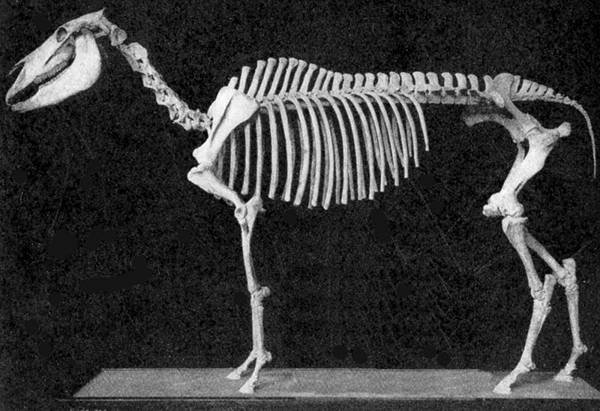
Equus scotti
Image: Image sourced via web search (Fair use / Educational)
About Equus scotti
Equus scotti, commonly known as Scott's horse, was a large and robust equid that roamed the vast grasslands and open woodlands of North America during the Pleistocene Epoch. This species represents a significant chapter in the long evolutionary history of horses, which paradoxically originated and diversified in North America before becoming extinct on the continent at the end of the last ice age. As a quintessential member of the Pleistocene megafauna, Equus scotti played a crucial role in its ecosystem and its well-preserved fossils have provided paleontologists with invaluable insights into the biology and environment of prehistoric North America.
Physically, Equus scotti was a powerfully built animal, larger and more robust than most modern domestic horses. Standing approximately 14 to 15 hands high (142-152 cm) at the withers, it was comparable in stature to a modern Quarter Horse or Morgan, but its skeletal structure indicates a much stockier and heavier build. Estimates suggest a body mass ranging from 400 to 600 kilograms (880 to 1,320 pounds). Its most distinguishing features were its stout, proportionally thick limb bones and broad hooves, adaptations that suggest it was well-suited for bearing significant weight and traversing varied terrain, from soft soils to harder ground. The skull was large and elongated, typical of the genus Equus, with a long diastema (the gap between the incisors and cheek teeth) and high-crowned (hypsodont) molars and premolars. These complex, ridged teeth were essential for grinding down the tough, abrasive grasses that formed the bulk of its diet. The overall impression would have been of a heavy, muscular horse, more akin to a modern draft-cross than a slender racehorse, built for endurance and power rather than sheer speed.
As a dedicated herbivore, the paleobiology of Equus scotti was centered around a grazing lifestyle. The hypsodonty of its teeth is a classic adaptation for a diet rich in silica-laden grasses, which are highly abrasive and would quickly wear down lower-crowned teeth. Isotopic analysis of its tooth enamel confirms a diet dominated by C4 grasses, which were prevalent in the open prairie and savanna-like environments it inhabited. This horse was a bulk feeder, consuming large quantities of vegetation to sustain its large body size. Its locomotion, inferred from its robust limb structure, was likely not geared for the extreme sprinting speeds of some modern equids. Instead, it was probably capable of sustained trotting and cantering, allowing it to cover vast distances in search of forage and water, a crucial ability in the seasonally variable Pleistocene climate. Inferred social behavior, based on modern equids, suggests that Equus scotti lived in herds. This social structure would have provided significant advantages, including collective defense against predators, improved foraging efficiency, and complex social interactions for mating and raising young. Fossil trackways and bonebeds containing multiple individuals support this interpretation of a gregarious, herd-living animal.
Equus scotti thrived in the dynamic and challenging world of Pleistocene North America. It inhabited a mosaic of environments, primarily open grasslands, savannas, and parklands that stretched across the continent, from Alaska to Mexico. The climate during this epoch was characterized by dramatic glacial-interglacial cycles, causing significant shifts in vegetation and sea levels. Scott's horse shared this landscape with an iconic assembly of megafauna. Its fellow herbivores included mammoths (Mammuthus columbi), mastodons (Mammut americanum), giant ground sloths (Megalonyx, Eremotherium), camels (Camelops), and several species of bison (Bison antiquus). This abundance of large herbivores supported a formidable array of predators. Equus scotti was a primary prey item for predators such as the saber-toothed cat (Smilodon fatalis), the American lion (Panthera atrox), dire wolves (Aenocyon dirus), and the giant short-faced bear (Arctodus simus). The constant threat of predation likely reinforced its herd behavior and honed its senses and endurance. As a large grazer, Equus scotti was a keystone species, influencing plant communities through its feeding habits and serving as a vital link in the food web, transferring energy from primary producers to apex predators.
The discovery and naming of Equus scotti are rooted in the early days of American vertebrate paleontology. The species was first described by the paleontologist James W. Gidley in 1900. Gidley based his description on fossil material, including a nearly complete skull and other skeletal elements, recovered from the Tule Canyon Formation in Briscoe County, Texas. This region, part of the Texas Panhandle, has proven to be a rich source of Pleistocene fossils. Gidley named the species in honor of the distinguished Princeton paleontologist William Berryman Scott, a leading figure in the field at the time. One of the most significant and well-known specimens of Equus scotti is a nearly complete skeleton discovered at the Rock Creek locality in Texas. This specimen, often referred to simply as the 'Rock Creek Horse', has been instrumental in understanding the anatomy and proportions of the species. Since its initial discovery, numerous fossils of Equus scotti have been unearthed across a wide geographic range, solidifying its status as one of the most common and widespread horses of the North American Pleistocene.
Equus scotti holds a pivotal position in the evolutionary history of the horse family, Equidae. Its story is part of the grander narrative of horse evolution, which primarily unfolded in North America over 55 million years, from the small, dog-sized Hyracotherium of the Eocene to the diverse members of the genus Equus in the Pleistocene. Equus scotti is considered a member of the 'stout-legged' or 'caballine' group of horses, which includes the modern domestic horse (Equus caballus) and the wild Przewalski's horse (Equus ferus przewalskii). Genetic studies on Pleistocene horse fossils, including those identified as E. scotti, have revealed a complex picture. DNA evidence suggests a close relationship between North American Pleistocene horses and modern domestic horses, indicating they belong to the same lineage. This finding implies that the ancestors of today's horses were thriving in North America before the lineage's extinction on the continent. The presence of Equus scotti and its relatives underscores that North America was the cradle of horse evolution, and the horses that were later domesticated in Eurasia were descendants of North American ancestors that had migrated across the Bering Land Bridge into Asia.
Despite being a well-known species, Equus scotti has been at the center of scientific debates, primarily concerning its taxonomy and its exact relationship to other Pleistocene equids. The Pleistocene fossil record of North American horses is abundant but morphologically complex, leading to the naming of numerous species over the years, such as Equus niobrarensis and Equus lambei. Many paleontologists now question whether these represent truly distinct biological species or simply regional, temporal, or even individual variations within a single, widespread, and variable species. Recent genetic research has compounded this debate. Ancient DNA analysis of various North American horse fossils has shown remarkably little genetic divergence among them, suggesting that many of the named species, including E. scotti, may represent a single, polytypic species that was genetically continuous with the wild horses of Eurasia. This has led to a push to synonymize many of these names under a broader species concept, though the debate over the paleontological and biological validity of these distinct morphospecies continues.
The fossil record of Equus scotti is extensive and geographically widespread. Its remains are found in Pleistocene deposits across the United States, from Washington and California in the west, through the Great Plains of Texas, Kansas, and Nebraska, and as far east as Florida. Fossils have also been recovered in Canada and Mexico. As one of the most common large mammals of its time, its fossils are relatively abundant in many localities. The most frequently found remains are isolated teeth and limb bones, which are durable and preserve well. However, more complete material, including skulls and partial to nearly complete skeletons, are known from several key sites, such as the Tule Canyon and Rock Creek sites in Texas, the La Brea Tar Pits in California, and various river gravel deposits throughout the Great Plains. The wealth of fossil material has allowed for detailed studies of its anatomy, diet, and population structure, making it one of the best-understood extinct horse species.
Equus scotti holds a notable place in public and educational contexts as a prime example of North America's lost megafauna. Skeletons and life-sized reconstructions of Scott's horse are featured in many natural history museums across the continent, including the American Museum of Natural History and the Field Museum. These displays serve to educate the public about the rich evolutionary history of horses in North America and the dramatic extinction event that wiped them out, alongside mammoths and saber-toothed cats, at the end of the Pleistocene. It stands as a powerful reminder that the horses seen today in North America are, in a sense, a reintroduction of a lineage that was once a fundamental part of the continent's native fauna.
Classification
Time Period
Discovery
Location
USA (Texas)
Formation
Tule Canyon Formation
Frequently Asked Questions
What is Equus scotti?
Equus scotti, commonly known as Scott's horse, was a large and robust equid that roamed the vast grasslands and open woodlands of North America during the Pleistocene Epoch. This species represents a significant chapter in the long evolutionary history of horses, which paradoxically originated and d...
When did Equus scotti live?
Equus scotti lived during the quaternary period of the cenozoic era approximately 2-0.01 million years ago.
Where was Equus scotti discovered?
Fossils of Equus scotti were discovered in USA (Texas) in the Tule Canyon Formation.
What did Equus scotti eat?
Equus scotti was a herbivore. It lived in terrestrial habitats.
What type of fossil is Equus scotti?
Equus scotti is preserved as a body fossil. The preservation quality is good.
Related Specimens
From the cenozoic era · body fossils

/09c845a0ecb7.png)