Woolly Mammoth
Mammuthus primigenius
Image: Category:Mammuthus primigenius fossils - Wikimedia Commons (CC BY-SA)
About Woolly Mammoth
The Woolly Mammoth, scientifically classified as Mammuthus primigenius, represents one of the most iconic and extensively studied prehistoric organisms of the Pleistocene epoch, serving as the quintessential emblem of the Ice Age. Emerging approximately 400,000 years ago and surviving in isolated pockets until roughly 4,000 years ago, this massive proboscidean dominated the frigid mammoth steppes of northern Eurasia and North America. Its profound significance to paleontology lies not only in its widespread geographic distribution and ecological importance as a keystone species but also in the unprecedented quality of its fossilized and frozen remains, which have provided scientists with an unparalleled window into Pleistocene biology, genetics, and the complex dynamics of extinction.
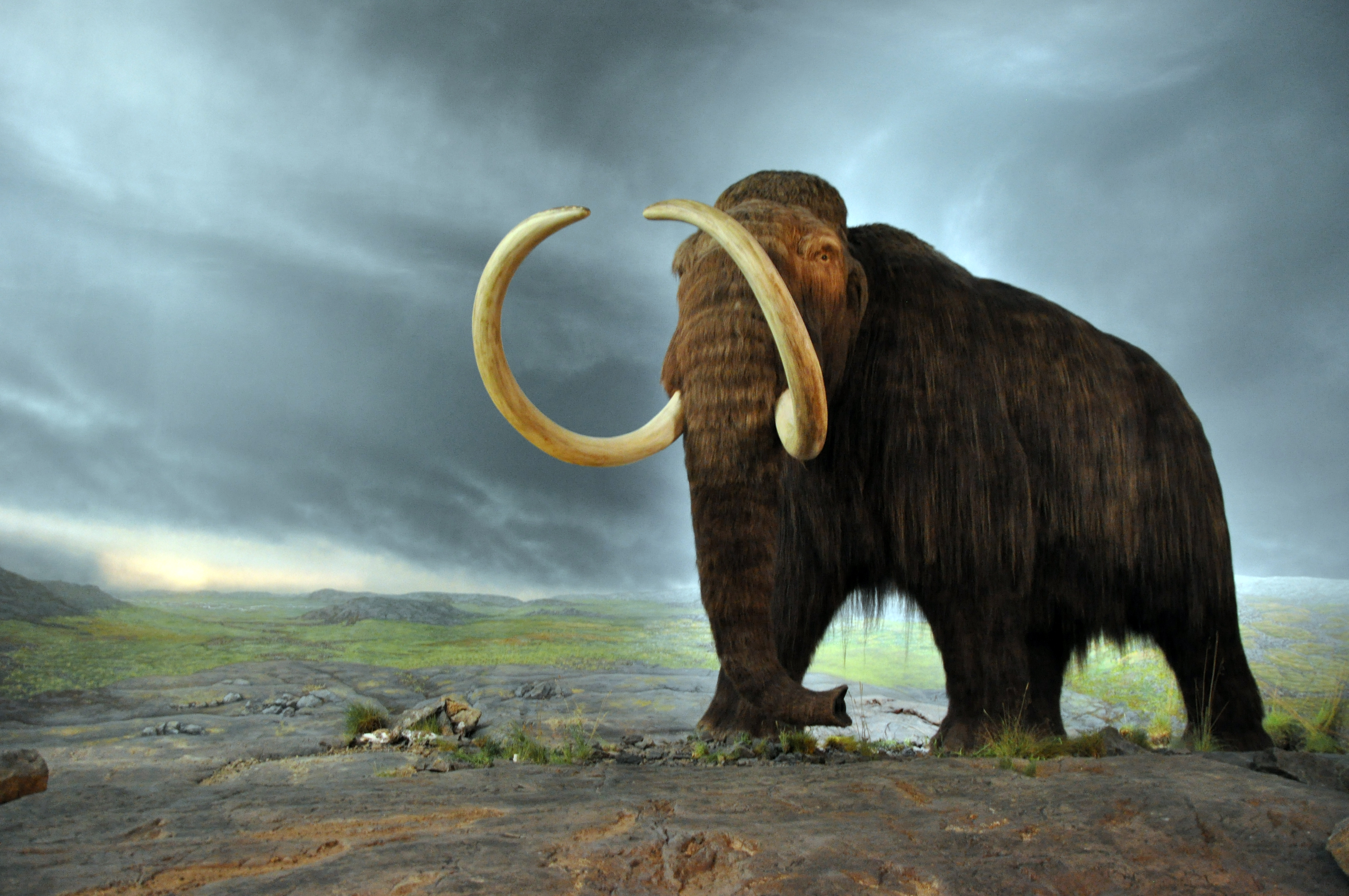
In terms of physical description, the woolly mammoth was a marvel of evolutionary adaptation, perfectly engineered to withstand the brutal extremes of the Pleistocene climate. Standing roughly 2.7 to 3.4 meters at the shoulder and reaching overall body lengths of up to 4.5 meters, adult males typically weighed between four and six metric tons, making them comparable in size to modern African elephants, though possessing a distinctly different silhouette. The mammoth's body was characterized by a high, single-domed skull, a pronounced hump of fat and muscle on its back, and a steeply sloping hindquarter. To insulate against sub-zero temperatures, the animal was enveloped in a highly specialized, dual-layered coat. The outer layer consisted of coarse, thick guard hairs that could reach up to 90 centimeters in length, while the inner layer was a dense, curly undercoat that trapped a layer of warm air close to the skin. Beneath the epidermis lay a formidable layer of subcutaneous fat, often measuring up to 10 centimeters thick, providing both critical insulation and a vital energy reserve during harsh winter months. To further minimize heat loss and the risk of frostbite, the woolly mammoth evolved remarkably small ears—measuring only about 30 centimeters in length, a fraction of the size of an African elephant's ears—and a highly abbreviated tail. Perhaps its most striking feature was its massive, highly curved tusks. These ivory structures, which grew continuously throughout the animal's life, could reach lengths of over 3 to 4 meters and weigh in excess of 90 kilograms each. The trunk, a highly sensitive and muscular appendage, ended in two distinct finger-like projections, an upper and a lower lobe, which allowed the mammoth to deftly manipulate small tufts of vegetation.
The paleobiology of the woolly mammoth reveals a highly specialized herbivore whose daily life was governed by the relentless demands of its frigid environment. To sustain its massive bulk, an adult mammoth required an estimated 180 to 200 kilograms of forage each day. Its diet consisted primarily of grasses and sedges, supplemented by herbaceous plants, mosses, shrubs, and occasional tree bark, depending on seasonal availability. The mammoth's feeding strategies were intricately linked to its anatomy. Its massive, curved tusks were likely employed as formidable snowplows, sweeping away deep winter drifts to expose the dormant vegetation beneath. Once the food was accessed, the trunk's prehensile tip plucked the plant matter, delivering it to a set of highly specialized molars. These massive teeth featured numerous parallel ridges of hard enamel, perfectly adapted for grinding abrasive, silica-rich grasses. As the teeth wore down, they were replaced in a continuous conveyor-belt fashion, a trait shared with modern elephants. Locomotion was steady and deliberate, with the animal walking on thick, padded feet that acted like snowshoes, distributing its immense weight across the soft, boggy tundra and deep snow. Behavioral inferences, drawn from both fossil trackways and comparisons with modern elephants, suggest that woolly mammoths were highly social creatures that lived in matriarchal herds composed of related females and their offspring, while adult males led largely solitary lives or formed loose bachelor groups. Growth patterns and life history are remarkably well-documented thanks to the continuous growth of their tusks. Much like tree rings, the cross-sections of mammoth tusks display daily, seasonal, and annual growth increments. Isotopic analysis of these rings has allowed paleontologists to reconstruct detailed biographies of individual mammoths, revealing periods of nutritional stress, seasonal migrations, the onset of sexual maturity, and, in males, the annual hormonal surges associated with musth. The average lifespan of a woolly mammoth is estimated to have been around 60 years.
The ecological context in which the woolly mammoth thrived was a unique and highly productive biome known as the mammoth steppe. During the Pleistocene, this vast ecosystem stretched continuously from western Europe, across northern Asia, and over the Bering land bridge into North America. The climate was characterized by extreme cold, high winds, and aridity, which prevented the formation of extensive forests and instead supported a seemingly endless expanse of nutrient-rich grasslands. The woolly mammoth was the undisputed keystone species of this environment. Through their sheer size and numbers, mammoths engineered their own habitat. Their relentless grazing prevented the encroachment of shrubs and trees, their heavy footfalls trampled the snow and compacted the soil, and their massive output of dung facilitated rapid nutrient cycling, all of which maintained the high productivity of the steppe grasses. In this dynamic ecosystem, the woolly mammoth shared the landscape with a spectacular array of Pleistocene megafauna. They co-existed alongside woolly rhinoceroses, steppe bison, wild horses, giant ground sloths, and formidable predators such as cave lions, dire wolves, short-faced bears, and saber-toothed cats. Furthermore, the woolly mammoth occupied a critical position in the food web, not only as a primary consumer of vegetation but also as a vital resource for apex predators and scavengers. Crucially, they also shared their environment with early hominins, including Neanderthals and anatomically modern humans, for whom the mammoth represented a walking supermarket, providing meat, fat, hides for clothing and shelter, and ivory and bone for tools and artistic expression.
The discovery history of the woolly mammoth is arguably the most fascinating of any prehistoric creature, largely due to the phenomenon of permafrost preservation. For centuries, the indigenous peoples of Siberia regularly encountered massive bones and enormous tusks emerging from the thawing riverbanks. Unfamiliar with elephants, many local legends attributed these remains to giant, subterranean mole-like creatures that died upon exposure to sunlight. The scientific community's understanding of the animal began to crystallize in the late 18th century. In 1799, the German scientist Johann Friedrich Blumenbach formally described the species, initially naming it Elephas primigenius, recognizing its affinity to modern elephants but noting its distinct, archaic features. The true breakthrough in mammoth paleontology occurred in 1806 when the Russian botanist Mikhail Adams recovered the first partially intact frozen mammoth carcass from the Lena River delta. The Adams mammoth provided the first definitive proof of the animal's thick, shaggy coat. This was followed by the famous Berezovka mammoth in 1901, an almost completely preserved adult male found in a seated position, which provided invaluable data on mammoth anatomy, stomach contents, and the mechanics of their preservation. In more recent decades, discoveries have accelerated due to climate change thawing the permafrost. In 2007, a Nenets reindeer herder named Yuri Khudi discovered Lyuba, a remarkably pristine one-month-old female mammoth calf on the Yamal Peninsula. Lyuba's internal organs, skin, and even the milk in her stomach were perfectly preserved, offering unprecedented insights into mammoth ontogeny and early life.
The evolutionary significance of the woolly mammoth is profound, offering a textbook example of evolutionary adaptation to extreme environmental pressures. The mammoth lineage belongs to the order Proboscidea and the family Elephantidae. The evolutionary story of mammoths began in Africa approximately 5 million years ago with early species such as Mammuthus subplanifrons. Over millions of years, as global climates cooled and the lineage migrated northward into Eurasia, they underwent a series of dramatic morphological changes. The direct ancestor of the woolly mammoth was the steppe mammoth, Mammuthus trogontherii, a colossal creature that roamed Eurasia during the Middle Pleistocene. Transitional fossils demonstrate a gradual reduction in overall body size, an increase in the complexity and ridge count of the molar teeth to process tougher grasses, and the development of cold-weather adaptations. Genetically, the woolly mammoth's closest living relative is the Asian elephant, Elephas maximus. Genomic studies have revealed that the two lineages diverged from a common ancestor roughly 6 million years ago, making the woolly mammoth more closely related to the Asian elephant than either is to the African elephant. The sequencing of the complete woolly mammoth genome, achieved by researchers such as Love Dalen and Hendrik Poinar, has identified specific genetic mutations responsible for their unique traits, including altered hemoglobin that functioned efficiently at freezing temperatures, genes regulating circadian rhythms in extreme seasonal daylight, and genes dictating fat storage and hair growth.
Despite the wealth of data, several scientific debates continue to surround the woolly mammoth. The most prominent and enduring controversy concerns the exact cause of their extinction. For decades, scientists have debated the relative impacts of climate change versus human hunting. The climate hypothesis argues that the rapid warming at the end of the last ice age, approximately 11,700 years ago, led to the collapse of the mammoth steppe, replacing the nutritious grasslands with boggy tundra and dense forests that could not sustain the megafauna. Conversely, the overkill hypothesis, famously championed by paleontologist Paul Martin, posits that the expansion of highly efficient human hunters across Eurasia and into the Americas drove the mammoths to extinction through unsustainable predation. Today, a consensus is emerging around a synergistic model, suggesting that climate-driven habitat fragmentation severely weakened mammoth populations, making the isolated remnants highly vulnerable to human hunting. Another major area of contemporary debate involves the ethics and feasibility of de-extinction. Spearheaded by geneticists like George Church, projects are currently underway utilizing CRISPR gene-editing technology to splice mammoth-specific cold-adaptation genes into the genome of the Asian elephant. Proponents argue that introducing a mammoth-elephant proxy could help restore the Arctic tundra ecosystem and combat permafrost thaw, while critics raise profound ethical concerns regarding animal welfare, the ecological unpredictability of introducing a synthetic organism, and the diversion of funding from the conservation of extant endangered species.
The fossil record of the woolly mammoth is exceptionally rich and geographically expansive. Millions of individual specimens, ranging from isolated teeth to complete skeletons and mummified carcasses, have been recovered across the northern hemisphere. The highest concentration of remains is found in the permafrost regions of Siberia, particularly in the Sakha Republic, as well as in the Yukon territory of Canada and the state of Alaska. The preservation quality in these regions is unparalleled in the fossil record, yielding intact soft tissues, blood, muscle, and viable DNA. Beyond the permafrost, mammoth bones are frequently dredged from the North Sea, a region known as Doggerland that was dry land during the glacial maximums. Famous fossil sites include the Hot Springs Mammoth Site in South Dakota, which preserves a sinkhole trap containing the remains of over 60 mammoths, primarily the related Columbian mammoth, but with evidence of woolly mammoths and potential hybrids. Crucially, the fossil record has revealed that the woolly mammoth did not go entirely extinct at the end of the Pleistocene. Isolated populations survived on remote islands as sea levels rose. On St. Paul Island in Alaska, mammoths persisted until about 5,600 years ago, eventually succumbing to a lack of fresh water. On Wrangel Island in the Russian Arctic, a dwarf population of woolly mammoths survived until approximately 4,000 years ago, outliving the construction of the Great Pyramid of Giza before finally succumbing to a combination of genetic inbreeding and environmental stress.
The cultural impact of the woolly mammoth is vast and enduring. For tens of thousands of years, they have captured the human imagination, beginning with our Paleolithic ancestors who meticulously documented their form in stunning cave paintings at sites like Rouffignac in France and Kapova Cave in Russia. Today, the woolly mammoth remains a staple of popular culture, featured prominently in literature, documentaries, and blockbuster animated films like the Ice Age franchise, which have cemented its status as a beloved icon of prehistory. In the realm of education and public engagement, mammoth skeletons and taxidermy reconstructions are star attractions in natural history museums worldwide, such as the Zoological Museum in St. Petersburg and the Royal BC Museum in Canada. Furthermore, the ongoing trade in legally collected mammoth ivory from Siberia continues to impact modern economies and conservation efforts, serving as a controversial substitute for elephant ivory. Ultimately, the woolly mammoth stands as a powerful symbol of a lost world, a testament to the incredible adaptability of life, and a stark reminder of the fragility of even the most dominant species in the face of rapid environmental change.
Classification
Time Period
Discovery
Location
Siberia, Russia
Frequently Asked Questions
What is Woolly Mammoth?
The Woolly Mammoth, scientifically classified as Mammuthus primigenius, represents one of the most iconic and extensively studied prehistoric organisms of the Pleistocene epoch, serving as the quintessential emblem of the Ice Age. Emerging approximately 400,000 years ago and surviving in isolated po...
When did Woolly Mammoth live?
Woolly Mammoth lived during the quaternary period of the cenozoic era approximately 0.4-0.004 million years ago.
Where was Woolly Mammoth discovered?
Fossils of Woolly Mammoth were discovered in Siberia, Russia.
What did Woolly Mammoth eat?
Woolly Mammoth was a herbivore. It lived in terrestrial habitats.
What type of fossil is Woolly Mammoth?
Woolly Mammoth is preserved as a body fossil. The preservation quality is exceptional.
Related Specimens
From the cenozoic era · body fossils