Epicyon
Epicyon haydeni
Image: Image sourced via web search (Fair use / Educational)
About Epicyon
Epicyon haydeni stands as a monumental figure in the annals of mammalian paleontology, representing the absolute zenith of canid size and power. Living during the Neogene period, specifically from the late Miocene to the early Pliocene epochs approximately 12 to 5 million years ago, this apex predator roamed the expanding grasslands and savanna-like environments of North America. As the largest known member of the Canidae family to have ever existed, Epicyon haydeni belonged to the extinct subfamily Borophaginae, a group colloquially and famously known as the bone-crushing dogs. This magnificent carnivore played a critical role in the ecosystems of the Miocene, acting as a top-tier predator and scavenger that shaped the evolutionary trajectories of numerous prey species. Its existence provides profound insights into the adaptive radiation of canids, demonstrating how the family evolved highly specialized, hyena-like ecological roles long before modern wolves and foxes established their current dominance. The significance of Epicyon haydeni extends beyond its mere size; it serves as a crucial biological marker for understanding the complex predator-prey dynamics of prehistoric North America, illustrating a time when the continent was home to a megafauna assemblage that rivaled the modern African savanna in both diversity and grandeur.
The physical description of Epicyon haydeni reveals an animal of terrifying proportions and specialized anatomical adaptations, far removed from the sleek, cursorial build of modern wolves. Estimates of its body mass suggest that large adult males could weigh anywhere from 100 to 170 kilograms (220 to 370 pounds), making it comparable in weight to a modern adult male African lion or a grizzly bear, and vastly outweighing the largest recorded modern gray wolves, which rarely exceed 80 kilograms. In terms of linear dimensions, Epicyon haydeni measured approximately 1.5 meters (about 5 feet) in body length, not including a thick, muscular tail, and stood nearly 90 centimeters (35 inches) tall at the shoulder. The most distinctive and awe-inspiring feature of Epicyon was undoubtedly its massive, heavily built skull. The cranium was broad and shortened compared to modern canines, featuring a highly elevated sagittal crest that provided an expansive surface area for the attachment of enormous temporalis muscles. These muscles, combined with a robust, heavily ossified lower jaw, granted Epicyon an exceptionally powerful bite force. The dentition was highly specialized for osteophagy, or bone-eating. The premolars were significantly enlarged, conical, and possessed thickened enamel, functioning much like the bone-cracking teeth of modern spotted hyenas. The carnassial teeth, while still capable of shearing meat, were also adapted to withstand the immense pressures of crushing thick limb bones of large ungulates. Postcranially, Epicyon haydeni was heavily muscled and robustly proportioned. Its limbs were somewhat shorter and thicker relative to its body size when compared to modern wolves, indicating that while it was a capable runner, it was not built for sustained, high-speed, long-distance pursuits. Instead, its skeletal architecture suggests an animal built for explosive power, capable of wrestling massive prey to the ground and defending carcasses against rival predators. The vertebrae and limb joints show adaptations for bearing heavy loads, and the paws were likely broad and powerful, equipped with non-retractable claws typical of canids but scaled up to match its massive bulk. Soft tissue inferences, drawn from the skeletal muscle attachment sites, paint a picture of a heavily necked, broad-chested beast with a formidable, intimidating presence.
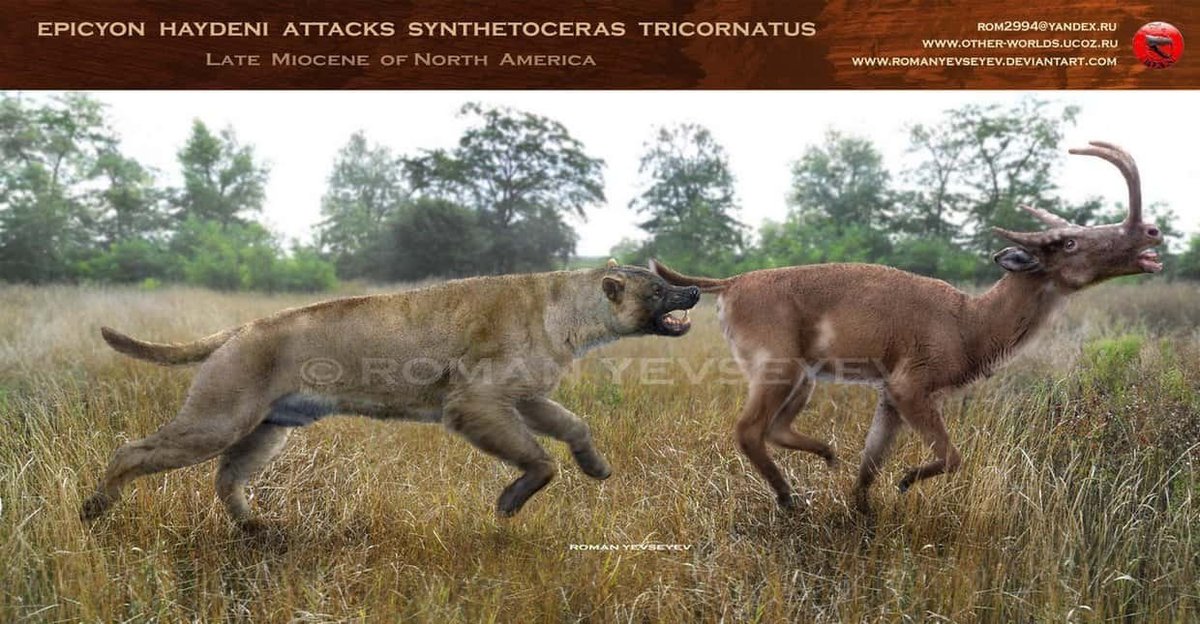
The paleobiology of Epicyon haydeni paints a fascinating picture of a highly specialized hypercarnivore that dominated its environment through sheer strength and specialized feeding strategies. Its diet consisted primarily of the abundant megafauna of the Miocene plains, including early horses, camels, rhinoceroses, and pronghorn antelopes. The robust nature of its skull and teeth strongly indicates that Epicyon was capable of consuming nearly the entire carcass of its prey, utilizing its bone-crushing capabilities to access nutrient-rich marrow that was unavailable to other predators. This dual role of active predator and highly efficient scavenger allowed Epicyon to maximize its caloric intake in a highly competitive environment. Hunting strategies likely involved a combination of ambush and short, powerful pursuits. Unlike modern wolves, which rely on endurance to exhaust their prey, Epicyon's heavier build suggests it relied on overwhelming force, perhaps hunting in packs to take down animals significantly larger than itself. The social behavior of Epicyon is a subject of intense study, with many paleontologists suggesting that, like modern social carnivores that tackle large prey, it likely lived and hunted in cooperative family groups or packs. This social structure would have been advantageous not only for hunting but also for defending kills from other formidable predators of the time, such as machairodont cats and giant bear-dogs. Growth patterns inferred from bone histology suggest that Epicyon, like many large mammals, experienced a rapid juvenile growth phase to quickly reach a size where it was less vulnerable to predation, followed by a prolonged period of muscle accumulation and skeletal robusticity development. Its metabolism was likely high, typical of active, warm-blooded carnivores, requiring a massive and consistent intake of meat and bone to sustain its enormous bulk and the energetic demands of its lifestyle.
The ecological context in which Epicyon haydeni thrived was one of dramatic environmental transformation and rich biological diversity. During the late Miocene and early Pliocene, North America was experiencing a significant climatic shift. The global climate was gradually cooling and drying, leading to the retreat of dense, closed-canopy forests and the vast expansion of open grasslands, savannas, and scrublands. This changing landscape triggered a massive evolutionary radiation of grazing herbivores, which in turn provided a bountiful prey base for large carnivores. Epicyon haydeni sat at the very apex of this complex food web. It shared its habitat with a spectacular array of co-existing species. The plains were herds of early, multi-toed horses like Hipparion, long-necked camels such as Aepycamelus, and barrel-bodied rhinoceroses like Teleoceras. Giant ground sloths, early gomphotheres (relatives of elephants), and various species of artiodactyls dotted the landscape. In this highly competitive predatory guild, Epicyon had to contend with other formidable carnivores. It shared the landscape with fearsome machairodontines (saber-toothed cats) like Amphimachairodus, which were specialized for taking down large prey with precision bites, and massive hemicyonids (bear-dogs) and early true bears like Agriotherium. The ecological niche of Epicyon was distinct; while the saber-toothed cats were likely the primary hunters of the largest megafauna, Epicyon's ability to crush bone meant it could utilize carcasses long after the cats had abandoned them, while also being fully capable of hunting large prey itself. This niche partitioning allowed these massive predators to coexist. The predator-prey relationships of the time were an evolutionary arms race; as herbivores evolved longer legs and faster running speeds to navigate the open plains, predators like Epicyon evolved greater size, pack-hunting behaviors, and specialized feeding mechanisms to ensure their survival in a harsh, unforgiving world.
The discovery history of Epicyon haydeni is deeply intertwined with the early days of American paleontology and the exploration of the American West. The species was first described by the eminent paleontologist Joseph Leidy in 1858, during a period of intense fossil hunting and scientific discovery in North America. Leidy originally assigned the fragmentary remains to the genus Canis, naming it Canis haydeni in honor of Ferdinand Vandeveer Hayden, a pioneering geologist who conducted extensive surveys of the western territories and collected the type specimen. The initial fossils were discovered in the Niobrara River region of Nebraska, an area that would later become famous for its incredibly rich Miocene fossil deposits. For many decades, the taxonomy of the bone-crushing dogs was a tangled web of confusing names and misclassifications, as fragmentary jaws and teeth were assigned to various genera such as Aelurodon and Osteoborus. It was not until the late 20th century, particularly through the exhaustive and meticulous work of paleontologists Richard Tedford, Xiaoming Wang, and Beryl Taylor, that the genus Epicyon was properly redefined and its evolutionary relationships clarified. Their comprehensive reviews of borophagine canids, published in the late 1990s, firmly established Epicyon haydeni as a distinct and valid taxon, separating it from its close relatives based on specific cranial and dental synapomorphies. Key specimens that have significantly advanced our understanding of Epicyon include beautifully preserved, nearly complete skulls recovered from the Ogallala Formation in Kansas and Texas, as well as associated postcranial material that finally allowed scientists to accurately estimate the animal's massive bodily proportions. These discoveries transformed Epicyon from a fragmentary curiosity into one of the most well-understood and iconic predators of the North American Miocene.
The evolutionary significance of Epicyon haydeni cannot be overstated, as it represents the absolute pinnacle of the borophagine radiation and a spectacular example of convergent evolution. The Borophaginae, one of the three major subfamilies of Canidae (alongside the extinct Hesperocyoninae and the extant Caninae), originated in North America and underwent a massive diversification during the Oligocene and Miocene epochs. Epicyon haydeni sits at the very top of this evolutionary tree, representing the extreme end of a lineage that progressively adapted toward hypercarnivory and osteophagy. Its evolutionary trajectory tells a compelling story of how canids adapted to fill the ecological niche of bone-crushing scavengers and apex predators—a role filled in the Old World by the entirely unrelated hyaenids (hyenas). This is a classic textbook example of convergent evolution, where unrelated organisms develop strikingly similar physical traits and ecological behaviors in response to similar environmental pressures. The robust skulls, vaulted foreheads, and massive, conical premolars of Epicyon are functionally identical to those of modern spotted hyenas, despite the two groups being separated by tens of millions of years of independent evolution. Furthermore, the eventual extinction of Epicyon and the entire borophagine lineage provides crucial insights into the vulnerability of highly specialized apex predators. As the climate continued to cool and dry moving into the Pliocene and Pleistocene, the megafaunal prey base shifted. Simultaneously, Epicyon faced increasing competition from the newly arriving, highly adaptable members of the Caninae subfamily (the ancestors of modern wolves and coyotes), which were faster, more cursorial, and required less food to survive. The extinction of Epicyon haydeni marks the end of an era, demonstrating how even the most powerful and dominant organisms can be driven to extinction by a combination of climate change and the emergence of more efficient, adaptable competitors.
Scientific debates surrounding Epicyon haydeni continue to stimulate research and discussion within the paleontological community. One of the primary ongoing controversies revolves around its specific hunting behavior and social structure. While its bone-crushing anatomy clearly indicates a capacity for scavenging, the extent to which Epicyon was an active predator versus an opportunistic scavenger remains a topic of lively debate. Some researchers argue that its massive size and relatively shorter limbs made it too slow to actively hunt the increasingly fleet-footed herbivores of the Miocene plains, suggesting it relied heavily on bullying other predators away from their kills. Conversely, others point to its massive musculature and potential pack-hunting behavior as evidence that it was a highly capable active predator, much like modern lions or spotted hyenas, which are both formidable hunters and efficient scavengers. Additionally, there are ongoing discussions regarding the exact biomechanics of its bite force. Advanced finite element analysis (FEA) and 3D modeling of Epicyon skulls are currently being used to simulate the stresses and strains on the cranium during biting, with researchers debating the precise limits of its bone-crushing capabilities compared to modern hyenas and other extinct predators. These debates highlight the dynamic nature of paleontology, where new technologies and methodologies continuously refine and sometimes challenge our understanding of prehistoric life.
The fossil record of Epicyon haydeni is relatively robust, particularly for a large apex predator, which are typically rare in fossil ecosystems due to their position at the top of the food chain. Fossils of Epicyon are found exclusively in North America, with a geographic distribution that spans the western and central United States, including significant discoveries in Nebraska, Kansas, Texas, Colorado, and California, as well as parts of northern Mexico. The preservation quality of these fossils ranges from fair to excellent, depending on the specific geological formation. The most commonly preserved elements are the robust jaws, isolated teeth, and massive skulls, which are highly resistant to taphonomic destruction due to their dense, heavily ossified nature. Postcranial elements, such as limb bones and vertebrae, are less common but have been found in sufficient quantities to allow for accurate skeletal reconstructions. Famous fossil sites that have yielded important Epicyon material include the various quarries within the Ogallala Group, the Ash Hollow Formation, and the Hemphill beds of Texas. These sites represent ancient river channels, floodplains, and waterholes where the remains of Epicyon and its prey were rapidly buried by sediments, preserving them for millions of years.
The cultural impact of Epicyon haydeni, while perhaps not as globally ubiquitous as that of Tyrannosaurus rex or the Woolly Mammoth, is nonetheless significant, particularly among paleontology enthusiasts and within the context of natural history education. The evocative moniker "bone-crushing dog" immediately captures the public imagination, conjuring images of a terrifying, mythical beast roaming the ancient American plains. Epicyon frequently appears in popular science books, documentaries about prehistoric predators, and paleoart, where it is often depicted in dramatic confrontations with massive Miocene herbivores or defending carcasses from saber-toothed cats. Museums across the United States, notably the American Museum of Natural History in New York and the Florida Museum of Natural History, feature impressive skeletal mounts and life restorations of Epicyon, serving as powerful educational tools to teach the public about mammalian evolution, convergent evolution, and the dramatic climatic shifts that have shaped the history of life on Earth. The fascination with Epicyon lies in its familiar yet alien nature—it is a dog, an animal we intimately know and love, but scaled up to monstrous proportions and equipped with the terrifying capabilities of a hyena, making it a perfect ambassador for the wonders of the prehistoric world.
Classification
Time Period
Discovery
Location
United States
Formation
Ogallala Formation
Frequently Asked Questions
What is Epicyon?
Epicyon haydeni stands as a monumental figure in the annals of mammalian paleontology, representing the absolute zenith of canid size and power. Living during the Neogene period, specifically from the late Miocene to the early Pliocene epochs approximately 12 to 5 million years ago, this apex predat...
When did Epicyon live?
Epicyon lived during the neogene period of the cenozoic era approximately 12-5 million years ago.
Where was Epicyon discovered?
Fossils of Epicyon were discovered in United States in the Ogallala Formation.
What did Epicyon eat?
Epicyon was a carnivore. It lived in terrestrial habitats.
What type of fossil is Epicyon?
Epicyon is preserved as a body fossil. The preservation quality is good.
Related Specimens
From the cenozoic era · body fossils