Xiphactinus
Xiphactinus audax
Image: Image sourced via web search (Fair use / Educational)
About Xiphactinus
Xiphactinus audax was a colossal predatory fish that patrolled the epicontinental seas of the Late Cretaceous period, approximately 100 to 66 million years ago. As one of the largest bony fishes of its time, its remains provide a dramatic window into the ferocious marine ecosystems that existed during the final age of the dinosaurs. Its fossils, particularly those from the Western Interior Seaway of North America, are renowned for their spectacular preservation, often capturing the creature's final, fatal moments.
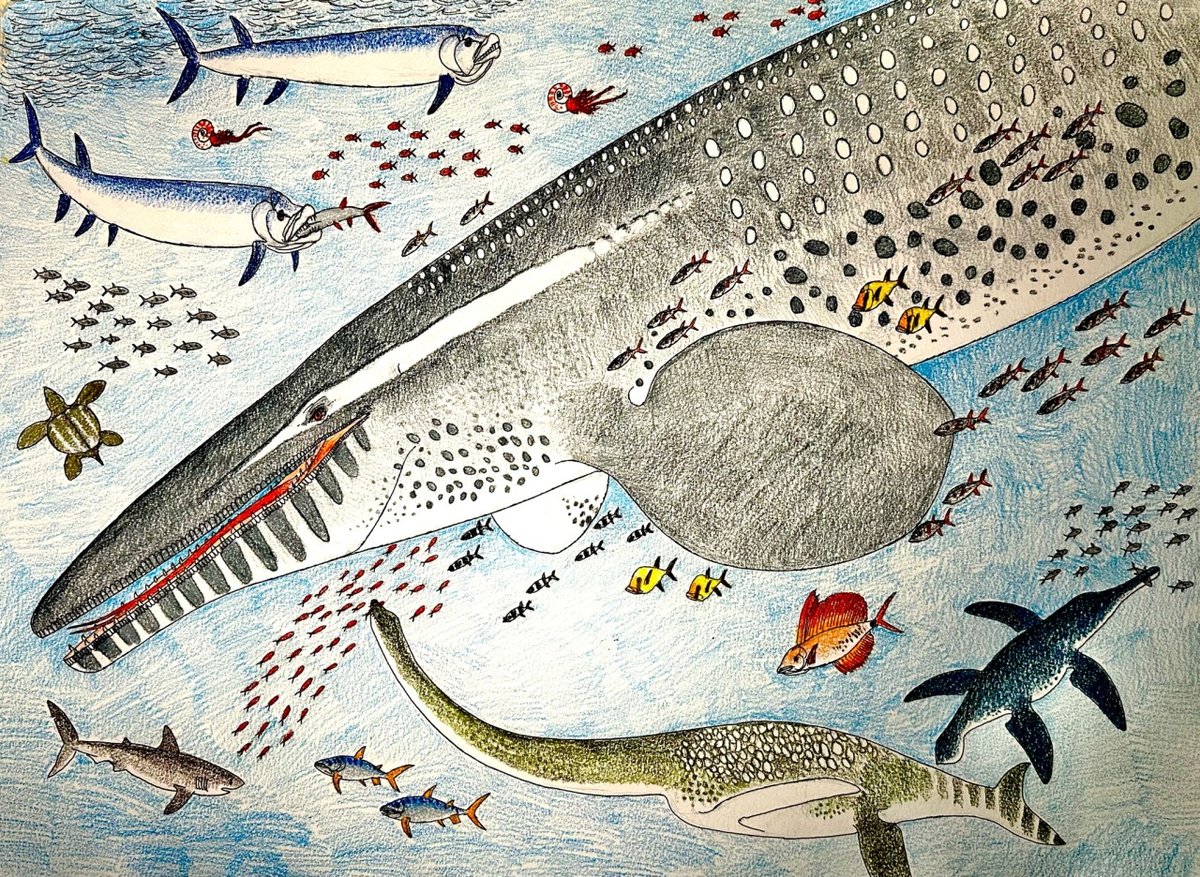
Xiphactinus was a truly formidable animal, reaching lengths of 4.5 to 6 meters (15 to 20 feet) and estimated to weigh up to 500 kilograms (1,100 pounds). Its body was streamlined and torpedo-shaped, built for powerful bursts of speed, much like a modern-day tarpon or barracuda, but on a vastly larger scale. The most striking feature was its head, which sported a deep, bulldog-like lower jaw that protruded slightly beyond the upper jaw, earning it the nickname "Bulldog Fish." This jaw was armed with an array of long, sharp, fang-like teeth, some reaching several centimeters in length, which were not designed for chewing but for impaling and securing struggling prey. Its skeleton was well-ossified for a fish of its kind, contributing to its excellent fossil record. The vertebral column was robust, supporting a powerful musculature that would have propelled its large, forked caudal (tail) fin through the water with immense force. Its pectoral fins were long and scythe-like, likely used for steering and stability during high-speed pursuits. Unlike sharks, Xiphactinus was a teleost, or ray-finned bony fish, and its anatomy reflects an advanced and highly successful predatory design within this group.
The paleobiology of Xiphactinus is vividly illustrated by its remarkable fossils. It was an apex predator, an ambush hunter that used its incredible speed to surprise and overwhelm its prey. Its diet consisted of other large fish, cephalopods, and even marine reptiles and diving seabirds. The most famous evidence for its feeding habits comes from the iconic "fish-within-a-fish" fossil housed at the Sternberg Museum of Natural History in Kansas. This 4-meter-long Xiphactinus specimen contains the perfectly preserved, undigested remains of a 1.8-meter-long Gillicus arcuatus, another large Cretaceous fish. The position of the Gillicus, swallowed head-first, suggests a rapid, powerful strike. However, this particular meal proved fatal; it is hypothesized that the struggling prey ruptured an internal organ of the Xiphactinus, or perhaps the sheer size of the meal led to its demise, preserving this predator-prey interaction for eternity. Such fossils indicate a voracious, opportunistic feeding strategy, where Xiphactinus would tackle prey up to a third of its own body length. Its powerful build suggests it was not a long-distance cruiser but rather a lunge predator, capable of explosive acceleration to catch fast-swimming prey in the open waters of the seaway.
Xiphactinus lived during the Late Cretaceous, a time when global temperatures were high and sea levels were at a peak, flooding continental interiors. Its primary habitat was the Western Interior Seaway, a vast, warm, shallow sea that split North America in two, stretching from the Arctic Ocean to the Gulf of Mexico. This marine environment was teeming with life, creating a complex and dangerous food web. Xiphactinus shared these waters with a host of formidable creatures. It would have competed with and been preyed upon by large marine reptiles like mosasaurs (Tylosaurus, Platecarpus) and plesiosaurs (Elasmosaurus), as well as large sharks such as Cretoxyrhina mantelli, the "Ginsu Shark." Its own prey included a wide variety of fish like Enchodus, Pachyrhizodus, and the aforementioned Gillicus. The skies above were patrolled by pterosaurs like Pteranodon and toothed seabirds such as Hesperornis, which may have occasionally fallen victim to a lunging Xiphactinus from below. As a top-tier predator, Xiphactinus played a crucial role in maintaining the ecological balance of this Cretaceous sea, controlling populations of smaller fish and serving as a food source for the even larger marine reptiles and sharks that occupied the absolute apex of the food chain.
The discovery history of Xiphactinus is rooted in the fossil-rich chalk beds of western Kansas. The species was first formally described by the renowned American paleontologist Joseph Leidy in 1870, based on a fragment of a pectoral fin spine he named Xiphactinus audax, meaning "audacious sword-ray." Leidy, working from limited material, could not have grasped the full scale of the animal. The true nature of Xiphactinus was revealed through the tireless efforts of fossil collectors like Charles H. Sternberg and his sons, who excavated numerous spectacular specimens from the Niobrara Formation in the late 19th and early 20th centuries. The most famous of these is the aforementioned "fish-within-a-fish" specimen (FHSM VP-333), discovered by George F. Sternberg in 1952 in Gove County, Kansas. This single fossil provides more insight into the animal's behavior than dozens of isolated bones ever could. Another significant specimen, found in the Pembina Gorge of Manitoba, Canada, in the 1970s, represents one of the largest Xiphactinus ever found, nicknamed "Bruce," and is displayed at the Canadian Fossil Discovery Centre.
Xiphactinus belongs to the order Ichthyodectiformes, an extinct group of advanced teleost fishes that flourished during the Jurassic and Cretaceous periods. This order is considered to be a sister group to all modern teleosts (Teleosteomorpha), placing them very close to the main trunk of the ray-finned fish evolutionary tree. While they left no direct modern descendants, their anatomy showcases a successful evolutionary experiment in large-scale pelagic predation among bony fishes, a niche now occupied by animals like tuna, marlin, and swordfish. The ichthyodectiforms, including relatives like Ichthyodectes and Gillicus, represent a crucial stage in the evolution of teleosts, demonstrating the early radiation of this group into diverse and dominant marine roles. Studying Xiphactinus helps paleontologists understand the ecological dynamics and evolutionary pressures that shaped the diversification of bony fishes, which today represent over 95% of all living fish species. Its existence highlights a time when bony fishes, not just sharks or marine reptiles, could evolve to become massive apex predators.
While the classification of Xiphactinus audax is stable, scientific discussions continue regarding its paleobiology and the broader ichthyodectiform group. Some debate centers on the exact mechanics of its feeding. The structure of its jaw and teeth suggests it was incapable of processing or shearing its food, meaning it had to swallow prey whole, a risky strategy as evidenced by the Sternberg fossil. There is also ongoing research into its growth rate and lifespan, conducted by examining the growth rings in its skeletal elements, which can provide clues about its metabolism and life history. Furthermore, the global distribution of the genus, with fossils found not only in North America but also in Europe, Australia, and potentially South America, raises questions about its dispersal patterns and the connectivity of the world's oceans during the Late Cretaceous. Each new find adds a piece to the puzzle of how this giant fish thrived across the globe for millions of years before its extinction.
The fossil record of Xiphactinus is impressively robust, particularly within the sedimentary layers of the Western Interior Seaway. The Niobrara and Smoky Hill Chalk formations of Kansas are world-famous for yielding dozens of articulated, three-dimensionally preserved skeletons. The anoxic conditions at the bottom of the seaway led to minimal scavenging and slow decomposition, resulting in exceptional preservation. Fossils are also found in the Mooreville Chalk of Alabama, the Pierre Shale of the Great Plains, and the Boyne Member of the Vermillion River Formation in Manitoba, Canada. While complete skeletons are uncommon, they are not exceedingly rare, and disarticulated elements like vertebrae, jaws, and fin spines are found with some regularity. This abundance of high-quality material has allowed for detailed anatomical studies and confident reconstructions of this ancient predator, making it one of the best-understood large fishes of the Mesozoic Era.
With its fearsome appearance and dramatic fossils, Xiphactinus has made a significant cultural impact. Its imposing skeletons are centerpiece displays in many major natural history museums, including the Sternberg Museum of Natural History in Hays, Kansas; the American Museum of Natural History in New York; and the Canadian Fossil Discovery Centre in Morden, Manitoba. The "fish-within-a-fish" fossil is an iconic image in paleontology, frequently featured in books, documentaries, and educational materials to illustrate predator-prey dynamics and the concept of fossilization. Xiphactinus has been featured in television series like the BBC's "Sea Monsters" and is a popular subject for paleoart, often depicted in violent confrontations with mosasaurs or sharks, capturing the public's imagination as a true sea monster from the age of dinosaurs.
Classification
Time Period
Discovery
Location
Kansas, USA
Formation
Niobrara Formation
Frequently Asked Questions
What is Xiphactinus?
Xiphactinus audax was a colossal predatory fish that patrolled the epicontinental seas of the Late Cretaceous period, approximately 100 to 66 million years ago. As one of the largest bony fishes of its time, its remains provide a dramatic window into the ferocious marine ecosystems that existed duri...
When did Xiphactinus live?
Xiphactinus lived during the cretaceous period of the mesozoic era approximately 100-66 million years ago.
Where was Xiphactinus discovered?
Fossils of Xiphactinus were discovered in Kansas, USA in the Niobrara Formation.
What did Xiphactinus eat?
Xiphactinus was a carnivore. It lived in marine habitats.
What type of fossil is Xiphactinus?
Xiphactinus is preserved as a body fossil. The preservation quality is excellent.
Related Specimens
From the mesozoic era · body fossils