Nectocaris
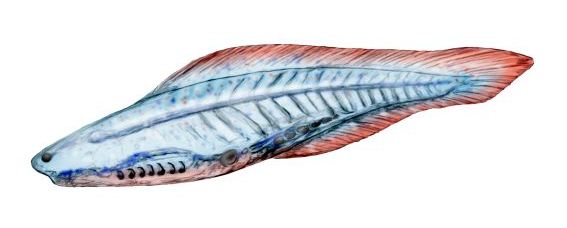
Nectocaris pteryx
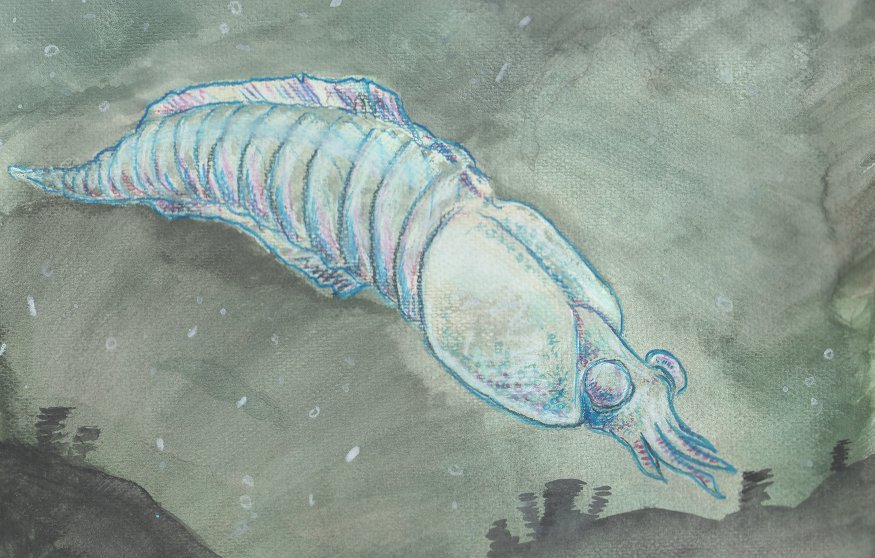
Image: Image sourced via web search (Fair use / Educational)
About Nectocaris
Nectocaris pteryx is a small, enigmatic marine organism that lived during the middle Cambrian Period, approximately 508 million years ago. Its fossils, primarily found in the renowned Burgess Shale of British Columbia, Canada, have sparked decades of scientific debate regarding its evolutionary relationships, making it a key puzzle piece in understanding the explosive diversification of animal life known as the Cambrian Explosion. Initially interpreted as a chordate or an arthropod, a comprehensive re-evaluation in 2010 controversially placed it as a very early, stem-group cephalopod, pushing back the known origin of this major mollusc group by at least 30 million years and radically altering our view of their early morphology.
Nectocaris was a small, kite-shaped animal, typically measuring between 2 and 7 centimeters in length. Its body was flattened dorsoventrally, resembling a somewhat streamlined, leaf-like form. The most striking features were located at its anterior end. It possessed two prominent, stalked camera-type eyes, similar in structure to those of modern cephalopods, which would have provided excellent vision for navigating its environment and detecting prey or predators. Below the eyes was a flexible, nozzle-like funnel, or siphon, which is a key characteristic used to link it with cephalopods. This siphon was likely used for jet propulsion, expelling water to move rapidly through the water column. The head region also bore a pair of long, prehensile tentacles, which were probably used for grasping prey. The main body, or trunk, was flanked by a pair of large, undulating lateral fins that ran along most of its length, providing stability and maneuverability during swimming. Internally, a series of vertically arranged bars, interpreted as gills or gill-like structures, were housed within a cavity analogous to the mantle cavity of modern molluscs. Unlike later cephalopods, Nectocaris completely lacked any sign of a shell, either internal or external, which contributed to the long-standing difficulty in its classification. Its overall body plan was a unique mosaic of features, combining a cephalopod-like head with a body more reminiscent of a flattened fish or a crustacean.
Based on its anatomy, the paleobiology of Nectocaris is inferred to be that of an active, nektonic (free-swimming) predator or scavenger. Its large, forward-facing camera eyes suggest it was a visual hunter, actively seeking out small prey in the water column. The pair of tentacles would have been effective tools for capturing and manipulating food items, possibly small arthropods, worms, or other soft-bodied creatures abundant in the Cambrian seas. Locomotion was likely bimodal. The large lateral fins would have allowed for graceful, undulatory swimming at slower speeds, ideal for searching for prey or maneuvering with precision. For rapid bursts of speed, either to ambush prey or escape from larger predators like Anomalocaris, Nectocaris would have employed jet propulsion by forcefully expelling water through its siphon, a method of movement that is the hallmark of modern squids and octopuses. This dual-mode propulsion system would have made it a highly agile and effective swimmer. There is no fossil evidence to suggest social behavior, so it is presumed to have been a solitary animal. Its streamlined body and active lifestyle imply a relatively high metabolism compared to more sedentary Cambrian fauna, fitting the profile of a mid-level predator within its ecosystem.
Nectocaris inhabited the warm, shallow marine environment represented by the Burgess Shale deposits. During the middle Cambrian, this region was located near the equator off the coast of the supercontinent Laurentia. It lived on or near a submarine escarpment, a steep underwater cliff adjacent to a deeper basin. The ecosystem was incredibly diverse, teeming with a bizarre array of newly evolved animal forms. Nectocaris shared its habitat with a host of other famous Cambrian creatures, including the formidable apex predator Anomalocaris, trilobites like Olenoides, the stalked filter-feeder Marrella, and the enigmatic Hallucigenia. In this complex food web, Nectocaris likely occupied a mid-tier predatory niche. It would have preyed upon smaller, soft-bodied animals and possibly juvenile arthropods, while in turn being a potential food source for larger predators, most notably Anomalocaris. The exceptional preservation of the Burgess Shale fauna provides a detailed snapshot of this ancient community, revealing a sophisticated ecological structure where organisms like Nectocaris played a crucial role as mobile, visually-oriented carnivores, a significant evolutionary step up from the simpler ecosystems that preceded the Cambrian Explosion.
The discovery history of Nectocaris is long and complex, reflecting the difficulty in interpreting its unusual anatomy. The first and, for a long time, only known specimen (ROM 44622) was collected from the Burgess Shale by Charles Doolittle Walcott in 1911. Walcott's initial field notes and unpublished plates show he was uncertain about its classification, variously labeling it as a crustacean or a member of the enigmatic 'Tuzoia' group. The fossil was poorly preserved and difficult to interpret, and it remained an obscure curiosity in the collections of the Smithsonian for decades. In 1976, paleontologist Simon Conway Morris formally described the specimen, naming it Nectocaris pteryx, meaning "winged swimmer." He cautiously interpreted it as a chordate due to a perceived axial rod, or possibly an arthropod with an unusual carapace. This single, ambiguous fossil left its true identity a mystery for over 30 years. The breakthrough came with the discovery of 91 new, much better-preserved specimens from the same Burgess Shale locality, collected by the Royal Ontario Museum. In 2010, Martin Smith and Jean-Bernard Caron published a landmark paper re-evaluating Nectocaris based on this new material, which clearly showed the eyes, tentacles, and siphon, leading to their revolutionary reclassification of the animal as a primitive cephalopod.
The evolutionary significance of Nectocaris is profound, particularly under its current interpretation as a stem-cephalopod. If this classification holds, it fundamentally rewrites the early history of one of the most successful and intelligent invertebrate groups. Previously, the earliest definitive cephalopods were the shelled nautiloids from the late Cambrian, around 480 million years ago. The existence of Nectocaris pushes the origin of the cephalopod lineage back by at least 30 million years, to the middle Cambrian. More importantly, it suggests that the very first cephalopods were not shelled, bottom-dwelling creatures as long believed, but were instead shell-less, free-swimming predators. This implies that the iconic shells of nautiloids and ammonites were a later evolutionary innovation within a side-branch of the cephalopod family tree, rather than a primitive ancestral trait for the entire group. Nectocaris, with its camera eyes, tentacles, and siphon, but complete lack of a shell, represents a crucial transitional form, providing a glimpse of what the common ancestor of all cephalopods, from the ancient ammonites to modern squids and octopuses, might have looked like. It demonstrates that the key predatory adaptations of cephalopods evolved very early in their history, during the initial burst of animal diversification.
Despite the compelling evidence presented by Smith and Caron in 2010, the classification of Nectocaris as a stem-cephalopod remains a subject of scientific debate. Some paleontologists remain skeptical, arguing that the features interpreted as a siphon and camera eyes could be taphonomic artifacts or convergent evolution. Critics point out that Nectocaris lacks other key mollusc characteristics, such as a radula (a toothed, rasping tongue), although this is a soft-tissue feature unlikely to be preserved. Alternative hypotheses have been proposed, suggesting it might belong to its own extinct phylum, Nectocaridida, with no modern relatives, or that it could be a highly derived member of the Dinocaridida, the group containing Anomalocaris. The debate centers on whether the similarities to cephalopods are homologous (shared due to common ancestry) or analogous (evolved independently). Resolving this controversy will likely require the discovery of even more exceptionally preserved fossils, perhaps from other Cambrian lagerstätten, that could shed further light on its internal anatomy and clarify its position in the animal kingdom.
The fossil record of Nectocaris is extremely limited, which contributes to the ongoing debates about its nature. For nearly a century, it was known from only a single, poorly preserved specimen from the Phyllopod Bed of the Walcott Quarry in the Burgess Shale, British Columbia, Canada. The subsequent discovery of 91 additional specimens from the same formation, now housed at the Royal Ontario Museum, dramatically increased the known sample size and provided the basis for its reinterpretation. Fossils of Nectocaris-like organisms, such as Vetustovermis from the Chengjiang biota in China and Petalilium from the Emu Bay Shale in Australia, have also been tentatively assigned to the Nectocarididae family, suggesting a potentially wider geographic distribution during the Cambrian. However, these assignments are also debated. The preservation of Nectocaris is exceptional due to the rapid burial in anoxic mud that created the Burgess Shale lagerstätte, allowing for the fossilization of soft tissues like eyes, fins, and gills, which are crucial for its identification.
While not as widely recognized by the public as Tyrannosaurus rex or Triceratops, Nectocaris holds a special status among paleontology enthusiasts for its role in a major scientific re-evaluation. Its story is a powerful example of how new fossil discoveries can completely overturn long-held scientific ideas. Casts and reconstructions of Nectocaris are featured in major museum exhibits on the Cambrian Explosion, most notably at the Royal Ontario Museum in Toronto, which holds the key collection of specimens. It has appeared in several documentary series about prehistoric life, often highlighted as one of the most bizarre and mysterious creatures of the Cambrian seas. Its educational importance lies in demonstrating the process of scientific inquiry and the strange, experimental body plans that characterized the dawn of animal life.
Classification
Time Period
Discovery
Location
Canada
Formation
Burgess Shale
Frequently Asked Questions
What is Nectocaris?
Nectocaris pteryx is a small, enigmatic marine organism that lived during the middle Cambrian Period, approximately 508 million years ago. Its fossils, primarily found in the renowned Burgess Shale of British Columbia, Canada, have sparked decades of scientific debate regarding its evolutionary rela...
When did Nectocaris live?
Nectocaris lived during the cambrian period of the paleozoic era approximately 508-505 million years ago.
Where was Nectocaris discovered?
Fossils of Nectocaris were discovered in Canada in the Burgess Shale.
What did Nectocaris eat?
Nectocaris was a carnivore. It lived in marine habitats.
What type of fossil is Nectocaris?
Nectocaris is preserved as a body fossil. The preservation quality is exceptional.
Related Specimens
From the paleozoic era · body fossils