Hypacrosaurus
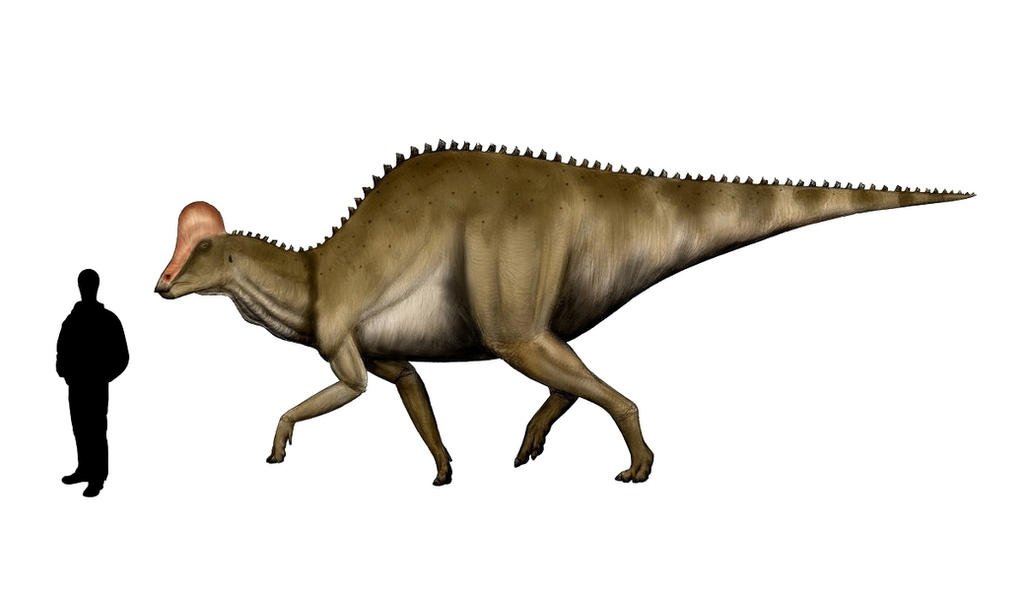
Hypacrosaurus altispinus
Image: Image sourced via web search (Fair use / Educational)
About Hypacrosaurus
Hypacrosaurus, a genus of large, hollow-crested hadrosaurid dinosaur, is one of the most scientifically illuminating prehistoric organisms to have emerged from the Late Cretaceous period. Living approximately 75 to 67 million years ago during the Campanian and Maastrichtian ages of the Mesozoic era, this magnificent creature primarily inhabited the lush, dynamic terrestrial ecosystems of what is now western North America. Its name, which translates to 'near the highest lizard,' reflects its impressive stature, which rivaled that of the apex predators of its time. Hypacrosaurus holds an extraordinarily significant place in the field of paleontology, not merely because of its size or its distinctive cranial ornamentation, but because its fossil record is uniquely comprehensive. The discovery of adult specimens, juveniles, hatchlings, embryos, and even fossilized eggs has provided paleontologists with an unparalleled window into the ontogeny, reproductive strategies, and social dynamics of duck-billed dinosaurs. By studying Hypacrosaurus, scientists have been able to reconstruct the life cycle of a dinosaur with a level of detail that is rarely possible in the paleontological record, establishing it as a keystone species for understanding Late Cretaceous dinosaur biology.
In terms of physical anatomy, Hypacrosaurus was a truly massive animal, with adult individuals estimated to have reached lengths of approximately 900 centimeters (nearly 30 feet) and weighing anywhere from 3 to 4 metric tons. This places it roughly in the same weight class as a modern African elephant, though its body plan was entirely different. The most visually striking feature of Hypacrosaurus was its cranial crest. Unlike the sweeping, tubular crest of its close relative Parasaurolophus, the crest of Hypacrosaurus was tall, rounded, and helmet-like, somewhat resembling the crest of Corythosaurus but generally lower and wider. This hollow structure was formed by the premaxillary and nasal bones and contained complex, looping nasal passages. Another defining skeletal characteristic of Hypacrosaurus, and the one that inspired its specific name 'altispinus,' was the presence of highly elongated neural spines on its dorsal (back) vertebrae. These spines were exceptionally tall, creating a prominent ridge or sail-like structure along the animal's back that was significantly higher than those seen in most other hadrosaurids. The exact function of this ridge remains a subject of study, but it likely played a role in thermoregulation, fat storage, or visual display. The animal possessed a robust, barrel-shaped torso supported by strong, pillar-like hind legs and shorter, yet heavily muscled, forelimbs. This limb proportion indicates that Hypacrosaurus was a facultative biped; it likely spent the majority of its time foraging on all fours but was fully capable of rearing up on its hind legs to reach higher vegetation or to flee from predators. Its hands ended in hoof-like nails, and soft tissue inferences from related hadrosaurs suggest the presence of a fleshy pad encasing the fingers, aiding in weight distribution. The skin, known from rare impressions, was covered in non-overlapping, polygonal scales, typical of hadrosaurids, providing a tough, leathery exterior.
The paleobiology of Hypacrosaurus paints a picture of a highly successful and adaptable herbivore. Its diet consisted entirely of plant matter, which it processed using one of the most advanced chewing mechanisms ever to evolve in terrestrial vertebrates. The front of its snout featured a broad, toothless beak covered in a keratinous sheath, perfectly adapted for cropping leaves, twigs, and pine needles. Once the vegetation was gathered, it was pushed to the back of the mouth where a massive dental battery awaited. This battery consisted of hundreds of tightly packed teeth that formed a continuous grinding surface. As the teeth wore down from the abrasive plant material, new teeth continuously erupted to replace them, ensuring the animal always had an efficient grinding mechanism. Hypacrosaurus likely employed a complex chewing motion, where the upper jaws flexed outward as the lower jaws closed, effectively shearing and crushing tough Cretaceous flora. Beyond its feeding strategies, Hypacrosaurus is incredibly famous for what it reveals about dinosaur growth and social behavior. Histological studies of its bones have shown that Hypacrosaurus grew at an astonishing rate. Hatchlings, which emerged from grapefruit-sized eggs, grew rapidly, reaching adult size in roughly 10 to 12 years. This accelerated growth rate is thought to be an evolutionary adaptation to heavy predation pressure; by reaching a massive size quickly, young Hypacrosaurus could outgrow the vulnerability of their youth. Furthermore, the discovery of nesting grounds with tightly packed clutches of eggs suggests that these animals were highly social, nesting in colonies much like modern seabirds. The altricial nature of the hatchlings strongly implies that parents provided extensive care, bringing food to the nest until the young were capable of foraging on their own.
During the time Hypacrosaurus roamed the Earth, the ecological context of western North America was vastly different from today. The continent was divided by the Western Interior Seaway, a massive inland sea that created a warm, humid, and highly productive coastal environment known as Laramidia. The climate was subtropical to temperate, characterized by distinct wet and dry seasons. The landscape was a mosaic of coastal swamps, floodplains, and dense forests dominated by conifers, ferns, cycads, and the newly diversifying angiosperms (flowering plants). Hypacrosaurus was a major primary consumer in this rich ecosystem, occupying a crucial position in the food web. It co-existed with a diverse array of other dinosaurs. In the Horseshoe Canyon Formation, it shared its habitat with other herbivores like the horned dinosaur Pachyrhinosaurus, the armored Edmontonia, and other hadrosaurs like Edmontosaurus. This high diversity of megaherbivores suggests niche partitioning, where different species specialized in feeding on different types or heights of vegetation. However, this environment was also fraught with danger. Hypacrosaurus was a prime prey item for apex predators, most notably the large tyrannosaurids like Albertosaurus and Daspletosaurus. To survive, Hypacrosaurus likely relied on its large size, herd behavior, and keen senses. The complex nasal passages within its hollow crest may have acted as resonating chambers, allowing individuals to produce loud, low-frequency sounds. These vocalizations could have been used to communicate over long distances, warning the herd of approaching predators, coordinating movements, or attracting mates.
The discovery history of Hypacrosaurus is a fascinating chapter in the annals of paleontology, beginning during the 'Great Dinosaur Rush' of the early 20th century. The genus was first discovered and named by the legendary American paleontologist Barnum Brown in 1913. Brown, working for the American Museum of Natural History, unearthed the holotype specimen of Hypacrosaurus altispinus along the Red Deer River in Alberta, Canada, within the strata of the Horseshoe Canyon Formation. This initial discovery consisted of a partial skeleton, including the distinctive elongated dorsal vertebrae that gave the species its name. For many decades, Hypacrosaurus was known primarily from these adult remains. However, the scientific understanding of this genus was revolutionized in the late 1980s and 1990s by the work of paleontologists Jack Horner and Phil Currie. Horner and his team, working in the Two Medicine Formation of Montana, discovered a new species, Hypacrosaurus stebingeri. This discovery was monumental because it included not just adult skeletons, but extensive nesting grounds containing eggs, embryos, and hatchlings. These finds provided the first definitive evidence of hadrosaurid embryos and offered unprecedented data on dinosaur ontogeny. The specimens from Montana became the basis for groundbreaking research on dinosaur growth rates and reproductive biology. The naming history has remained relatively stable, though the relationship between H. altispinus and H. stebingeri has been the subject of ongoing study, with some researchers suggesting they represent a single evolving lineage over time.
In terms of evolutionary significance, Hypacrosaurus is a classic representative of the Lambeosaurinae, a subfamily of hadrosaurid dinosaurs characterized by their hollow cranial crests. Within this group, it is placed in the tribe Corythosaurini, making it a close relative of other famous crested dinosaurs like Corythosaurus and Olorotitan. The evolutionary trajectory of Hypacrosaurus and its kin highlights a remarkable period of adaptive radiation during the Late Cretaceous, where hadrosaurids diversified rapidly to exploit various ecological niches. The evolution of the hollow crest is of particular interest. It represents a highly specialized adaptation that likely served dual functions: visual display for species recognition and sexual selection, and acoustic resonance for vocal communication. By studying the subtle differences in crest shape between Hypacrosaurus, Corythosaurus, and Lambeosaurus, paleontologists can trace the evolutionary pressures that drove the diversification of these magnificent animals. Furthermore, the rapid growth rates observed in Hypacrosaurus provide critical evidence for the ongoing debate about dinosaur metabolism. The bone histology, which resembles that of fast-growing modern birds and mammals rather than slow-growing reptiles, strongly supports the hypothesis that hadrosaurids were endothermic (warm-blooded) or at least possessed a highly elevated metabolism compared to modern ectotherms. This evolutionary link to the metabolic strategies of modern descendants underscores the dynamic and highly active nature of these prehistoric beasts.
Despite the wealth of fossil material, Hypacrosaurus remains the subject of several scientific debates. One of the primary ongoing controversies revolves around the exact function and evolutionary development of the cranial crest. While the consensus strongly favors visual display and vocal resonance, some researchers continue to investigate whether the complex nasal passages played a role in olfaction (smell) or even thermoregulation, cooling the brain during periods of intense physical activity. Another area of debate concerns the taxonomy of the genus, specifically the relationship between Hypacrosaurus altispinus and Hypacrosaurus stebingeri. Some paleontologists argue that the anatomical differences between the two are minor and may represent chronological variation within a single, continuous lineage (anagenesis) rather than two distinct, branching species. Additionally, interpretations of their social behavior, particularly the extent of parental care, are occasionally challenged. While the altricial nature of the hatchlings suggests they needed feeding, some argue that the evidence for prolonged, active provisioning by the parents is circumstantial and that the young may have been more independent than typically portrayed.
The fossil record of Hypacrosaurus is exceptional, ranking among the best for any dinosaur genus. Fossils are predominantly found in the Horseshoe Canyon Formation of Alberta, Canada, and the Two Medicine Formation of Montana, USA. The known specimens number in the dozens, ranging from isolated bones to nearly complete, articulated skeletons. The preservation quality is frequently excellent, owing to the rapid burial conditions of the ancient floodplains they inhabited. What makes the Hypacrosaurus fossil record truly extraordinary is the preservation of delicate life stages. The discovery of intact nests, unhatched eggs containing fossilized embryos, and aggregations of hatchlings provides a complete growth series. Typically, the robust limb bones, vertebrae, and the massive skulls are well-preserved. The Devil's Coulee site in Alberta and the Egg Mountain region in Montana are famous fossil sites that have yielded the majority of these incredible ontogenetic specimens, cementing Hypacrosaurus as a vital source of data for vertebrate paleontology.
In popular culture, Hypacrosaurus may not be as universally recognized as Tyrannosaurus rex or Triceratops, but it holds a special place among dinosaur enthusiasts and in educational settings. Because of its incredible fossil record regarding nests and babies, it is frequently featured in documentaries and books focusing on dinosaur family life and reproduction. Notable displays can be found at the Royal Tyrrell Museum of Palaeontology in Alberta and the Museum of the Rockies in Montana, where exhibits of its nests and growth series captivate the public. It serves as a crucial educational tool, helping to dispel the outdated notion of dinosaurs as slow, solitary monsters, and instead presenting them as dynamic, social animals with complex life histories.
Classification
Time Period
Discovery
Location
Alberta, Canada
Formation
Horseshoe Canyon Formation
Frequently Asked Questions
What is Hypacrosaurus?
Hypacrosaurus, a genus of large, hollow-crested hadrosaurid dinosaur, is one of the most scientifically illuminating prehistoric organisms to have emerged from the Late Cretaceous period. Living approximately 75 to 67 million years ago during the Campanian and Maastrichtian ages of the Mesozoic era,...
When did Hypacrosaurus live?
Hypacrosaurus lived during the cretaceous period of the mesozoic era approximately 75-67 million years ago.
Where was Hypacrosaurus discovered?
Fossils of Hypacrosaurus were discovered in Alberta, Canada in the Horseshoe Canyon Formation.
What did Hypacrosaurus eat?
Hypacrosaurus was a herbivore. It lived in terrestrial habitats.
What type of fossil is Hypacrosaurus?
Hypacrosaurus is preserved as a body fossil. The preservation quality is excellent.
Related Specimens
From the mesozoic era · body fossils