Gryphaea
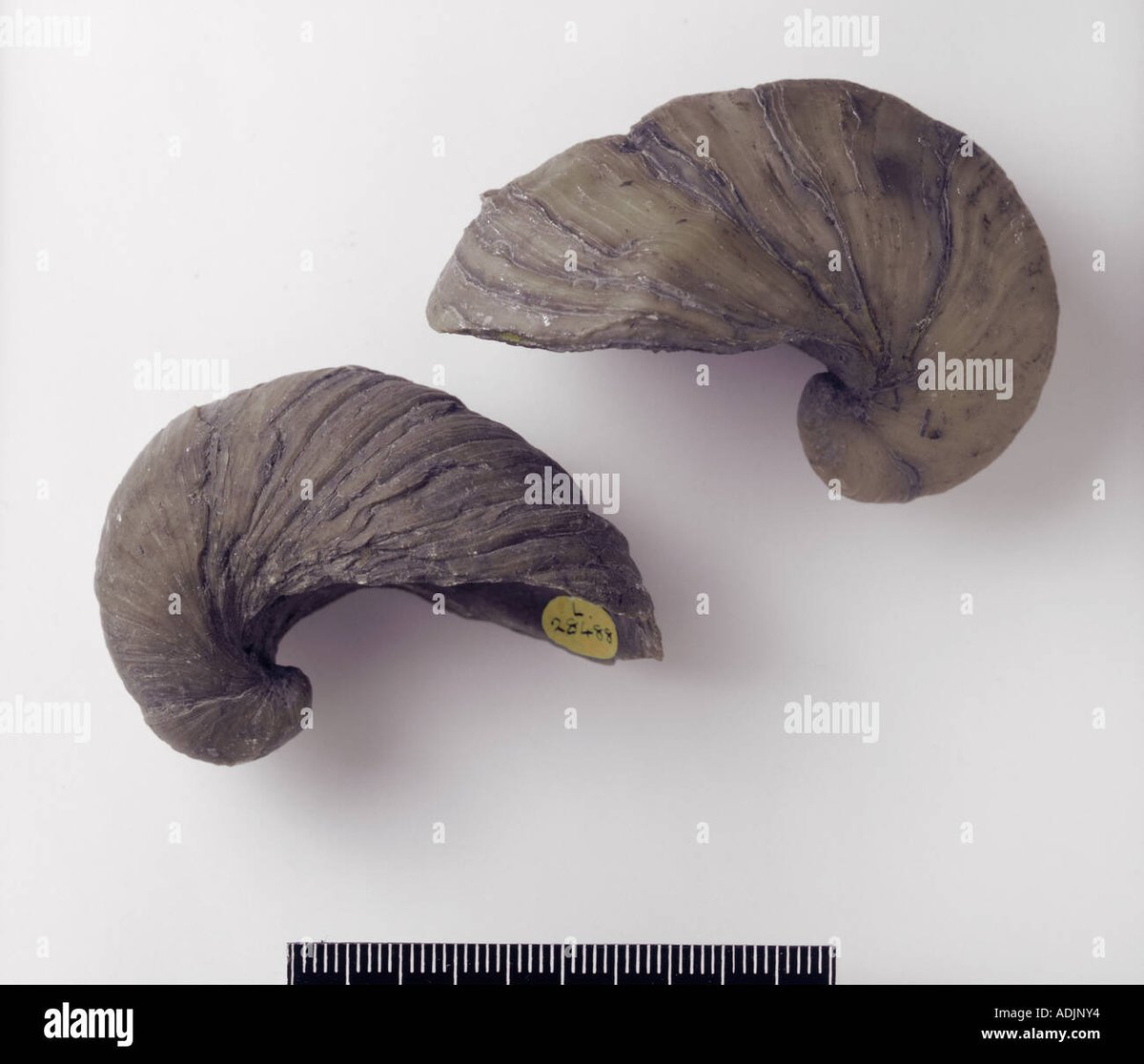
Gryphaea arcuata
Image: Image sourced via web search (Fair use / Educational)
About Gryphaea
Gryphaea is an extinct genus of bivalve mollusc, commonly known as the 'Devil's Toenail' due to the distinctive shape of its fossilized shells. These marine invertebrates thrived in the warm, shallow seas of the Mesozoic Era, particularly during the Jurassic Period, from approximately 200 to 175 million years ago. Their fossils are exceptionally common in certain geological strata, making them a significant index fossil used by geologists to date rock layers and a familiar find for amateur fossil hunters worldwide.
The most striking feature of Gryphaea arcuata is its inequivalve shell, meaning the two valves (or shells) are markedly different in size and shape. The lower, or left, valve is large, convex, and heavily coiled, resembling a thick, curved horn or a distorted toenail. This valve, which would have been partially buried in the soft muddy substrate of the seafloor, could grow up to 10 centimeters in length. Its surface is often marked with concentric growth lines, recording the animal's progressive enlargement over its lifespan. In contrast, the upper, or right, valve is much smaller, flattened, and fits over the lower valve like a lid or operculum. This smaller valve protected the soft-bodied animal inside from predators and environmental hazards. The shell itself was composed of calcite, arranged in a robust lamellar structure that contributed to its excellent preservation potential. The interior of the shell shows a single large adductor muscle scar, typical of oysters, which was used to hold the valves closed. The pronounced coiling of the lower valve is a key diagnostic feature, distinguishing it from other oyster-like bivalves.
As a sessile, benthic organism, Gryphaea was a filter-feeder, playing a crucial role in the marine ecosystem by clearing suspended organic matter and plankton from the water column. It would have lived on the seafloor, with its large, heavy lower valve acting as an anchor in the soft mud or silt. Water would have been drawn in through an opening between the valves, passed over the gills which filtered out food particles, and then expelled. This feeding strategy is common among modern bivalves like oysters and mussels. The growth pattern of Gryphaea has been a subject of detailed study. The prominent growth lines on the shell are believed to represent seasonal or annual cycles, allowing paleontologists to estimate the age and growth rate of individual animals. Studies suggest they grew relatively quickly, reaching maturity within a few years. Their lifestyle was entirely stationary; once settled as larvae, they remained in one spot for their entire lives. The shape of the shell is thought to be an adaptation to this lifestyle on soft substrates, with the curved, heavy base preventing the organism from sinking into the mud or being overturned by currents.
The world of the Early Jurassic was a vastly different place. The supercontinent of Pangaea was actively breaking apart, creating new seaways and shallow epicontinental seas that flooded large parts of what is now Europe. Gryphaea arcuata flourished in these warm, subtropical marine environments, such as the extensive sea that covered much of the British Isles. The climate was generally warmer and more humid than today, with no polar ice caps. Gryphaea shared its habitat with a diverse array of marine life. It lived alongside other invertebrates like ammonites (such as Psiloceras and Dactylioceras), belemnites, crinoids, and other bivalve species. The seafloor was a bustling ecosystem where Gryphaea occupied a low trophic level as a primary consumer. It was likely prey for various predators, including durophagous (shell-crushing) fish like Hybodus sharks, marine reptiles such as ichthyosaurs and plesiosaurs which may have occasionally fed on them, and large predatory ammonites. Vast accumulations of Gryphaea shells on the seafloor would have formed reef-like structures or shell beds, creating complex habitats that provided shelter for smaller organisms, much like modern oyster reefs do today.
The discovery and recognition of Gryphaea fossils predate formal scientific paleontology. Their distinctive and common nature led to them being collected for centuries, earning them the folkloric name 'Devil's Toenails' in England. According to legend, these were the discarded toenail clippings of the devil, and they were sometimes carried as charms to ward off rheumatism. The formal scientific description of the genus was provided by the renowned French naturalist Jean-Baptiste Lamarck in 1801. The specific species, Gryphaea arcuata, was also named by Lamarck in the same year. One of the key figures in its early study was William Smith, the 'Father of English Geology,' who used the predictable sequence of fossils, including abundant Gryphaea beds, to create the first geological map of a country in 1815. He recognized that specific Gryphaea species were confined to particular rock layers, establishing them as one of the first and most important index fossils for correlating Jurassic strata across different regions. There are no single 'famous' specimens akin to a T. rex skeleton, as their scientific value lies in their sheer abundance and stratigraphic consistency rather than individual completeness.
In the grand tapestry of life, Gryphaea represents a specialized lineage within the bivalve molluscs, belonging to the order Ostreida, which includes modern oysters. It is not a direct ancestor of today's oysters (family Ostreidae) but belongs to a closely related, extinct family, the Gryphaeidae. The evolutionary story of Gryphaea is a classic example of an evolutionary trend known as 'coiling' or 'gryphaeate' morphology. Paleontologists have traced a lineage through successive rock layers, starting from flatter, more oyster-like ancestors (such as Liostrea) in the Late Triassic, which gradually evolved the more tightly coiled and inequivalve shell of Gryphaea in the Early Jurassic. This evolutionary sequence, documented beautifully in the Lias Group of southern England, is a textbook case of gradualism, where small, incremental changes accumulate over millions of years to produce a significant morphological shift. This adaptation is believed to have been driven by the need to stabilize the shell on soft, soupy seafloor substrates, with the coiling providing a more stable, self-righting base. The eventual decline and extinction of the genus in the Cretaceous may have been linked to changing sea levels and competition from more modern, flatter oyster species.
While the broad evolutionary history of Gryphaea is well-established, some scientific debates persist. One long-standing discussion revolves around the precise life orientation of the animal. While the traditional view holds that the heavy, convex valve was partially buried in the sediment for stability, some researchers have proposed alternative orientations, suggesting the commissure (the line where the valves meet) may have been held at a specific angle to the substrate to optimize feeding currents. Another area of active research involves using stable isotope geochemistry on Gryphaea shells. By analyzing the ratios of oxygen and carbon isotopes preserved within the calcite growth bands of the shell, scientists can reconstruct detailed records of Jurassic sea temperatures, seasonality, and water chemistry. These studies are refining our understanding of Mesozoic climates and have revealed, for example, the temperature fluctuations experienced by an individual animal throughout its life, providing a high-resolution snapshot of the Jurassic environment. The exact reasons for the decline of the gryphaeids and the subsequent radiation of the true oysters (ostreids) remain a topic of investigation, likely involving a complex interplay of environmental change and competitive exclusion.
The fossil record of Gryphaea is exceptionally rich and widespread. Fossils are most famously found in the Jurassic marine deposits of Europe, with classic localities in the United Kingdom (particularly along the Jurassic Coast of Dorset and the coasts of Yorkshire and Somerset), France, Germany, and Switzerland. The Blue Lias formation in Britain is renowned for containing vast shell beds composed almost entirely of Gryphaea arcuata. These fossils are incredibly common, to the point where they are a defining feature of the rock. Preservation is typically excellent; the robust calcite shells are often preserved in three dimensions with fine surface detail intact, although the soft parts of the animal are never found. Usually, the two valves are found disarticulated, separated after the animal's death, but finding them still joined together is not uncommon. Their abundance makes them one of the first fossils many people in Europe ever find, serving as a gateway to the science of paleontology for countless enthusiasts and students.
Due to their distinctive shape and abundance, 'Devil's Toenails' have a notable cultural footprint, especially in the United Kingdom. They are a staple of museum collections worldwide, from the grand halls of the Natural History Museum in London to small local museums in areas with Jurassic geology. They are frequently used in educational settings to teach fundamental geological principles like stratigraphy, index fossils, and the concept of deep time. While they lack the dramatic appeal of dinosaurs, their tangible connection to a lost world and their folkloric history give them a unique charm. For many, finding a Gryphaea fossil is a personal and direct connection to the age of marine reptiles and ammonites, a small, curved key unlocking the immense history of the planet held within the rocks underfoot.
Classification
Time Period
Discovery
Location
Europe, particularly the United Kingdom and France
Formation
Lias Group (specifically formations like the Blue Lias)
Frequently Asked Questions
What is Gryphaea?
Gryphaea is an extinct genus of bivalve mollusc, commonly known as the 'Devil's Toenail' due to the distinctive shape of its fossilized shells. These marine invertebrates thrived in the warm, shallow seas of the Mesozoic Era, particularly during the Jurassic Period, from approximately 200 to 175 mil...
When did Gryphaea live?
Gryphaea lived during the jurassic period of the mesozoic era approximately 200-175 million years ago.
Where was Gryphaea discovered?
Fossils of Gryphaea were discovered in Europe, particularly the United Kingdom and France in the Lias Group (specifically formations like the Blue Lias).
What did Gryphaea eat?
Gryphaea was a filter-feeder. It lived in marine, shallow sea-floor (benthic) habitats.
What type of fossil is Gryphaea?
Gryphaea is preserved as a body fossil. The preservation quality is excellent.
Related Specimens
From the mesozoic era · body fossils