Ammonite (Placenticeras)
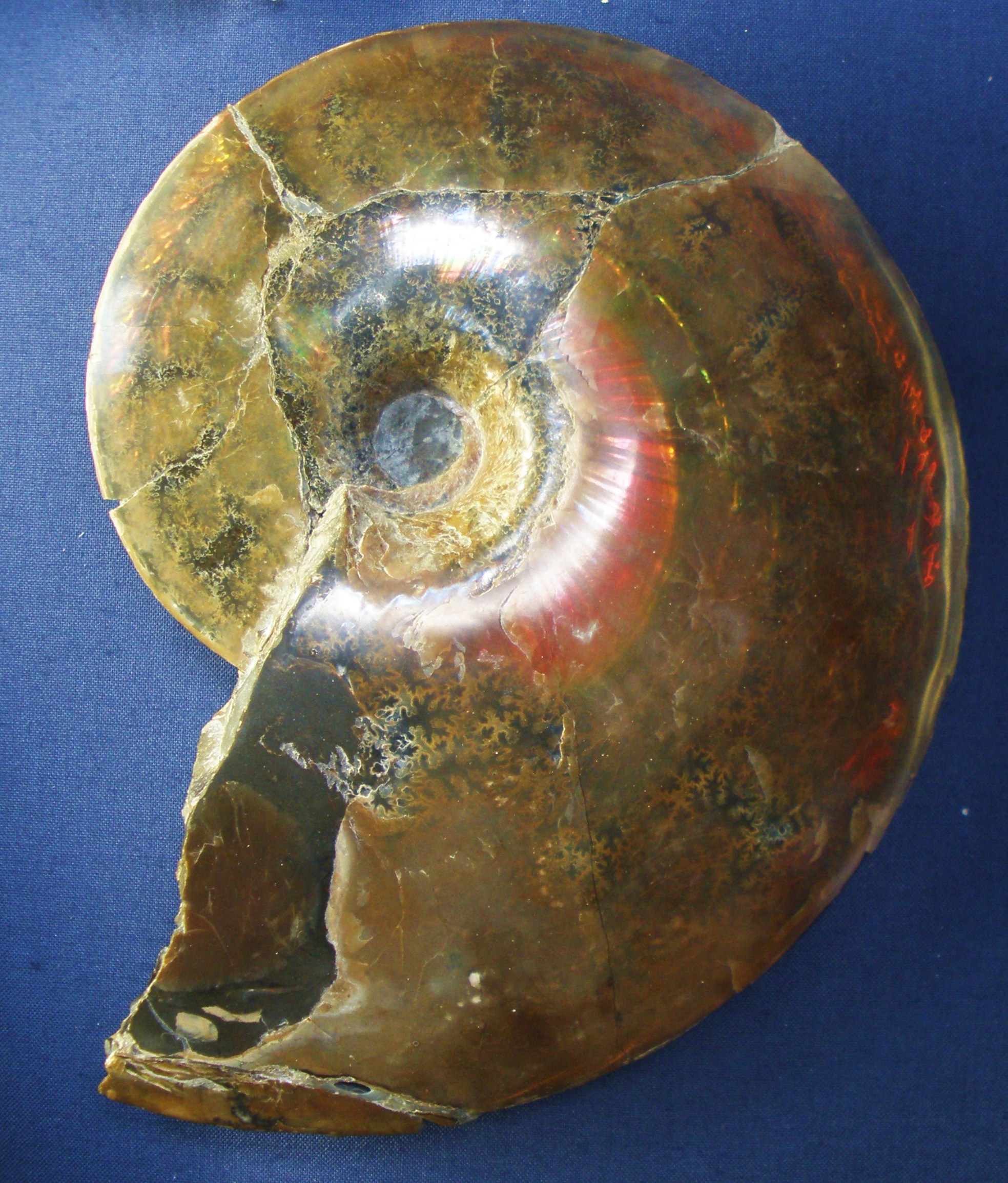
Placenticeras meeki
Image: File:Placenticeras meeki.jpg - Wikimedia Commons (CC BY-SA)
About Ammonite (Placenticeras)
Placenticeras meeki was a large, highly advanced ammonite cephalopod that inhabited the shallow, warm waters of the Western Interior Seaway during the Late Cretaceous period, approximately 83 to 72 million years ago. Renowned for its streamlined, disc-like shell and its frequent preservation as the iridescent gemstone ammolite, this marine predator represents a pinnacle of ammonoid evolution just prior to the end-Cretaceous mass extinction. Its abundant and exceptionally preserved fossils across North America have made it a cornerstone species for understanding Mesozoic marine ecosystems and the intricate dynamics of ancient predator-prey relationships.
The physical anatomy of Placenticeras meeki reflects a highly specialized adaptation to active marine life. As a cephalopod, it possessed a soft body housed within a rigid, multi-chambered aragonite shell. The shell of this species was distinctly involute, meaning the outer whorl completely covered the inner whorls, resulting in a tightly coiled, laterally compressed, and highly streamlined disc shape. This morphology significantly reduced hydrodynamic drag, indicating that Placenticeras meeki was a capable and active swimmer compared to its more globular relatives. Specimens range dramatically in size, typically measuring between 10 and 100 centimeters in diameter, with the largest individuals representing fully mature adults that could weigh several kilograms in life. The exterior of the shell was relatively smooth but adorned with subtle, sinuous ribs and a series of small tubercles or nodes along the flanks and venter, which may have provided structural reinforcement against the immense pressure of the ocean depths or the crushing jaws of predators. Internally, the shell was divided into a series of chambers, or camerae, by complex, highly folded walls known as septa. The living animal occupied only the largest, outermost chamber, while the inner chambers were filled with gas and fluid to regulate buoyancy. Protruding from the head of the soft body would have been a crown of tentacles, likely equipped with suckers or hooks, surrounding a powerful, chitinous, parrot-like beak and a radula used for processing food. In comparison to modern cephalopods, its soft tissue anatomy would have closely resembled that of modern squids and octopuses, though its external shell aligns it more closely in appearance, though not in direct lineage, with the modern Nautilus.
The paleobiology of Placenticeras meeki paints a picture of a dynamic and voracious predator. Its diet consisted primarily of small fish, crustaceans, and other smaller invertebrates that shared its marine habitat. Utilizing its excellent vision, a hallmark of advanced cephalopods, it would have tracked its prey before launching a rapid attack using jet propulsion, expelling water forcefully through a muscular funnel. Once within striking distance, its tentacles would ensnare the prey, drawing it toward the powerful beak-like jaws capable of crushing the carapaces of crustaceans or the shells of smaller mollusks. Locomotion was achieved through a combination of this jet propulsion and precise buoyancy control. A biological tube called the siphuncle ran through the septa of the shell, allowing the animal to pump fluids in and out of the empty chambers, thereby altering its overall density to ascend or descend in the water column with minimal energetic cost. Growth patterns in Placenticeras meeki, as evidenced by the spacing of the septa and the accretionary growth lines on the exterior of the shell, suggest rapid early development followed by a slowing of growth upon reaching sexual maturity. Paleontologists also believe this species exhibited sexual dimorphism, a common trait in ammonites, where the females, termed macroconchs, grew significantly larger than the males, or microconchs, to accommodate the production of large quantities of eggs.
The ecological context of Placenticeras meeki is inextricably linked to the Western Interior Seaway, a massive, shallow inland sea that split the North American continent into two landmasses, Laramidia to the west and Appalachia to the east, during the Late Cretaceous. The climate during the Campanian age was significantly warmer than today, with high global sea levels creating a vast, sunlit marine environment teeming with life. Placenticeras meeki occupied a crucial mid-level position in the complex food web of this seaway. While it was a formidable predator of smaller nektonic and benthic organisms, it was simultaneously a primary food source for the apex predators of the Cretaceous seas. The waters it inhabited were shared with a diverse array of marine reptiles, including long-necked plesiosaurs, fast-swimming ichthyosaurs, and, most notably, the fearsome mosasaurs. Fossil evidence clearly demonstrates this predator-prey dynamic, as numerous shells of Placenticeras meeki have been discovered bearing distinct, puncture-like bite marks that perfectly match the dental spacing of large mosasaurs like Tylosaurus. Furthermore, the seafloor beneath these ammonites was populated by a rich benthic community of bivalves, gastropods, and echinoderms, while the water column was shared with other ammonite species, such as the uncoiled Baculites, creating a highly competitive and diverse ecosystem.
The discovery and subsequent study of Placenticeras meeki are deeply intertwined with the early history of North American paleontology. The species was first formally described and named in the late 19th century during the era of the great geological surveys of the American West. The specific epithet, meeki, was chosen to honor Fielding Bradford Meek, a pioneering American paleontologist who made monumental contributions to the understanding of invertebrate fossils in the western United States. Early specimens were collected from the rugged badlands of South Dakota and Wyoming, but the most spectacular discoveries have historically come from the Bearpaw Formation, a geologic formation of dark marine shale that stretches across Montana and into the Canadian province of Alberta. It was in these Canadian deposits, particularly along the St. Mary River, that indigenous populations first encountered the brilliant, iridescent fragments of these shells, which they referred to as iniskim, or buffalo calling stones, attributing spiritual significance to them long before Western science classified the organism. In the 20th century, systematic excavations in the Bearpaw Formation yielded complete, perfectly preserved specimens encased in ironstone concretions, providing the foundation for our modern understanding of the species' anatomy and its unique fossilization process.
In terms of evolutionary significance, Placenticeras meeki represents one of the most derived and specialized forms within the subclass Ammonoidea. Ammonites first appeared in the Devonian period and underwent multiple near-extinctions and explosive radiations before reaching their zenith in the Mesozoic era. Placenticeras belongs to the order Ammonitida, characterized by the most intricate and complex suture patterns—the visible lines where the internal septa meet the outer shell wall. These highly frilled, fractal-like ammonitic sutures are believed to have provided maximum structural strength to the shell with minimal weight, an evolutionary innovation that allowed Placenticeras meeki to inhabit a wider range of depths and withstand greater physical stress than its ancestors. While they share a distant common ancestor with modern nautiloids, ammonites are actually more closely related to the subclass Coleoidea, which includes modern squids, octopuses, and cuttlefish. The eventual extinction of Placenticeras meeki and all other ammonites at the Cretaceous-Paleogene boundary 66 million years ago remains a subject of intense study. It is theorized that their reproductive strategy, which likely involved tiny, planktonic young that floated near the ocean surface, made them particularly vulnerable to the sudden acidification and cooling of the surface waters following the Chicxulub asteroid impact, whereas the deep-dwelling nautiloids survived.
Despite the wealth of fossil material, Placenticeras meeki remains the subject of several fascinating scientific debates. One of the most prominent controversies centers around the interpretation of the supposed mosasaur bite marks found on many specimens. While early researchers, notably Erle Kauffman in the 1990s, argued convincingly that these punctures were the direct result of mosasaur predation, proposing that the reptiles deliberately crushed the buoyancy chambers to force the ammonite to the surface, later paleontologists have challenged this narrative. Some researchers have suggested that certain holes in the shells were not caused by teeth, but rather by the attachment of limpets or other parasitic organisms that bored into the shell while the ammonite was still alive, or by scavengers after the shell had sunk to the seafloor. Another ongoing debate involves the taxonomy and species boundaries within the genus Placenticeras. Because ammonite shells can exhibit significant morphological variation due to environmental factors, sexual dimorphism, and individual growth rates, some scientists argue that several different named species of Placenticeras found in the Western Interior Seaway might actually represent a single, highly variable species, prompting calls for a comprehensive taxonomic revision using modern morphometric analysis.
The fossil record of Placenticeras meeki is extraordinary, both in its geographic extent and the quality of preservation. Fossils are distributed widely across the central corridor of North America, from the Gulf Coast of the United States up through the Dakotas, Montana, and into Alberta and Saskatchewan in Canada. The Bearpaw Formation is undoubtedly the most famous and prolific source of these fossils. Here, the anoxic, muddy conditions of the ancient seafloor prevented rapid decomposition and scavenging, allowing the shells to be gradually encased in hard concretions. The most remarkable aspect of this preservation is the formation of ammolite. During the fossilization process, the aragonite that composed the original shell was subjected to immense tectonic pressure and heat. Instead of recrystallizing into the more stable mineral calcite, as is typical for most fossils, the aragonite layers were compressed. This compression altered the microstructure of the shell, creating a series of microscopic, stacked platelets that interfere with light, producing a stunning, iridescent play of colors ranging from deep reds and greens to rare blues and purples. This structural color is a post-mortem artifact, meaning the living ammonite did not possess these vibrant rainbow hues, but it has resulted in some of the most visually spectacular fossils ever discovered.
The cultural impact of Placenticeras meeki extends far beyond the confines of academic paleontology. The discovery of gem-quality ammolite in the 1970s transformed this ancient cephalopod into a highly sought-after commodity in the jewelry industry. In 1981, the World Jewellery Confederation officially recognized ammolite as a gemstone, and it was later designated as the official gemstone of the province of Alberta. Commercial mining operations now carefully extract these fossils, balancing the demand for luxury goods with the need for scientific preservation. Complete, iridescent specimens of Placenticeras meeki are considered masterpieces of natural history and are prominently displayed in major museums around the world, including the Royal Tyrrell Museum of Palaeontology and the American Museum of Natural History. Through these dazzling displays, Placenticeras meeki serves as a powerful educational tool, capturing the public imagination and providing a tangible, beautiful connection to the deep time and the vanished marine worlds of the Mesozoic era.
Classification
Time Period
Discovery
Location
Western Interior Seaway of North America (e.g., South Dakota, Wyoming, USA; Alberta, Canada)
Formation
Bearpaw Formation
Frequently Asked Questions
What is Ammonite (Placenticeras)?
Placenticeras meeki was a large, highly advanced ammonite cephalopod that inhabited the shallow, warm waters of the Western Interior Seaway during the Late Cretaceous period, approximately 83 to 72 million years ago. Renowned for its streamlined, disc-like shell and its frequent preservation as the ...
When did Ammonite (Placenticeras) live?
Ammonite (Placenticeras) lived during the cretaceous period of the mesozoic era approximately 83-72 million years ago.
Where was Ammonite (Placenticeras) discovered?
Fossils of Ammonite (Placenticeras) were discovered in Western Interior Seaway of North America (e.g., South Dakota, Wyoming, USA; Alberta, Canada) in the Bearpaw Formation.
What did Ammonite (Placenticeras) eat?
Ammonite (Placenticeras) was a carnivore. It lived in marine habitats.
What type of fossil is Ammonite (Placenticeras)?
Ammonite (Placenticeras) is preserved as a permineralized fossil. The preservation quality is exceptional.
Related Specimens
From the mesozoic era · permineralized fossils