Protoceratops
Protoceratops andrewsi
Image: File:Triceratops horridus 1.jpg - Wikimedia Commons (CC BY-SA)
About Protoceratops
Protoceratops andrewsi was a sheep-sized, herbivorous ceratopsian dinosaur that inhabited the arid landscapes of what is now Mongolia's Gobi Desert during the Late Cretaceous period, approximately 83.5 to 70.6 million years ago. Although its name translates to 'first horned face,' it is a pivotal, yet hornless, ancestor to the more famous horned dinosaurs like Triceratops, offering invaluable insights into the early evolution of this iconic group. The exceptional abundance and preservation of its fossils, spanning every life stage from egg to adult, have made Protoceratops one of the most thoroughly understood dinosaurs, illuminating aspects of dinosaurian growth, behavior, and paleoecology.
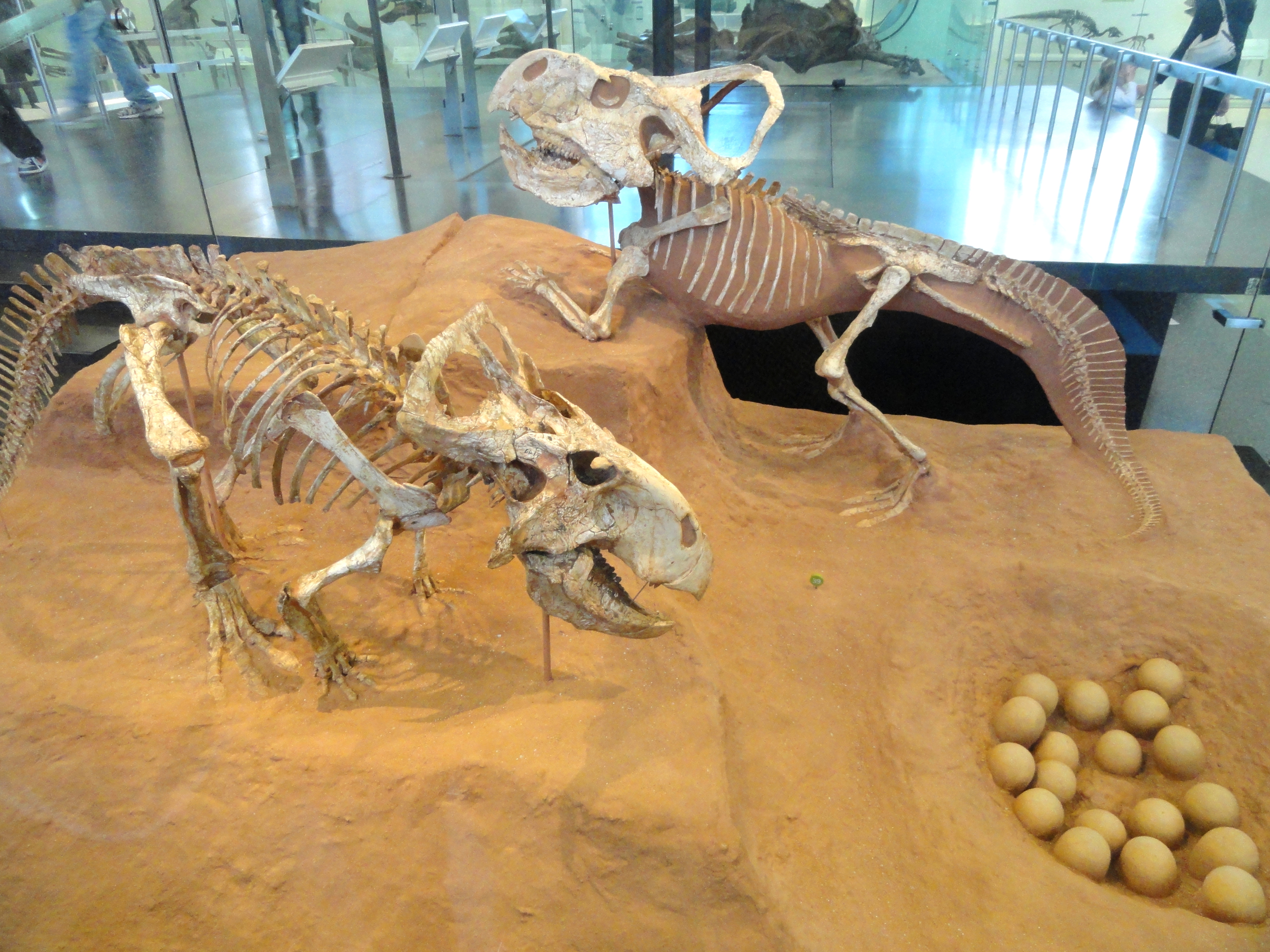
The physical anatomy of Protoceratops andrewsi presents a fascinating mosaic of primitive and derived ceratopsian traits. An adult typically measured around 1.8 meters (approximately 6 feet) in length from its beak to the tip of its tail, stood about 0.6 meters (2 feet) high at the shoulder, and likely weighed between 60 and 180 kilograms (130 to 400 pounds), comparable in size to a modern domestic pig or a large sheep. It had a stocky, quadrupedal build with a barrel-shaped torso, robust limbs, and a relatively short, deep tail. Its most defining feature was its disproportionately large skull, which could reach up to 0.5 meters long. At the front of the skull was a powerful, toothless beak, or rostrum, which would have been covered in keratin in life, forming a sharp, parrot-like shearing tool. Behind the beak, the jaws were lined with batteries of leaf-shaped teeth designed for slicing tough vegetation. The most prominent cranial feature was the large, bony frill extending from the back of the skull. Unlike its later relatives, this frill was solid, lacking the large openings (fenestrae) seen in many other ceratopsians, and was likely used for display and as an anchor for powerful jaw muscles rather than for defense. While it lacked true brow or nasal horns, a small, roughened bump of bone, known as a nasal boss, was present above the nostrils, which was more pronounced in some individuals, suggesting it played a role in intraspecific display.
The paleobiology of Protoceratops is remarkably well-documented thanks to the wealth of fossil evidence. As a herbivore, its powerful beak and shearing dental batteries were perfectly adapted for processing the tough, arid-adapted flora of the Djadochta Formation, such as cycads, ferns, and early flowering plants. The immense jaw muscles, anchored to the expansive frill and the deep lower jaw, would have generated a formidable bite force, allowing it to crop and process fibrous plant material efficiently. Its sturdy, quadrupedal stance suggests it was a relatively slow-moving animal, built more for steady browsing than for speed. Fossil trackways are rare, but its limb structure points to a walking gait. The discovery of bonebeds containing multiple individuals of various ages suggests that Protoceratops may have lived in social groups or herds, a behavior that could have offered protection from predators and facilitated mating. Growth series studies, made possible by the discovery of individuals from hatchling to adult, show that the distinctive frill and nasal boss developed and grew disproportionately larger with age, a classic example of allometric growth. This pattern strongly indicates that these features were secondary sexual characteristics, becoming more pronounced as the animal reached sexual maturity, likely used in courtship displays and dominance contests between males.
Protoceratops lived in a semi-arid, desert-like environment characterized by vast sand dune fields, intermittent streams, and oases, a habitat preserved in the sandstone deposits of the Djadochta Formation. The climate was seasonal, with hot, dry periods punctuated by brief, intense rainy seasons that would have temporarily transformed the landscape. This challenging environment supported a unique and well-documented ecosystem. Protoceratops occupied a crucial position in the food web as a primary consumer, likely one of the most common medium-sized herbivores in its habitat. It shared this world with a diverse array of other dinosaurs. Fellow herbivores included the small pachycephalosaur Prenocephale and the heavily armored ankylosaur Pinacosaurus. The apex predator of this ecosystem was likely Tarbosaurus, a close relative of Tyrannosaurus rex, though smaller predators were more immediate threats. These included small dromaeosaurs like Velociraptor mongoliensis and troodontids such as Saurornithoides, which may have preyed on young or vulnerable Protoceratops. The famous "Fighting Dinosaurs" specimen, which preserves a Protoceratops and a Velociraptor locked in a fatal struggle, provides direct and dramatic evidence of this predator-prey relationship, capturing a moment where the herbivore managed to crush its attacker's arm in its powerful beak even as the raptor's sickle claw was embedded in its neck.
The history of Protoceratops is inextricably linked to one of the most famous expeditions in paleontological history. The species was discovered in 1922 by photographer James B. Shackelford, a member of the third Central Asiatic Expedition to the Gobi Desert led by the renowned American explorer and naturalist Roy Chapman Andrews of the American Museum of Natural History. The initial fossils, including the type specimen skull, were found at a site called the "Flaming Cliffs" (Bayn Dzak) in Mongolia. In 1923, paleontologists Walter W. Granger and William K. Gregory formally described the animal, naming it Protoceratops andrewsi in honor of their expedition leader. The generic name, meaning 'first horned face,' was chosen because they correctly identified it as a primitive ancestor of the North American horned ceratopsians. The expeditions of the 1920s unearthed a treasure trove of Protoceratops material, but the most groundbreaking find was the discovery of the first scientifically recognized dinosaur eggs. Initially misattributed to Protoceratops, these nests, found in clutches, provided the first concrete evidence that dinosaurs laid eggs and exhibited nesting behavior. Decades later, in the 1990s, the embryo of an oviraptorid dinosaur was found within an identical egg, revealing the true parentage and leading to the reinterpretation of Oviraptor ('egg thief') as a dedicated parent. True Protoceratops eggs and embryos have since been correctly identified, further cementing its importance.
Protoceratops holds a vital position in the evolutionary tree of dinosaurs, specifically within the group Ceratopsia. It belongs to the family Protoceratopsidae, a group of early neoceratopsians that represents a crucial transitional stage between the small, bipedal Asian psittacosaurids and the giant, quadrupedal, and elaborately horned ceratopsids of North America, such as Triceratops and Styracosaurus. Protoceratops exhibits key features that bridge this evolutionary gap. While fully quadrupedal like its later relatives, its limb proportions were less specialized. Its skull showcases the foundational elements of the ceratopsid condition: a well-developed frill and a powerful beak. However, it lacks the large brow and nasal horns and the complex dental batteries of the more derived forms, marking it as an intermediate form. The presence of a small nasal boss can be seen as the incipient stage of the larger nasal horns that would evolve in its descendants. Its geographic location in Asia also supports the widely accepted hypothesis that the ceratopsian lineage originated in Asia before migrating to North America via the Beringian land bridge during the Late Cretaceous, where they diversified into the giants of the era. Thus, Protoceratops is not just a species but a critical data point for understanding macroevolutionary patterns of dispersal and diversification.
Despite being one of the best-known dinosaurs, Protoceratops is still the subject of scientific debate and ongoing research. One area of discussion revolves around its taxonomy. While Protoceratops andrewsi is the type species, another species, Protoceratops hellenikorhinus, was named in 2001 based on remains from a different Mongolian formation. This larger species possessed a more upright frill and a pair of small horn-like protuberances, suggesting greater diversity within the genus than previously thought. The precise function of the frill also remains a topic of debate. While its role in display and muscle attachment is widely accepted, some researchers have proposed it could have also played a role in thermoregulation, with blood vessels helping to dissipate heat. Another controversy surrounds its inferred social behavior. While bonebeds suggest gregariousness, some paleontologists argue these accumulations could be the result of environmental factors, such as droughts concentrating animals around a dwindling water source, rather than true herding behavior. The evidence for parental care, once thought to be strong, is also being re-evaluated, with some studies suggesting a more reptilian, hands-off approach to nesting.
The fossil record of Protoceratops andrewsi is extraordinary in both its quality and quantity, making it a paleontological benchmark. The vast majority of specimens have been unearthed from the Djadochta Formation and the nearby Tugrik Formation in the Gobi Desert of southern Mongolia. Famous fossil localities such as the Flaming Cliffs (Bayn Dzak) and Tugriken Shireh have yielded hundreds of individual skeletons. This remarkable fossil abundance is due to the unique depositional environment of the ancient desert, where sudden sandstorms could rapidly bury and preserve animals with stunning fidelity. The completeness of the record is unparalleled; paleontologists have access to entire growth series, from delicate, thin-shelled eggs and embryonic skeletons to tiny hatchlings, juveniles of various sizes, and fully mature adults exhibiting clear sexual dimorphism. This allows for detailed studies of its ontogeny (growth and development) that are impossible for most other dinosaurs. The "Fighting Dinosaurs" specimen, discovered by a Polish-Mongolian expedition in 1971, remains one of the most spectacular fossils ever found, a behavioral fossil that provides a dynamic snapshot of Mesozoic life and death.
The wealth of fossil material and the compelling stories behind its discovery have given Protoceratops a significant cultural impact. It is a staple exhibit in major natural history museums around the world, including the American Museum of Natural History in New York and the Mongolian Dinosaur Museum in Ulaanbaatar. Its manageable size and distinctive appearance make it an accessible and popular subject for museum displays, often depicted in lifelike dioramas of the Gobi Desert ecosystem. Protoceratops frequently appears in dinosaur books, documentaries, and educational materials as a key example of ceratopsian evolution and dinosaur behavior. While it may not have the celebrity status of Tyrannosaurus or Triceratops, its crucial role in the history of paleontology—from the discovery of dinosaur eggs to the "Fighting Dinosaurs"—ensures its place as one of the most scientifically important and fascinating dinosaurs ever discovered.
Classification
Time Period
Discovery
Location
Gobi Desert, Mongolia
Formation
Djadochta Formation
Frequently Asked Questions
What is Protoceratops?
Protoceratops andrewsi was a sheep-sized, herbivorous ceratopsian dinosaur that inhabited the arid landscapes of what is now Mongolia's Gobi Desert during the Late Cretaceous period, approximately 83.5 to 70.6 million years ago. Although its name translates to 'first horned face,' it is a pivotal, y...
When did Protoceratops live?
Protoceratops lived during the cretaceous period of the mesozoic era approximately 83.5-70.6 million years ago.
Where was Protoceratops discovered?
Fossils of Protoceratops were discovered in Gobi Desert, Mongolia in the Djadochta Formation.
What did Protoceratops eat?
Protoceratops was a herbivore. It lived in terrestrial habitats.
What type of fossil is Protoceratops?
Protoceratops is preserved as a body fossil. The preservation quality is excellent.
Related Specimens
From the mesozoic era · body fossils