Annularia
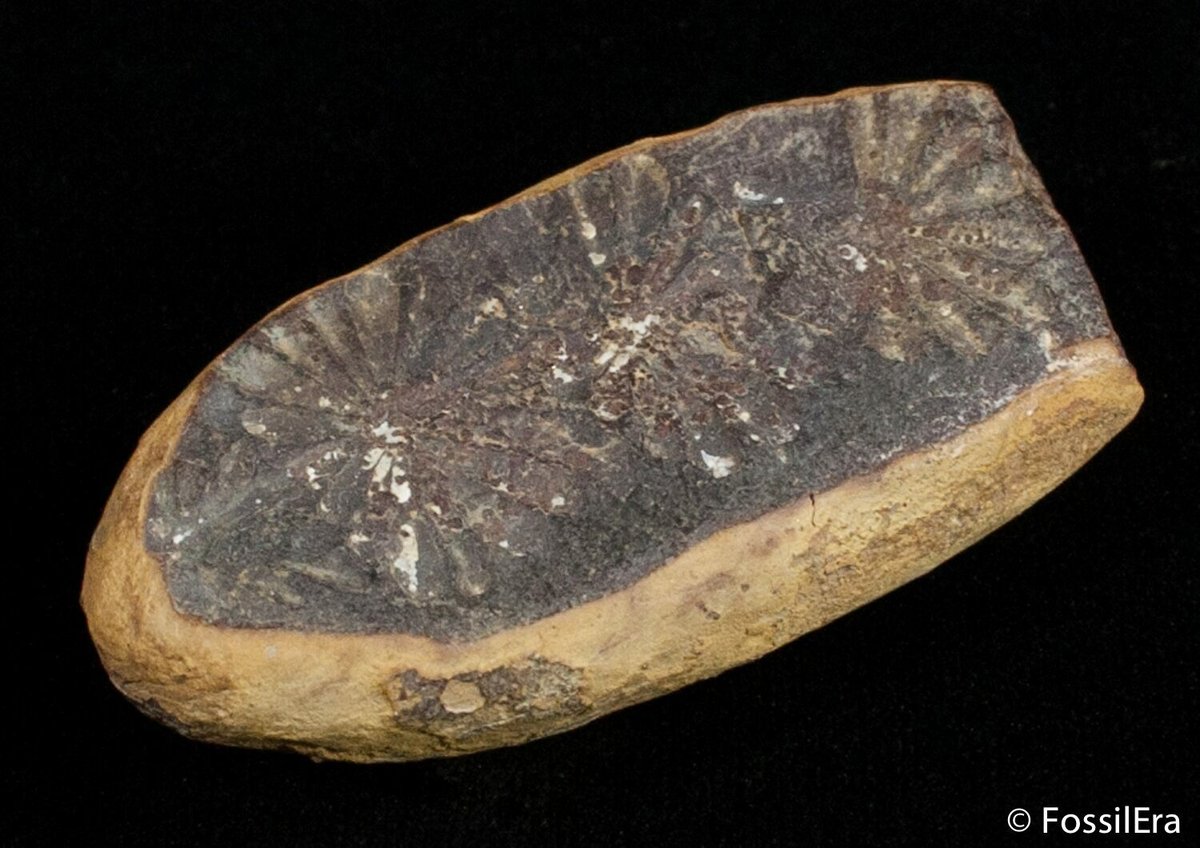
Annularia stellata
Image: Image sourced via web search (Fair use / Educational)
About Annularia
Annularia is a form genus representing the fossilized foliage of the extinct arborescent horsetail Calamites, a dominant plant group that flourished in the vast, steamy coal swamps of the Carboniferous Period. These distinctive fossils, characterized by star-like whorls of leaves, provide a crucial window into the structure and ecology of some of the earliest complex forest ecosystems on Earth. Found globally in Carboniferous deposits, Annularia fossils are not a distinct plant species themselves, but rather the detached leaf structures of a much larger, tree-like organism, making them vital for reconstructing the full anatomy and life appearance of their parent plants.
The physical form of Annularia is its most defining characteristic. The fossils consist of whorls, or verticils, of leaves arranged radially around a central point where they once attached to a slender twig or branch of a Calamites tree. Each whorl of Annularia stellata typically contains between 8 and 30 individual leaves, forming a star-like or circular pattern that can range from 1 to 5 centimeters in diameter, though some larger examples have been found. The leaves themselves are lanceolate (lance-shaped) or spathulate (spatula-shaped), being wider at the tip than at the base, and possess a single, prominent central vein or midrib. Unlike the needle-like leaves of some other Calamites foliage genera like Asterophyllites, Annularia leaves are flattened and relatively broad, suggesting they were adapted for maximizing light capture in the dense, shaded understory of the Carboniferous swamps. These whorls were borne at nodes along the articulated, ribbed stems of Calamites, which could grow to heights of 20 meters or more, resembling giant bamboo. The Annularia foliage would have clothed the smaller, more delicate branches, forming a dense canopy layer.
As the foliage of a Calamites tree, the paleobiology of Annularia is intrinsically linked to its parent organism. Its primary biological function was photosynthesis, converting sunlight into energy to fuel the massive growth of the entire plant. The flattened, broad shape of the leaves was an efficient adaptation for this process in a low-light environment. Calamites, the parent plant, was a fast-growing, opportunistic species that likely colonized disturbed areas like riverbanks and floodplains, similar to modern horsetails (Equisetum). It reproduced via spores produced in cones, known as Calamostachys or Palaeostachya, and also spread vegetatively through an extensive underground rhizome system. This rhizome network allowed it to form dense, clonal thickets that could rapidly dominate an area. The growth pattern was modular, with jointed stems that grew in segments. The Annularia leaf whorls would have been shed periodically, much like modern deciduous trees, contributing significantly to the leaf litter on the forest floor, which ultimately formed the vast coal seams characteristic of this period. The entire plant was a primary producer, forming the base of the food web for a host of Carboniferous arthropods.
The ecological context of Annularia was the humid, tropical environment of the Late Carboniferous Period, often called the 'Coal Age.' During this time, much of the Earth's landmass was consolidated near the equator in the supercontinent of Pangaea. The climate was warm and wet, with little seasonality, fostering the growth of immense, lush swamp forests that covered vast areas of North America, Europe, and Asia. These 'coal swamps' were dominated by giant lycophytes like Lepidodendron (scale trees), seed ferns such as Medullosa, and the arborescent horsetails, Calamites, to which Annularia belonged. These plants created a multi-tiered forest with towering canopies and a dark, damp understory. The environment was oxygen-rich, estimated to be as high as 35% of the atmosphere, which supported the evolution of giant arthropods, including the dragonfly-like Meganeura with a wingspan of 75 cm, and the millipede-like Arthropleura, which could reach over 2 meters in length. Annularia, as part of Calamites, was a foundational primary producer in this ecosystem, providing food and habitat for herbivores and detritivores, and its decay was a primary contributor to the peat that would later become coal.
The discovery and study of Annularia are deeply intertwined with the Industrial Revolution and the rise of coal mining in Europe during the 18th and 19th centuries. Miners in Great Britain, Germany, and France frequently encountered these beautifully preserved, star-shaped fossils on slabs of shale and sandstone extracted from coal seams. These 'fossil ferns' were among the first prehistoric plant remains to be systematically collected and studied by early naturalists and paleontologists. The genus Annularia was formally named in 1822 by the German naturalist Ernst Friedrich von Schlotheim, though it was the French paleobotanist Adolphe-Théodore Brongniart who, in his seminal 1828 work 'Histoire des végétaux fossiles,' solidified its classification and recognized its connection to the stem fossils known as Calamites. For decades, Annularia, Asterophyllites (another foliage type), and Calamites (stems) were often treated as separate plants. It was only through the painstaking work of later paleobotanists, such as William Crawford Williamson in the late 19th century, who found these different parts in physical connection, that the full, composite nature of the Calamites tree was finally understood. No single 'type specimen' exists in the way a vertebrate fossil might; rather, our understanding is built from countless fragments found worldwide.
Annularia's evolutionary significance lies in its representation of the Sphenopsida (or Equisetopsida), a lineage of vascular plants that includes modern horsetails. During the Carboniferous, this group achieved a level of size and ecological dominance it has never regained. Calamites, with its Annularia foliage, represents the pinnacle of arborescent (tree-like) evolution within this lineage. Its study provides critical insights into how early vascular plants solved the biomechanical and physiological problems of growing to tree size, developing complex branching patterns, and competing for light in dense forests. The fossils show a sophisticated, modular body plan with jointed stems and distinct foliage types, a successful strategy that allowed them to thrive for millions of years. While their giant forms died out during the Permian-Triassic extinction event, the fundamental body plan survived in their much smaller relatives, the genus Equisetum. Thus, Annularia is not just a fossil leaf; it is a link to a time when the ancestors of the humble, modern horsetail were giants that shaped entire global ecosystems, illustrating a major chapter in the diversification of terrestrial plant life.
Despite being a well-known fossil, Annularia is still part of ongoing scientific discussion, primarily concerning its precise biological function and the specific ecological niches of different species. One key debate revolves around the exact relationship between different form genera of foliage (like Annularia and Asterophyllites) and stem genera (like Calamites). While it is accepted they belong to the same parent plant, it is debated whether different foliage types represent different species of Calamites, or perhaps different stages of growth or adaptations to different light levels (e.g., sun leaves vs. shade leaves) on the same plant. The species Annularia stellata itself is a broad classification, and some researchers argue that it may encompass several biologically distinct species that are difficult to differentiate based on compressed foliage alone. Furthermore, recent studies using advanced imaging and chemical analysis of the fossil cuticle aim to better understand the plant's physiology, such as its rate of transpiration and photosynthetic efficiency, refining our models of the Carboniferous climate and atmosphere.
The fossil record of Annularia is abundant and widespread, making it one of the most common plant fossils from the Carboniferous Period. It is found globally in sedimentary rocks of the Upper Carboniferous (Pennsylvanian) and, to a lesser extent, the Early Permian. Major fossil sites include the classic coal-bearing regions of the United Kingdom, the Saarland in Germany, the Nord-Pas-de-Calais basin in France, and the Appalachian Basin in North America, particularly in states like Pennsylvania, Ohio, and Illinois. The Mazon Creek fossil beds in Illinois are particularly famous for producing exceptionally well-preserved Annularia fossils within siderite nodules, which sometimes preserve fine cellular detail. The fossils are almost always found as compression or impression fossils, where the plant material was flattened between layers of sediment, leaving a carbonaceous film or a detailed imprint. Because the foliage was delicate and easily detached from the main stem, complete, articulated specimens showing Annularia attached to large Calamites branches are exceptionally rare and scientifically valuable. However, isolated whorls are so common that they are a staple find for amateur and professional fossil collectors alike.
Due to its elegant, star-like shape and its abundance, Annularia has a notable cultural impact, particularly in the realm of education and fossil collecting. It is often one of the first fossils that students or amateur collectors learn to identify, serving as a perfect introduction to the concept of prehistoric life and the ancient coal swamp ecosystems. Major natural history museums worldwide, including the Smithsonian National Museum of Natural History, the Field Museum in Chicago, and the Natural History Museum in London, feature prominent displays of Carboniferous flora that include excellent specimens of Annularia. Its distinctive and aesthetically pleasing pattern makes it a popular fossil to own, and it frequently appears in textbooks, documentaries, and paleoart as a key visual signifier of the Carboniferous Period, symbolizing a lost world of giant plants and insects.
Classification
Time Period
Discovery
Location
Europe (specifically, historical coal mining regions of Great Britain, Germany, and France)
Formation
Coal Measures (e.g., Westphalian and Stephanian stages), Llewellyn Formation
Frequently Asked Questions
What is Annularia?
Annularia is a form genus representing the fossilized foliage of the extinct arborescent horsetail Calamites, a dominant plant group that flourished in the vast, steamy coal swamps of the Carboniferous Period. These distinctive fossils, characterized by star-like whorls of leaves, provide a crucial ...
When did Annularia live?
Annularia lived during the carboniferous period of the paleozoic era approximately 320-300 million years ago.
Where was Annularia discovered?
Fossils of Annularia were discovered in Europe (specifically, historical coal mining regions of Great Britain, Germany, and France) in the Coal Measures (e.g., Westphalian and Stephanian stages), Llewellyn Formation.
What did Annularia eat?
Annularia was a photosynthetic. It lived in terrestrial (swamp forests, floodplains, riverbanks) habitats.
What type of fossil is Annularia?
Annularia is preserved as a impression fossil. The preservation quality is good.
Related Specimens
From the paleozoic era · impression fossils